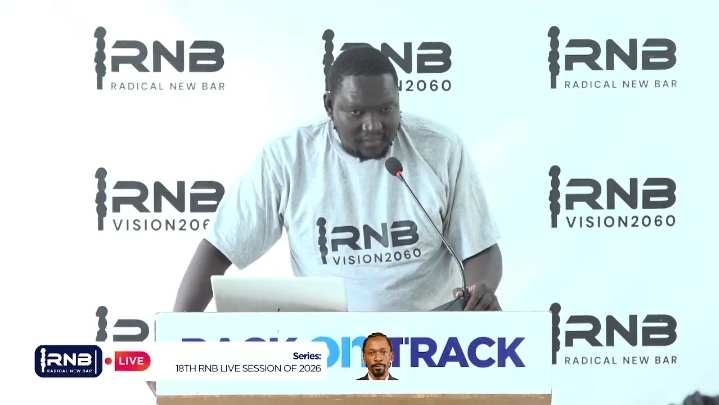
A speech I presentd at the 18th RNB Live on 4th June, 2026 at ULS House, Kampala

Paperless Judiciary: Why Aren’t We Ready?
A speech presented by Enen Ambrose, blogger at www.enenlegalworld.com at the 18th RNB Live on 4th June, 2026 at ULS House, Kampala
The President of the Uganda Law Society, Isaac K. Ssemakadde SC, the Most Perpendicular Vice President, Anthony Asiimwe, my Northern Uganda Representative to the ULS Governing Council, Egaru Emmanuel Omiat, who I believe is following this discussion online,the General Secretary Salim Babu, together with fellow members of the ULS RNB Governing Council — whom I prefer to call the ULS RNB High Command — the highly distinguished members of the medical fraternity present with us today, colleagues, fellow officers of the court, distinguished guests, and fellow citizens both here in the hall and watching us online:
I was invited to speak in my capacity as a blogger at www.enenlegalworld.com on the theme: A Fully Paperless Judiciary — Why Aren’t We Ready?
I stand before you today with deep humility and sincere concern. As a technology enthusiast who believes that technology must facilitate access to justice rather than impede it, I have witnessed firsthand the challenges that arise when we rush into a fully paperless system without adequately preparing the people it is meant to serve.
What I have observed is not mere technical inconvenience. It is something far more serious — a subtle but damaging form of harm which I prefer to call “the quiet violence of procedure” being done to the very people we are sworn to serve.
Part I: The Quiet Crisis
This is not the violence of guns or angry mobs. It is the quiet, daily violence of a system that pretends everything is working when it clearly isn’t.
Just three days ago, on 1st June 2026, the Judiciary’s deadline for crossing into full paperless operations came and went. Yet the Judiciary’s ICT Director confirmed that the system will only be rolled out to 49 courts — just 20% of the total.
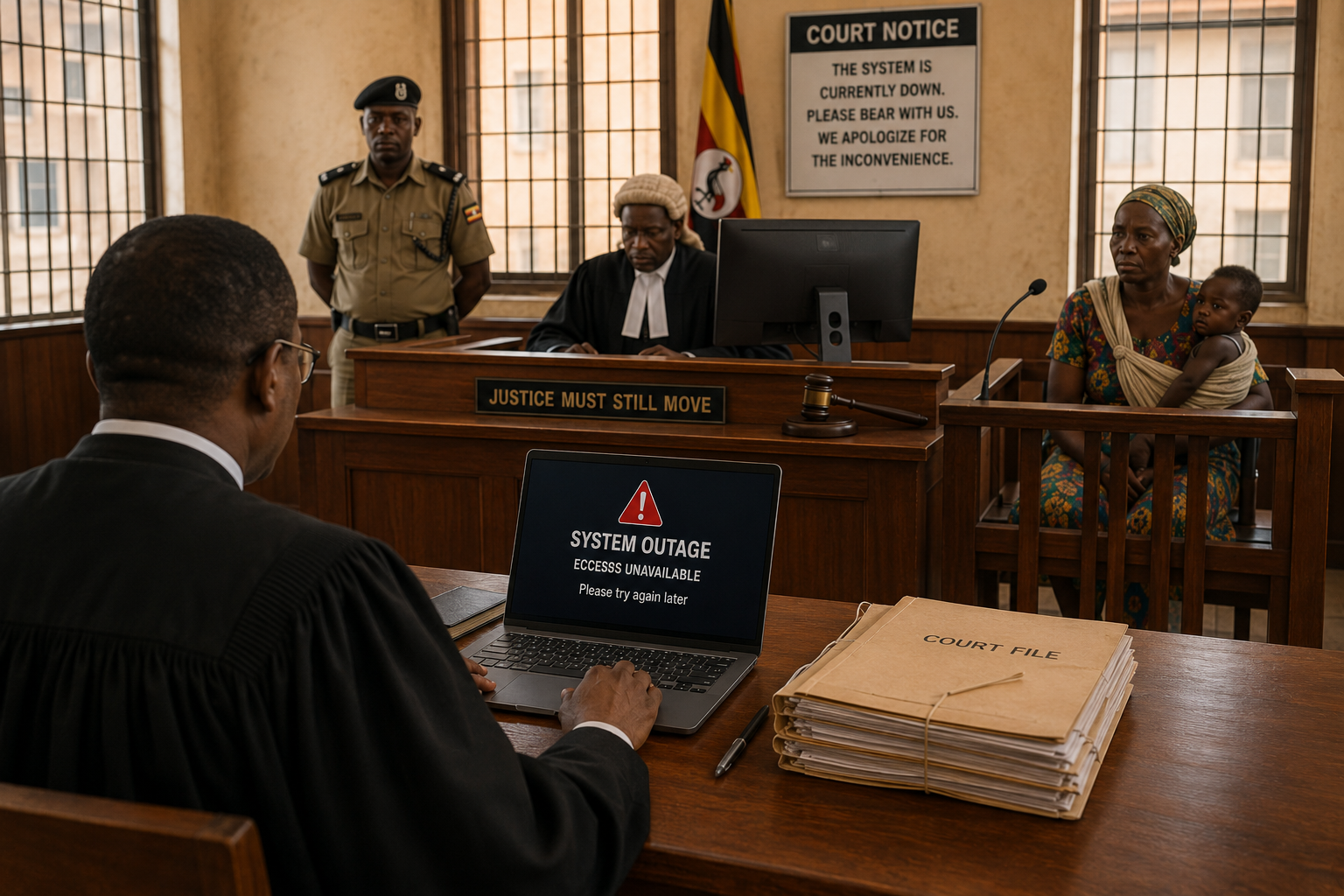
Imagine a magistrate who cannot access a bail application because the network has failed. The system coldly declares “the file is not before court.” Yet the accused — whether a poor market vendor, a struggling farmer, or a respected professional — stands right there in the dock.
When this recently happened to an advocate, that person was remanded to Luzira Prison.
We have always been told that justice delayed is justice denied. But what do we call justice that has simply disappeared from the screen?
We are rushing into a paperless judiciary while many citizens, and even many lawyers, still cannot navigate it. If a poor person cannot understand their case without a single sheet of paper, have we really advanced, or have we simply replaced one barrier with a more expensive, more frustrating one?
Part II: The Evidence on the Ground
My concerns are not theoretical. A recent survey by the PM Digital Law Hub revealed worrying numbers:
– 87% of judicial officers and advocates have experienced frequent system disruptions.
– 78% say technical support is unreliable.
– 67% were not confident we would be ready for the June 1st deadline.
– 59% have received no formal training at all.
Let me give you a picture of what these numbers mean. My firm once sent a bright, confident legal assistant to the Gulu branch of the Uganda Registration Services Bureau. His task was to certify company records we needed as evidence in court. He knew the registry. He knew the clerk. He was polished and fully prepared.
But when he arrived, the physical counter was still there — yet the records had already moved online. The staff of URSB turned him back empty-handed. That day, we had no choice but to force ourselves to adapt to the new technology.
That, colleagues, is exactly where many of us are today with ECCMIS. We are still walking the old path, trusting the old counters, while the world has moved on.
Let me tell you another story — one that has not happened yet, but will happen if we are not careful. I want you to meet a lawyer. She is experienced. She has practised for fifteen years. One afternoon, she receives an urgent call. A client is about to be evicted. A temporary injunction must be filed before 5:00 p.m. She knows the High Court Registry well. She has done this a hundred times. But when she arrives, the counters are gone. The clerks point to a sign: “All filings electronic. Use ECCMIS. No paper accepted.” She does not have her laptop. The courthouse Wi‑Fi is down. Her phone battery is low. She tries to log in — she has forgotten her password. She calls her clerk. No answer. The clock shows 4:47 p.m. Her client will be evicted tomorrow. And there is nothing she can do. Colleagues, come July 2026, if the paperless mandate is fully enforced without the changes we are demanding, this will happen. I guarantee it. Our lady lawyer will stand in that registry, fully unarmed and disempowered. In that moment, like our legal assistant at URSB, she will learn the hard way: how she was trained for the profession is no longer relevant. She must upgrade her digital skills — or risk being rendered irrelevant.
In 2026, we still have judicial officers reaching for the Civil Procedure Rules of 1929 to determine the validity of a summons delivered through a WhatsApp message, while the entire body of laws enacted to facilitate the digital transformation of the Judiciary gathers dust.
Without a clear Practice Direction from the Chief Justice, and without digital competence forming part of performance evaluation, even this limited rollout to only 49 courts risks a spectacular failure.
Part III: The Human Cost
The Nocturnal Lawyer
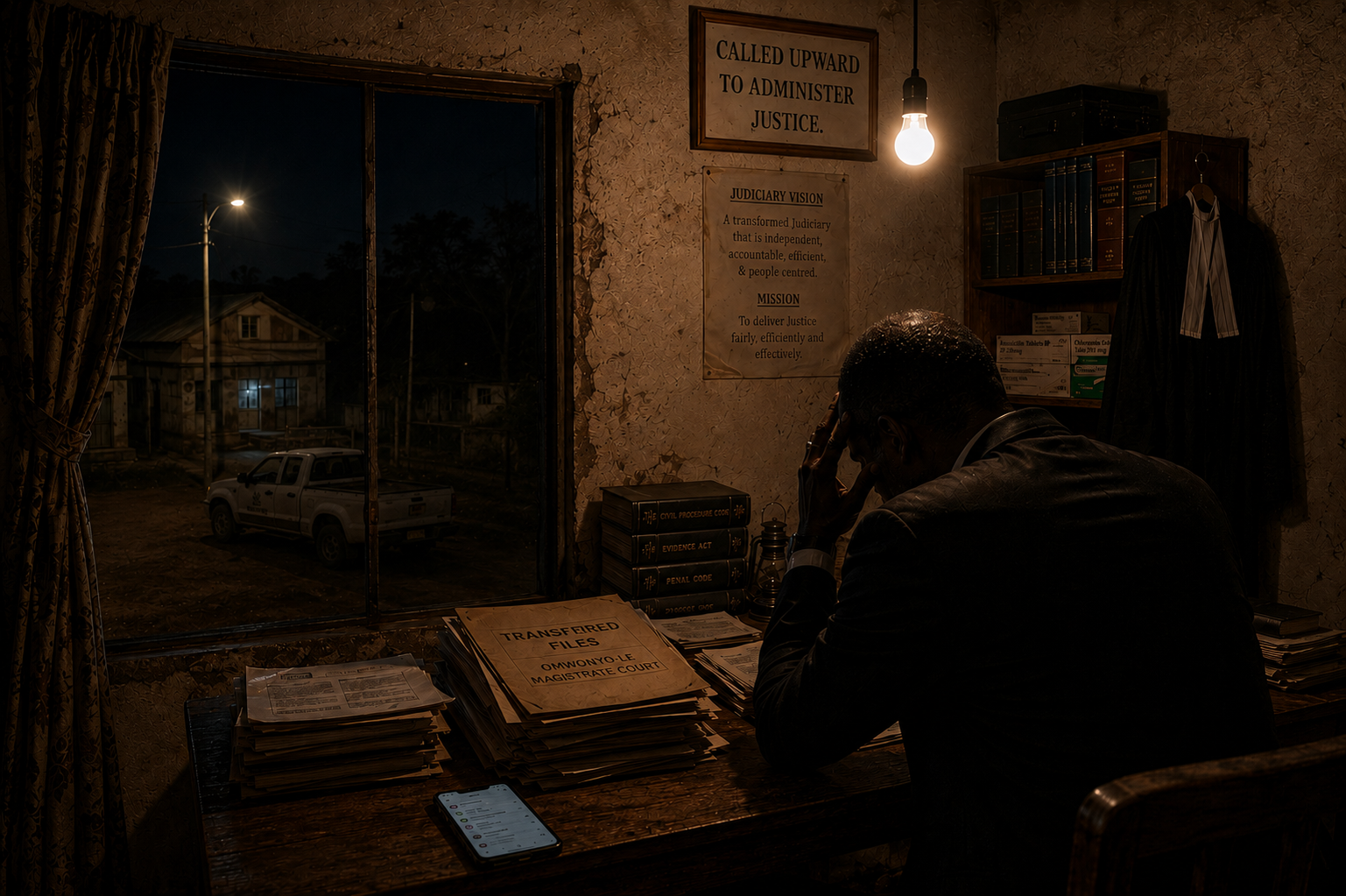
Our advocates are now working at 2:00 a.m. not because they are dedicated, but because the system is too slow and congested during the day. We have, in effect, outsourced government server problems to the sleep and mental health of lawyers.
This is not digital transformation. It is like constructing a magnificent house without laying a proper foundation — impressive on the surface, but unsustainable and harmful to those who must live in it.
A new digital underclass
As Advocate Madira Jimmy from Arua warned me, many lawyers in the North risk being reduced to “local assistants” for Kampala-based lawyers who have better internet and support.
The same law degree, the same oath, but a completely different playing field. This is creating a dangerous hierarchy inside our own profession.
The Vanishing File
Under the old physical system, a file could be traced. Today, an urgent application can simply “disappear” in the ECCMIS system.
A judicial officer who does not wish to attend to a matter no longer needs to hide a physical file. They can simply say, “The system shows nothing.” And who can argue with a screen they cannot see?
We recently experienced this when the Uganda Law Society filed an urgent Human Rights Application concerning the Ggaba trial. That application was effectively not attended to.
In my humble view, this incident points not only to a potential case of misconduct against the concerned judicial officers, but more importantly, to a deeper and disturbing lack of accountability in our digital justice system.
If this can be done to the Uganda Law Society itself, one wonders: who else is suffering the same fate — ordinary citizens who have no voice and no remedy at all?
Part IV: What We Must Do
I am not here to condemn the Bar or the Bench, nor am I here as a doomsayer. My critique is directed across the board — at all of us who have a role to play in the successful adoption of digital transformation in the administration of justice.
- Mandate Offline Functionality — Every court computer must be able to pre-cache daily files and work when the network fails. Our banking, email apps, file backup systems like Google Drive already do this.
- Mandatory Training — No more “learning on the job.” Every judicial officer, clerk, and advocate must undergo verifiable digital training.
- Recognise Modern Communication — Issue a Practice Direction accepting service via WhatsApp and SMS to verified numbers. The court can always set aside service where injustice is shown.
- True Hybrid System — Do not treat paper as the enemy. A genuine hybrid approach beyond the current 20% rollout is wisdom, not weakness.
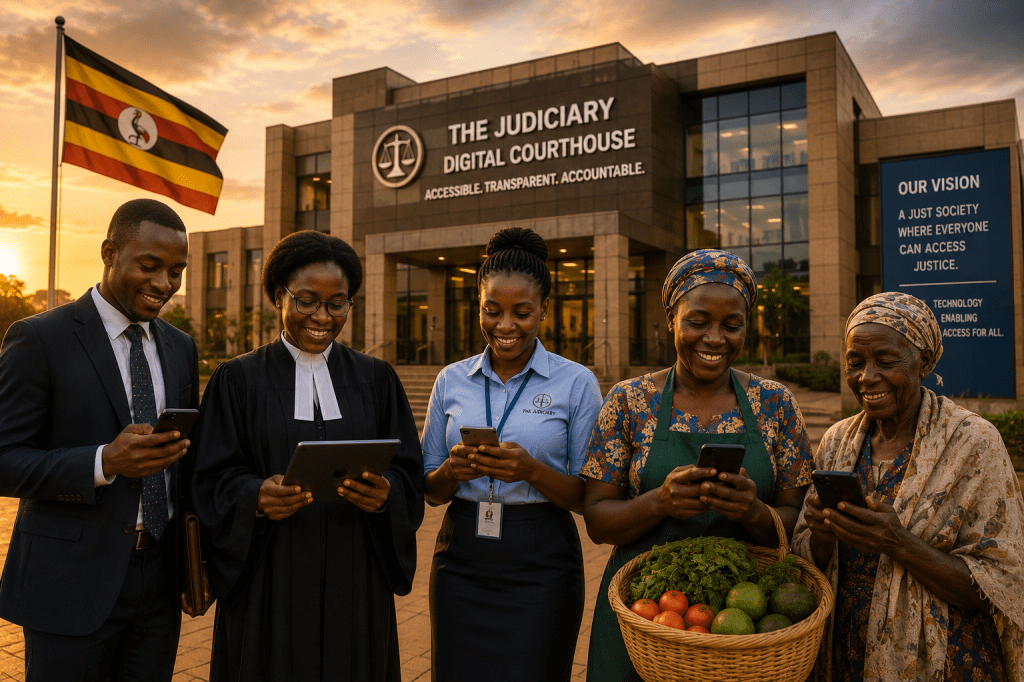
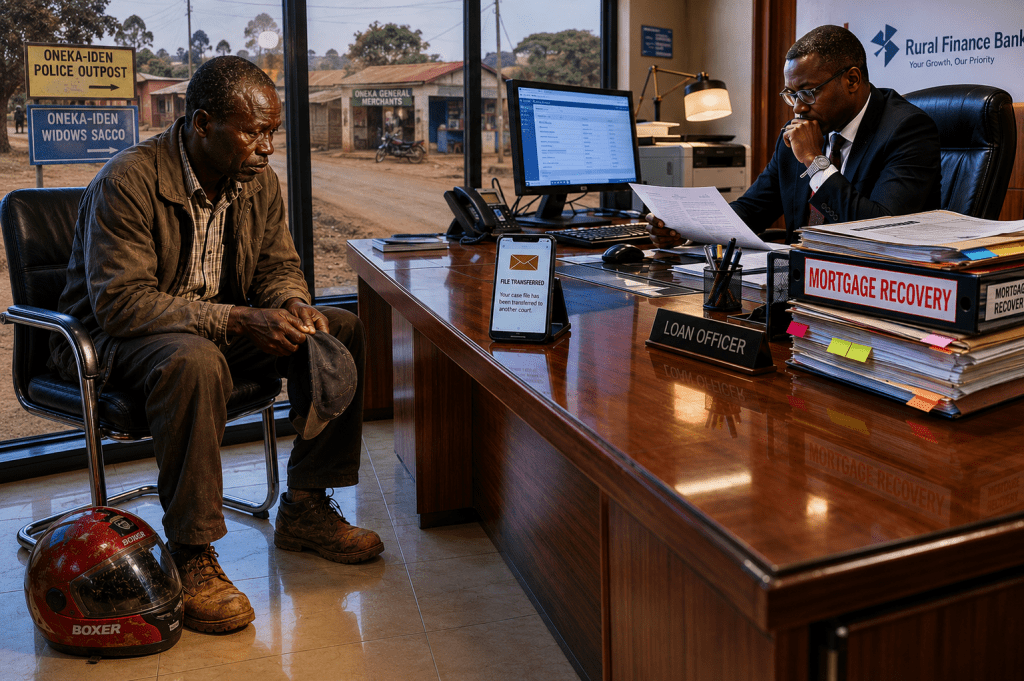
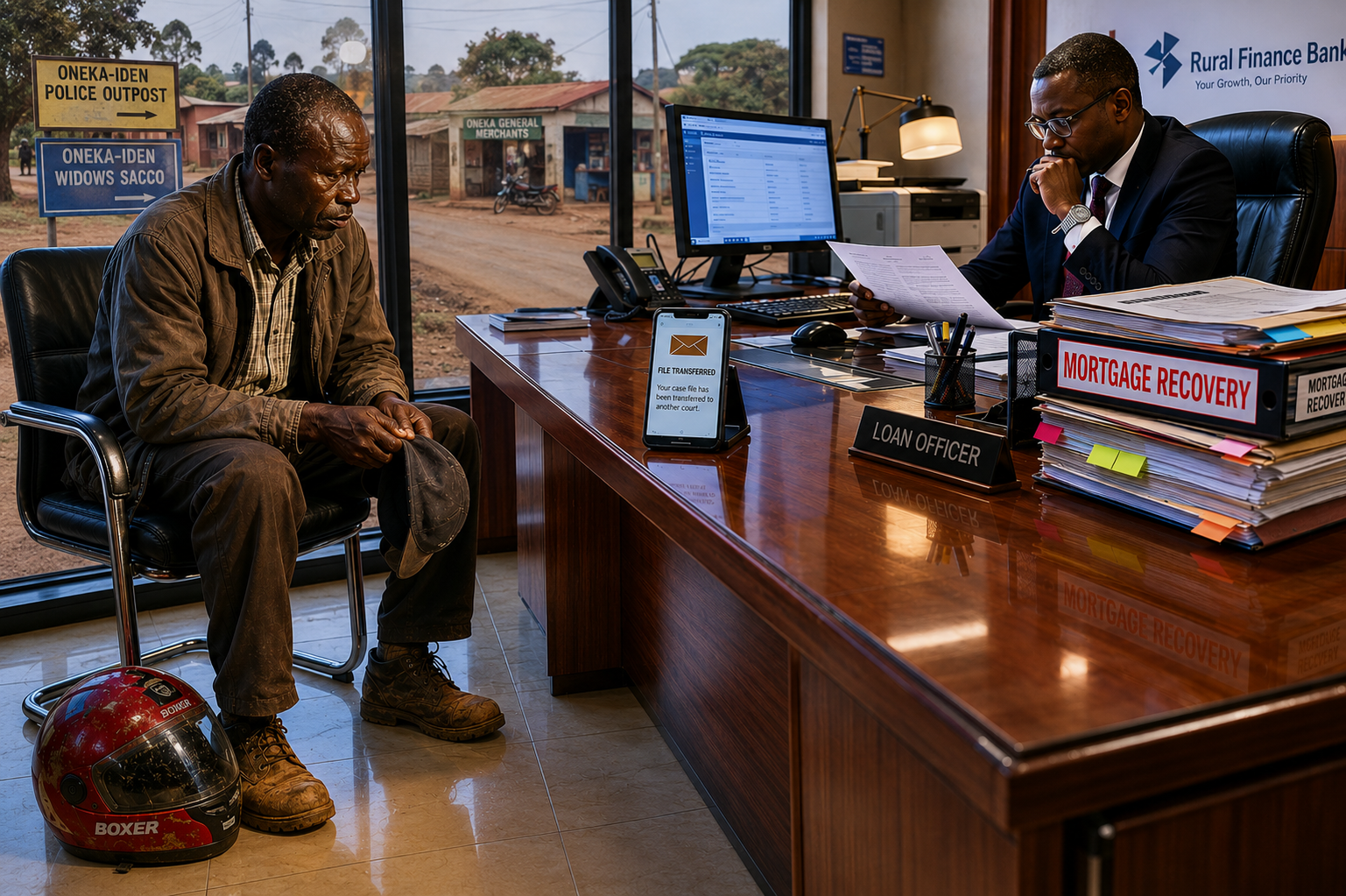
- Citizen-Centred Design — The system must work for the widow in Amudat who has never opened a PDF.
- Cultivate a Transformed Legal Culture — Digital transformation without a corresponding culture of accountability and citizen-centred justice is merely digitising the old bad manners. We must deliberately build a new legal culture where technology serves justice rather than concealing injustice.
- Embrace Technology at Individual and Institutional Level — We must consciously cultivate a new culture of embracing technology at both personal and institutional levels. A lawyer who boasts that they never read their emails or deliberately switches off their WhatsApp blue ticks is no different from a judicial officer who conveniently claims “the system shows nothing.” True digital transformation demands personal responsibility from all of us.
Part V: A Call to Action
To my fellow advocates: We must continue having honest and regular conversations about digital transformation and the development of a new digital legal culture. Our shared goal is to ensure that technology truly enhances access to justice for all. Let us speak up constructively, with one voice, for the good of our clients and the future of our profession.
To judicial officers: My clarion call to you today is this — many of you are working under very difficult conditions. Let us join hands and fight together for better tools, better infrastructure, and better support.
As the ancient proverb teaches us — and I have merely adapted it here — “the roots of accountability are bitter, but the fruits are sweet.” (A variation of Aristotle’s famous saying on education). Let us therefore courageously cultivate, at both personal and institutional levels, a new legal culture of accountability and genuine digital transformation.
To the people of Uganda: Walk with us. The widow in Amudat — who has never opened a PDF — the accused in Luzira, whose bail application vanished from a screen, and the nocturnal lawyer, awake at 2am fighting a congested server — they need us to get this right.
The spirit is willing. Let us now strengthen the flesh of this system.
Thank you.
I remain Enen Ambrose of Enen Legal World, a legal literacy blog which you can find at www.enenlegalworld.com and I say this for God and My Country.
ENEN AMBROSE
A copy of the speech can be found here:
JOIN THE UNDERGROUND AND FUEL THE MOVEMENT

We have created a dedicated fans WhatsApp Channel. Don’t miss the latest updates, get early bird access to our latest blog posts and more, so much more. Click the following link to follow the Channel: https://whatsapp.com/channel/0029Vb9BQqw5a246bWVsLl3j
Independent institutional critique and advocacy for a radical overhaul of legal culture require time, deep research, and uncompromised independence. If these narratives bring value to your legal journey or challenge your perspective, please visit our HOME PAGE to see how you can support this platform directly and keep the critique fierce and relentless.
Enen Ambrose. Advocate
Member, Judiciary Affairs Committee,
Uganda Law Society
& Founder–Enen Legal World



















 enenlegalworld