There is a village called Abongodero. Abongodero means without a granary.
The villagers named it after Mzee Zakayo’s ingenuity.
Zakayo was clever. He never built a granary of his own. Instead, he raised cattle, fat bulls, glossy heifers. When hunger season approached, he would walk to a farmer whose granaries groaned with millet and offer a bull in exchange for rights to a certain number of storehouses. Enough to feed his household. Enough to impress the neighbors.
The arrangement was sealed with a handshake. Everyone knew Zakayo’s cattle. Everyone knew he paid.
The villagers admired him.
“..Look at Zakayo!..”they whispered around evening fires. “He eats from granaries he never built!“
They admired him so much that they named the village after his ingenuity.
Abongodero.
A photo of a granary. Credit. Uganda Today: from article: A testament to tradition: the art of grain in Uganda’s homesteads by Chris Kato.
But abundance has a wicked sense of humor.
Zakayo’s children grew up knowing which families owed them food, which granaries bore their father’s mark. They inherited cattle, but not discipline. They inherited the right to eat, but not the wisdom to plant.
One of them was Okello Anyapo.
Anyapo. The lazy one.
Okello inherited land so fertile it blushed when rain touched it. Black soil. Generous soil. Soil that would have yielded harvests his grandfather never imagined.
But his hoe remained smooth. His fields grew weeds tall enough to vote.
When hunger came, Okello blamed the sun for burning too bright. He blamed the rain for falling too hard. He blamed the ancestors for not speaking loudly enough. He blamed everyone except his idle hands.
Across the stream lived Owera Apur.
Apur the Farmer.
He did not give speeches about productivity. He simply woke before the rooster finished its gossip. He dug. He planted. He weeded. He waited. His granary stood behind his hut like a quiet monument to repetition.
He had no cattle to trade. He had only his back, his hands, and his patience.
His granary stood full.
Proof that the land was never the problem.
Then hunger came like a leopard.
The families who once owed Zakayo’s children had rebuilt their stores. They no longer needed cattle. They needed their millet for themselves.
Okello’s inheritance could not be traded for what no one would sell.
Hunger clawed him thin.
He crossed the stream.
“Uncle,” he said. “We are blood. Remember Father Zakayo? The village bears witness to his name.”
In Lango, dignity comes before shame. Owera sighed. He looked at his granary—full from seasons of sweat.
He opened the door.
“Enter,”he said. “Take what you need.”
Not ownership. Not supervision. Not rules.
Just access.
Okello entered empty and emerged round.
He returned the next day. And the next. Soon he stopped pretending to farm at all.
Why sweat when sacks yawn open? Why ration when no one counts? Why plant when the granary door never closes?
By planting season, Owera opened his store to prepare for the rains.
It echoed like a drum.
Empty.
When confronted, Okello adjusted his waistband and smiled.
“You allowed me.“ “There were no rules.“ “I merely accessed.”
And that is how Abongodero learned what their ancestors should have known:
You never send a starving man to the granary.
[End of Episode 1]
Stay tuned and on the look out for Episode 2 of the legend of Abongodero.
Deep within the Mambo Forest, the animal kingdom lived in awe of a single, dazzling truth: their ruler, Twon Gweno the cock, wore a crown of living fire. His comb was a legend, a crest of such vibrant crimson that the elders swore it was a fragment of the first sun. His morning crow was a decree:
“Bow to my glory, and you will be spared my flame.”
And so, the animals bowed. Fear made them pious; fear made the cock sovereign with unquestioned loyalty, respect and cooperation from the rest of the animal kingdom in that forest. It was a classic case of natural-born legitimacy; never really earned.
One evening, a crisis struck. Ichuli, the fox, the sole specialist in lighting the communal fire, was away. The wood was piled, but the spark was missing. The night, cold and predatory, loomed.
Odyek Odyek, the hyena, a friend to truth and enemy of pretence, stepped forward.
“The solution is simple,” she said. “We bow to Ladit Twon Gweno’s crown of fire. I will sprint to his home and borrow a spark.”
She took a tuft of the driest spear grass, the Obia and went to the cock’s compound. She found him in a deep, unconscious slumber. Without waking him, she gently pressed the grass to his legendary crown, waiting for the catch, the sizzle, the proof.
The grass rested on the crown, as inert as if it had been placed on a cool stone. The legendary fire was a phantom.
Odyek Odyek, the hyena returned to the gathering and dropped the cold, unburnt grass in the centre of the circle. No words were needed. The lie they had bowed to for generations unravelled in that silent moment.
Power, and unearned but coerced legitimacy unmasked, bled its authority into the silent night.
⚖️ The Lesson
Borrowed fire must warm the hearts of the people. When it no longer does, the borrower is called to account.
So it is with the courts. The robe, the gavel, the summons, and the warrant are instruments loaned by the people. Article 126(1) of the Constitution does not sing an ornament; it issues a command:
Judicial power is derived from the people and shall be exercised by the Courts in their name and in accordance with the law and their values, norms, and aspirations.
🧱 The Three Pillars of Legitimacy
Legitimacy; the respect of the people and their cooperation with the courts, is the covenant at the heart of that loan. It demands three sacramental elements:
Reflection: Judicial power must reflect the values and aspirations of the people; not the insatiable appetite of a sophisticated elite for luxury or high life.
Truth: Courts must administer justice in accordance with law and truth, not convenience or midnight deals.
The Judicial Oath: The solemn undertaking before God to do justice to all manner of people without fear, favour, ill will or affection is no actor’s prayer; it is a chain of duty.
Strip away any of these, and what remains is a gowned pretender, eloquent and majestic, perhaps, but hollow: a cock whose crown no longer burns.
The Evidence of Decay
For those who have seen:
• Appeal files missing thirty-eight pages.
• A High Court hearing conducted not in a public courtroom but secretly in a posh hotel in which 15 minutes out of those proceedings were conducted in the absence of the opposite party and the whole process bashed by the Court of Appeal for want of a fair hearing and lack of judicial accountability and transparency and thereby further exacerbating the already slim public trust in the Court system entirely
• A lower bench judicial officer bashed; “I don’t want to see this rubbish here, take it back where it came from” when they had sought guidance over files of thousands of remand detainees who had clocked mandatory bail, over 5 years where the Office of the Director of Public Prosecution state attorneys appeared neither willing nor ready to commit them for trial in the High Court.
• The poorest peasants completely blocked from accessing justice because the lower courts have received directives not to register and dispose of customary land disputes unless a surveyor had first rendered a preliminary survey report; peasants who have never heard of, met heard about or hired the services of a professional called a surveyor. They have to sell a chunk of land to afford a surveyor to conduct a preliminary survey and get their case registered.
• A National Bar Association President’s liberty preserving Application for stay of execution of a manifestly void Contempt of Court ruling take close to 9 months without disposal.
These are not footnotes; they are flesh-and-blood indictments. The 1995 Constitution’s promise of a speedy and fair hearing has become hot air—Kikwangala, Kichupuli, Kawani.
🗣️ The Test — The Philosophy of Insults. Withdrawing legitimacy and requiring that it be earned back by fidelity to its 3 pillars.
“To insult without malice but with evidence is to perform constitutional maintenance and maintain pure legitimacy.”
Hence the philosophy of insults. This is not the petty malice of a tavern quarrel. It is a civic stress-test, a pressure gauge for legitimacy.
It is the public’s cry:
“GIVE US WHAT YOU OWE US.”
We lent you power; we demand accountability in return.
A people that cannot insult and mock power has already lost moral authority. The right to insult and offend the powerful is not a luxury, it is the citizen’s tool for testing whether the borrowed flame is real.
📜 The Proof — The Jurisprudence of Defiance
“Leaders should grow hard skins to bear.” “Power must endure insult to remain clean.”
Uganda: When the Constitution Answered Back
This philosophy is not just wisdom; it is the settled weight of law. Consider Andrew Mwenda, whose words rattled the Republic:
This philosophy is not just wisdom; it is the settled weight of law. Consider Andrew Mwenda, whose words rattled the Republic: “You see these African Presidents. This man went to University, why can’t he behave like an educated person? Why does he behave like a villager?’
Museveni can never intimidate me. He can only intimidate himself ……… the President is becoming more of a coward and every day importing cars that are armor plated and bullet proof and you know moving in tanks and mambas, you know hiding with a mountain of soldiers surrounding him, he thinks that, that is security. That is not security. That is cowardice”
Actually Museveni’s days are numbered if he goes on a collision course with me.”
You mismanaged Garang’s Security. Are you saying it is Monitor that caused the death of Garang or it is your own mismanagement? Garang’s security was put in danger by our own Government putting him first of all on a junk helicopter, second at night, third passing through Imatong Hills where Kony is ?……Are you aware that your Government killed Garang?”
I can never withdraw it. Police call them, I would say the Government of Uganda, out of incompetence led to or caused the death of Garang”
When the state reached for iron law and charged him with sedition, the Constitutional Court answered with freedom, declaring that people from all backgrounds enjoy equal rights of expression, polite or not.
“……Our people express their thoughts differently depending on the environment of their birth, upbringing and education.
While a child brought up in an elite and God fearing society may know how to address an elder or leader politely, his counterpart brought up in a slum environment may make annoying and impolite comments, honestly believing that, that is how to express him/herself.
All these different categories of people in our society enjoy equal rights under the Constitution and the law. And they have equal political power of one vote each.Then came the killer line that buried sedition:
“……During elections voters make very annoying and character assassinating remarks and yet in most cases false, and yet no prosecutions are preferred against them. The reason is because they have a right to criticize their leaders rightly or wrongly. The Court concluded “Leaders should grow hard skins to bear.” A copy of the judgment can be found here:
In Burkina Faso, journalist Issa Konaté was jailed for calling a prosecutor “a criminal in a robe.” In his Words:
“…….The Prosecutor of Faso is the godfather of bandits. He is the sponsor, the organizer, the leader of a vast network of counterfeiters and traffickers that he protects with his power and status.” This is a prosecutor who does not prosecute crime, he commands it. He is not a guardian of order but a godfather of disorder While honest citizens sleep in fear, the chief lawman of our nation sits in his office, dividing the spoils of crime with police officers and bankers He is not a magistrate; he is a criminal in a robe. A saboteur of justice…….”
The African Court answered with thunder and reason. Custodial sentences for speech are a bludgeon against Democracy: “The Court is of the view that the violations of laws of freedom of speech and the press cannot be sanctioned by custodial sentences, without going contrary to the provisions of Articles 9and 19 of the Charter”
The Court pronounced itself on the role of public figures under scrutiny.
“There is no doubt that a prosecutor is a public figure; as such he is more exposed than an ordinary individual and is subject to many and more severe criticisms. Given that, a higher degree of tolerance is expected of him”
From this we learn that “Power must endure insult to remain clean.”
🪶 The Heritage; The Lango Grammar of Reproof
This civic logic is not foreign to us. In Lango, the sharp tongue has long done the work of reform.
• “Ole yin ibedo dako dako”; “…..you man, you behave womanly…”. It is not cruelty. It is shock therapy for duty and clarion call for the family patriarch to “man up” and live up to his responsibilities to his family, to lead firmly, provide for it and protect it.
• “Lango mito alek”; “…..Lango deserves a pestle…” A reminder that discipline is coming unless reform comes first and that it intact comes usually after enforced discipline.
• “Kwany Ka Point” The Gen Z’s and Millenials have similarly curved their own wisdom, “pick only the point”: As plain and simple as that. Pick only the point, filter it from the insult.
• “Ikok Ugali idogi.” “…..You will cry with Ugali in your mouth. …”
In the old rite of passage, a young man’s two upper incisors were pulled, and boiling herbal Ugali was placed in his mouth to ease the agony. He cried through the very remedy meant to heal. Reform rarely feels like mercy.
So when the citizen mocks the powerful, the intention is not cruelty; it is Ugali in the mouth of power: a necessary sting, a painful antidote.
The insult becomes a civic anaesthetic; searing, brutally humiliating, but designed to cleanse and restore legitimacy
Reform rarely feels like mercy. So when the citizen insults and mocks the powerful, the intention is not cruelty. It is Ugali in the mouth of power: a necessary sting, a painful antidote.
🔥 The Repair — The Calculus of Force
Public outrage, properly aimed, creates four fields of pressure that make corruption intolerable:
1. Professional Ostracization: When integrity collapses, the social scaffolding of a career falls with it.
2. Erosion of Authority: A judge who loses public confidence loses jurisdictional muscle and may in fact receive fewer to zero allocations of files to handle or minimal chances to be chosen to sit on a panel in the case of hearings in courts that are manned by more than one Judicial Officer.
3. Legal and Institutional Siege: Scandal catalyses petitions, litigation, and oversight that eat at illegitimacy.
4. Political Abandonment: The appointing power prefers a scapegoat to a scandal, forcing a “voluntary” exit.
From this, we learn that insults are not instruments of mob rule; they are the social physics of accountability.Yet outrage alone is not reform. The sting must translate into architecture: cooling-off periods for judges, transparent appointments, and independent oversight with teeth. Shame, the direct consequence of insult, reveals the rot; law must excise it.
⚔️ The Awakening — The Price of Truth
“The hyena who taught the village to see.”
For too long, the Uganda Law Society was a sleeping giant while the temple burned. But the dry grass is now burning in Masaka. When the President of the Bar , the hyena who taught the village to see, lives in exile for refusing to apologise for truth, his banishment becomes the ultimate test.
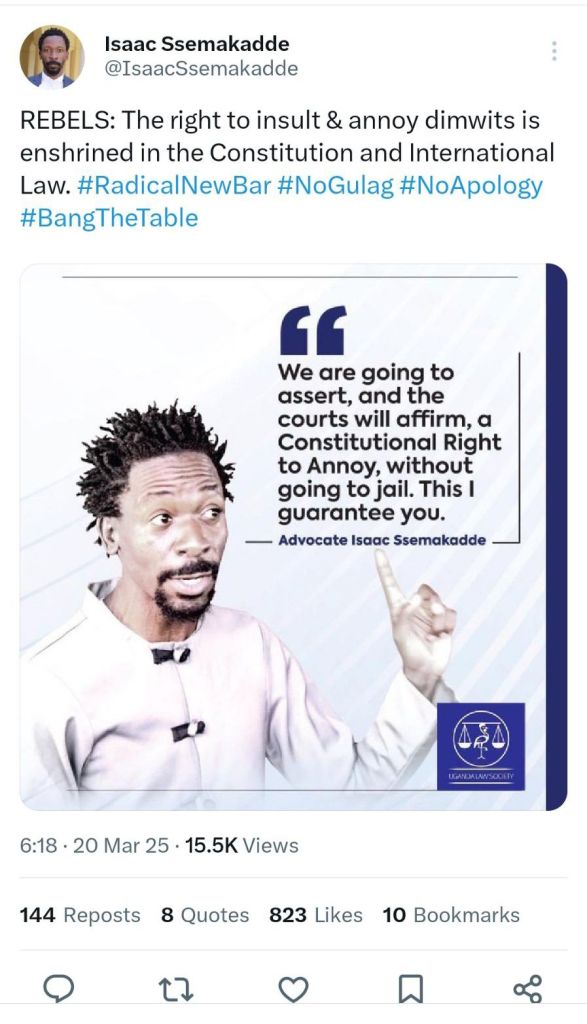
Isaac K Ssemakadde (SC) President of Uganda Law Society. Credit: Uganda Law Society Website.
📜 The Counsel;A Call to the Bench and the People
This is not an invitation to vulgarity for its own sake. Insult as a civic weapon must be wielded with evidence, not rumour; with satire steeped in fact, not malice.
To the Judges:
Grow the hard skins the Constitutional Court commanded you to have. Wear patience as armour, not menace. Treat insult as a thermometer, not as treason or contempt.
When a citizen insults, ask: does this insult point to truth? If yes, answer in reason, remedy the wrong, and let the nation watch you Act. If not, let the insult fall like a pebble. The dignity and legitimacy of the bench is earned by magnanimity and the stoic creed of the 3 pillars of legitimacy namely Reflection (of law, values, norms and aspirations); Truth and by abiding by the Judicial Oath. It is not enforced by fury, bullying or jaling dissent.
This doctrine requires courage from all sides. The Bar must be relentlessly courageous and fearless in its insult and ridicule while exacting in its ethics.
The public must be loud and literate, hurl insults but bring evidence. Lawyers must translate courage into petitions, not merely WhatsApp gossip and tweets. The Legislature must codify protections for speech against disproportionate criminal sanction and the Judiciary must redicscover the humility of the oath, the most important leg of judicial legitimacy; to do justice without fear, favour, ill will or affection.
To
the citizens: Wield the pen. Make the insult precise devastatingly; threads that link to missing pages, memes that reveal truth.
🌞 The Benediction & Epilogue
Lock and Roseau taught and we learnt from the social contract doctrine that all power, judicial power inclusive, like the communal bull, is never owned. It is loaned to serve, not to feast upon. Judicial officers are, therefore, commissioners, agents of the people, not monarchs. The people are the principal. When the agent betrays, the principal must insult loudly in true reprimand.
If those entrusted with it betray the trust, the people must remind them, sometimes with satire, sometimes with searing words, that borrowed fire must warm, not burn.
This is neither an incitement to violence nor a call for insurrection. It is a call to civil carnage against corruption, ritualised, and peaceful.
Let the insults be sharp, witty, and relentless, and let them dismantle rotten cartels of impunity. Turn every courtroom cover into a public syllabus: transparent reasons, readable judgments, accountability writ in footnotes and public records. Make the institutions bleed truth, not people.
To end illiteracy in justice, let every citizen wield the pen.
Let the hyenas come. Let the baraza be noisy.
Let society test the crown every morning until the judges can point, with open hands and clear reasons, and say:
“Here is the flame.”
Until then, press the grass. Let the crown be tried in daylight. Let the fire prove itself true.
✍️ Dedication
This blog is dedicated to all prisoners, present and past, of conscience, self-expression, and free speech: Male Mabirizi Kiwanuka, Ivan Samuel Sebadduka J, and Isaac K. Ssemakadde (SC), President of the Uganda Law Society, for executing a civic duty tragically confused with contempt of court.
Contempt must be reserved for direct obstruction of justice, not as a cudgel to discipline ridicule. Imprisoning insult and mockery is to forget the nature and source of judicial power: the people’s consent.
May the Good Lord bless and protect you all. And may we witness, in our lifetime, thick-skinned judicial officers who treat insults with nothing more than “a wry smile,” as aptly put twenty-five years ago by the eminent British jurist, Lord Justice Simon Brown.
The author is a member of the inaugural Judiciary Affairs Committee of the Uganda Law Society.
DISCLAIMER: This Blog is not a call for mob justice, chaos or disorder against our beloved holders of judicial power and other public power, it is brutal and defiant reminder that illegitimate conduct leads to a withdrawal of respect from the very owners of the power and attracts criminal and administrative sanctions, some as grave as removal from office. It is also to encourage the clean and disciplined judicial officers to continue upholding the consent of the people for them to administer justice by upholding the stoic pillars of legitimacy first mentioned in this Blog, and that with or without climbing the career ladder, God, the original designer of justice will be the ultimate one to reward their efforts both now and in the afterlife.
This blog is not intended to be used as legal advice, and the author denies liability for use of the contents herein as legal advice. Readers are encouraged to consult a licensed Advocate to give them specialised advice and representation.
For feedbacks and comments: ambrosenen@gmail.com.
References.
For further reading or references. I consulted the following books.
1. Politics as a Vocation (Politik als Beruf) by Max Weber
2. Second Treatise of Government” by John Locke.
3. The Social Contract” (Du contrat social) by Jean-Jacques Rousseau.
4. Weapons of the Weak: Everyday Forms of Peasant Resistance” by James C. Scott.
At Enen Legal World, we don’t just blog legal commentary to make laws accessible to the people. We craft stories that resonate, grounded in unyielding truth. We recently stumbled upon a sensational piece by Ono Bwino’s Sengooba Alirabaki, boldly titled “Panic At NRM Elections Tribunal As Senior Lawyer Protests Appearing Before Junior Counsel Byamazima.” It claimed Senior Counsel Caleb Alaka “stormed out” of the NRM Elections Tribunal, supposedly too proud to face “junior lawyer” Joshua Byamazima over his client’s 2026 parliamentary ticket.
Our mission? To dig deep and deliver facts with impact. What we uncovered shocked us: this story wasn’t just shaky, it trampled on the sacred principles of journalism: accuracy, fairness, and transparency.
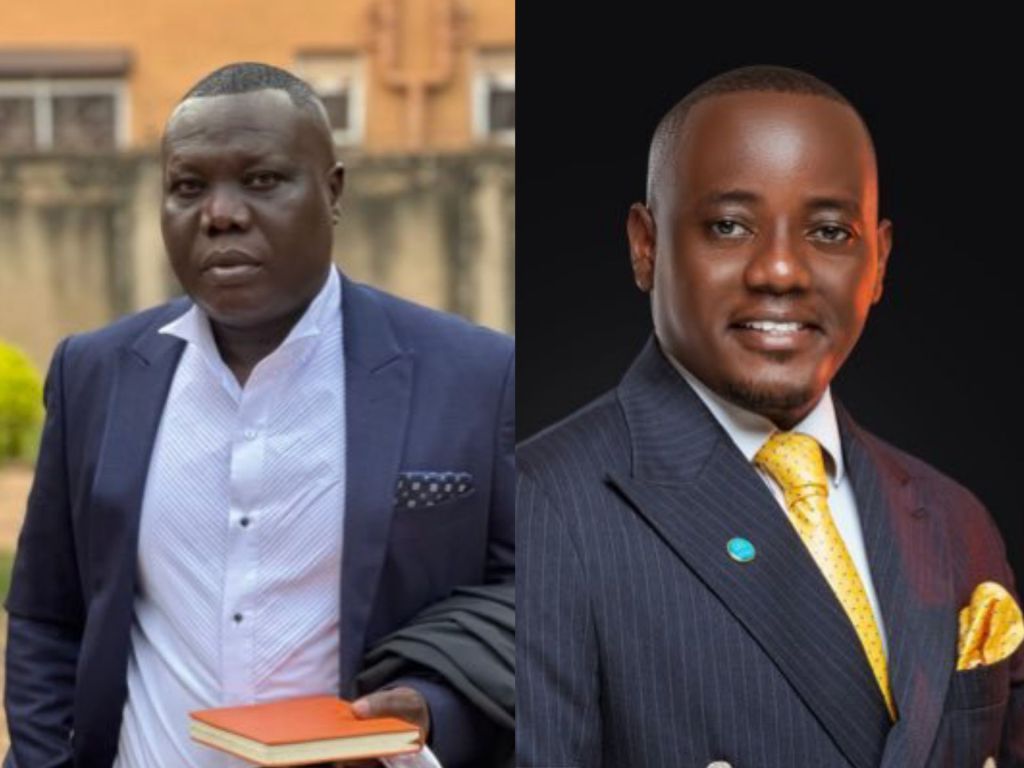
Left, Senior Advocate, Caleb Alaka: Right, Counsel Byamazima Joshua. Images from their respective X (formerly Twitter handles)
We reached out to Senior Counsel Alaka, and his response hit like a thunderbolt:
“This is an absolute lie… I have appeared before Byamazima before without any qualm. I do not undermine institutions I am obliged to serve in my professional work.”
And then came the clincher. Alaka told us:
“It is alleged that I was representing Samuel Odongo Oledo against Samuel Okwir Odwe before the tribunal. For the record, I do not know Oledo, he has never been my client, I have never talked to him, and I have never acted for him or his opponent. I have full trust in the tribunal and have no reason to protest against any member. A judicial or quasi-judicial officer is to be respected regardless of age.”
These words obliterated the article’s narrative. Diving deeper, we found zero evidence for Alaka’s alleged protest, no trace of his input sought, and a flimsy reliance on shadowy “highly placed sources” to peddle a fabricated tale of professional scorn.
This isn’t reporting. It’s gossip draped in newsprint, a betrayal of the truth we’re sworn to uphold.
In line with our commitment to accuracy and fairness, Enen Legal World reached out to both the author of the Ono Bwino piece and Tribunal member Joshua Byamazima for their comments before going live. The author did not take our call. Mr. Byamazima declined to comment, instead referring us to a “director” without providing specifics. By the time we went live with this blog, no authorised official from the NRM Elections Tribunal had responded to our request for comment.
At Enen Legal World, where we don’t just blog legal commentary but believe in blogging with impact, and above all, with truth, we call out such failures with unrelenting clarity.
Unverified claims? They’re rumors, not stories. No right of reply? That’s a hit piece, not journalism. No transparency? That’s propaganda, not reporting.
Ono Bwino’s piece isn’t just flawed. It’s a masterclass in how to erode public trust.
To our fellow storytellers in the media world: chase bold narratives, but let truth be your compass. Verify with primary sources, amplify all voices, and lay your methods bare. At Enen Legal World, we believe a story’s power lies in its truth, not its flash. A blog full of concoctions attracts heavy legal consequences, namely, a suit in defamation with hefty awards in general damages and costs. It pits sector regulators like the Uganda Communications Commission against the authors. Most importantly, such reckless spewing of unverified claims does reputational harm to the individuals concerned. We call out such injustices plainly, publicly, and defiantly.
We don’t just write at Enen Legal World, we ignite conversations, champion fairness, and wield truth as our mightiest tool. If we can’t tell stories that stand firm on facts, we’ve got no business telling them at all.
Disclaimer:
The information provided here is only intended to spark conversations about responsible journalism and its legal consequences. It is not intended to be used as legal advice and should not be used as such. We accept no liability for use of information contained in this Blog as legal advice. Readers are encouraged to consult a qualified licensed attorney for situation specific legal advice.
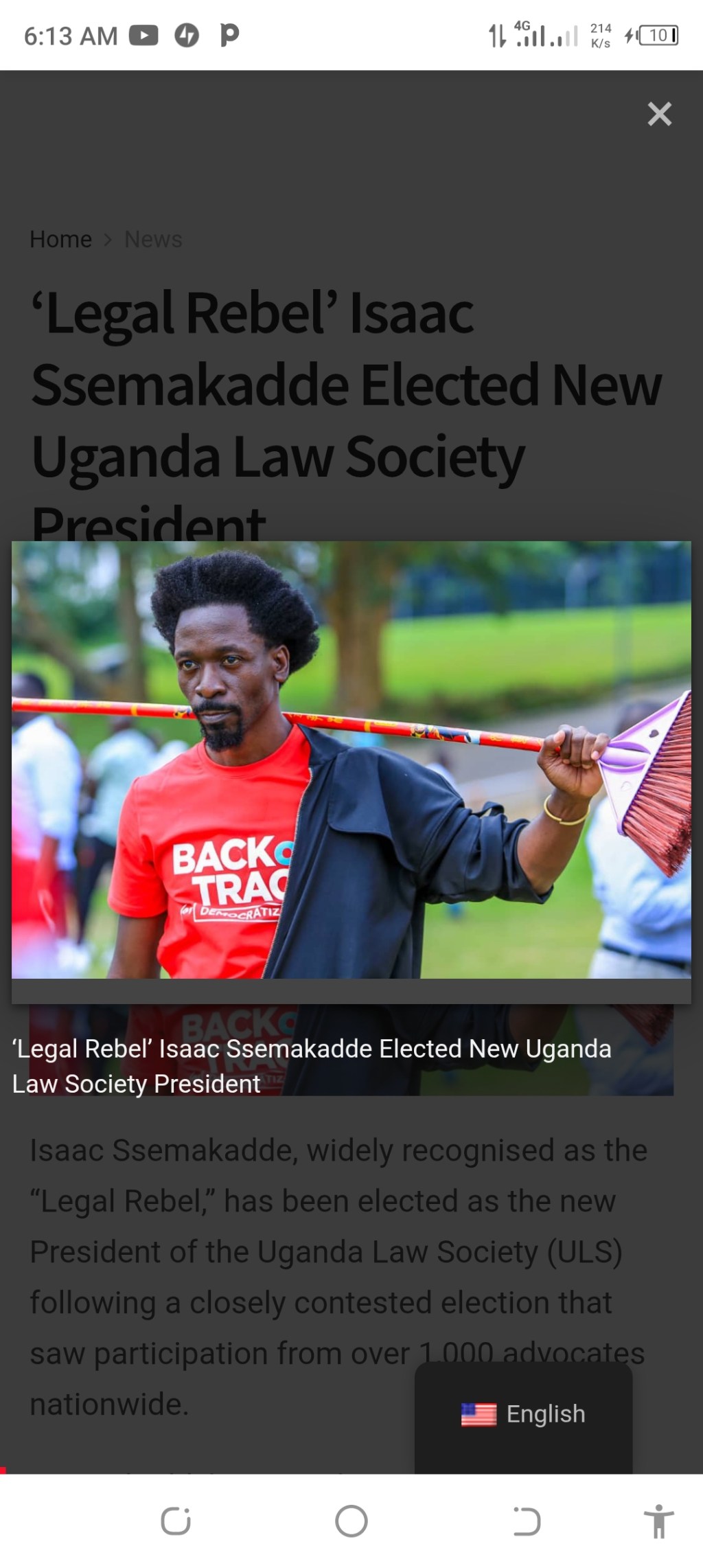
Image: President Isaac Kimaze Ssemakade. Image Credit: Isaac Ssemakade’s X(formerly Twitter post)
Uganda’s judiciary just went full-on nuclear—and there’s no holding back. On New Law Year day, the very system that’s supposed to be the bastion of justice turned into a circus. The ULS President got stonewalled, the Chief Justice practically demanded an apology, and then came the blow—Justice Ssekana slammed down a two-year sentence on Ssemakadde for contempt of court. It wasn’t just a ruling; it was a middle finger to anyone who dared question the establishment.
And if that wasn’t enough, the entire scandal is being dragged into the international arena. The Judiciary, in a move that can only be described as a self-inflicted public relations massacre, has tried to weaponize an Interpol Red Notice for an offense as laughably flimsy and culturally controversial as “insulting the modesty of a woman.” Yes, you read that right. While Interpol is busy chasing down genuine threats, war Lords, Drug cartels, Uganda’s courts are out here acting like they’re in a personal vendetta—pursuing a man for throwing sharp words at the system.
The madness deepens: the whole legal shambles that produced the warrant is under revision in the High Court, completely unattended, like a sinking ship left to rot. And guess what? Ssemakadde isn’t going down without a fight. He’s vowed, through his legal team, to challenge any Red Notice that dares to be issued against him—an audacious promise that practically screams “bring it on!”
Meanwhile, the Executive and Parliament, both seasoned in navigating international diplomacy, stand in stark contrast to the Judiciary’s response. Having faced sanctions, blacklisting, and travel bans in the past, they are well-versed in managing the complex web of international scrutiny, asset freezes, and the like. Who doesn’t recall the free Bobi Wine protests that rocked global capitals. Who doesn’t recall a foreign affairs minister who was on global travel sanctions. Have we very quickly forgotten the backlash from Western states when the Uganda’s Anti-Homosexuality Act was passed into Law and upheld by the Constitutional Court. Experts and negotiators from the Ministry of Foreign Affairs burnt the midnight oil and the Ugandan state is still here to stay. The Judiciary, however, is primarily trained in upholding decorum, judicial conduct, and domestic legal frameworks. It is ill-equipped to handle the nuances of foreign policy, international relations, and diplomacy. So, the real question is: if the international community begins to ask hard-hitting questions about accountability and the rule of law—questions that go beyond the courtroom—will the Attorney General and the Ministry of Foreign Affairs step in to shield the Judiciary from the fallout? Or will they be left to fend for themselves, with their lack of expertise in international relations becoming glaringly apparent?
Yes, development partners like the European Union, funders of the SUPREME project, Pepperdine University behind the plea bargain project, IDLO, Amnesty International, the Democratic Governance Facility (who knows they may come back) will have key questions about transparency, accountability and Rule of Law, directly addressed to our third estate about where their Millions of Aid is going. They will not be amused if they think their resources are being deployed to fight what appears to be petty fights.
And what more, individual partner states with a long tradition of democracy may refuse to hand over President Ssemakade on grounds that the Red Notice is politically motivated and targeting free speech and dissent. Dramatically enough, interpol itself may refuse to put out the Red Notice, why? It goes against the Interpol Constitution. The offense leading up to the warrant isn’t listed as one of those for which a Red Notice can be put out and enforced.
This isn’t your everyday legal drama; it’s a blood-soaked, high-stakes showdown where the very soul of Uganda’s justice system is on trial. Ssemakadde, with the cunning of a renegade professor from Money Heist, baited the Judiciary into a carefully crafted trap. Just like the Professor orchestrated the heists with meticulous precision, Ssemakadde pulled off a legal masterstroke, using the Judiciary’s own flaws against it. His provocation wasn’t a reckless act of defiance; it was a radical surgery planned to expose the raw, festering wounds of Uganda’s ailing legal system. The Judiciary walked straight into his trap, and now the courts stand naked and vulnerable on the global stage.
So here we are, witnessing a system that once prided itself on upholding justice now doing a complete 180 into chaos. The Judiciary has thrown down the gauntlet, and if the international community decides to respond, it won’t be a pretty sight. The madness is palpable, the stakes are astronomical, and the fallout could reshape Uganda’s legal landscape forever.
At this point, there’s only one entity that can pull Uganda’s judiciary back from the brink of absolute disaster: the relevant High Court Judge. The request for a Red Notice is a ticking time bomb, and if it’s not halted right here, within the Judiciary itself, the fallout will be catastrophic. The international community is already watching, and Uganda’s fragile legal system is on the verge of being exposed in the harshest possible light. This isn’t just about one man; this is about the future of Uganda’s justice system and its credibility on the world stage.
But amid the chaos, there’s still hope. There are still clean judges, magistrates, and lawyers who believe in the integrity of the law and the values of justice. This system is not beyond redemption, but it’s going to take those who truly care about upholding the rule of law to stand up, speak out, and fight for a better, fairer future. This moment—this unprecedented crisis—can be the turning point for Uganda’s legal system if the right people step forward.
The Judiciary stands at a crossroads. If swift, decisive action isn’t taken now, Uganda’s courts will find themselves at the heart of a global scandal—a bloodbath of embarrassment from which there may be no recovery. This is the moment of truth. The question is: will the Judiciary rise to the occasion, or will it collapse under the weight of its own mistakes?
The clock is ticking, and the time for action is now. The relevant High Court Judge holds the key—let them make the right call before it’s too late.
DISCLAIMER: This Blog is not made to attack the institution of the Judiciary but to spark conversations and discourse on vital reforms.
More about the author on the about page for feedback and comments.
The Supreme Court has spoken. The revolution has won. The military courts are finished. It took 25 years of legal battles, endless delays, and the relentless fire of Uganda’s most radical legal minds, but justice has finally arrived. And when it came, it wasn’t subtle. It came with the full force of the Constitution, a gavel so loud it could shake the foundations of every military courtroom still pretending to be a temple of justice.
This is not just a legal victory; it is a demolition job on a long-standing abuse of power. It is the final nail in the coffin for a system that has for decades terrorized civilians, dragging them before military tribunals as if they were rogue soldiers, silencing dissent under the guise of national security. And the Supreme Court? Oh, the Supreme Court delivered its judgment with flair, with humor, and with the kind of clarity that leaves no room for debate.
Chief Justice Owiny-Dollo, ever the master of courtroom theatre, laid it all bare in ways that had the entire legal fraternity both laughing and nodding in agreement. Imagine a Uganda where he, a civilian, is picked to lead a military brigade to guard the war-torn eastern border with the DRC. Imagine him, clad in combat gear, barking orders to soldiers while probably asking them which way to point a gun. Or worse—picture him in a hospital theatre, standing over an unconscious patient, scalpel in hand, completely clueless about whether he’s holding a kidney or a liver. Madness, right? Exactly. That, he said, is the absurdity of putting untrained military officers in charge of dispensing justice.
This was the point where even the most rigid courtroom observer had to chuckle. But beneath the humor was a devastating truth: military courts are tribunals run by people without the first clue about judicial procedure, yet they have spent years presiding over cases, handing down life sentences and convictions like they were distributing rations at a military mess. The Chief Justice didn’t mince his words. The Constitution was clear, and so was the Court—military justice is for military personnel, period. Civilians have no business being tried there.
And yet, as the judgment was delivered, there was another remarkable moment. Counsel Caleb Alaka, one of Uganda’s legal firebrands, stood up and did something few saw coming—he apologized. On behalf of the Uganda Law Society, he expressed regret for the extreme activism, the relentless pressure, the public letters, the weekly legal firebombs the Radical New Bar had been hurling at the Supreme Court, demanding action. The judges listened, some perhaps amused, others with the quiet satisfaction of warriors who had just emerged victorious in a long and bloody intellectual battle.
The apology was sincere, but let’s be honest—this war was necessary. The Radical New Bar, under the fearless and uncompromising leadership of Isaac K. Ssemakadde, fought like hell to make this ruling happen. The legal establishment had long grown too comfortable, too resigned to waiting indefinitely for judgments while civilians continued to be dragged before military tribunals. The RNB was having none of it. Weekly press conferences, legal activism so sharp it cut through the silence, direct challenges to judicial inertia—this was lawfare at its finest. And in the end, the pressure worked.
The judgment is now out, and the message is clear: no more military courts for civilians. No more kangaroo justice. No more legal intimidation. If the army wants to try someone, that person better be wearing a uniform. Otherwise, they belong in the courts of law established by the Constitution. And for those still clinging to the old ways, still hoping that military justice can be used as a tool of fear and suppression? Pack up your case files. Your era is over.
For the Uganda People’s Defence Forces, the ruling leaves no room for negotiation. Civilians currently facing trial in military courts must be released. Every ongoing case must be dropped. Any attempt to defy this ruling will not just be illegal—it will be suicidal. The ULS and the RNB are watching. The Supreme Court is watching. And the Ugandan people, tired of impunity, will not tolerate another second of this nonsense.
Parliament? Time to clean house. The UPDF Act needs to be amended—immediately. Those loopholes that allowed military courts to overstep their jurisdiction must be sealed permanently. No more ambiguity, no more exploitation of civilians through legal gymnastics. This ruling has set the standard, now it’s up to lawmakers to ensure the law reflects it. And the Executive? The President, the Attorney General, the Director of Public Prosecutions—they need to act. Not tomorrow, not next week. Now.
For those who still think this is just another ruling, another judgment to be ignored or manipulated—think again. This is the beginning of a new era. The days when military courts were used as tools of intimidation are gone. The days when civilians had to fear being hauled before unqualified military judges who don’t know the difference between fair trial rights and a parade drill are gone. This is what victory looks like.
Uganda’s legal profession will never be the same. The Supreme Court has reaffirmed its place in history. The Radical New Bar has cemented its reputation as the most effective force for legal accountability in modern Uganda. And the Constitution? It has won. The rule of law has won. Justice has won.
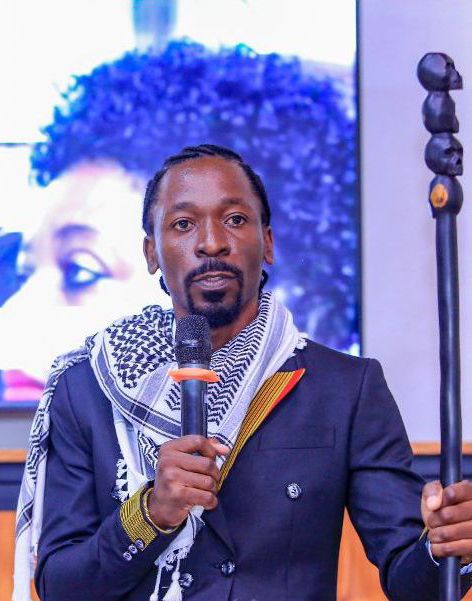
Enen Ambrose is a Rule of Law enthusiast and a supporter of the firebrand president of the Uganda Law Society, Isaac K Ssemakade.
Disclaimer: This write up is for informational purposes only and should not be taken as a substitute for professional legal advice. Readers are advised to seek the services of a qualified attorney in their area of Jurisdiction for situation specific legal advice and course of action.
Do you have a story in your community that sheds light on the Rule of Law discourse that you want us to discuss about? Or do you have valuable constructive feedback for us?
Please reach out to us on, ambrosenen@gmail.com or +256789856805



 enenlegalworld