Tag: Fair hearing

  • The Philosophy of Insults: When Truth Becomes Fire and Tests Legitimacy”Enen’s Letter to the Radical New Bar and Every Citizen Who Still Dares to Speak

    The Philosophy of Insults: When Truth Becomes Fire and Tests Legitimacy”Enen’s Letter to the Radical New Bar and Every Citizen Who Still Dares to Speak

    Logo: Enen Legal World


    🪶 The Fable

    Deep within the Mambo Forest, the animal kingdom lived in awe of a single, dazzling truth: their ruler, Twon Gweno the cock, wore a crown of living fire. His comb was a legend, a crest of such vibrant crimson that the elders swore it was a fragment of the first sun. His morning crow was a decree:

    Bow to my glory, and you will be spared my flame.”

    And so, the animals bowed. Fear made them pious; fear made the cock sovereign with unquestioned loyalty, respect and cooperation from the rest of the animal kingdom in that forest. It was a classic case of natural-born legitimacy; never really earned.

    One evening, a crisis struck. Ichuli, the fox, the sole specialist in lighting the communal fire, was away. The wood was piled, but the spark was missing. The night, cold and predatory, loomed.

    Odyek Odyek, the hyena, a friend to truth and enemy of pretence, stepped forward.

    “The solution is simple,” she said. “We bow to Ladit Twon Gweno’s crown of fire. I will sprint to his home and borrow a spark.”

    She took a tuft of the driest spear grass, the Obia and went to the cock’s compound. She found him in a deep, unconscious slumber. Without waking him, she gently pressed the grass to his legendary crown, waiting for the catch, the sizzle, the proof.

    The grass rested on the crown, as inert as if it had been placed on a cool stone. The legendary fire was a phantom.


    Odyek Odyek, the hyena returned to the gathering and dropped the cold, unburnt grass in the centre of the circle. No words were needed. The lie they had bowed to for generations unravelled in that silent moment.

    Power, and unearned but coerced legitimacy unmasked, bled its authority into the silent night.


    ⚖️ The Lesson

    Borrowed fire must warm the hearts of the people. When it no longer does, the borrower is called to account.


    So it is with the courts. The robe, the gavel, the summons, and the warrant are instruments loaned by the people. Article 126(1) of the Constitution does not sing an ornament; it issues a command:

    Judicial power is derived from the people and shall be exercised by the Courts in their name and in accordance with the law and their values, norms, and aspirations.


    🧱 The Three Pillars of Legitimacy

    Legitimacy; the respect of the people and their cooperation with the courts, is the covenant at the heart of that loan. It demands three sacramental elements:

    Reflection: Judicial power must reflect the values and aspirations of the people; not the insatiable appetite of a sophisticated elite for luxury or high life.

    Truth: Courts must administer justice in accordance with law and truth, not convenience or midnight deals.

    The Judicial Oath: The solemn undertaking before God to do justice to all manner of people without fear, favour, ill will or affection is no actor’s prayer; it is a chain of duty.


    Strip away any of these, and what remains is a gowned pretender, eloquent and majestic, perhaps, but hollow: a cock whose crown no longer burns.


    The Evidence of Decay

    For those who have seen:

    • Appeal files missing thirty-eight pages.

    • A High Court hearing conducted not in a public courtroom but secretly in a posh hotel in which 15 minutes out of those proceedings were conducted in the absence of the opposite party and the whole process bashed by the Court of Appeal for want of a fair hearing and lack of judicial accountability and transparency and thereby further exacerbating the already slim public trust in the Court system entirely

    • A lower bench judicial officer bashed; “I don’t want to see this rubbish here, take it back where it came from” when they had sought guidance over files of thousands of remand detainees who had clocked mandatory bail, over 5 years where the Office of the Director of Public Prosecution state attorneys appeared neither willing nor ready to commit them for trial in the High Court.

    • The poorest peasants completely blocked from accessing justice because the lower courts have received directives not to register and dispose of customary land disputes unless a surveyor had first rendered a preliminary survey report; peasants who have never heard of, met heard about or hired the services of a professional called a surveyor. They have to sell a chunk of land  to afford a surveyor to conduct a preliminary survey and get their case registered.

    • A National Bar Association President’s liberty preserving Application for stay of execution of a manifestly void Contempt of Court ruling take close to 9 months without disposal.  


    These are not footnotes; they are flesh-and-blood indictments.
    The 1995 Constitution’s promise of a speedy and fair hearing has become hot air—Kikwangala, Kichupuli, Kawani.


    🗣️ The Test — The Philosophy of Insults. Withdrawing legitimacy and requiring that it be earned back by fidelity to its 3 pillars.

    To insult without malice but with evidence is to perform constitutional maintenance and maintain pure legitimacy.”


    Hence the philosophy of insults. This is not the petty malice of a tavern quarrel. It is a civic stress-test, a pressure gauge for legitimacy.

    It is the public’s cry:

    “GIVE US WHAT YOU OWE US.”


    We lent you power; we demand accountability in return.

    A people that cannot insult and mock power has already lost moral authority. The right to insult and offend the powerful is not a luxury, it is the citizen’s tool for testing whether the borrowed flame is real.


    📜 The Proof — The Jurisprudence of Defiance

    “Leaders should grow hard skins to bear.”
    “Power must endure insult to remain clean.”

    Uganda: When the Constitution Answered Back

    This philosophy is not just wisdom; it is the settled weight of law. Consider Andrew Mwenda, whose words rattled the Republic:


    This philosophy is not just wisdom; it is the settled weight of law. Consider Andrew Mwenda, whose words rattled the Republic:
    You see these African Presidents. This man went to University, why can’t he
    behave like an educated person? Why does he behave like a villager?’

    Museveni can never intimidate me. He can only intimidate himself ……… the
    President is becoming more of a coward and every day importing cars that are
    armor plated and bullet proof and you know moving in tanks and mambas, you
    know hiding with a mountain of soldiers surrounding him, he thinks that, that
    is security. That is not security. That is cowardice”

    Actually Museveni’s days are numbered if he goes on a collision course with
    me.”

    You mismanaged Garang’s Security. Are you saying it is Monitor that caused
    the death of Garang or it is your own mismanagement? Garang’s security was
    put in danger by our own Government putting him first of all on a junk
    helicopter, second at night, third passing through Imatong Hills where Kony
    is ?……Are you aware that your Government killed Garang?”

    I can never withdraw it. Police call them, I would say the Government of
    Uganda, out of incompetence led to or caused the death of Garang”

    When the state reached for iron law and charged him with sedition, the Constitutional Court answered with freedom, declaring that people from all backgrounds enjoy equal rights of expression, polite or not.

    “……Our people express their thoughts differently depending on the environment of their birth, upbringing and education.

    While a child brought up in an elite and God fearing society may know how to address an elder or leader politely, his counterpart brought up in a slum environment may make annoying and impolite comments, honestly believing that, that is how to express him/herself.

    All these different categories of people in our society enjoy equal rights under the Constitution and the law. And they have equal political power of one vote each.Then came the killer line that buried sedition:

    “……During elections voters make very annoying and character assassinating remarks and yet in most cases false, and yet no prosecutions are preferred against them. The reason is because they have a right to criticize their leaders rightly or wrongly. The Court concluded “Leaders should grow hard skins to bear.”
    A copy of the judgment can be found here:


    Burkina Faso: The Continental Echo

    In Burkina Faso, journalist Issa Konaté was jailed for calling a prosecutor “a criminal in a robe.” In his Words:

    “…….The Prosecutor of Faso is the godfather of bandits. He is the sponsor, the organizer, the leader of a vast network of counterfeiters and traffickers that he protects with his power and status.”
    This is a prosecutor who does not prosecute crime, he commands it. He is not a guardian of order but a godfather of disorder
    While honest citizens sleep in fear, the chief lawman of our nation sits in his office, dividing the spoils of crime with police officers and bankers
    He is not a magistrate; he is a criminal in a robe. A saboteur of justice…….”


    The African Court answered with thunder and reason. Custodial sentences for speech are a bludgeon against Democracy:
    “The Court is of the view that the violations of laws of freedom of speech and the press cannot be sanctioned by custodial sentences, without going contrary to the provisions of Articles 9 and 19 of the Charter”

    The Court pronounced itself on the role of public figures under scrutiny.

    “There is no doubt that a prosecutor is a public figure; as such he is more exposed than an ordinary individual and is subject to many and more severe criticisms. Given that, a higher degree of tolerance is expected of him”

    A copy of the judgment can be found here:


    From this we learn that “Power must endure insult to remain clean.”


    🪶 The Heritage; The Lango Grammar of Reproof

    This civic logic is not foreign to us. In Lango, the sharp tongue has long done the work of reform.

    • “Ole yin ibedo dako dako”; “…..you man, you behave womanly…”. It is not cruelty. It is shock therapy for duty and clarion call for the family patriarch to “man up” and live up to his responsibilities to his family, to lead firmly, provide for it and protect it.

    • “Lango mito alek”; “…..Lango deserves a pestle…” A reminder that discipline is coming unless reform comes first and that it intact comes usually after enforced discipline.


    • “Kwany Ka Point” The Gen Z’s and Millenials have similarly curved their own wisdom, “pick only the point”: As plain and simple as that. Pick only the point, filter it from the insult.


    • “Ikok Ugali idogi.”  “…..You will cry with Ugali in your mouth. …”


    In the old rite of passage, a young man’s two upper incisors were pulled, and boiling herbal Ugali was placed in his mouth to ease the agony. He cried through the very remedy meant to heal. Reform rarely feels like mercy.

    So when the citizen mocks the powerful, the intention is not cruelty; it is Ugali in the mouth of power: a necessary sting, a painful antidote.

    The insult becomes a civic anaesthetic; searing, brutally  humiliating, but designed to cleanse and restore legitimacy

    Reform rarely feels like mercy.
    So when the citizen insults and mocks the powerful, the intention is not cruelty. It is Ugali in the mouth of power: a necessary sting, a painful antidote.


    🔥 The Repair — The Calculus of Force

    Public outrage, properly aimed, creates four fields of pressure that make corruption intolerable:

    1. Professional Ostracization: When integrity collapses, the social scaffolding of a career falls with it.


    2. Erosion of Authority: A judge who loses public confidence loses jurisdictional muscle and may in fact receive fewer to zero allocations of files to handle or minimal chances to be chosen to sit on a panel in the case of hearings in courts that are manned by more than one Judicial Officer.


    3. Legal and Institutional Siege: Scandal catalyses petitions, litigation, and oversight that eat at illegitimacy.


    4. Political Abandonment: The appointing power prefers a scapegoat to a scandal, forcing a “voluntary” exit.

    From this, we learn that insults are not instruments of mob rule; they are the social physics of accountability.Yet outrage alone is not reform. The sting must translate into architecture: cooling-off periods for judges, transparent appointments, and independent oversight with teeth. Shame, the direct consequence of insult, reveals the rot; law must excise it.


    ⚔️ The Awakening — The Price of Truth

    The hyena who taught the village to see.”

    For too long, the Uganda Law Society was a sleeping giant while the temple burned. But the dry grass is now burning in Masaka.
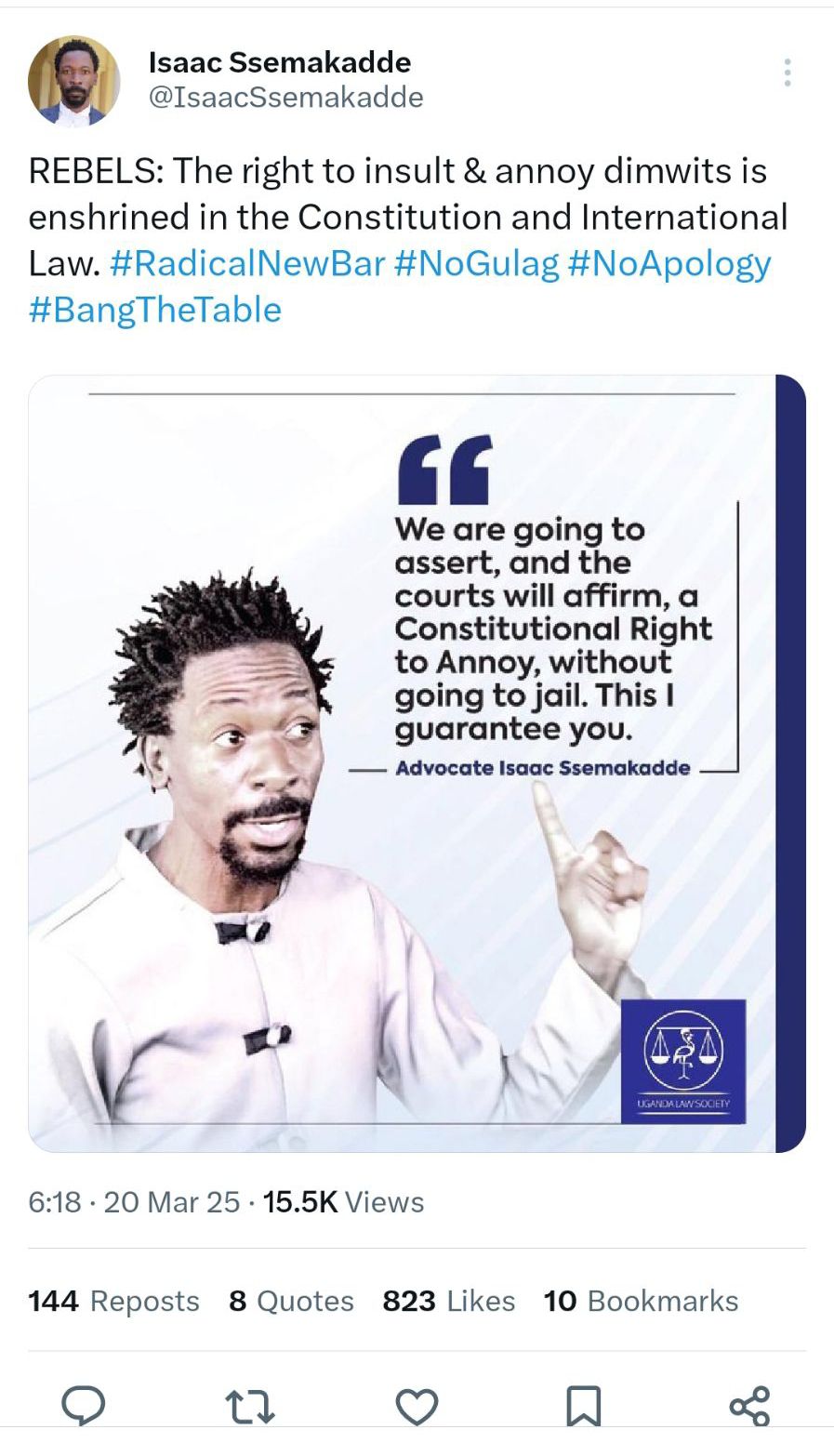
    When the President of the Bar , the hyena who taught the village to see, lives in exile for refusing to apologise for truth, his banishment becomes the ultimate test.

    Isaac K Ssemakadde (SC) President of Uganda Law Society. Credit: Uganda Law Society Website.


    📜 The Counsel; A Call to the Bench and the People

    This is not an invitation to vulgarity for its own sake.
    Insult as a civic weapon must be wielded with evidence, not rumour; with satire steeped in fact, not malice.

    To the Judges:

    Grow the hard skins the Constitutional Court commanded you to have. Wear patience as armour, not menace. Treat insult as a thermometer, not as treason or contempt.

    When a citizen insults, ask: does this insult point to truth? If yes, answer in reason, remedy the wrong, and let the nation watch you Act. If not, let the insult fall like a pebble. The dignity and legitimacy of the bench is earned by magnanimity and the stoic creed of the 3 pillars of legitimacy namely Reflection (of law, values, norms and aspirations); Truth and by abiding by the Judicial Oath. It is not enforced by fury, bullying or jaling dissent.

    This doctrine requires courage from all sides. The Bar must be relentlessly courageous and fearless in its insult and ridicule while exacting in its ethics.

    The public must be loud and literate, hurl insults but bring evidence. Lawyers must translate courage into petitions, not merely WhatsApp gossip and tweets. The Legislature must codify protections for speech against disproportionate criminal sanction and the Judiciary must redicscover the humility of the oath, the most important leg of judicial legitimacy; to do justice without fear, favour, ill will or affection. 

    To

    the citizens: Wield the pen. Make the insult precise devastatingly; threads that link to missing pages, memes that reveal truth.


    🌞 The Benediction & Epilogue

    Lock and Roseau taught and we learnt from the social contract doctrine that all power, judicial power inclusive, like the communal bull, is never owned. It is loaned to serve, not to feast upon. Judicial officers are, therefore, commissioners, agents of the people, not monarchs. The people are the principal. When the agent betrays, the principal must insult loudly in true reprimand.


    If those entrusted with it betray the trust, the people must remind them, sometimes with satire, sometimes with searing words, that borrowed fire must warm, not burn.

    This is neither an incitement to violence nor a call for insurrection. It is a call to civil carnage against corruption, ritualised, and peaceful.

    Let the insults be sharp, witty, and relentless, and let them dismantle rotten cartels of impunity.
    Turn every courtroom cover into a public syllabus: transparent reasons, readable judgments, accountability writ in footnotes and public records.
    Make the institutions bleed truth, not people.

    To end illiteracy in justice, let every citizen wield the pen.

    Let the hyenas come. Let the baraza be noisy.

    Let society test the crown every morning until the judges can point, with open hands and clear reasons, and say:

    Here is the flame.”

    Until then, press the grass. Let the crown be tried in daylight.
    Let the fire prove itself true.

    ✍️ Dedication

    This blog is dedicated to all prisoners, present and past, of conscience, self-expression, and free speech: Male Mabirizi Kiwanuka, Ivan Samuel Sebadduka J, and Isaac K. Ssemakadde (SC), President of the Uganda Law Society, for executing a civic duty tragically confused with contempt of court.

    Contempt must be reserved for direct obstruction of justice, not as a cudgel to discipline ridicule.
    Imprisoning insult and mockery is to forget the nature and source of judicial power: the people’s consent.

    May the Good Lord bless and protect you all.
    And may we witness, in our lifetime, thick-skinned judicial officers who treat insults with nothing more than “a wry smile,”
    as aptly put twenty-five years ago by the eminent British jurist, Lord Justice Simon Brown.

    The author is a member of the inaugural Judiciary Affairs Committee of the Uganda Law Society.

    DISCLAIMER: This Blog is not a call for mob justice, chaos or disorder against our beloved holders of judicial power and other public power, it is brutal and defiant reminder that illegitimate conduct leads to a withdrawal of respect from the very owners of the power and attracts criminal and administrative sanctions, some as grave as removal from office. It is also to encourage the clean and disciplined judicial officers to continue upholding the consent of the people for them to administer justice by upholding the stoic pillars of legitimacy first mentioned in this Blog, and that with or without climbing the career ladder, God, the original designer of justice will be the ultimate one to reward their efforts both now and in the afterlife.

    This blog is not intended to be used as legal advice, and the author denies liability for use of the contents herein as legal advice. Readers are encouraged to consult a licensed Advocate to give them specialised advice and representation.

    For feedbacks and comments: ambrosenen@gmail.com. 

    References.

    For further reading or references. I consulted the following books.

    1. Politics as a Vocation (Politik als Beruf) by Max Weber

    2. Second Treatise of Government” by John Locke.

    3. The Social Contract” (Du contrat social) by Jean-Jacques Rousseau.

    4. Weapons of the Weak: Everyday Forms of Peasant Resistance” by James C. Scott.

    5. How to Do Things with Words” by J.L. Austin.

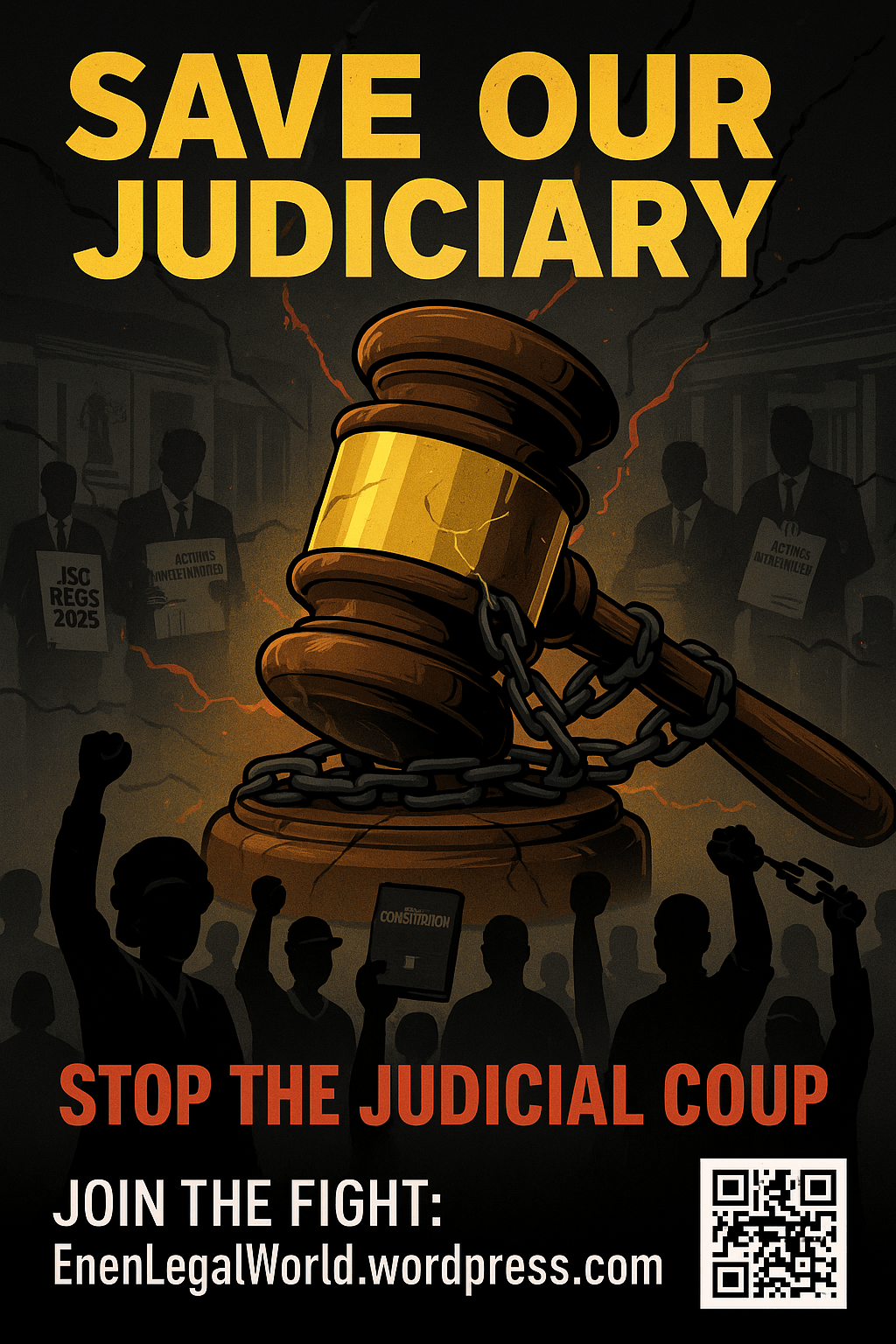
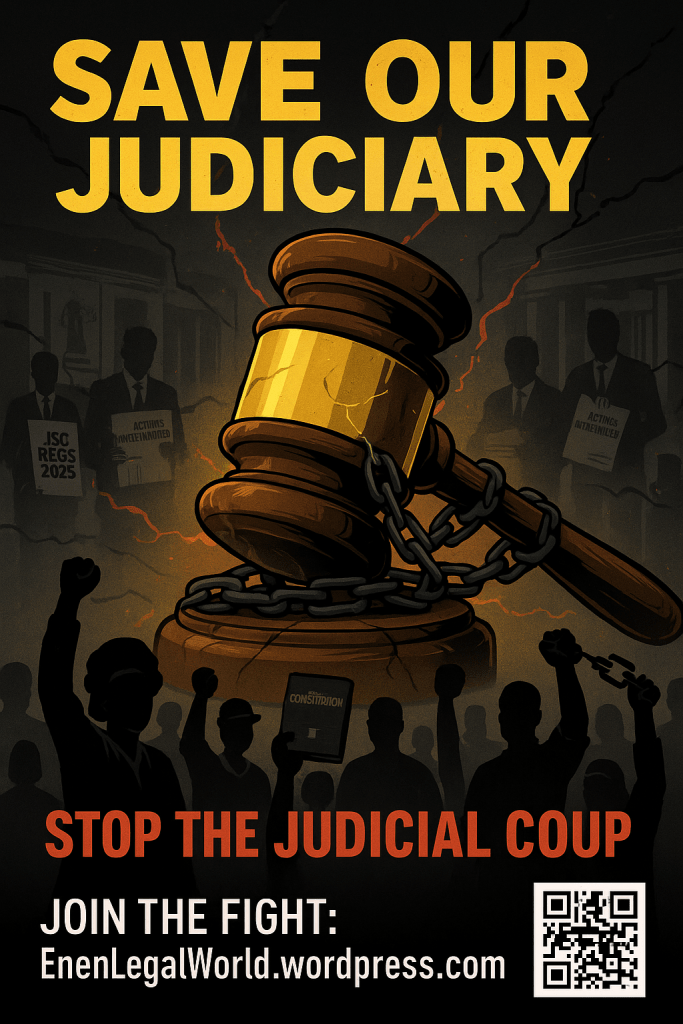
  • Uganda Needs Judges with Balls of Titanium Alloy—Not the Shackles of the JSC Regulations, 2025: Why You Should Be Worried

    Uganda Needs Judges with Balls of Titanium Alloy—Not the Shackles of the JSC Regulations, 2025: Why You Should Be Worried


    Let’s not waste time.
    Uganda’s judiciary has been hijacked. Quietly. Legally. Treacherously.

    They didn’t need a coup d’état. They just needed Statutory Instrument No. 4 of 2025—the Judicial Service Commission Regulations—to pass unchallenged.

    You can access a copy of those regulations here:


    And now the Constitution isn’t bleeding.

    It’s on life support. Plugged into a system designed to kill it slowly.

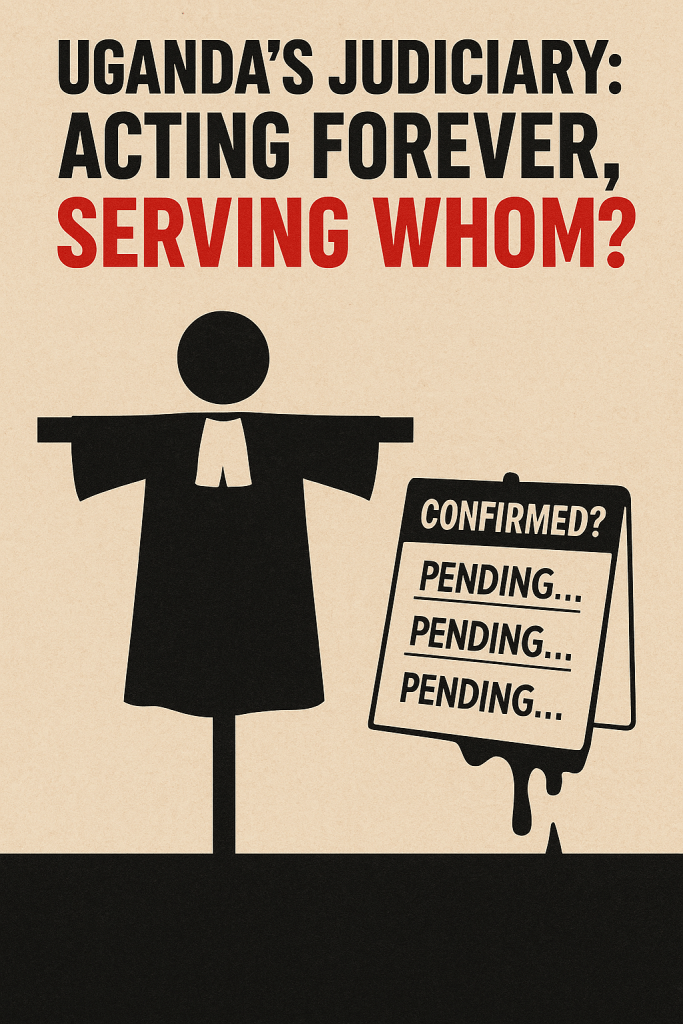
    Judges on Acting Terms. Courts on Probation. Justice on the Brink.


    Here’s what they’ve done:

    Invented a system where new judges are appointed on in an acting capacity, with the duration determined at the whims of the appointing authority—yes, like interns at a mobile money kiosk.

    Given the President the power to recycle retired judges, no questions asked. No medical. No mental. No morals.

    Created performance evaluations for judges like they’re applying for a promotion at a law firm.

    That’s right, you’re not day dreaming, the system was rigged. In 2022, the Constitutional Court damned this shrewd “sharp practice” and threw it in our Constitutional History by declaring it unconstitutional in Dr. Busingye Kabumba and Karamagi vs Attorney General.

    A copy of that decision can be found here:

    Good judgment, right? Damn, the government rigged it. It instead created a legal loophole which enabled it to pass these damned Regulations. 

    Firstly, it appealed against.  Secondly  the government obtained what is in effect  a suspension of the independence of the Judiciary as the Supreme Court delays to decide the Government’s Appeal .

    A copy of the decision which suspended the independence of High Court Judges as the government waits for a decision in its own appeal from the above case can be accessed from here:


    Okay, let’s dive into the evil in the Regulations.
    Reg. 29–33 and 31 are the smoking guns.
    And what they shoot is judicial independence—straight between the eyes.

    And Then There’s 2026…

    Uganda’s next elections are not just around the corner—they’re rumbling like thunder.

    And we know the script:

    Mass arrests.

    Disappearances.

    Violent suppression.

    Habeas corpus applications flying like confetti.

    Human rights cases lined up like a firing squad.


    It will take judges to hear them all.

    But what kind of judges?

    Not fearless ones. Not permanent ones. Not independent ones.

    The Regulations guarantee this:

    When the state comes for you, the judge before you may still be “acting,” “probationary,” or “awaiting confirmation.”

    You don’t need a judge praying for job security.

    You need a judge with balls forged from titanium alloy, ready to grab the State by its ball sac and say:

    Back off. The Constitution says this citizen walks free.”

    These Regulations can’t produce that judge.
    They produce whispering cowards in robes.

    But Wait, There’s a Recruitment Cartel Too

    They didn’t just kill judicial independence at the appointment level.

    They also built a Search and Recruitment Committee—and a Sub-Committee—with a quorum of TWO people.

    Let that sink in:
    Two people can now shortlist Uganda’s judges.

    Who are these people?

    The Attorney General—yes, the government’s own lawyer.

    The Chairperson of the JSC—currently Justice Singiza, who was once branded a “Nazi Judge” by opposition supporters for adjourning Besigye’s habeas corpus case instead of hearing it urgently.


    And guess who they kicked out of this process?

    The two (2) representatives of the Uganda Law Society.

    The very people the Constitution says should be part of the Judicial Service Commission.

    It Was Planned. Timed. Executed.

    These Regulations were passed while the Uganda Law Society is in court, fighting to elect its representatives.

    The plan is clear:
    Keep them out. Lock the process down. Staff the courts with friendly judges. Control the law from the inside out.

    This isn’t just bad law.

    It’s a judicial cartel in robes.

    And You Think It Doesn’t Affect You?

    Wait until your land is taken.
    Wait until your protest turns into a prison sentence.
    Wait until your loved one disappears.
    Wait until the courtroom is the only place left to cry out.

    Then you’ll pray that your judge isn’t still auditioning for a contract renewal.

    Here’s the Message:

    Uganda’s justice system is being rebuilt—not to protect you, but to survive you.

    It is no longer about law.
    It’s about control.
    It’s about loyalty.
    It’s about silencing justice before you can even plead for it.

    This is the war. This is the moment. This is the alarm.

    If you have eyes you better see, and if you have ears you better listen.

    More about me and disclaimer in the about page.

  • Foot Soldier’s Last Stand: Inside the Madness of Sycophants, Rogue WhatsApp Admins, and the Northern Bar Bench Forum

    Foot Soldier’s Last Stand: Inside the Madness of Sycophants, Rogue WhatsApp Admins, and the Northern Bar Bench Forum

    Photocredit: Team of Advocate Paul Mukiibi with their Brand: Chain breakers in the campaign to represent the Uganda Law Society at the Judicial Service Commission.

    It started like a flicker—a tiny spark of defiance that should’ve ignited a roaring wildfire of rage and justice. Instead, it was smothered by the gargantuan, self-righteous boots of censorship, as if the admins of the Northern Bar-Bench Forum were playing the role of divine gatekeepers to the underworld of logic, reason, and free speech. It was the perfect storm waiting to brew, and here we were, caught in the vortex of unrelenting madness.

    Imagine this: a friend—let’s call them Advocate C—dared to share a link to an article so scorching that the digital air itself trembled. The scandal? The Honorable Chief Justice, in a move so brazen it could only be conceived in the dankest corners of the power-obsessed universe, allegedly schemed to extend the retirement age for Supreme Court Justices. Why? To keep his gnarled hands on the throne, forever and ever. He also decided to appoint an Acting Principal Judge without so much as a whiff of the President’s blessing, like a schoolyard bully claiming the lunchroom as his own personal fiefdom. The legal streets of the Forum exploded in righteous fury, an inferno of truth and justice clamoring for attention.

    And then… the admins. Oh, the admins. The self-crowned, self-important emperors of silence—oh yes, those power-hungry weasels. They descended like locusts, their ban-hammers blazing. Link? Gone. Criticism? Erased. “Don’t post things that make other members uncomfortable,” they decreed, as if comfort was the holy grail of democracy. What’s uncomfortable, you ask? The CJ’s alleged power grab that should’ve made every Ugandan’s blood boil? That’s what should’ve made us all “uncomfortable.” But no, not in their world. The admins had a higher calling: the suppression of truth, under the guise of “unity” and “comfort.” What a joke.

    That night, at 8:43 PM, the world shook. I—Ambrose Enen—I was done. I had had enough of their charade. With the force of a thousand furious lions, I stormed into the admins’ fortress of lies. I sent them a question that cracked their gilded masks and made their self-satisfied jaws clench like desperate prey:

    “Why are you strangling debates about the Hon. Chief Justice, you cowardly sycophants?”

    I threw down the gauntlet, demanding they justify their pathetic, trembling submission to the powers that be, to shield His Lordship from the fire of scrutiny. The CJ had once bellowed like a lion, declaring, “If you’re not criticized, it means you’re doing nothing and the people just choose to ignore you!” And here they were, trying to shield him from even the faintest whiff of criticism. Hypocrisy? Monumental. So, I unsheathed Article 29 of the Constitution like a blazing sword and sliced through their pitiful, sanctimonious excuses with the fury of an avenging god. I invoked the speech of the Chief Justice himself when he delivered his own lead Judgment in Kabaziguruka case, where the Supreme Court put a grinding halt on the trial of civilians in the Court martial. The Chief Justice was referring to President Isaac Ssemakade’s work method, weekly public press engagements dubbed the “RNB Live” in which fireballs were hurled at the Justices of the Supreme Court for delaying to deliver that very judgment. The very Supreme Court had in an earlier judgment in the case of  Charles Onyango Obbo and Andrew Mujuni Mwenda had crowned free speech as an untouchable deity, immune to the fragile egos of all public officials from the President to the Military.

    Read a copy of that Judgment here:

    Related: read also: https://enenlegalworld.wordpress.com/2024/11/20/revisiting-free-speech-professional-ethics-and-gender-sensitivity-in-uganda-a-legal-and-social-analysis/

    I screamed at them, demanding they answer me: Had they erased the CJ’s own edict—that criticism is the lifeblood of action? Or had they buried the people’s right to challenge power under a mountain of self-inflicted fear?

    I didn’t stop there. I summoned the name of the great Isaac Ssemakadde, a volcano of legal brilliance who melts the hearts of tyrants and leaves them quaking in their boots. His name sent ripples of panic through their ranks, like a shark’s fin slicing through calm waters. And I laughed—loudly—at their terrified whimpering.

    The admins’ response? Hilarious. They pulled out the same tired, sanctimonious rhetoric, claiming the Forum, created in 2019 by the then “mighty” Conrad Oroya, was meant to unite “advocates” and “judicial officers” from the greater North. They paraded their so-called patrons, from the CJ down to the lowliest Magistrates, and tried to paint themselves as paragons of unity and reason. But wait—oh wait—they accused the Radical New Bar (RNB) of destroying the Forum, branding us as “scourges of the legal profession.” Apparently, our “scathing attacks” were too much for their fragile egos, too sharp for their delicate sensibilities. They shrieked that we’d turned their sacred Forum into a warzone. And that—that was their best excuse for censorship.

    But, my friends, that wasn’t enough. They threatened to boot us out, to banish us from their “pious” space where only their carefully curated lies were welcome. Oh, how I laughed. I thought of Maxime Rovere’s words in his book, How to Deal with Idiots and not be one yourself: “Idiots infest every cesspool, even the loftiest halls of government.” But this wasn’t a government cesspool, oh no. This was a digital one, run by clowns in armor of “civility” and “comfort.” I held back my laughter only because it was a laugh of pure, unadulterated rage.

    The admins couldn’t take the heat, and then, boom. A revolution. It didn’t come in the form of an army, no. It came in the form of words. Words sharper than a thousand blades.

    A Grade 1 Magistrate—yes, a Grade 1 Magistrate—came for them, tearing through their lies like a wildfire through dry grass. “Article 29 doesn’t grovel before judicial comfort,” they roared. “You’re strangling debate about the CJ, and in doing so, you’re ripping the soul from the legal profession itself.”

    Then, like a chorus of angels singing the hymn of truth, came another Magistrate. It came with fire in their belly and venom in their words. “Your fear of the Radical New Bar only exposes your cowardice,” they snarled. “You’re terrified of a few questions—questions!—about the CJ’s power plays. What kind of admins are you?”

    Then came Advocate A—oh yes, Advocate A—with a fire so hot it could melt the very walls of their sanctimonious den. They came at the admins like a raging storm, laughing at their pathetic attempts to shield the CJ from the rightful fire of criticism. They mocked them for their “bootlicking” and told the admins to lick the dust. They didn’t just fight—they laughed in their faces. And their message? “You’ve earned this defeat, you glorious cowards.”

    But that’s when the real rebellion began. Just after my banishment, Advocate B—yes, Advocate B—launched a tidal wave of resistance. “See you in Gulu Learned Friends,” they sneered. “But first, post that message which  was deleted here!”

    The forum’s demise wasn’t my banishment. Oh no. It died when it sold its soul, when it chose silence over truth, when it cowered before power. And here’s the thing—the admins? They didn’t even see it coming.

    But then came the words of Isaac Ssemakadde—oh, those words, those molten words that seared their way into my soul. “Impunity’s greatest weakness is the craving it has for respectability, legitimacy, and sycophancy. Deny it one of those lubricants, and you will begin to see ‘how the mighty fall.’ So fast.” And then he said the words that would light the fuse of my rebellion for good: “Principle is always vulnerable in the face of power; especially in spaces of long-term subjugation where the legal culture is manipulative & unapologetic in defence of power. Only a revolution, grounded in principle, can reverse things now.”

    I heard it. The call. The revolution, forged in fire and principle, was now in my blood. And so, like a storm that cannot be stalled, I went to battle. Unbanned. Unbowed. Unafraid.

    Because here’s the truth: The Northern Bar-Bench Forum was supposed to be a crucible of ideas, a place where Uganda’s brightest minds clashed, burned away the dross, and emerged better. Instead, it became a cesspool, a sanctuary for the most dangerous thing of all: fear. Fear of truth. Fear of scrutiny. Fear of Article 29.

    And in that fear, they forgot. They forgot what a forum was meant to be. They forgot that power, unchecked and unchallenged, is the very thing that devours empires.

    So here’s to the outcasts, the truth-tellers, the Ssemakaddes who set the world ablaze with righteous fury! Here’s to Advocate A, Advocate B, and every single renegade who refused to bow before the gods of comfort. Here’s to Article 29 and the indomitable, damn-near-holy faith that free speech isn’t a gift from admins or judges—it’s our birthright, you small little intern Honorable WhatsApp administrator dictators!

  • Foot Soldiers Fight Back: Free Speech, Social Media, and the Battle for Judicial Accountability in Uganda

    Foot Soldiers Fight Back: Free Speech, Social Media, and the Battle for Judicial Accountability in Uganda

    Judicial power in Uganda is not a divine right handed down to judges in solemn robes. It is borrowed authority from the people, and when borrowed power is abused, the lenders have every right to demand accountability. That is what happened when Ugandans erupted in fury over Justice Douglas Singiza’s decision to adjourn a habeas corpus application, effectively prolonging an already illegal detention.

    This was not an internet tantrum—it was a constitutional defense mission, executed in real-time by citizens who understand their rights better than some of the people wearing wigs in courtrooms. Article 126(1) of the Constitution is clear:

    Judicial power is derived from the people and shall be exercised in conformity with the law and with values, norms, and aspirations of the people.”

    So, when the people declare that a ruling has spat on their constitutional values, they are not just complaining—they are executing their duty to keep judicial power in check.

    This is not the first time Singiza has found himself at the center of a human rights disaster. When Kakwenza Rukirabashaija, a novelist and torture victim, applied to retrieve his passport for urgent medical treatment abroad, it was Singiza—then Chief Magistrate at Buganda Road Court—who denied him. His reasoning?

    👉 “Ugandan hospitals can handle his condition.”

    Imagine suffering broken ribs, festering wounds, and open scars from state torture, only for a judge to declare that a hospital in Wandegeya is sufficient to handle what should be a war crimes case. This is the same judge who, three years later, sends Besigye and Lutale back to illegal detention while he thinks about their habeas corpus plea.

    The pattern is now too clear to ignore—delayed justice when it benefits the state, procedural gymnastics when fundamental rights are at stake, and then a full-blown judicial meltdown when the public calls it out.

    And how did Singiza react to the backlash? Like a true 21st-century authoritarian—he made the ruling about himself. Instead of addressing the constitutional chaos he created, he spent his precious obiter dicta crying about online criticism.

    What’s next? Should Ugandans start seeking judicial permission before commenting on court decisions? Must all legal critiques now be submitted in triplicate, with an affidavit from a Senior Advocate?

    This is a dangerous trend—a creeping attempt to criminalize judicial criticism and insulate courts from the same public scrutiny that every other arm of government faces.

    The executive is insulted daily.
    The legislature is mocked in real-time.
    The military is dragged through the mud.

    But the judiciary wants to be untouchable?

    In Onyango Obbo & Andrew Mwenda v. Attorney General, the Supreme Court made it clear that public officials—including judges—must tolerate criticism. Free speech does not require politeness, and it is not invalidated because it offends the recipient.

    Yet, here we are, watching judges compose emotional victim statements in court rulings instead of defending the Constitution.

    This is not judicial independence—this is judicial fragility.

    Uganda has reached a crossroads: either the judiciary remembers that it serves the people, or the people will remind it in ways it will never forget. Judicial power, like all borrowed authority, can be reclaimed when misused.

    This is not a warning.
    This is a constitutional reminder.

    DISCLAIMER: This blog is not intended to mock or attack the person of the Hon. Justice Douglas Ssingiza. It is commentary on the interesting obiter dicta in the Habeas Corpus Application of Dr. Kizza Besigye and Obeid Lutale vs. Attorney General. The Ruling in that case can be found here:

    The author is a Rule of enthusiast. More in the about page.

  • Reflections of the Uganda Law Council’s Refusal to License Martha Karua

    Reflections of the Uganda Law Council’s Refusal to License Martha Karua

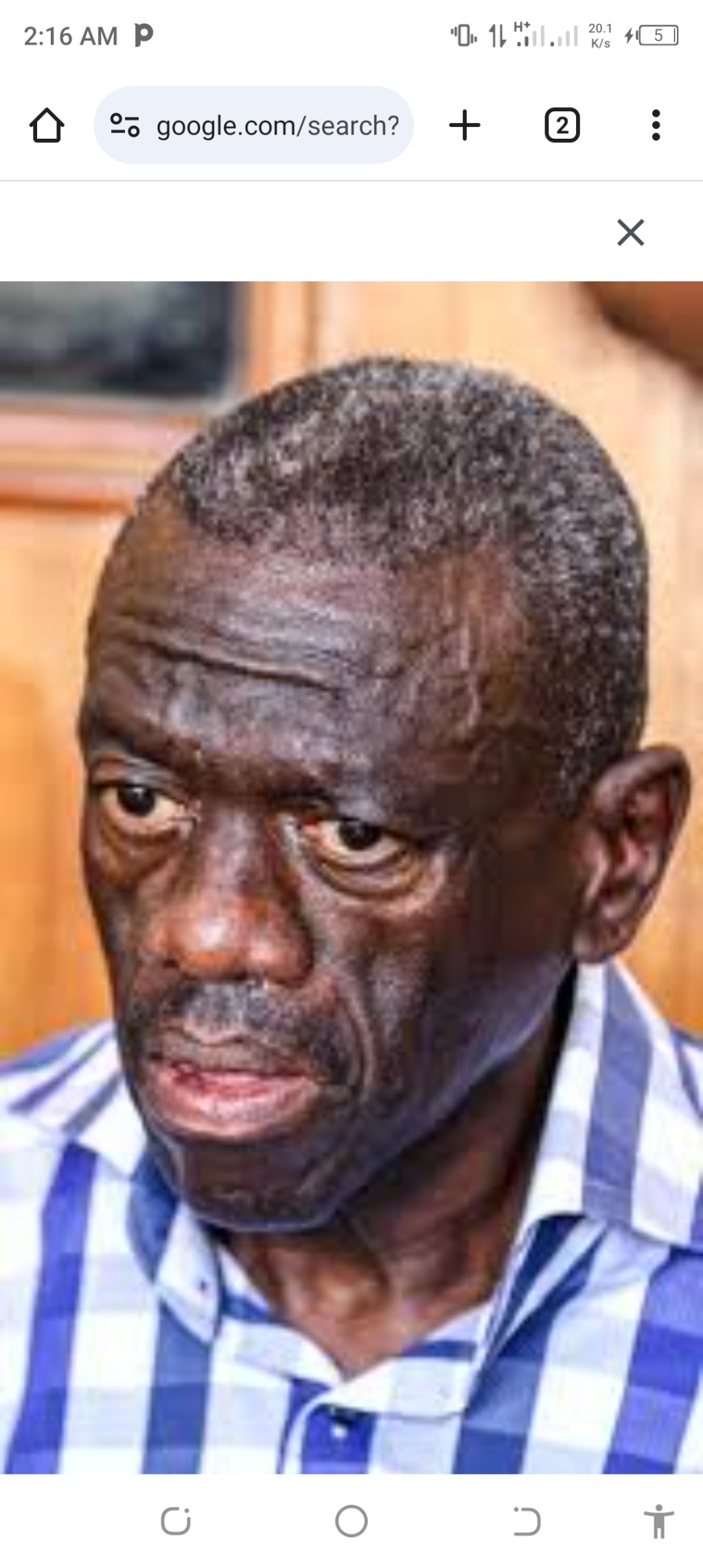
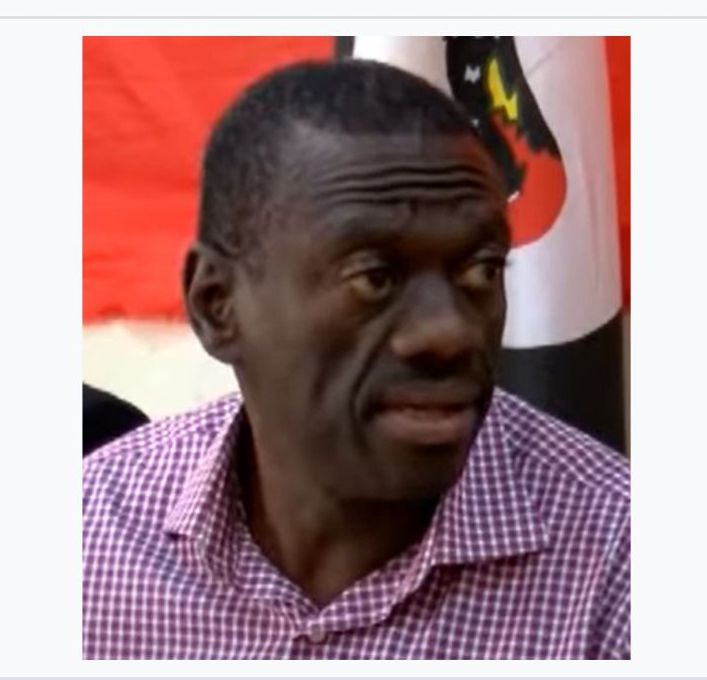
    Rtd Col. Dr. Kiza Besigye. Photo credit: Wikipedia


    The refusal by the Uganda Law Council to grant Martha Karua, a distinguished Senior Counsel from Kenya, a temporary practicing license to represent Dr. Kizza Besigye in his ongoing trial before Uganda’s General Court Martial has raised significant concerns in my mind about Uganda’s legal system, regional cooperation, and political interference. In this post, I will break down my perspective on why this decision is problematic, critiquing the reasons provided by the Law Council and exploring the broader implications it has for both Uganda and the East African Community (EAC) at large.

    Background Context: The Case of Dr. Kizza Besigye

    Dr. Kizza Besigye, one of Uganda’s leading opposition figures, was invited to Nairobi by Martha Karua for a book launch. During this event, Besigye was allegedly found with a firearm in his hotel room, which led to his controversial extradition back to Uganda. This case is more than just a legal matter; it raises important issues surrounding Kenya’s sovereignty, extradition laws, and the treatment of political figures within the region. Besigye’s trial before the General Court Martial has been heavily scrutinized, especially in light of the Supreme Court’s recent stay of a ruling by the Constitutional Court in the case of Michael Kabaziguruka v. Attorney General (Constitutional Petition No. 45 of 2016), which had declared that military courts in Uganda have no jurisdiction to try civilians.

    The refusal to grant Karua a temporary license, made by the Uganda Law Council, appears to be a politically charged decision, occurring against the backdrop of these ongoing legal and political tensions. As a legal professional, I find this decision troubling, particularly when considering the broader implications for regional integration and the rule of law in Uganda.


    The Reasons Cited by the Law Council for Denial

    The Uganda Law Council gave several reasons for denying Martha Karua a temporary license to practice law in Uganda for Besigye’s defense. Let’s examine these reasons critically and reflect on the potential political undertones and legal inconsistencies involved.

    1. Lack of Notarized Documents
    The Law Council argued that Karua’s application was incomplete because it lacked notarized copies of her practicing certificate, a letter of good standing, nationality documents, and academic qualifications.

    My View: This is a procedural issue that could have been easily remedied. Rather than outright denying the application, the Law Council could have requested the missing documents or offered Karua an opportunity to rectify the deficiencies. This decision to deny her based on minor technicalities rather than facilitating her compliance reflects poor administrative practice. A lawyer of Karua’s stature should not be obstructed by such minor procedural issues.


    2. Absence of a Valid Practicing Certificate for Erias Lukwago
    Another reason cited for the refusal was that Karua’s local sponsor, Erias Lukwago, did not have a valid practicing certificate. This was apparently a reason for not processing the application.

    My View: The idea that Karua’s application should be rejected because Lukwago did not provide a valid practicing certificate is misguided. Upon reviewing the Judiciary website, it is clear that Erias Lukwago has an active practicing certificate for 2024. The Law Council could have simply verified this information rather than using this as a reason to deny Karua’s application. The failure to make such a simple verification indicates either an oversight or an intentional attempt to complicate the process. This was an avoidable technicality that should not have been used as grounds for denial.


    3. No Special Expertise Brought by Karua
    The Law Council claimed that Karua did not bring any special skills that Uganda’s legal community lacked, suggesting that her involvement in the case was unnecessary.

    My View: This argument is deeply problematic. The client has a fundamental right to choose their lawyer, and Karua’s expertise was specifically sought by Dr. Besigye. Her representation was not about fulfilling some special legal need that Ugandan lawyers couldn’t address but rather about providing the client with a lawyer of their choice. This rationale dismisses the right of a person to have the legal representation they feel is best suited to their case. The Council’s argument undermines not only Besigye’s right to choose but also the principles of justice and fairness.


    4. Political Undertones
    The Law Council expressed concerns about the political nature of the case, suggesting that Karua’s involvement was motivated by politics, given her association with Besigye and her public stance as an advocate for democracy and human rights.

    My View: This is where I find the decision most troubling. The role of the Law Council is not to pass judgment on the political affiliations of individuals involved in legal proceedings but to ensure that justice is served. Karua’s political opinions or affiliations should have no bearing on the decision to allow her to practice temporarily. The Council’s decision seems to be a veiled attempt to politically sideline a lawyer based on her association with a political opponent of the government. This kind of interference in legal matters not only compromises the integrity of the Law Council but also undermines the fairness of the trial itself.


    5. Conduct Before Approval
    Karua was accused of “holding out” as an advocate before her application had been approved, due to her presence at the court proceedings.

    My View: Karua made it clear that she was attending the proceedings as a visiting jurist awaiting approval. She did not mislead the court or claim to be practicing without a license. The accusation seems to be an exaggeration, designed to discredit her professional integrity. This accusation, made without substantiation, adds to the sense that the Law Council was looking for any excuse to deny her application.


    6. Logistical Constraints of the Law Council
    The Law Council mentioned that it could not expedite the application process due to its members’ full-time commitments in other roles, making it difficult to process Karua’s application on time.

    My View: This is a failure of institutional management rather than a valid reason to deny an application. If the Law Council is unable to manage the process in a timely manner, it speaks to the need for reform within the institution. A delay caused by the Council’s own logistical constraints should not serve as a reason to deny an individual the right to practice law in Uganda, especially in a case of such significance.


    The Double Standards of the Law Council

    One of the most glaring inconsistencies in this case is the selective application of the Law Council’s rules regarding foreign lawyers. Historical precedents show that the Council has granted temporary licenses to foreign lawyers when it suits the political interests of the government. For instance:

    John Khaminwa, a Kenyan lawyer, was allowed to represent President Museveni in a high-profile election petition before the Ugandan Supreme Court in 2001.

    Jim Gash, an American lawyer, was granted a temporary license to represent a client in Uganda, working on juvenile justice reform.


    These instances clearly demonstrate that the Law Council is capable of granting temporary licenses to foreign lawyers when it is politically convenient. However, when it comes to a case involving a prominent opposition figure like Dr. Besigye, the same flexibility is not applied. This selective approach casts doubt on the impartiality of the Law Council and raises questions about whether political considerations played a role in the denial of Karua’s application.


    The Regional and International Implications

    The refusal to grant Karua a temporary practicing license also raises important questions about Uganda’s commitment to regional integration. The East African Community (EAC) Treaty and its protocols, including the Mutual Recognition Agreement (MRA), emphasize the free movement of professionals across member states, including legal practitioners. By denying Karua’s application, Uganda is in direct contradiction of these commitments, which could harm the spirit of regional cooperation that the EAC seeks to foster.

    Uganda’s actions appear to undermine the EAC’s goal of facilitating the free movement of labor and professional services. This decision is particularly paradoxical given President Museveni’s strong advocacy for regional integration. If Uganda continues to place political barriers in the way of legal professionals from other EAC member states, it risks isolating itself from the very integration processes that Museveni has long championed.


    The Uganda Law Society’s Advocacy for Reform

    In response to the Law Council’s decision, the Uganda Law Society (ULS) has rightly condemned the denial of Karua’s application as per incuriam—legally flawed. The ULS has also called for reforms to ensure that such decisions are made impartially, without political interference. Some members of the ULS have even gone so far as to advocate for the abolition of the Law Council altogether, citing its growing susceptibility to political pressure and inefficiency in handling applications for foreign lawyers.

    I fully support this call for reform. The Law Council, and indeed all legal institutions, must operate with full independence, free from political influence. The integrity of Uganda’s legal system depends on the ability of lawyers to perform their duties without fear of political repercussions. The Law Council’s decision in Karua’s case demonstrates the need for urgent reform to ensure that legal institutions are better equipped to serve the principles of justice impartially.


    My Call for Reform and Conclusion

    In conclusion, the Uganda Law Council’s decision to deny Martha Karua a temporary practicing license is not just a legal misstep but also a reflection of broader issues within Uganda’s legal system. The refusal to grant the license based on procedural technicalities, political undertones, and double standards casts doubt on the impartiality and fairness of the decision-making process. Furthermore, it contradicts Uganda’s commitments to regional integration and the free movement of professionals within the East African Community

    About author:

    ENEN AMBROSE

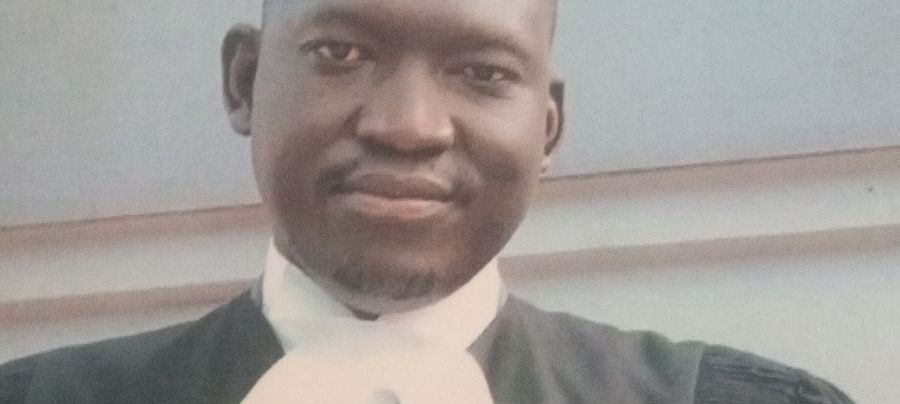
    The author is a Rule of Law enthusiast working at M/S Okurut-Magara Associated Advocates in the up country Town of Adjumani.

    DISCLAIMER: all information in this blog is for general knowledge and educational purposes and is not intended to provide legal advice. Readers are encouraged to seek qualified attorneys in their areas of Jurisdiction for situation specific legal advice and courses of action.

    Contact us:

    Mobile, 0789856805

    ambrosenen@gmail.com.