There is a village called Abongodero. Abongodero means without a granary.
The villagers named it after Mzee Zakayo’s ingenuity.
Zakayo was clever. He never built a granary of his own. Instead, he raised cattle, fat bulls, glossy heifers. When hunger season approached, he would walk to a farmer whose granaries groaned with millet and offer a bull in exchange for rights to a certain number of storehouses. Enough to feed his household. Enough to impress the neighbors.
The arrangement was sealed with a handshake. Everyone knew Zakayo’s cattle. Everyone knew he paid.
The villagers admired him.
“..Look at Zakayo!..”they whispered around evening fires. “He eats from granaries he never built!“
They admired him so much that they named the village after his ingenuity.
Abongodero.
A photo of a granary. Credit. Uganda Today: from article: A testament to tradition: the art of grain in Uganda’s homesteads by Chris Kato.
But abundance has a wicked sense of humor.
Zakayo’s children grew up knowing which families owed them food, which granaries bore their father’s mark. They inherited cattle, but not discipline. They inherited the right to eat, but not the wisdom to plant.
One of them was Okello Anyapo.
Anyapo. The lazy one.
Okello inherited land so fertile it blushed when rain touched it. Black soil. Generous soil. Soil that would have yielded harvests his grandfather never imagined.
But his hoe remained smooth. His fields grew weeds tall enough to vote.
When hunger came, Okello blamed the sun for burning too bright. He blamed the rain for falling too hard. He blamed the ancestors for not speaking loudly enough. He blamed everyone except his idle hands.
Across the stream lived Owera Apur.
Apur the Farmer.
He did not give speeches about productivity. He simply woke before the rooster finished its gossip. He dug. He planted. He weeded. He waited. His granary stood behind his hut like a quiet monument to repetition.
He had no cattle to trade. He had only his back, his hands, and his patience.
His granary stood full.
Proof that the land was never the problem.
Then hunger came like a leopard.
The families who once owed Zakayo’s children had rebuilt their stores. They no longer needed cattle. They needed their millet for themselves.
Okello’s inheritance could not be traded for what no one would sell.
Hunger clawed him thin.
He crossed the stream.
“Uncle,” he said. “We are blood. Remember Father Zakayo? The village bears witness to his name.”
In Lango, dignity comes before shame. Owera sighed. He looked at his granary—full from seasons of sweat.
He opened the door.
“Enter,”he said. “Take what you need.”
Not ownership. Not supervision. Not rules.
Just access.
Okello entered empty and emerged round.
He returned the next day. And the next. Soon he stopped pretending to farm at all.
Why sweat when sacks yawn open? Why ration when no one counts? Why plant when the granary door never closes?
By planting season, Owera opened his store to prepare for the rains.
It echoed like a drum.
Empty.
When confronted, Okello adjusted his waistband and smiled.
“You allowed me.“ “There were no rules.“ “I merely accessed.”
And that is how Abongodero learned what their ancestors should have known:
You never send a starving man to the granary.
[End of Episode 1]
Stay tuned and on the look out for Episode 2 of the legend of Abongodero.
In Pharaoh’s Uganda, dreams bleed at the Law Development Centre’s gates. In 2024 alone, over 1,500 aspiring lawyers were barred from the Bar Course—a tenth plague, slaughtering futures.
“The state’s iron whip chains. lawyers to bake bricks for tyranny rather than wield shields for the people.”
To the village Barraza, this is no mere law school tale. It is a war for justice: bills rise, warriors roar. Will the National Legal Examinations Centre Bill 2025 free Uganda’s advocates—or forge fresh shackles?
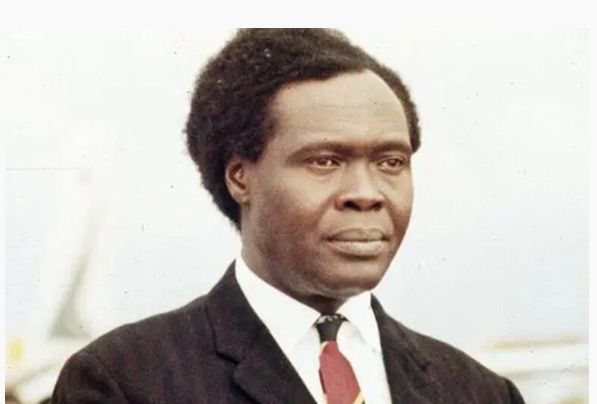
Image: Dr. Apollo Milton Obote. Former Primer Minister and first Executive President of Uganda.
The 1956 Uganda Law Society, Act, Cap 305, chained lawyers in Pharaoh’s brick yard, crushing their independence and autonomy by imposing state law officers, the Attorney General and Solicitor their governing council. This effectively led to state capture, aligning the legal profession with the colonial power’s interests instead of advancing the rights of the colonized peoples. The 1970 Advocates Act, Cap 295 further entrenched the chains: the Law Council, chaired by a judge who is appointed by the Attorney General after consultation with the Chief Justice. Other state law officers, the Solicitor General, a Chief Magistrate and only 3 lawyers, their president, and 2 others elected by them, a token of independence. Yet this substantially unelected group of powerful officials controlled eligibility, Bar exams, and disciplinary powers.
The initial denial of Martha Karua a temporary license by the Ugandan Law Council and the reasons which it gave should tell you my dear reader everything else you need to know about the state of the independence of Uganda’s Legal Profession.
“Independence and autonomy for the lawyers remained but only a cruel mirage.”
The Global Commandment: Let My Lawyers Go!
In 1990, the UN Congress in Havana thundered: the Basic Principles on the Role of Lawyers, echoing Exodus 5:1“Let my lawyers go!” Principle 24 demanded self-governing, autonomous professional associations.
The International Bar Association’s Standards echoed this, decreeing in Article 17 that lawyer associations must be independent, their councils freely chosen without state interference. Article 18 makes this crystal clear:
“The functions of the appropriate lawyers’ association in ensuring the independence of the legal profession shall be inter alia: (h) to promote a high standard of legal education as a prerequisite for entry into the profession and the continuing education of lawyers, and to educate the public regarding the role of a Lawyers’ Association.”
Again, to the village Barraza, let me break this down into what my “A” Level economics teacher, Mr. Stanley Lukera, taught us, the “grandmother’s approach”: the Uganda Law Society, whose leaders are elected by the members, the lawyers themselves, must be the body responsible for setting academic standards for entry into the legal profession. That means setting and/or advocating for high-quality law school curricula, Bar exam requirements, or other qualifications before one can serve as an advocate.
Yet Uganda’s Pharaoh only sneered. The Law Council and ULS Act stood firm, chaining lawyers to state whims. The village Barraza waited for defenders, but lawyers, bound by Pharaoh’s overseers, could not rise.
The People’s Covenant Ignored
In 1995, Uganda’s people, the ultimate consumers of justice, struck a covenant in their Constitution. National Objectives and Directive Principles of State Policy, Paragraphs II(vi) and V(ii) XX declared that non-governmental bodies like the Uganda Law Society (ULS) must retain autonomy to champion human rights, their independence guaranteed by the state. Five years after the UN and IBA commandments, the people demanded their lawyers be freed to hold power accountable, to defend Mityana widows from land grabs, Soroti youths from unjust arrests, Mbale vendors from cheating landlords.
But Pharaoh’s heart hardened, as in Exodus 8:15. The state clutched the legal profession tighter, wielding the Law Development Centre (LDC) as its slave-pit. With nearly 20 universities churning out law graduates, LDC remained the sole gatekeeper of the Post-Graduate Diploma in Legal Practice, its infrastructure crumbling under the weight. Pre-entry exams, meant to manage capacity, became another lash, while quality control at universities was a paper tiger.
Supplementary exam fees bled students, parents, guardians, spouses, boyfriends, and sugar daddies dry in millions of shillings for a second chance at Pharaoh’s mercy. Then came the tenth plague, the killing blow: in 2024, LDC barred over 1,500 qualified applicants from the Bar Course, admitting only 1,260 of 2,600, citing “limited resources”. Like the death of Egypt’s firstborn in Exodus 11:1-10, this was no mere setback; it was a massacre of futures, a cry that pierced the heavens.
“Law Council’s block was arbitrary and irrational.”
The court quashed the ban, imposed permanent injunctions, and awarded 20 million UGX each. This blog is dedicated to among others, these courageous lawyers who walked through Pharaoh’s furnace and are now fine practicing Advocates.
Even public figures were not spared: Kyagulanyi Robert Ssentamu Alias Bobi Wine’s Cavendish University degree faced state scrutiny pre-graduation, proof Pharaoh’s heart hardens even against the popular. The musician turned leader of the National Unity Platform (NUP), Uganda’s largest opposition political party told members of the press shortly after his graduation that “When news came out that I was set to graduate, the usual detractors got busy and made every effort to stop me,” he said. “Some people, ostensibly working for the regime and other detractors, went as far as petitioning the National Council for Higher Education.” He added “NCHE officials went to the University and demanded for every document regarding my studies… It was a very detailed and intense investigation,
Pharaoh’s Whip extends beyond Law, it bites real flesh.
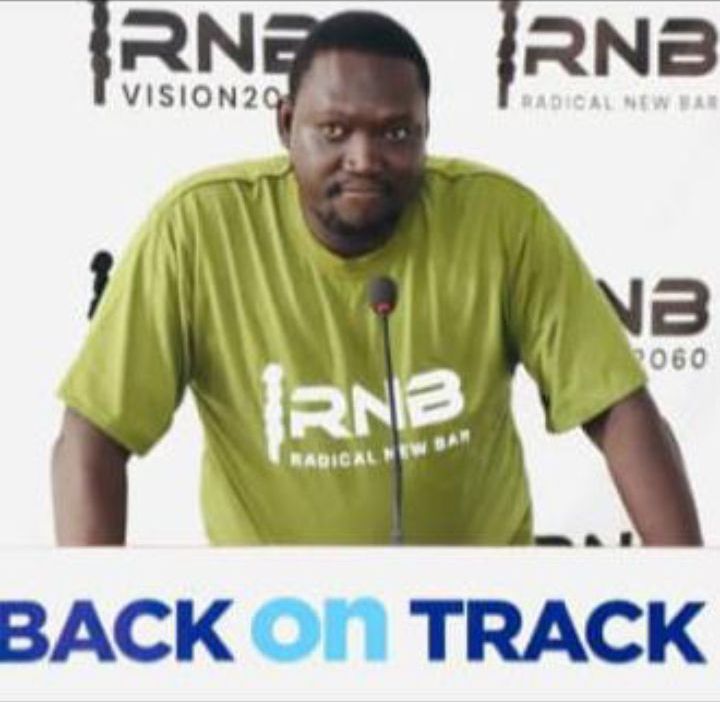
Pharaoh’s tyranny isn’t just legislative—it’s flesh and blood. At the 20th #RNBLive Series, Yours truly had the lived experience of delivering the speech of the ULS President Isaac K. Ssemakadde’s speech. A copy of that speech is attached and A video of it is also attached. The modern Aaron, spoke fire:
“Advocate Abed Nasser Mudyobole… forcibly disappeared by state security. His abduction echoes the tyranny that hunted Njuba, Kayondo, Sebutozi, Ayigihugu. Lawyers who defend the Constitution, who question power, are enemies to be silenced.”
Author delivering the speech of the ULS President Isaac K. Ssemakadde on 29th May 2025 at the ULS House, Kampala.
The courts shackle ULS blocking meetings (Kirima v ULS, 2024), Halting lawyers Constitutional voices at the Judicial Service Commission with appeals arising thereform under perpetual abeyance decisions (Mugisha v ULS), sentencing ULS President Isaac Ssemakadde in February, 2025 for criticizing a judge.
Bakampa: Vision for Job-Ready Lawyers
From LDC’s ashes rose Bakampa Brian Baryaguma. His Legal Education and Training Bill 2024:
“No more paying twice for one loaf. Lawyers ready to defend the people.”
National Legal Examinations Centre Bill 2025: Red Sea or New Shackles?
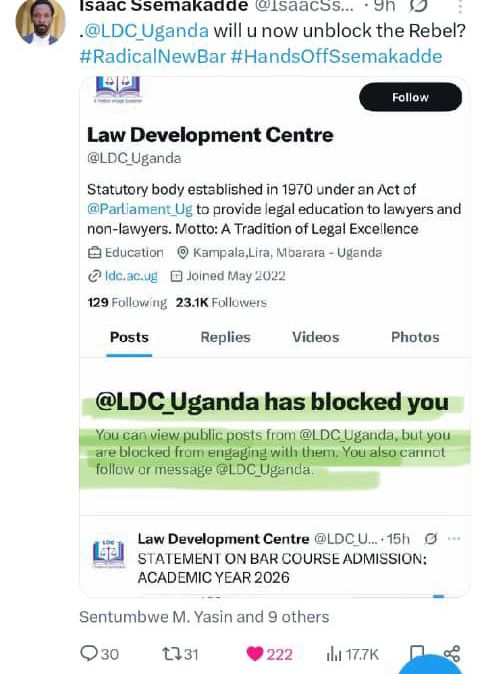
ULS President Isaac K. Ssemakadde, mirroring Moses and Aaron, long campaigned against LDC. He demanded that it be abolished way back in 2021 in his address to Law Students at Makerere University. In what appeared to be a fit of rage, LDC reacted by blocking Ssemakadde on its X handle.
When news broke out that Cabinet had drafted the National Legal Examinations Centre Bill, 2025, the Radical New Bar President asked on whether LDC will unblock him?
Image: Isaac K. Ssemakadde asked if LDC would unblock him after the bill proposing its abolition as he had suggested was made public by the Solicitor General. Credit, Isaac Ssemakadde’s X (formerly Twitter handle)
The bill proposes to free the Post Graduate Bar Diploma in Legal Practice from LDC, and shut it down completely, but Pharaoh’s hand still grips:
Attorney General, a cabinet minister and political appointee, appoints Director of the center on the recommendation of the governing council & the chairperson of the governing Council itself (Clauses 17 and 8 respectively). This erodes the corporate governance principles in Clause 19 of the Bill.
The Attorney General can remove council members, set rules, and determine fees for services of the centre
The risk of elite and exclusionary political capture remains real. The ghosts of exorbitant fees, especially supplementary Examinations which sucked all stakeholders dry, should not be allowed to lurk after abolition of LDC.
“The legal profession stands at the Red Sea. Will it walk through freely or be recaptured?”
Call to Arms: Strike the Red Sea!
To defend justice, rights, and the Rule of Law, the following MUST BE DONE NOW to prevent lawyers from being captured and tamed “young” and moulded into frightened cowards who cannot foster accountability.
1. Let the ULS Command– ULS and not a state law officer should appoint the NLEC Director & Council.
2. Skills Fuse – Bakampa’s model in university curricula: drafting, moots, clerkship. The doctors and engineers have proven that you don’t need to pay twice for the same loaf.
3. Fees Free; The Council should retain a higher autonomy to set fees and, in collaboration with ULS, set academic and examination criteria and standards
A group of lawyers trained through fear, intimidation, and heavy involvement of state law officers loses the courage to fight for the Mityana widows, Soroti youths, and Mbale vendors: lawyers must rise bravely and fearlessly. The rule of law suffers gravely, and so does the effective functioning of the justice system as a whole.
Strike the Red Sea! Free ULS! #LetMyLawyersGo
“Pharaoh may harden his heart, but justice and truth can’t be enslaved forever.”
You, dear reader, should participate heavily in freeing your rights defenders, call up the big people you know, Your area member of parliament, your Dean, faculty of Law, your ULS region’s Council member and demand that “they strike the Red Sea” and implement these recommendations so that your rights defenders, the lawyers gain full autonomy and independence.
#Strike the Red Sea!
#Let My Lawyers Go!
This Blog is dedicated to the fearless champions of a better legal education and a better legal practice regulation in Uganda. Bakampa Brian Baryaguma, the author of the Legal Education and Training Bill who personally granted me the copyrights to quote his works extensively. His journey in the struggle has been chronicle by him on his personal Blog at https://huntedthinker.blogspot.com/https://huntedthinker.blogspot.com/?m=1. I strongly encourage readers to visit his Blog and support his rallying call for members of the Public to contribute views on his bill which is attached:
President of Uganda Law Society, Isaac K. Ssemakadde for prophesying the eventual shut down of LDC, being blocked by the same institution on X (formerly twitter), expelling the Attorney General and Solicitor General from the governing council of the ULS via RNB Executive Order No. 1 of 2024 and earlier on filing a Constitutional Petition, which canvases the international law framework that has been presented and is still pending judgment by the Constitutional Court. My personal prayers are with you as you endure the pain of self exile for tackling the challenges of the legal profession from the root cause. May the good Lord protect you and touch the justices of the Constitutional Court for a just decision.
This blog is further dedicated to the lawyers who engaged the legal system in the journey to reform the legal system, namely Pius Nuwagaba, Asiimwe Alex Byaruhanga, and his 12 colleagues for challenging the Law Council head on. Your struggles curated this milestone and led the legal profession, especially intending Advocates to now arrive at the Red Sea, waiting to strike the waters to open up the sea, to cross and permanently ensure the independence and full autonomy of the Legal Profession.
Finally, each and every lawyer, member of the public who added embers to the revolutionary fire to free the legal profession, parents, Judges who rendered justice, you all stood on the right side of history, may God bless you.
Enen Ambrose, the author, is an Advocate and member of the inaugural Judicial Affairs Committee of the Uganda Law Society.
DISCLAIMERS!
This blog is intended to spark discussions around the current National Legal Education Centre Bill 2025. References to individuals and institutions are based on publicly reported developments and not meant to attack individuals or institutions mentioned directly.
Nothing in this Blog is intended for use as legal advice. Author accepts no liability for use of the contents herein as legal advice. Readers are advised to seek the services of a licensed Advocate for situation specific legal advice.
For comments and feedback, reach to us at ambrosenen@gmail.com


 enenlegalworld