
Tag: Misogyny

  • EPISODE 1: THE LEGEND OF ABONGODERO

    EPISODE 1: THE LEGEND OF ABONGODERO

    Enen Legal World Logo


    There is a village called Abongodero. Abongodero means without a granary.

    The villagers named it after Mzee Zakayo’s ingenuity.

    Zakayo was clever. He never built a granary of his own. Instead, he raised cattle, fat bulls, glossy heifers. When hunger season approached, he would walk to a farmer whose granaries groaned with millet and offer a bull in exchange for rights to a certain number of storehouses. Enough to feed his household. Enough to impress the neighbors.

    The arrangement was sealed with a handshake. Everyone knew Zakayo’s cattle. Everyone knew he paid.

    The villagers admired him.

    “..Look at Zakayo!..”they whispered around evening fires. “He eats from granaries he never built!

    They admired him so much that they named the village after his ingenuity.

    Abongodero.

    A photo of a granary.  Credit. Uganda Today: from article: A testament to tradition: the art of grain in Uganda’s homesteads by Chris Kato.

    But abundance has a wicked sense of humor.

    Zakayo’s children grew up knowing which families owed them food, which granaries bore their father’s mark. They inherited cattle, but not discipline. They inherited the right to eat, but not the wisdom to plant.

    One of them was Okello Anyapo.

    Anyapo. The lazy one.

    Okello inherited land so fertile it blushed when rain touched it. Black soil. Generous soil. Soil that would have yielded harvests his grandfather never imagined.

    But his hoe remained smooth. His fields grew weeds tall enough to vote.

    When hunger came, Okello blamed the sun for burning too bright. He blamed the rain for falling too hard. He blamed the ancestors for not speaking loudly enough. He blamed everyone except his idle hands.

    Across the stream lived Owera Apur.

    Apur the Farmer.

    He did not give speeches about productivity. He simply woke before the rooster finished its gossip. He dug. He planted. He weeded. He waited. His granary stood behind his hut like a quiet monument to repetition.

    He had no cattle to trade. He had only his back, his hands, and his patience.

    His granary stood full.

    Proof that the land was never the problem.

    Then hunger came like a leopard.

    The families who once owed Zakayo’s children had rebuilt their stores. They no longer needed cattle. They needed their millet for themselves.

    Okello’s inheritance could not be traded for what no one would sell.

    Hunger clawed him thin.

    He crossed the stream.

    “Uncle,” he said. “We are blood. Remember Father Zakayo? The village bears witness to his name.”

    In Lango, dignity comes before shame. Owera sighed. He looked at his granary—full from seasons of sweat.

    He opened the door.

    Enter,”he said. “Take what you need.”

    Not ownership. Not supervision. Not rules.

    Just access.

    Okello entered empty and emerged round.

    He returned the next day. And the next. Soon he stopped pretending to farm at all.

    Why sweat when sacks yawn open?
    Why ration when no one counts?
    Why plant when the granary door never closes?

    By planting season, Owera opened his store to prepare for the rains.

    It echoed like a drum.

    Empty.

    When confronted, Okello adjusted his waistband and smiled.

    You allowed me.
    There were no rules.
    “I merely accessed.”

    And that is how Abongodero learned what their ancestors should have known:

    You never send a starving man to the granary.

    [End of Episode 1]

    Stay tuned and on the look out for Episode 2 of the legend of Abongodero. 
  • Dr. Solo vs The Feminist Furies: How One Tweet Cut Through Fibroids, Free Speech, and Misogyny

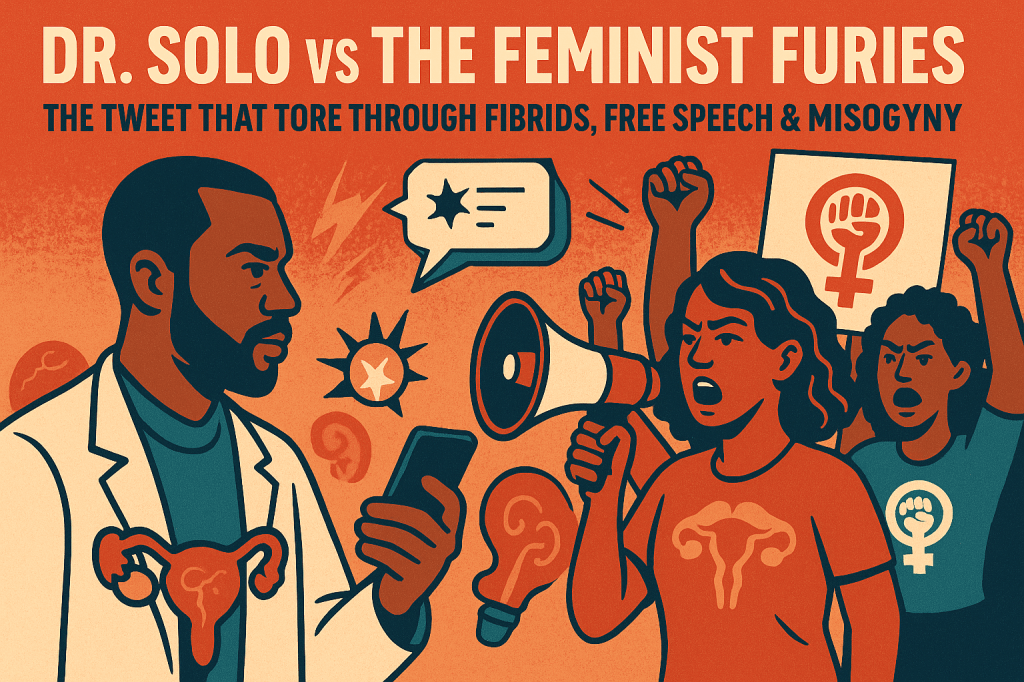
    Dr. Solo vs The Feminist Furies: How One Tweet Cut Through Fibroids, Free Speech, and Misogyny

    When Dr. Solomon Kimera logged onto Twitter that morning, stethoscope probably still warm from ward rounds, he didn’t just post—he detonated.

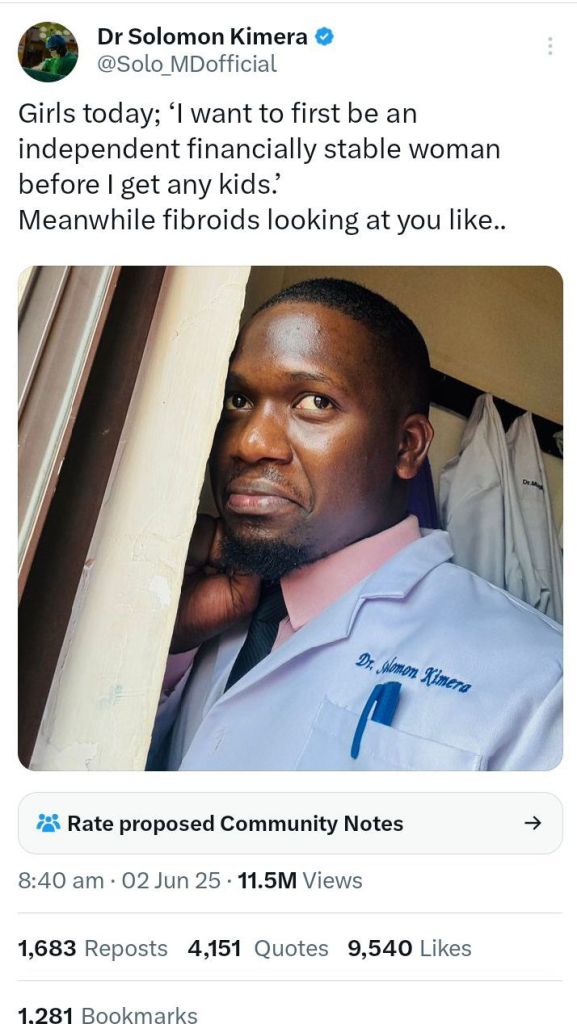
    One tweet about fibroids. Another swipe at tight pants and infertility. That was all it took.

    Credit: Dr. Solomon Kimera’s X(formerly Twitter) post on his handle.


    Boom.

    Searches for “fibroids” surged. Men quietly retired their skinny jeans. Women hit the group chats first, then stormed clinics, fists full of questions. The Uganda Medical Council blinked. Then it panicked.

    The backlash was volcanic. Petitions. Think-pieces. Firestorms of quote tweets yelling “misogyny!” and “strip his license!”

    But something strange was happening in the noise. Beneath the outrage, something cracked open.

    Because if Uganda starts policing how doctors speak—even when they sound like trolls—it’s not just Dr. Solo’s voice on the line. It’s the Constitution’s, too.

    Uganda’s Article 29(1)(a) wasn’t crafted to protect polished speeches in well-lit auditoriums. It’s there for the street fights. For the blunders. For the provocateurs.

    Back in 2004, Charles Onyango-Obbo v. Attorney General reminded us that true freedom of expression includes the right to shock, offend, and disturb.

    You can access a copy of that judgment here:

    Not just the right to say things people agree with—but the right to spark discomfort.

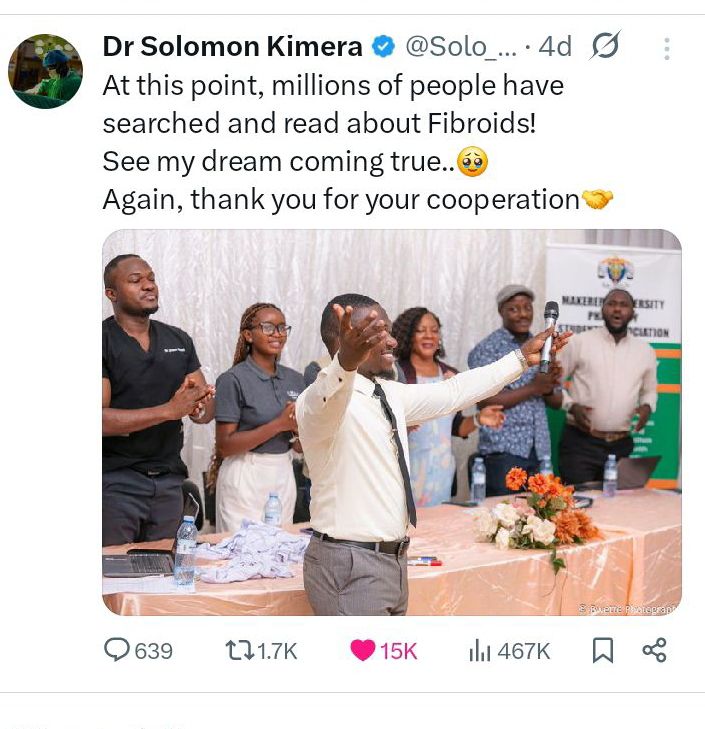
    By that measure, Dr. Solo’s tweet wasn’t just protected—it was a public health campaign. It was a major public health intervention that no health ministry, world over has achieved with the highest budgetary  allocation and human personnel muscle can achieve.  It least, judging from history.

    Credit: Dr. Solomon Kimera alias Dr. Solo’s X (formerly Twitter) post, which indicted a massive success of his radical method of delivery health concerns.


    Still, legal protection doesn’t mean emotional immunity. Especially not for the women silently bleeding through extra pads at work, miscarrying dreams they never told anyone about, misdiagnosed by doctors who didn’t bother to look deeper.

    So yes, his tone was brutal. Clinical. Even smug. But for some, it was the first time fibroids had been acknowledged in public—not as a whisper, but as a national scream.

    Because before this, fibroids were the disease of euphemisms.

    Just “that pain.” Just “heavy flow.” Just something women dealt with.

    And then one loud, reckless doctor barged into the room with no filter and said what nobody else would.

    Ugly, yes. But effective.

    That kind of disruption—messy, jarring, necessary—is often where real change begins. Hell yes. Hippocrati’s oath binds doctor to treat you, save your life. That’s granted. The oath doesn’t bind the medics to decorum per se.

    True feminism doesn’t need everyone to speak gently. It needs people to speak honestly. And if we start silencing dissent because it doesn’t sound like a TED Talk, we’re just building a quieter version of the same old oppression.

    Doctors aren’t priests. They’re not politicians. They shouldn’t be expected to sugarcoat clinical truth just to stay “professional.”

    If polite pamphlets and decroum protocols worked, fibroids wouldn’t still be Uganda’s shadow epidemic—affecting nearly 20% women, many of them untreated, misdiagnosed, or dismissed.

    To verify these figures,  at least for the Ugandan context, read here

    This isn’t about defending one man’s ego. It’s about defending the right to say uncomfortable things that might save lives.

    So maybe instead of cancelling Dr. Solo, we do something harder.

    We ask: Why did this tweet land so hard? Why aren’t women being listened to unless someone shocks us into hearing them?

    Then we turn that chaos into something real:
    – Fund public education.
    – Train doctors to listen, not just lecture.
    – Create space where pain isn’t minimized by decency codes.

    We don’t need fewer voices. We need louder ones—with better tools, better data, and better empathy.

    One rogue tweet woke up a country. Imagine what a thousand coordinated voices could do.

    Maybe he was reckless. Maybe he was rude. But maybe, just maybe, he struck a nerve we’d been ignoring too long.

    Say what you want about the man. Just don’t pretend this didn’t matter.

    Fibroids are finally on the national radar. And it took a troll doctor with Twitter fingers to get us there.

    The author is a Rule of law enthusiast,  a practicing Advocate in Ugandan Courts of Judicature, a free speech Advocate and a member of the inaugural Judiciary Affairs Committee of the Uganda Law Society.

    Disclaimer: The author does not endorse or encourage misogyny and other forms of violation of women’s rights.  The views expressed here are purely to spark public discourse and public health awareness drives for the greater good of the whole society,  women inclusive.

    The Blog is for purely public discourse and is not intended to serve as a substitute for professional legal advice.

    Readers are strongly encouraged to seek the services of professional legal personal for situation specific advice. No liability is accepted for harm that arises from using information contained in this Blog as a substitute for professional legal advice.

    Do you have comments or feedback for us, please leave them in the comment section or reach out to us at: ambrosenen@gmail.com  | 256 789856805