Category: Employment Law

  • Chronicles of His Worship Mulyanyama — Episode 3

    Chronicles of His Worship Mulyanyama — Episode 3

    When “Just Cause” Entered the Registry


    Author’s Note: The Chronicles of His Worship Mulyanyama is a serialized literary commentary designed to constructively critique the institutional and structural implications of the Magistrates Courts (Amendment) Act, No. 6 of 2026. This work is a creative exploration of the human infrastructure behind public service and is not intended to ridicule, embarrass, or undermine the integrity of the Judiciary.

    The brown envelope had not lied.

    TRANSFER OF FILES – FOR JUST CAUSE.
    No explanation. No appeal. Just a signature from the Chief Magistrate and a list of file numbers.

    Among them: File No. 43. The twins fighting over cassava. Imat Nekolina’s envelope. Ocen Okello’s breach of contract case for the supply of beans to Kec Primary School.

    All of them, transferred. To whom? For what reason? The envelope did not say.

    Mulyanyama set the letter down. He did not call the Chief Magistrate. He simply stared at his phone.


    Counsel Ogwang Adede woke before sunrise.

    He had spent 200,000 shillings on fuel the previous evening – a calculated investment. Today, he would drive from Lira to Omwonyo‑le for Ocen Okello’s case. Four years of beans. Four years of adjournments. Today, he would close the defence under Order 17 Rule 4.

    He checked his phone.

    A message from the headmaster: “Fees balance remains. Your son cannot sit exams.”

    He silenced it. First, court. Then fees.


    Then he opened the Lira High Court WhatsApp group.

    NOTICE: The Honourable Judge will not sit this week. He has been deployed to Omwonyo‑le for a donor‑funded SGBV session. All matters stand adjourned.

    He refreshed. The Omwonyo‑le Magistrates Court group had a new notice:

    NOTICE: His Worship Mulyanyama has been designated Registrar for the forthcoming SGBV session. Additionally, a donor‑funded plea bargaining session will run for two weeks. No judicial officer will be at Omwonyo‑le during this period.

    He scrolled further.

    UPDATE: All other magistrates and the Registrar have travelled for a Judiciary conference. Only those excused for donor conditionalities remain in session.

    Counsel Ogwang Adede stared at the screen.

    In Lira – no Judge.
    In Omwonyo‑le – no Mulyanyama.
    No Magistrate. No Registrar. No court.
    Two weeks.

    He had spent 200,000 shillings on fuel. But that was not the worst of it.

    That morning, he had been expecting a deposit of 30,000,000 shillings in taxed costs from a judgment debtor – Okullo Aram. The matter was coming up for Notice to Show Cause before the Registrar of the High Court in Lira. Okullo had called last evening, panicking, begging not to be thrown into civil prison. He was prepared to deposit the money in front of the Registrar.

    Then Okullo sent a message: a photo of a notice from the Registrar’s chambers. The Registrar had travelled to Kampala overnight – for a donor‑funded workshop on case management.

    After sending the notice, Okullo’s phone went silent.

    Counsel Ogwang Adede called back. Twice. Three times. Nothing.

    Later, he learned that Okullo Aram had five children in university and three in secondary school. The money that was meant for taxed costs had been redirected – to tuition fees, to accommodation, to books.

    The debtor had not fled. He had simply reprioritised. And the law could not touch him – because the Registrar was not there to hear the Notice to Show Cause.

    His clerk’s salary would wait.
    His legal assistant’s salary would wait.
    The headmaster’s message about his son’s exams would not wait.


    Then his firm WhatsApp group buzzed.

    A calling letter. From His Worship Munyakuzi, Chief Magistrate of Oneka Iden – the Chief Magisterial area under which Omwonyo‑le fell.

    TRANSFER OF FILE – FOR JUST CAUSE.
    On the court’s own motion, Ocen Okello’s case is transferred to my court for hearing.

    No application from any party. No consent. No explanation.
    Just just cause.

    Counsel read it twice. His hands did not shake. They had done this before.


    Mulyanyama had also seen the letter.

    He picked up his phone and called Munyakuzi.

    “Sir, with respect… those are live matters. Judicial independence –”

    A pause. Then Munyakuzi laughed.

    “Worship, did you not read Section 217A of the amendment? I have powers to transfer those files to my Court.”

    The line went dead.

    Mulyanyama stared at his phone. The ground at Omwonyo‑le had swallowed an axe. Now the law was swallowing itself.


    Ocen Okello did not learn about the transfer from a noticeboard.

    He learned it from Alyek Molly.

    He had not even reached the bank. His Boxer motorcycle was still coughing dust somewhere between Abako and Oneka Iden when his phone vibrated.

    He smiled when he saw the name. Alyek Molly – Registry. He answered immediately.

    “My daughter… how is today?”

    For a second, Alyek said nothing. Then her voice came – soft, tired, almost apologetic.

    “Mzee… don’t come to court.”

    Silence.

    “I have already told your lawyer.”

    Ocen slowed the motorcycle. “What now?”

    Alyek looked through the registry window before answering. “His Worship has two critical assignments.” She lowered her voice. “He has been designated Registrar for the SGBV session… and after that… another plea bargain project. Two hundred files. Fifteen days.”

    Ocen said nothing.

    Alyek swallowed. “Mzee… save your fuel.”

    The line went dead.


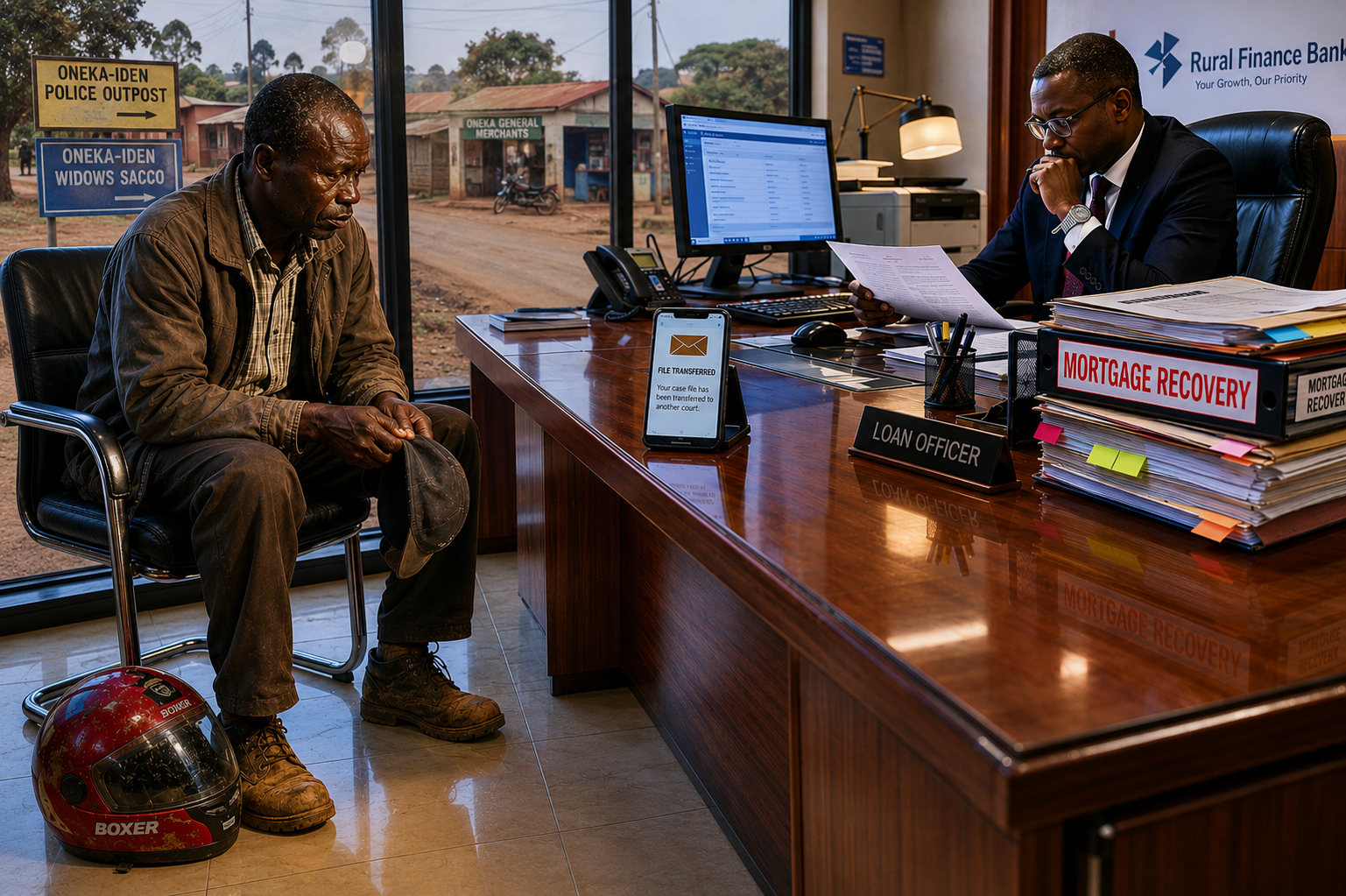
    Forty minutes later, Ocen Okello sat inside the office of the loan officer.

    Tie. Ledger. Calculator. No smile.

    The file marked MORTGAGE RECOVERY – FINAL NOTICE lay open on the desk.

    Ocen removed his cap. Held it in both hands. And began pleading.

    “Sir… please do not sell my house.”

    He swallowed. “The case is very near judgment, I promise.”

    The loan officer said nothing. So Ocen continued.

    “My lawyer says… no more than one month.”

    He pointed weakly toward Omwonyo‑le. “The court has some delays… delays I do not fully understand… delays I cannot even explain properly…”

    Just then – his phone vibrated again.

    This time, Counsel Ogwang Adede.

    He opened the message.

    Brown envelope. Three words.

    TRANSFERRED FOR JUST CAUSE.

    Ocen read it once. Read it twice. Then slowly looked back at the loan officer… and for the first time in four years… did not know which debt was more dangerous – the one inside the bank, or the one inside the court.


    By lunchtime, Omwonyo‑le was already whispering.

    The new Chairperson of the School Management Committee of Kec Primary School – the same school that had eaten Ocen Okello’s beans – was an old boy of Chief Magistrate Munyakuzi.

    In Omwonyo‑le, rumours travelled faster than judgments.
    And this rumour had teeth.

    “He is willing to vouch for his old buddy,” Alyek Molly heard from a clerk in Oneka Iden. “To save the school from an old crippling debt.”

    Alyek said nothing. She was still calculating her mother’s medication. Friday’s tuition. The per diem that would now not come.


    That evening, Mulyanyama sat in his rented room above the pharmacy in Oneka Iden.

    The brown envelope still lay on the table.
    Open. Unfolded. Unanswered.

    The names stared back at him.
    Imat Nekolina. Ocen Okello.
    Four years. Red ribbons. Borrowed fuel. Dead witnesses.
    Transferred. For just cause.

    His phone vibrated.
    Counsel Ogwang Adede.

    Mulyanyama stared at the screen for two rings. Then answered.

    No greetings. Just breathing.

    Then Counsel spoke.

    “Worship… what is going on?”

    Silence.

    “What happened?”

    Another silence. Then the question that hit harder than any objection ever raised in court:

    “Who complained?”

    Mulyanyama looked again at the brown envelope. Then at the ceiling. Then finally spoke. Quietly. Almost apologetically.

    “Counsel… I honestly have no idea.”

    A pause. Then –

    “Just orders from above.”

    Neither man spoke again. For a few seconds, all that remained between lawyer and magistrate was breathing.

    Then the line went dead.

    And for the first time since the amendment, His Worship Mulyanyama realised something far more dangerous than corruption:

    Sometimes a file is not stolen. Sometimes… it is simply called upward.


    Before you blame a magistrate for “delayed justice”… ask two questions:

    Who funded the last special session in your court? And how many times has a file been transferred – without your consent – “for just cause”?

    The system is not broken.
    The system is fully booked.

    Enen Ambrose

    Advocate

    Member: Judiciary Affairs Committee

    Uganda Law Society,

    For feedback or comments: enen@enenlegalworld.com

    If you missed the start of this journey, you can catch up on the systemic breakdown of the Magistrates Courts in Chronicles of His Worship Mulyanyama — Episode 2

    Legal Disclaimer Fiction & Non-Defamation Notice:

    This post is a pure work of fiction and creative literature. The characters, dialogue, specific incidents, and settings—including the character of His Worship Mulyanyama and the location of Omwonyo-le Magistrates Court—are products of the author’s imagination or are used fictitiously. Any resemblance or exact matches to actual persons, living or dead, real-life judicial officers, or specific ongoing cases is entirely coincidental. This text is created solely for the purpose of systemic legislative critique and systemic advocacy; it is not maliciously constructed, nor should it be interpreted as an attempt to defame, misrepresent, or malign any living individual or public office holder.

    The legal references in this Series is for information purposes only and is not intended to be used as a substitute for legal advice. The author does not assume responsibility or admit liability arising from the use of the contents of this blog as legal advice.

    The author strongly encourages readers to consult a licensed attorney for specific context related legal advice.

    FUEL THE MOVEMENT

    Independent institutional critique and advocacy for a radical overhaul of legal culture require time, deep research, and uncompromised independence. If these narratives bring value to your legal journey or challenge your perspective, please visit our HOME PAGE to see how you can support this platform directly and keep the critique fierce and relentless.

    Enen Ambrose. Advocate & Founder–Enen Legal World


  • Chronicles of His Worship Mulyanyama — Episode II

    Chronicles of His Worship Mulyanyama — Episode II

    The Mobile Court That Ate the Diary


    Author’s Note: The Chronicles of His Worship Mulyanyama is a serialized literary commentary designed to constructively critique the institutional and structural implications of the Magistrates Courts (Amendment) Act, No. 6 of 2026. This work is a creative exploration of the human infrastructure behind public service and is not intended to ridicule, embarrass, or undermine the integrity of the Judiciary.


    At 9:43am, the white Land Cruiser rolled into Omwonyo‑le.

    Nobody looked surprised.
    Not the warders.
    Not the litigants.
    Not even His Worship Mulyanyama.

    Only Alyek Molly looked up from the registry.

    She had not been paid in three months.

    That morning, before leaving home, she had crushed her mother’s last blood‑pressure tablet into halves – so it could survive two more days.

    Her tuition at Kampala International University (Mbale campus) was due on Friday. Second year, Bachelor of Laws. She still kept her old Diploma in Law transcript folded inside her registry drawer – next to unpaid electricity receipts.

    When she saw the Land Cruiser, she did not smile.
    But her shoulders relaxed. Just a little.


    The memo was short. Cold. Typed.

    “All ordinary cause‑list matters stand adjourned pending implementation of the Mobile Justice Outreach Session.”

    Fifteen days.


    Ocen Okello closed his eyes.

    Four years.
    Four.
    Not because his case was difficult.
    Because the defendant – a government primary school – had failed to bring its final two witnesses. Again.

    The first adjournment: His Worship Mulyanyama had been away at donor‑funded SGBV training.
    The next three: the school simply came empty‑handed. Each time, the defence begged. Each time, His Worship adjourned – in the interest of justice.
    Each time – no costs.

    Counsel Ogwang Adede had financed this trip from Lira by himself.

    This time, his client simply could not raise it.

    Not because he did not want justice.
    Because justice was competing with school fees.

    With last month’s Bolicap debt – the money he had borrowed to bring both himself and counsel to this same court… for a hearing that never took off.

    With the money still owed to Okello Ajing, who had rescued him that same morning when every other door had gone silent.

    With sugar.
    With paraffin.
    With soap.

    And somewhere inside that collapsing arithmetic… sat the question of whether justice was becoming more expensive than the debt he had come to recover.

    So Counsel Ogwang Adede came anyway.
    On his own fuel.
    On his own time.
    On his own thinning patience.

    And on the dangerous assumption… that today, after four years, somebody inside Omwonyo‑le would finally be ready to finish a case.

    Today, Counsel Ogwang Adede had come ready – not prepared to swallow one more adjournment dressed as “the interest of justice.”

    He had the court file under one arm.
    His diary in the other hand.

    And in the margins of his notebook – authorities, annotations, and one final prayer:

    Order 17 Rule 4 of the Civil Procedure Rules.

    Close the defence.
    Take oral submissions.
    Fix the matter for judgment.

    Four years was enough.

    Today he had not come to negotiate with delay.
    Today… he had come to end it.

    Then Alyek Molly pinned the memo.
    And nobody entered Court No. 2.


    Imat Nekolina did not understand the white car.

    She only knew that her case was not today. Again.
    She approached Alyek Molly. “When?”

    Alyek shrugged. “After the mobile court.”

    “My witness,” Imat said quietly, “the doctor says he has less than fourteen days.”

    Alyek said nothing. She had heard this before too.
    But her mind was already calculating: fifteen days of per diem. Enough for her mother’s medication. Enough for Friday’s tuition.
    She did not wish for the donor to come. But she could not afford to wish otherwise.


    Mulyanyama watched from his chambers.

    He saw Counsel Ogwang Adede standing on the cracked steps – file, diary, notebook – the oral application still just a prayer in his head.
    He saw Imat Nekolina’s face.
    He saw Ocen Okello kick his Boxer motorcycle back to life – and ride away without looking back.

    The Visitor was already inside Court No. 1, setting up his laptop.

    The donor had paid for fifteen days.
    Per diem. Transport. Lunch allowance.
    Enough… to make resistance expensive.

    That evening, Mulyanyama texted a friend:
    “They call it access to justice. I call it access to their priorities.”

    The friend replied: “Did you eat?”

    Mulyanyama did not answer.


    Before you blame a magistrate for “delayed justice”… ask two questions:

    Who funded the last special session in your court? And how many times did the government defendant adjourn without cost?


    Two days later, another envelope arrived.

    Not white.
    Brown.
    Government brown.

    The subject line read:

    TRANSFER OF FILES – FOR JUST CAUSE.

    Mulyanyama read it once.
    Read it twice.

    Then looked at his phone.

    One message waited.
    Just three words.

    Did you eat?


    Institutions are not always captured by force.
    Sometimes… they are rented.
    One allowance at a time.

    Enen Ambrose, Enen Legal World

    Member: Judiciary Affairs Committee

    Uganda Law Society

    Enen Legal World.

    For Feedback or comments: enen@enenlegalworld.com


    Legal Disclaimer

    Fiction & Non-Defamation Notice:

    This post is a pure work of fiction and creative literature. The characters, dialogue, specific incidents, and settings—including the character of His Worship Mulyanyama and the location of Omwonyo-le Magistrates Court—are products of the author’s imagination or are used fictitiously. Any resemblance or exact matches to actual persons, living or dead, real-life judicial officers, or specific ongoing cases is entirely coincidental. This text is created solely for the purpose of systemic legislative critique and systemic advocacy; it is not maliciously constructed, nor should it be interpreted as an attempt to defame, misrepresent, or malign any living individual or public office holder.

    The legal references in this Series is for information purposes only and is not intended to be used as a subtitute for legal advice. The author does not assume responsibility or admit liability arising from the use of the contents of this blog as legal advice.

    The author strongly encourages readers to consult a licensed attorney for specific context related legal advice.

    If you missed Episode 1 of this series, You can access it here: Chronciles of His Worship Mulyanyama Episode 1


  • Chronicles of His Worship Mulyanyama — Episode I

    Chronicles of His Worship Mulyanyama — Episode I

    The Magistrate Who Never Carried Lunch

    Enen Legal World Logo

    Author’s Note: The Chronicles of His Worship Mulyanyama is a serialized literary commentary designed to constructively critique the institutional and structural implications of the Magistrates Courts (Amendment) Act, No. 6 of 2026. This work is a creative exploration of the human infrastructure behind public service and is not intended to ridicule, embarrass, or undermine the integrity of the Judiciary.

    At 7:45am, His Worship Mulyanyama was nowhere near court.

    He sat inside a parked Judiciary double‑cabin pickup, forty kilometres from Omwonyo‑le Magistrates Court. Engine off. Air dead. Phone in hand.

    Battery: 19%.

    Bank balance: not enough.

    Fuel gauge: hovering just above E – the dangerous place where public service stops being transport… and becomes theology.

    On his screen: Mo‑kash. Wewole. ManguCash. Ka‑Sente.

    Four lenders. Four rejections. One salary.

    He had not yet started the engine. Because before justice could move, fuel had to move first.

    So he made another call. Not to a litigant. Not to a lawyer. To a friend.


    His Worship Mulyanyama making calls to top up his fuel before setting off for work.

    By 10:06am, the double‑cabin rolled into Omwonyo‑le.

    The benches were already full.

    Imat Nekolina had walked three kilometres from her village, a faded manila envelope pressed against her chest. Inside: a death certificate, two handwritten land agreements, and a photograph of six goats – the only things her late husband had left behind. She had been coming to court since 2022. This morning, she left cassava unharvested. Again.

    Ocen Okello had kicked his Boxer motorcycle until it coughed to life. Four years earlier, he supplied beans to a government primary school. Class One children had become Class Five. Two headteachers transferred. One bursar retired. The beans had long been eaten – but Ocen had never been paid.

    Yesterday, after every friend with a smartphone suddenly became “busy”, and every relative promised to “call back”, Ocen borrowed his advocate’s transport facilitation from Bolicap – because his lawyer was driving from Lira on the day of the case. This morning, he still had no money of his own. So before sunrise, he crossed the trading centre, placed his extra tablet on the wooden counter of Okello Ajing. Okello Ajing looked at it twice, then pushed a few folded notes across. Just enough for fuel – to follow a file that had forgotten his name.

    Ocen Okello and Imat Nekolina at the waiting lobby.

    Mulyanyama stepped out of the pickup. He did not apologise for the delay. He simply walked to his chambers, put on his robe, and inked his stamp.

    The robe covered the sweat. The stamp covered the hunger. The silence covered the missed calls.


    Court No. 2 had eighty‑three matters cause‑listed before lunch.

    He signed bail forms. Stamped adjournments. Called absent lawyers. Listened to excuses. Listened to tears. Listened to lies. Listened to truth.

    Stamped. Signed. Stamped. Signed. Stamped. Signed.

    By 10:56am, he could no longer remember whether File No. 43 was cattle theft, trespass, or twins fighting over their father’s cassava garden. Only that all of them wanted justice – and all of them wanted it today.

    At 11:02am, his phone vibrated again.

    “Daddy, school says no exam without fees.”

    He read the message. Locked the screen. Then proceeded to deny bail in a case involving twenty thousand shillings. The accused had no transport to return for trial. Mulyanyama explained the law – the risk of absconding, the need for sureties, the presumption of innocence.

    His voice was steady. His reasoning was sound. But between his words, the message sat: No exam without fees.

    By noon, he had not eaten.

    Court No. 1 had computers. Three of them. All bearing the Judiciary crest. All covered in dust. Outside, a solar mast stood proudly beside the flagpole – as if justice here ran on sunlight.

    And on good weeks… it did. When the batteries cooperated. When the switch‑over panel remembered its job. When Umeme remembered Omwonyo‑le existed. Which was usually one morning in five – sometimes between six and ten.

    After that, the screens went black. And when judgments had to be written, when reports had to be filed, when legal research had to be done – Mulyanyama would remove his robe, start the government pickup, and drive twenty kilometres to the nearest trading centre… to borrow electricity.

    That was the unwritten rule of Omwonyo‑le: You do not complain. You endure.

    Omwonyo Magistrates Court Compound

    A litigant approached his desk. Not with a bribe. With a roasted goat leg wrapped in old newspaper. Steam rose. The man said nothing. He simply bowed and left.

    Mulyanyama looked at the meat. He looked at the phone. He looked at Imat Nekolina. He hesitated. Then he ate.

    This was his first meal of the day.

    And somewhere in Kampala, Parliament had quietly decided that His Worship Mulyanyama was ready for more – more files, more value, more pressure – under the newly enacted Magistrates Courts (Amendment) Act, No. 6 of 2026.

    No one asked about his clerk.
    No one asked about his fuel.
    No one asked what he had eaten.
    No one asked about the missed calls.
    No one asked about the solar mast, or the twenty‑kilometre drive to borrow electricity.

    They simply raised his jurisdiction – and left his stomach empty.

    Before His Worship Mulyanyama could deliver justice… he first had to finance it.

    The ground at Omwonyo‑le had swallowed an axe.
    Now it was swallowing him.

    Before you judge His Worship Mulyanyama… visit your nearest court. Stand there for one morning. Count the files. Count the faces. Then ask one question:

    What is missing here?

    You may not like the answer.

    And in Omwonyo‑le… hunger was only the beginning.
    Because one week later… a white Land Cruiser entered the court compound.

    Some systems do not collapse.
    They simply teach good people how to survive inside broken ones.

    Enen Ambrose,

    Advocate.

    Member: Judiciary Affairs Committee

    Uganda Law Society

    Legal World. enen@enenlegalworld.com

    Legal Disclaimer
    Fiction & Non-Defamation Notice:

    This post is a pure work of fiction and creative literature. The characters, dialogue, specific incidents, and settings—including the character of His Worship Mulyanyama and the location of Omwonyo-le Magistrates Court—are products of the author’s imagination or are used fictitiously. Any resemblance or exact matches to actual persons, living or dead, real-life judicial officers, or specific ongoing cases is entirely coincidental. This text is created solely for the purpose of systemic legislative critique and systemic advocacy; it is not maliciously constructed, nor should it be interpreted as an attempt to defame, misrepresent, or malign any living individual or public office holder.

    If you loved this Episode 1 and would love to continue enjoying it, Please acccess Episode 2 from here:

    Chronicles of His Worship Mulyanyama The Mobile Court That Ate the Diary— Episode II

    FUEL THE MOVEMENT Independent institutional critique and advocacy for a radical overhaul of legal culture require time, deep research, and uncompromised independence. If these narratives bring value to your legal journey or challenge your perspective, please visit our HOME PAGE to see how you can support this platform directly and keep the critique fierce and relentless.

    — Enen Ambrose. Advocate & Founder–Enen Legal World

  • The Invisible Crisis: Domestic Workers, Child Abuse, and the Urgent Call for Reform in Uganda


    In the dead of night, in the shadow of suburban homes, a quiet crisis unfolds—a crisis so pervasive, so searing, that its scars are too often ignored. It’s the story of the forgotten, the unseen: the domestic workers who scrub our floors, cook our meals, and care for our children. But behind their tireless work lies an underbelly of exploitation, a cycle of pain and resentment that breeds unimaginable cruelty.

    Photo Credit: Daily Monitor, Uganda


    Imagine a child, no older than a toddler, helplessly crying out as a maid—someone entrusted with their safety—lashes out in violence. It isn’t fiction. It’s the stark reality of Uganda today. Jolly Tumuhiirwe, the maid filmed mercilessly torturing a toddler in 2014, became the face of a brutal phenomenon. Her face, twisted in anger, her hands raised to strike—captured in grainy footage that would haunt us forever. It was not just the horrifying sight of a child being brutalized. It was the image of a system so broken, it allowed this cruelty to flourish in the first place.

    Tumuhiirwe’s vile act was far from an isolated incident. In 2017, Juliet Nanyonjo, another maid, was caught on camera strangling a six-month-old infant she was hired to look after. The infant’s desperate gasps for air were a harrowing cry for help from a child unable to protect themselves from the violence of someone whose very job was to nurture and care. This was not an isolated act of brutality; this was the outcry of a broken system, where the emotional toll on domestic workers pushed them to lash out at the most vulnerable—children who had no voice, no power.

    But why do these workers, often women themselves, turn to such extremes? Why is it that some—just a few—feel the need to vent their anger and frustration on children? To truly understand this, we must peel back the layers of systemic failure that lead to these horrors.

    A System That Breeds Violence: How Abuse is Manufactured

    At the core of this problem lies a system that has long neglected the rights and humanity of domestic workers. These women—many of them mothers, daughters, and sisters—are tasked with the most sensitive of duties: caring for our families. Yet, their labor is often undervalued, their working conditions unbearable, and their voices silenced.

    Imagine working 12 to 16 hours a day, with no set break, no proper compensation, and no respect. Picture living in overcrowded, unkempt quarters, with no privacy or dignity. And for those who dare speak out, the threat of being replaced by another desperate soul looms large. This is the grim reality for many domestic workers. They are often invisible—seen only as tools to be used and discarded at will.

    And when their bodies and spirits are worn thin by exhaustion and mistreatment, it is the children who bear the brunt of their anger. Those innocent beings, who trust in the adults around them, become the objects of misplaced rage. When a maid tortures a child, it is not just an individual act of cruelty—it is the product of years of exploitation, neglect, and emotional trauma. Workers who are constantly under pressure, constantly treated as subhuman, inevitably break. The violence is not a reflection of their inherent nature but a symptom of a broken system that has pushed them to the edge.

    The Minimum Wage Debate: A Dead End for Reform

    The absence of a minimum wage in Uganda is more than just a legal issue—it’s a crisis in human dignity. Domestic workers are paid a pittance for the backbreaking work they perform. Often, they receive far less than a living wage, and their hours are unregulated. This leaves them vulnerable not only to economic exploitation but also to psychological and emotional abuse. With little hope of earning a decent living, many domestic workers are forced to stay in situations that drain them of their energy, their spirit, and their will to continue.

    The Employment Bill, which was meant to address this issue, has been languishing in Parliament for years. Despite proposals for minimum wages, regulated working hours, and better working conditions, the bill has failed to pass into law. This failure is not just a legislative oversight; it is a moral failure—a failure to protect the most vulnerable members of our society.

    Without a legal framework that guarantees fair wages and basic protections, domestic workers are left at the mercy of their employers. And when an employer turns a blind eye to their well-being, or worse, exploits them for financial gain, the worker becomes a ticking time bomb—her anger and frustration building to a breaking point. The result is often tragic.

    How Other Jurisdictions Have Tackled the Issue

    The abuse of domestic workers is not a problem unique to Uganda. Countries around the world have struggled with similar issues, but many have taken significant steps to address the systemic exploitation of domestic workers. And while no system is perfect, these reforms serve as a reminder that change is not only possible—it is necessary.

    1. The Philippines: As one of the largest exporters of domestic labor, the Philippines has long grappled with issues of abuse against domestic workers. In response, the country passed Republic Act No. 10361 (the Domestic Workers Act), which provides protections for workers, including fair wages, regulated working hours, and the right to safe working conditions. This law also mandates that workers receive at least one day off per week, paid holidays, and protection from abuse.


    2. United Arab Emirates (UAE): The UAE has a significant population of migrant domestic workers, many from Southeast Asia and Africa. In 2017, the UAE introduced the Domestic Workers Law, which provides workers with a minimum wage, regulated hours, and protections against physical and verbal abuse. The law also requires that workers’ salaries be paid on time, and that they receive rest periods during their shifts.


    3. South Africa: In 2013, South Africa passed the Basic Conditions of Employment Act (BCEA), which extended labor protections to domestic workers. This legislation set limits on working hours, mandated paid leave, and established a minimum wage for domestic workers. This law has been a landmark victory in the fight for labor rights, ensuring that domestic workers are no longer treated as second-class citizens.


    4. Brazil: In Brazil, the Domestic Workers’ Law of 2013 was a groundbreaking reform that extended labor protections to domestic workers. This law guarantees workers the right to a minimum wage, paid leave, overtime pay, and a regulated workweek. It was a significant step forward in recognizing the rights of domestic workers and ensuring their dignity and well-being.


    These examples show us that meaningful reforms are not only possible—they are essential. By enacting similar laws in Uganda, we can begin to create a system that values domestic workers, protects them from abuse, and provides them with the dignity they deserve.

    ILO’s Role and International Legal Framework

    Uganda is a signatory to several international treaties that address the rights of domestic workers. Among these is the International Labour Organization (ILO) Convention No. 189 on Domestic Workers, adopted in 2011. This treaty sets out comprehensive labor rights for domestic workers, including the right to decent working conditions, protection from abuse, and the right to fair pay. It requires member states to implement laws that regulate working hours, establish minimum wages, and provide protections against exploitation.

    Uganda, like many countries, has yet to fully integrate these protections into its national laws. While the Employment Bill has been proposed, the failure to enact it into law leaves domestic workers vulnerable to mistreatment and exploitation. The ILO Convention No. 189 calls on governments to ensure that domestic workers enjoy the same rights as other workers, and Uganda must live up to these obligations.

    The Universal Declaration of Human Rights also provides a framework for protecting the dignity and rights of all workers, including domestic workers. Article 23 of the declaration states that everyone has the right to work in favorable conditions, receive equal pay for equal work, and enjoy the right to rest and leisure. Uganda must heed these global standards and enact reforms that protect domestic workers from abuse and ensure that their labor is properly valued.

    Empathy Over Abuse: How We Can Break the Cycle

    The cycle of abuse must end. But to break it, we must address the root causes. We must recognize that domestic workers are not disposable. They are not invisible. They are human beings deserving of the same rights, the same respect, and the same protections as any other worker.

    To the employers of Uganda: How long will we continue to dehumanize the very individuals who care for our children, cook our meals, and clean our homes? How long will we let the vulnerability of these workers be exploited for our benefit? Empathy cannot be an afterthought. It must be the foundation of our treatment of domestic workers. They are not machines to be used and discarded. They are women, mothers, daughters, sisters. Their pain is real, their anger justified. When they lash out, it is because they have been ignored for far too long. The time for kindness, respect, and justice is now.

    To Hon. Betty Amongi, the Minister of Gender, Labour and Social Development, and the Parliament of Uganda: The time to act is now. The Employment Bill must no longer be allowed to gather dust in the corridors of Parliament. We demand that this bill be passed into law, that it provide a minimum wage, regulated working hours, and comprehensive protections for domestic workers. If we continue to let these workers be exploited, we are complicit in their suffering. The stories of maids breaking down, of children tortured, of lives shattered, will not fade. They will only grow louder. **

    About Author.

    ENEN AMBROSE

    The Author is a Rule of Law enthusiast, an Advocate of the Courts of Judicature and a believer in progressive realization of full enjoyment of social, political and economic rights by all peoples.

    DISCLAIMER:

    All information here is only intended to provide information and to spark public discourse on the subject. No part of this Blog Post is intended to be used as Legal Advice. The author accepts no responsibility for any loss or injury arising from the use of the information contained in this post as Legal Advice. Readers are strongly encouraged to consult with a qualified attorney in their areas of Jurisdiction for situation specific advice and appropriate course of action.

    If you find this Blog interesting, please like, comment and share with your friends and colleagues on your favorite social media platforms.

    Do you have a development that you feel needs a discussion? Or do you have any feedback for us? Please reach out to us on ambrosenen@gmail.com or mobile +256789856805.