The greatest tribute is not another speech, but a justice system worthy of the ideals he ultimately embraced.
Enen Legal World Logo
ADJUMANI | 23 July 2026 — Some tributes are spoken from the podium. Others emerge unexpectedly from history itself.
From where we stood among the thousands gathered in Adjumani District to bid farewell to the Rt. Hon. (Rtd.) Gen. Moses Ali, it was clear that this was more than a funeral. It was a moment where the past and the future of Uganda’s constitutional project converged. Soldier, former rebel leader, peacemaker, statesman, and ultimately an Advocate of the High Court of Uganda—his life was a mirror held up to the nation’s own turbulent journey toward the Rule of Law.
Image: The Late Hon. Rtd. Gen Moses Ali
Among the mourners was the Uganda Law Society (ULS), represented on behalf of its President, Isaac K. Ssemakadde represented by yours truly, the RNB footsoldier, colloqiually referred to by many lawyers as “footsoldier”. The Society had prepared a formal tribute celebrating the General’s remarkable journey. Owing to the constraints of a tightly scheduled state programme, the tribute was received for the official record but was not delivered from the podium.
Find the copy of the ULS euology/condolence message here:
Yet, fate arranged that its central message would still find a voice—not from the lawyers’ table, but from another elder statesman who knew General Moses Ali’s public service intimately.
Speaking later in the programme, Rt. Hon. Baku Raphael Obudra reminded the congregation that the late General had long championed access to justice for West Nile. He recalled, in particular, Ali’s steadfast advocacy for the establishment of a High Court Circuit in Moyo.
Then came a moment that transformed a funeral into a constitutional conversation.
Obudra urged the national leadership to expedite the operationalisation of the already established Moyo High Court Circuit, so that the ideals for which Gen. Moses Ali had worked would finally become a lived reality for the communities he served.
Image: The Rt. Hon. Baku Raphael Obudra. Former Deputy IGG and Acting IGG
The response from the mourners was immediate and unmistakable. Thunderous applause rolled across the funeral grounds. It was more than an appreciation of a speech; it was a collective affirmation of a shared aspiration—a people’s plea for justice brought home.
The Legacy Beyond the Battlefield
Perhaps the most remarkable chapter of Gen. Moses Ali’s life was not that he once led men in war, but that he ultimately placed his faith in the law itself.
History remembers him as a commander of the Uganda National Rescue Front (UNRF), a movement born from one of the country’s most turbulent chapters. But history did not end there. He was a signatory to peace, a senior cabinet minister, Deputy Prime Minister, Member of Parliament, and, in his later years, an Advocate of the High Court of Uganda.
To become an Advocate after commanding armies is to acknowledge that the most enduring victories are not won by force, but by institutions that outlive those who build them. His personal evolution mirrors Uganda’s own constitutional journey—from the trauma of conflict toward the promise of governance under law.
History repeatedly teaches that when societies fail to create credible constitutional avenues through which competing ideas may be expressed and resolved, grievances often migrate from the courtroom to the battlefield. Uganda’s Constitution was designed to prevent precisely that. It invites citizens to settle disagreements through elections rather than insurgency, through parliamentary debate rather than violence, through independent courts rather than mob justice.
But that promise remains unfinished.
The Moyo High Court: A Living Memorial
The legal instrument establishing the Moyo High Court Circuit is already in force. Yet, for many residents of West Nile, accessing the High Court still requires a gruelling journey of approximately 200 kilometres to Arua; a burden measured not only in distance, but in transport costs, missed wages, delayed hearings, abandoned claims, and justice indefinitely deferred.
Operationalising the Moyo Circuit would therefore achieve far more than administrative decentralisation. It would honour a vision that General Ali championed. It would restore public confidence in a judiciary that is visibly present and accessible. It would bring constitutional justice closer to the very people the Constitution exists to protect.
Great nations honour their heroes not merely by remembering their names, but by strengthening the institutions for which they stood. Individuals pass from history. Institutions carry history forward. A High Court that dispenses justice to future generations would therefore become a more enduring monument than any statue erected in bronze.
The Radical New Bar’s Continuing Conversation
The conversation that unfolded at the funeral resonates with principles long advanced by the Radical New Bar—that justice depends upon institutions that are independent, accountable, and accessible to every citizen.
These are not abstract ideals. They determine whether citizens trust courts over confrontation, advocacy over intimidation, and constitutional dialogue over conflict. As when by Malcom X, When societies fail to provide peaceful and credible avenues for resolving competing interests, instability often follows. The better path is the constitutional path: independent courts, fearless Advocates, judicial accountability, and a public square where ideas compete freely without fear.
Finishing the Journey
If Uganda truly wishes to honour Gen. Moses Ali, let us ensure that his commitment to access to justice becomes a lived reality.
Let the Moyo High Court Circuit open its doors without further delay. Let judicial independence remain sacrosanct. Let lawyers continue to defend the Constitution fearlessly. Let the Rule of Law stand stronger than the Rule of Force.
A journey from conflict to reconciliation. From force to law. From exclusion to access. From memory to justice.
For the greatest tribute to any statesman is not the eloquence of our eulogies—it is the courage to finish the work that he began.
If the life of General Moses Ali teaches us anything, it is this: the Rule of Law is the final victory over the Rule of Force. Let that victory now find a permanent home in Moyo.
JOIN THE UNDERGROUND ANDFUEL THE MOVEMENT
We have created a dedicated fans WhatsApp Channel. Don’t miss the latest updates, get early bird access to our latest blog posts and more, so much more. Click the following link to follow the Channel: https://whatsapp.com/channel/0029Vb9BQqw5a246bWVsLl3j
Independent institutional critique and advocacy for a radical overhaul of legal culture require time, deep research, and uncompromised independence. If these narratives bring value to your legal journey or challenge your perspective, please visit our HOME PAGE to see how you can support this platform directly and keep the critique fierce and relentless.
Madrid Bar Association and World Jurist Association seek urgent UN intervention over alleged interference with Besigye defence team.
Two international legal organisations have formally petitioned the United Nations, urging urgent intervention over what they describe as a sustained pattern of state interference targeting lawyers representing Dr. Kizza Besigye and Hajji Obeid Lutale in ongoing treason-related proceedings before Ugandan courts.
The communication was jointly submitted by the Human Rights Section of the Madrid Bar Association (Ilustre Colegio de la Abogacía de Madrid – ICAM) and the Human Rights Institute of the World Jurist Association (WJA). It is addressed to the United Nations Special Rapporteur on the Independence of Judges and Lawyers and the United Nations Working Group on Arbitrary Detention through the Office of the United Nations High Commissioner for Human Rights (OHCHR).
The Lawyers’ Complaint
According to the petition, the international organisations argue that the reported arrest, detention, prosecution and alleged ill-treatment of Kampala Lord Mayor and senior advocate Erias Lukwago, together with earlier incidents affecting other members of the defence team, form part of what they characterise as an escalating pattern of interference with the independence of the legal profession in Uganda.
The communication states that the pattern cannot be understood by looking at Mr. Lukwago’s case in isolation. Instead, it points to a sequence of events involving retired Major Ronald Iduuli, advocate Eron Kiiza, Kenyan Senior Counsel Martha Karua, and the subsequent attempt to provide state-selected lawyers after members of the original defence team became unavailable.
Martha Karua’s Deportation
The petition also highlights the events of 22 June 2026, when Kenyan Senior Counsel Martha Karua travelled to Uganda to participate in the defence but was denied entry at Entebbe International Airport and returned to Kenya. The communication argues that her exclusion raises questions concerning the right of accused persons to legal representation by counsel of their own choosing and references the East African Court of Justice’s earlier decision in Samuel Mukira Mohochi v Attorney General of Uganda.
State-Appointed Counsel
A significant portion of the communication focuses on the issue of legal representation after the arrest of Mr. Lukwago and the exclusion of Ms. Karua.
According to the petition, the accused declined representation from lawyers proposed through state channels, maintaining that the absence of their preferred advocates resulted from actions taken against those advocates themselves. The communication argues that compelling acceptance of substitute counsel would undermine the constitutional right to legal representation by a lawyer of one’s own choice.
The communication grounds its arguments in both domestic and international law.
Among the authorities cited are:
Article 28(3)(d) of the Constitution of Uganda.
Article 14 of the International Covenant on Civil and Political Rights (ICCPR).
Article 7 of the African Charter on Human and Peoples’ Rights.
Principles 16 and 18 of the United Nations Basic Principles on the Role of Lawyers.
According to the petition, these instruments require that lawyers be able to perform their professional functions without intimidation, harassment or improper interference.
What the Petition Seeks
The Madrid Bar Association and the World Jurist Association request the United Nations to:
transmit an urgent appeal to the Government of Uganda;
seek clarification regarding Martha Karua’s exclusion from Uganda;
request an independent investigation into the arrest of Ronald Iduuli;
urge the Government not to impose state-selected counsel on accused persons who have rejected such representation;
call upon Uganda to guarantee the independence of lawyers in accordance with domestic and international legal obligations; and
monitor proceedings before the High Court of Uganda, including the hearing scheduled for 29 July 2026.
A Wider Debate
The petition comes amid continuing discussion about the independence of the legal profession in Uganda and the ability of advocates to represent clients in politically sensitive proceedings without fear of intimidation or interference.
Whether the United Nations Special Rapporteur or the Working Group on Arbitrary Detention will take action in response to the communication remains to be seen.
Enen Legal World will continue monitoring developments relating to this matter and provide further News Bytes and legal analysis as events unfold.
JOIN THE UNDERGROUND ANDFUEL THE MOVEMENT
We have created a dedicated fans WhatsApp Channel. Don’t miss the latest updates, get early bird access to our latest blog posts and more, so much more. Click the following link to follow the Channel: https://whatsapp.com/channel/0029Vb9BQqw5a246bWVsLl3j
Independent institutional critique and advocacy for a radical overhaul of legal culture require time, deep research, and uncompromised independence. If these narratives bring value to your legal journey or challenge your perspective, please visit our HOME PAGE to see how you can support this platform directly and keep the critique fierce and relentless.
The Uganda Law Society (ULS) has raised concerns over what it describes as a growing shift towards “opaque e-justice,” warning that recent electronic case management directions issued in the high-profile Besigye case risk undermining constitutional guarantees of fair hearing, open justice and equality of arms.
In a press statement released on Tuesday, the Society criticized the case management directions issued on 17 July 2026 by Justice Simon Peter M. Kinobe in High Court Miscellaneous Application No. 0248 of 2026, involving Dr Kizza Besigye and Hajji Obeid Lutale against Gen Muhoozi Kainerugaba and the Attorney General.
A copy of the Press Statement can be accessed here:
According to the ULS, the directions impose stringent electronic filing deadlines under the Judiciary’s Electronic Court Case Management Information System (ECCMIS) while failing to account for litigants who may lack reliable access to computers, internet connectivity, legal representation or other basic resources required to participate effectively in digital proceedings.
The Society argues that such requirements disproportionately disadvantage vulnerable litigants, particularly incarcerated applicants, and risk transforming technology from a tool that expands access to justice into one that restricts it.
The statement further links the concerns to the Society’s earlier advisory issued on 4 June 2026 in response to the Chief Justice’s Administrative Circular No. 1 of 2026. In that advisory, the ULS questioned whether the Judiciary’s digital transformation framework sufficiently safeguards constitutional principles of transparency, public accountability and open justice.
According to the Society, the latest case management directions reinforce those concerns by emphasizing administrative efficiency without corresponding safeguards for public and media access to court proceedings and records.
The ULS also questioned the practicality of requiring incarcerated applicants to comply with tight electronic timelines while the respondents—senior government officials represented by the State—enjoy significantly greater institutional resources.
The Society maintains that this imbalance threatens the constitutional principle of equality of arms and may compromise the right to a fair hearing guaranteed under Article 28 of the Constitution.
Beyond timelines, the statement criticizes the absence of mandatory pre-hearing scheduling conferences in complex constitutional litigation and warns that the Judiciary has yet to establish adequate contingency protocols for power outages, internet disruptions and system failures that could affect electronic proceedings.
The Uganda Law Society called upon the trial judge to review the directions and adopt realistic procedural timelines that ensure meaningful participation by all parties.
It also renewed its call for the rescission of the Chief Justice’s Administrative Circular No. 1 of 2026 and urged the Judiciary to develop a revised digital justice framework that expressly subordinates electronic court administration to constitutional guarantees of openness, fairness and equal access to justice.
The statement concludes with a warning that digital innovation must remain a servant of justice rather than its master.
“Justice that cannot be seen or accessed by the people is no justice at all,” the Society said.
JOIN THE UNDERGROUND ANDFUEL THE MOVEMENT
We have created a dedicated fans WhatsApp Channel. Don’t miss the latest updates, get early bird access to our latest blog posts and more, so much more. Click the following link to follow the Channel: https://whatsapp.com/channel/0029Vb9BQqw5a246bWVsLl3j
Independent institutional critique and advocacy for a radical overhaul of legal culture require time, deep research, and uncompromised independence. If these narratives bring value to your legal journey or challenge your perspective, please visit our HOME PAGE to see how you can support this platform directly and keep the critique fierce and relentless.
The pages that follow are written in an unusual form. They are neither a judicial opinion, nor an academic journal article, nor a political manifesto in the ordinary sense. They are an epistle, an open letter addressed to the Radical New Bar, the Bench, the Bar, the wider Justice Sector, and ultimately to the people of Uganda. The choice of this form is deliberate.
Throughout history, letters have served as instruments of reflection, correction, encouragement and reform. They have challenged institutions, comforted communities, and invited generations to re-examine the principles upon which they stand. This Letter is offered in that same spirit. Its central concern is neither the defence nor the condemnation of any single institution. Rather, it asks a broader question:
How should justice institutions sustain the confidence of the people in an age of profound technological, social and constitutional change?
The arguments that follow draw upon legal philosophy, constitutional thought, developments in Uganda’s justice sector, scholarship on Alternative Justice Systems, and contemporary public experience. They seek neither to diminish the constitutional role of the courts nor to glorify their competitors. Instead, they invite all who labour for justice to reflect upon a proposition that lies at the heart of this Letter:
Justice is a competitive market in which institutions continually earn, or lose the confidence of the people they exist to serve.
Whether the reader ultimately agrees with this proposition is less important than engaging seriously with the questions it raises.
This Letter is therefore offered, not as the final word on the future of justice, but as a contribution to an ongoing national conversation about legal culture, institutional legitimacy, and the enduring pursuit of justice.
The reader is now invited to proceed.
JOIN THE UNDERGROUND ANDFUEL THE MOVEMENT
We have created a dedicated fans WhatsApp Channel. Don’t miss the latest updates, get early bird access to our latest blog posts and more, so much more. Click the following link to follow the Channel: https://whatsapp.com/channel/0029Vb9BQqw5a246bWVsLl3j
Independent institutional critique and advocacy for a radical overhaul of legal culture require time, deep research, and uncompromised independence. If these narratives bring value to your legal journey or challenge your perspective, please visit our HOME PAGE to see how you can support this platform directly and keep the critique fierce and relentless.
The first mistake I made was believing that the person on the other end of the phone was who she said she was.
The second was more embarrassing.
I knew enough about technology to build applications that crawl public databases, retrieve information and place it in the hands of ordinary citizens.
I knew enough about law to be suspicious of almost everything.
But on that particular day, I was busy being grateful.
And gratitude, I would later discover, is a very poor cybersecurity system.
Let me rewind.
A few days ago, I came across a TikTok account carrying videos of the Hon. Justine Nameere, the Minister of State for Local Government. In one of the videos, she was speaking about a promise she had made during her campaign for election as Member of Parliament.
She had promised to support people with seed capital of UGX 5,000,000.
I had been developing digital solutions—Android applications, Progressive Web Applications and iOS systems—which I believed could contribute to the #Digital_Transformation agenda of the Isaac Ssemakadde SC-led Radical New Bar at the Uganda Law Society.
I will not say much more about the projects here.
I was simply trying to turn some of my ideas into something real.
And like many people with an idea and a little passion, I was looking for strategic sponsors willing to support the early development of what may one day become a public utility.
The proposed seed capital would have helped.
I asked for UGX 2,000,000.
“Only?”
The voice on the other end asked.
Then she said she would make it UGX 5,000,000.
There are other things I am not yet ready to discuss publicly.
My problem was not ideas.
My problem was money.
Technology, in the 21st century, has a cruel sense of humour. You can have the idea. You can have the passion. You can even have the ability to build the thing.
But at some point, Firebase wants to be paid.
Servers want to be paid.
Digital assets want to be paid.
Company registration wants to be paid.
And the tech person you finally discover after three months of fighting with software development platforms also wants to be paid.
So, yes, UGX 5,000,000 would have helped.
Then a number was provided to me through the TikTok account.
I saved it.
And sent a simple message.
“Hi.”
The person on the other end urged me to call.
I did not.
She urged me again.
I still did not.
Then the phone rang.
She called me.
The voice was hers.
Or, at least, it sounded exactly like hers.
I picked up.
I introduced myself.
I told her where I was.
Adjumani.
We spoke.
And this is where the story becomes uncomfortable.
Because the conversation was not some vague, robotic conversation between a stranger and a man desperate for money.
I told her that I had followed her visit to Dokolo with the Senior Minister.
I remembered the stern warning she had given contractors when she was handing over a road construction project.
I told her that, although I was in Adjumani, Dokolo had Lango people.
“Those are my people too,” I told her.
Then I suggested that she consider visiting Otuke as part of the countrywide crusade against corruption in Local Government.
The conversation was natural.
It flowed.
Then we turned to the issue of seed capital.
I explained what I was doing.
Legal technology.
Digital platforms.
Legal education.
Solutions intended to digitise aspects of legal governance.
I asked for UGX 2,000,000.
Two million shillings.
The response was almost comic.
“Only?”
Then she said she would make it UGX 5,000,000.
I expressed gratitude.
She told me what she required.
A bank account.
A phone number registered in my name.
A passport-size photograph.
And my National ID.
I set out to assemble the requirements.
There is a small detail here which still amuses me.
I tried to create a passport-size photograph using AI.
I had been cleaning up images, reconstructing angles and trying to make technology do what a professional photographer does in a few minutes.
I failed miserably.
Eventually, I went to a real photo studio and took real passport photographs.
Sometimes, the future must respectfully step aside for a man with a camera.
I sent the requirements.
Then the video call came.
And this is where the plot quietly changed.
The call began with the face on the screen appearing slightly blurred.
Not dramatically.
Just enough to make the image look like one of those poor internet connections we have all become accustomed to.
I did not immediately panic.
I had already spoken to the person.
The voice was hers.
The face looked like hers.
The story made sense.
Then the banking arrangements began.
I was asked about my bank account.
At some point, a bank video call was purportedly made.
The UGX 5,000,000 was even shown to me.
The person on the other side looked exactly like the Minister.
I had my National ID.
I had my phone.
I had already furnished my banking and mobile money details.
Then came the curious issue of the bank.
Bank of Africa.
I was asked whether I had a Bank of Africa account.
I did not.
Then the story took a turn.
I was told to deposit UGX 155,000 on my mobile money account.
The explanation was that the Minister’s Secretary would initiate a transaction and withdraw the money directly from my phone.
After that, the UGX 5,000,000 would be sent to my mobile money account.
I paused.
And somewhere in that pause, the entire story finally stopped being a story about seed capital.
It became a story about a transaction charge.
I have spent enough time around Ugandan systems to know that when a person tells you that you must first send money in order to receive money, the bells should not merely ring.
They should summon the entire brass band.
I blocked the number.
Immediately.
The number being used to contact me on WhatsApp was 0790773651.
The number is registered in the name of Sumaya Tumwesigye.
Another number, 0755116502, later attempted to contact me while purporting to be Hajjat Namyalo.
I subsequently established that the real Hajjat Namyalo is a known public figure who serves as Secretary in the Office of the National Chairperson of the NRM.
I am deliberately stating these facts carefully.
I am not saying that the persons in whose names these numbers are registered are the people who contacted me.
In fact, that is precisely the problem.
If a SIM card is registered in your name and is being used to impersonate public officials and solicit money, you may have a problem you do not even know exists.
And this is where I depart from my normal programming.
Enen Legal World is primarily a legal literacy and Rule of Law platform.
I write about law.
I write about institutions.
I write about governance.
I occasionally write things which make people very uncomfortable.
But today, I am breaking the normal editorial policy.
Because cyber fraud has become too clever to be treated as a distant problem belonging to “those people who are easily deceived.”
I was not sitting in a dark room waiting for free money from a stranger.
I had a genuine project.
I had seen a genuine campaign promise.
I had a reason to believe that a Minister might support a young Ugandan working on technology.
I had a conversation that contained details which made the interaction feel real.
I saw a face.
I heard a voice.
And I almost became a statistic.
The fraudsters did not merely impersonate a Minister.
They walked into a story that was already true.
That is what makes this dangerous.
The next person may not pause at UGX 155,000.
The next person may have just lost a job.
The next person may have school fees due.
The next person may believe that UGX 5,000,000 has finally arrived to rescue them.
And when that person sends the money, the fraudsters will not need to explain how the video call worked.
They will simply disappear.
I have already spoken to the Minister’s office and provided the numbers used to contact me.
I intend to report the matter to the police and seek guidance on the proper preservation and investigation of the available evidence.
Because this is not merely about my almost-loss of UGX 155,000.
It is about a technology that can now make a person look like somebody else, sound like somebody else and say things that the real person may actually have said before.
We have entered a very dangerous era.
The face is no longer proof.
The voice is no longer proof.
And if you think a WhatsApp video call is sufficient authentication, you may be living in the past.
Today, I was lucky.
Not because I am smarter than the fraudsters.
Not because I possess some supernatural ability to detect a deepfake.
I was lucky because, somewhere between the Minister’s Secretary and UGX 155,000, the story finally became too strange even for my imagination.
This time, I have chosen not to remain neutral on cyber fraud. Because this is no longer somebody else’s problem.
I am therefore calling upon the authorities to take up this case — and the many other cyber fraud cases that continue to torment members of the public. And I ask you, my dear reader, to join me in demanding the same.
Because the next call may not be made to somebody else.
EDITORIAL NOTE: This is a first-person account of an attempted fraud as experienced by the author. The events described are supported by the author’s contemporaneous records and subsequent verification efforts. The author has shared the matter with the relevant authorities and invites investigation.
For the avoidance of doubt, this account does not suggest that the individuals whose names or identities were impersonated participated in the fraud. The concern is that their identities may have been misused by persons who are presently unknown to me.
JOIN THE UNDERGROUND ANDFUEL THE MOVEMENT
We have created a dedicated fans WhatsApp Channel. Don’t miss the latest updates, get early bird access to our latest blog posts and more, so much more. Click the following link to follow the Channel: https://whatsapp.com/channel/0029Vb9BQqw5a246bWVsLl3j
Independent institutional critique and advocacy for a radical overhaul of legal culture require time, deep research, and uncompromised independence. If these narratives bring value to your legal journey or challenge your perspective, please visit our HOME PAGE to see how you can support this platform directly and keep the critique fierce and relentless.
Constitutionalism, Deterrence and the Price of Violating Non-Derogable Rights
Constitutional courts shape legal culture. Some decisions expand the reach of rights. Others contract it. Some become monuments to constitutional progress. Others become warnings from history.
Indeed, it may come to be remembered as one of the most consequential constitutional regressions since the promulgation of the 1995 Constitution.
The judgment has already generated intense debate. Supporters praise it as a restoration of balance between the rights of accused persons and society’s legitimate interest in the prosecution of crime. Critics view it as a retreat from the robust protection of non-derogable rights that Ugandan courts painstakingly developed over the last two decades.
I count myself among the latter.
Not because I underestimate the importance of criminal accountability.
Not because I believe every constitutional violation should automatically free every accused person.
But because I believe the Court has fundamentally misunderstood the constitutional function of consequences.
At its heart, Faruku is not a case about criminals.
It is a case about incentives.
It is a case about deterrence.
It is a case about the price the State must pay when it violates the Constitution.
And once one understands that, the implications become profoundly unsettling.
The provision was never principally about rewarding accused persons.
It was never principally about frustrating criminal trials.
Nor was it intended to create technical escape routes for the guilty.
Its purpose was institutional.
Its purpose was preventative.
Its purpose was deterrent.
Every legal system creates incentives.
A police officer deciding how to obtain evidence responds to incentives.
An investigator deciding whether to respect constitutional safeguards responds to incentives.
A security agency deciding whether compliance is worth the inconvenience responds to incentives.
The genius of Section 11(2) was that it altered those incentives.
It communicated a simple message:
If you violate non-derogable rights, you may lose the prosecution altogether.
That message did not exist to protect criminals.
It existed to discipline power.
It existed to ensure that constitutional compliance became the cheapest option available to the State.
The Court has now substantially weakened that discipline.
THE DOCTRINAL ERROR: WHEN A DETERRENT BECOMES A SUGGESTION
The central problem with Faruku is doctrinal before it is political.
Section 11(2) was not merely a remedy available to an accused person after a violation had occurred.
It was a prophylactic rule.
A constitutional deterrent.
A bright-line consequence designed to influence institutional behaviour before violations occurred.
The provision did not merely compensate victims.
It regulated power.
By emphasizing alternative remedies such as compensation, civil suits, administrative sanctions and criminal proceedings against offending officers, the Court transformed a deterrent into a suggestion.
That distinction matters.
A deterrent commands compliance.
A suggestion invites balancing.
A deterrent changes behaviour.
A suggestion merely expresses disapproval.
The practical consequence is that the constitutional cost of violating non-derogable rights has been reduced.
Rights rarely disappear overnight.
More often, they remain on paper while their practical force is quietly diminished.
That is why Faruku is so significant.
The issue is not whether rights still exist.
The issue is whether violating them has become cheaper.
ARTICLE 44 WAS WRITTEN IN BLOOD, NOT THEORY
Perhaps the most troubling feature of the judgment is its apparent detachment from the constitutional history that produced Article 44 itself.
Article 44 did not emerge from academic theory.
It did not emerge from abstract constitutional philosophy.
It emerged from Uganda’s encounter with arbitrary power.
It emerged from detention without trial.
It emerged from torture.
It emerged from disappearances.
It emerged from constitutional crises that taught painful lessons about what happens when power operates without meaningful restraint.
The framers of the 1995 Constitution understood something simple:
Power rarely restrains itself.
That understanding explains why certain rights were elevated beyond ordinary balancing exercises.
The Constitution does not merely describe freedom from torture as important.
It describes it as non-derogable.
That distinction is critical.
A right that may be balanced against competing interests is fundamentally different from a right that may not.
The Court repeatedly invokes society’s interest in prosecution.
But Article 44 itself represents a balancing exercise already undertaken by the framers.
They considered the demands of security.
They considered public order.
They considered law enforcement.
They nevertheless chose to place certain rights beyond derogation.
The question therefore is not whether courts should rebalance those interests today.
The question is whether courts are free to rebalance what the Constitution has already balanced.
That question deserves far greater attention than it has thus far received.
LEGAL CULTURE: A PERSONAL OBSERVATION
Years ago, I appeared before a Chief Magistrate in a criminal matter that had stagnated for nearly three years.
I argued that the accused person’s constitutional right to a fair and speedy trial had been violated.
The Magistrate looked at me and asked:
“Are you sure the Constitution says the hearing must be speedy?”
I answered in the affirmative.
A copy of the Constitution was produced.
The word was found.
The Magistrate then asked:
“But Counsel, why are you over-lawyering?, I thought you are in a hurry and have other things to do? Me I want to adjourn my matters today and travel for the weekend”
Many younger lawyers would find that exchange difficult to believe.
That is precisely the point.
For the last two decades Uganda’s legal culture has been evolving.
But together they built something larger than individual precedents.
They built a culture.
A culture in which State actors increasingly understood that constitutional violations carry consequences.
Faruku teaches a different lesson.
THE COURT’S BALANCING EXERCISE
To criticize the judgment honestly, one must first acknowledge its strongest argument.
Society possesses a legitimate interest in the prosecution of crime.
Victims possess rights.
Public safety matters.
Few reasonable people would celebrate a system in which serious offenders automatically escape accountability because constitutional violations occurred during investigation.
That concern deserves respect.
I do not pretend the question is easy.
There are undoubtedly hard cases at the margins.
But the answer to a difficult question is not to abandon deterrence altogether.
The Court’s solution effectively transfers the cost of constitutional violations away from the State and onto the victim of those violations.
The Court assures us that alternative remedies remain available.
Compensation.
Civil litigation.
Administrative sanctions.
Criminal prosecution of offending officers.
In theory, this appears balanced.
In practice, it appears detached from reality.
How many torture survivors successfully litigate compensation claims after years of detention, trial, imprisonment, poverty and trauma?
How many possess the resources necessary to commence fresh proceedings against the very institutions that violated their rights?
The remedy exists on paper.
Life exists in reality.
The two are not always the same.
THE REALITY PROBLEM
Constitutional theory cannot be divorced from constitutional reality.
Uganda is not debating torture in a vacuum.
Uganda is not debating arbitrary detention in a vacuum.
Uganda is not debating abuse of power in a vacuum.
We are debating these issues within a society where allegations of torture remain common, where unlawful detention continues to generate public controversy and where citizens routinely question whether constitutional safeguards are sufficient to restrain State power.
Perhaps the most chilling symbol of this reality is linguistic.
Ugandans now speak of “drones” not as aircraft but as a particular form of feared encounter with power.
Think about that.
Think about how much constitutional failure must occur before a society casually incorporates the language of disappearance into everyday conversation.
That normalization did not happen by accident.
It happened because constitutional safeguards increasingly appeared uncertain.
The question is whether Faruku strengthens those safeguards or weakens them.
In 1896, the United States Supreme Court decided Plessy v Ferguson.
The Court did not abolish equality.
It merely reinterpreted it in a manner that dramatically reduced its practical force.
Rights remained on paper.
Their effectiveness diminished in reality.
Fifty-eight years later, Brown v Board of Education repudiated that approach.
The lesson is not about race.
The lesson is about constitutional trajectories.
Constitutional progress is not inevitable.
Rights expand.
Rights contract.
Courts advance liberty.
Courts retreat from it.
Faruku does not abolish Article 44.
It does something more subtle.
And therefore potentially more consequential.
It preserves the right while reducing the consequences of violating it.
That is the structural similarity.
In neither case was the constitutional right formally erased.
Instead, the practical cost of ignoring it became negotiable.
That is how constitutional regressions often occur.
Not through dramatic declarations.
Not through open hostility to rights.
But through incremental reductions in consequence.
History teaches that constitutional decline rarely begins when courts announce that rights no longer matter.
It begins when courts assure us that rights still matter while simultaneously reducing the cost of violating them.
CONCLUSION
The Supreme Court may reverse Faruku.
It may not.
That question will be answered in due course.
The more profound question concerns constitutional culture.
For two decades Uganda appeared to be moving toward a constitutional order in which rights carried consequences and power carried limits.
Faruku signals movement in the opposite direction.
Whether that signal becomes a turning point or merely a temporary detour remains unknown.
History will answer that question.
The rest of us must live through it.
If future generations inherit a stronger constitutional culture, Faruku will be remembered as a wrong turn that was eventually corrected.
If they inherit a weaker one, where torture remains illegal but increasingly inexpensive for the State, they may remember it differently.
Not as the day constitutional rights disappeared.
But as the day violating them became cheaper.
Not as the day the Constitution died.
But as the day it was asked to whisper where once it could roar.
DISCLAIMER:
The contents of this Blog are not intended to be used as a substitute for legal advice. The author shall not accept liability for use of the contents of this Blog as legal advice. Readers are encuraged to consult qualified advocates for real life situations for legal advice.
JOIN THE UNDERGROUND ANDFUEL THE MOVEMENT
We have created a dedicated fans WhatsApp Channel. Don’t miss the latest updates, get early bird access to our latest blog posts and more, so much more. Click the following link to follow the Channel: https://whatsapp.com/channel/0029Vb9BQqw5a246bWVsLl3j
Independent institutional critique and advocacy for a radical overhaul of legal culture require time, deep research, and uncompromised independence. If these narratives bring value to your legal journey or challenge your perspective, please visit our HOME PAGE to see how you can support this platform directly and keep the critique fierce and relentless.
You move from police station to police station looking for him.
Nobody tells you where he is.
Nobody tells you what he has done.
Nobody tells you when he will come home.
Then one morning, somebody calls.
“He is being produced in court.”
You rush there.
He arrives limping.
His mother begins to cry.
Even before he speaks, everybody in court can see that something happened.
The State says he is a criminal.
He says he was tortured.
The Court agrees that his rights were violated.
But the trial continues anyway.
That is why the Constitutional Court’s decision in Faruku Muhamed and 2 others v Attorney General matters. A copy of the judgment can be accessed here
Many Ugandans will never read the judgment.
Many will never understand the legal arguments.
But every Ugandan should understand what is at stake.
Because this case is not really about criminals.
It is about power.
For nearly twenty years , in cases like those of Uganda Law Society and the famous Kayunga riots Uganda’s courts had been slowly teaching the State a simple lesson:
There are some lines you do not cross.
Some rights are so important that violating them comes at a heavy price.
That principle was not created to protect criminals.
It was created to protect citizens.
It was created because Uganda knows what happens when people in power stop fearing the Constitution.
Our Constitution was not written in paradise.
It was written after years of arbitrary arrests.
Years of torture.
Years of disappearances.
Years of constitutional crises.
Years in which the ordinary citizen stood almost naked before the power of the State.
The framers understood something simple.
A government should never be allowed to break the law in order to enforce the law.
That is why some rights were declared non-derogable.
Untouchable.
Non-negotiable.
Beyond convenience.
Beyond politics.
Beyond excuses.
The Faruku decision changes that conversation.
The Court has not legalized torture.
The Court has not abolished constitutional rights.
The Court has done something more subtle.
It has reduced the cost of violating them.
And history teaches us that constitutional decline rarely begins when rights are abolished.
It begins when violating them becomes cheaper.
Supporters of the decision ask a fair question.
Should a murderer walk free because he was tortured?
Should a terrorist escape punishment because his rights were violated?
Those questions sound persuasive.
Until we ask another.
If the State already had enough evidence to convict, why was torture necessary in the first place?
Why break the ribs?
Why remove the fingernails?
Why apply electric wires?
Why violate the Constitution at all?
That is the question Uganda should be asking.
Instead, we are being encouraged to focus on what happens after the violation.
Sue for damages.
File another case.
Seek compensation.
But every Ugandan knows the reality.
The person who emerges from years of detention, trial, imprisonment, poverty and trauma rarely possesses the energy, resources or influence required to start another legal battle.
The remedy exists on paper.
Life exists in reality.
And those two things are not always the same.
Perhaps the most frightening symbol of this reality is a single word.
“Drones.”
There was a time when a drone was something that flew in the sky.
Today, many Ugandans hear that word and think of something else entirely.
Think about how abnormal that is.
Think about how much had to happen before an entire country accepted that vocabulary.
Think about how many stories are hidden inside that single word.
The abnormal has become normal.
The shocking has become routine.
The unacceptable has become familiar.
And when that happens, constitutional erosion is already underway.
Some people will say these concerns are exaggerated.
They will say rights still exist.
They will say courts remain independent.
Perhaps.
But constitutional history is filled with societies that discovered too late that rights on paper are not the same thing as rights in practice.
A Constitution is not tested when it protects the popular.
It is tested when it protects the unpopular.
It is not tested when it restrains the weak.
It is tested when it restrains the powerful.
The true measure of constitutionalism is not how the State treats those it likes.
It is how the State treats those it fears, suspects, opposes or despises.
That is why this moment matters.
Not because a criminal might benefit.
But because power always expands into spaces where consequences disappear.
Today it may be a suspected criminal.
Tomorrow it may be a journalist.
The next day it may be a businessman.
The day after that it may be an opposition supporter.
One day it may be your son.
Or your daughter.
Or you.
The Supreme Court may yet reverse this decision.
History may yet correct it.
But the real answer will not be found in law reports.
It will be found in what follows.
If State agencies become more respectful of constitutional rights, perhaps the Court’s faith in alternative remedies will be vindicated.
If they do not, future generations may look back upon Faruku as the moment Uganda’s Constitution was not destroyed—
but the moment it was asked to stand aside while power carried on with business as usual.
Our Constitution was meant to be a fence around the citizen.
A fence is only as strong as the dog that guards it.
If the dog can no longer bite, only the thief has reason to celebrate.
That is why some of us are mourning today.
Not because the Constitution is dead.
But because it has been asked to whisper where once it could roar.
DISCLAIMER:
The contents of this Blog are not intended to be used as a substitute for legal advice. The author shall not accept liability for use of the contents of this Blog as legal advice. Readers are encuraged to consult qualified advocates for real life situations for legal advice.
JOIN THE UNDERGROUND ANDFUEL THE MOVEMENT
We have created a dedicated fans WhatsApp Channel. Don’t miss the latest updates, get early bird access to our latest blog posts and more, so much more. Click the following link to follow the Channel: https://whatsapp.com/channel/0029Vb9BQqw5a246bWVsLl3j
Independent institutional critique and advocacy for a radical overhaul of legal culture require time, deep research, and uncompromised independence. If these narratives bring value to your legal journey or challenge your perspective, please visit our HOME PAGE to see how you can support this platform directly and keep the critique fierce and relentless.
A procedure that turns courts into shrines of injustice, where freedom is a fairy tale and land is lost
Author’s Note:The Chronicles of His Worship Mulyanyama is a serialized literary commentary designed to constructively critique the institutional and structural implications of the Magistrates Courts (Amendment) Act, No. 6 of 2026. This work is a creative exploration of the human infrastructure behind public service and is not intended to ridicule, embarrass, or undermine the integrity of the Judiciary.
The stack of criminal files had not moved in eight years.
One hundred of them. One hundred human beings. One hundred stories of land, hunger, and a law that refused to die.
The State had never filed committal bundles. The accused had been on remand since before the last census. Neither could be granted bail – not by Mulyanyama. Only the High Court could do that. And the High Court had done nothing.
Yokoyadi’s Hoe – Eight Years
Yokoyadi was the elder brother of Ocen Okello – the bean supplier who had been chasing a school’s debt for four years. When their parents died during the LRA insurgency, Yokoyadi dropped out of school. He worked as a porter, a brickmaker, a night guard. He never went to court. He only wanted to protect the three acres their grandfather had cleared with a machete.
Then Majutu arrived. An urban elite. A man who bought land after the war and spoke of “development.” Majutu wanted Yokoyadi’s plot. He offered a pittance. Yokoyadi refused.
One morning, Majutu’s workers came to mark the boundary. Yokoyadi ran out with his hoe. He did not swing it at anyone. He struck the ground between them. He shouted: “Either you kill me first, or I die on this land. It will not leave my family.”
That evening, Majutu called a police officer he knew. He reported aggravated robbery. He claimed Yokoyadi had threatened him with a deadly weapon – the hoe – and attempted to steal his mobile phone. There were no witnesses except Majutu’s own workers.
Yokoyadi was arrested. Remanded. The State never filed proper committal papers. The case did not move.
Eight years later. Majutu had erected a fence. He had built a guest house. He had planted eucalyptus where Yokoyadi’s father was buried.
Yokoyadi had not seen a judge in five years. The file sat on Mulyanyama’s desk – a monument to a hoe that had become a life sentence.
The Pastor’s Form – Eight Years
Micaki was a widow. She could not read or write. She trusted people in uniforms – including Pastor Solomon, who ran a Pentecostal church in the trading centre.
One afternoon, Pastor Ayak visited Micaki. He told her the government was giving free money to elderly vulnerable persons. He had a form. He just needed her thumbprint. She was grateful. She dipped her thumb in the stamp pad.
Just as she was about to press it on the paper, her son Emmanuel walked in. He had returned from Lira for a visit. He saw the form. He yanked it from the pastor’s hand. He read it. It was not a government grant. It was a gift inter vivos – a transfer of ten acres to the pastor’s church foundation entirely for free!
Emmanuel shouted. He demanded that the pastor leave. He chased him out of the compound. He did not touch him. He did not threaten his life. He simply raised his voice and pointed to the road.
Two weeks later, a vagrant was found dead near the pastor’s church – a man known to drink at the local bar. Pastor Ayak went to the police. He told them Emmanuel had threatened him, that Emmanuel was violent, that Emmanuel must have killed the vagrant in a robbery.
There was no evidence. No witness placed Emmanuel near the body. But the pastor was influential. His church had friends in the district. Emmanuel was arrested. Charged with murder. Capital offence. No bail.
Eight years later. Pastor Ayak had built a primary school and a church on Micaki’s land. A banner read: “New Hope Pentecostal School – Transforming Lives.”
Micaki sat on the roadside, watching children play where her cassava used to grow.
Emmanuel had never been tried. The State had no witnesses. The file would not die.
The Attempt
Mulyanyama could not grant bail. He could not dismiss the charges. The law said he could only communicate the charges and call up the file for mention – to track the status of police inquiries or investigations. He could not provide any effective remedy for freedom – even though the law said every suspect was innocent until proven guilty or until conviction.
He was not a magistrate. He was a warehouse for human beings.
So he bundled the 100 files. He wrote a cover letter to the Resident Judge of the High Court Circuit. He asked for supervisory intervention. He personally drove the files to the High Court registry.
A week later, his phone rang. He did not recognise the number. He answered.
“Worship Mulyanyama.”
The voice was tired. Not cruel. Tired.
“This is the Resident Judge.”
Mulyanyama straightened. “Good afternoon, my Lord.”
“I am looking at your letter. The one about the committal files.”
“Yes, my Lord. The accused have been on remand for eight years. The State has not filed commital papers. I cannot grant bail. I cannot dismiss the charges. I was hoping your Lordship could exercise supervisory –”
The Judge cut him off.
“I have murder sessions across four districts. I have bail applications from two prisons. I have a donor‑funded SGBV session starting next week. I do not have time for one hundred twenty one files that should have been dealt with at your level.”
Mulyanyama: “With respect, my Lord, the law does not permit me to –”
“Then the law is an ass.”
Silence.
“Listen to me, Worship. I am not your appeal court. I am not your clerk. Those files are your problem. Deal with them.”
The line went dead.
Mulyanyama stared at his phone. He understood now: the Judge was not cruel. He was simply drowning. And the 100 files were the first to sink.
The Interns
One afternoon, a group of internship students from Gulu University arrived at Omwonyo‑le. They were bright, eager, and armed with notebooks. Their supervisor had assigned them to sensitise remand inmates about their rights – the right to be presumed innocent, the right to legal representation, the right to a speedy trial.
Mulyanyama allowed it. He had no power to refuse. He also had no power to help.
The students sat with Yokoyadi. They explained Article 28 of the Constitution. They spoke of bail, of committal, of the State’s duty to file papers.
Yokoyadi listened. Then he asked: “If all that is true, why have I been here eight years?” ,”Is there anything you can do to assist me?“
The students had no answer. They were not qualified advocates. The law did not permit them to file anything, to apply for anything, to demand anything. They could only teach rights – not enforce them.
They visited Emmanuel. He did not speak. He stared at the wall. One student tried to hold his hand. He pulled away.
That evening, the students sat outside the court, silent. Their supervisor told them: “You have seen the gap between the law on paper and the law in practice. Now you must decide if you still want to be lawyers.”
Mulyanyama watched them leave. He thought of the innocence of these brilliant Bachelor of Laws Degree students and what the future of Law and Legal practice probably held in store for these “emiti emito”– Luganda, his mother tongue’s proverbial expression of “children”. He thought of the 100 accused persons who had appeared before him for periods ranging between 7 to 8 years.
He did not write in his diary that night. There was nothing left to say.
Before you ask why justice delays… ask these questions:
How many Yokoyadis are waiting in your local prison – eight years, ten years, twelve? How many Emmanuels are on remand because a wealthy, influential, highly connected and malicious complainant whispered a lie? And why does the law still force a magistrate to hold a hearing that serves no purpose?
Eight years is not a delay. Eight years is a sentence – served without conviction.
Enen Ambrose. Advocate. Member: Judiciary Affairs Committee of Uganda Law Society.
This post is a pure work of fiction and creative literature. The characters, dialogue, specific incidents, and settings—including the character of His Worship Mulyanyama and the location of Omwonyo-le Magistrates Court—are products of the author’s imagination or are used fictitiously. Any resemblance or exact matches to actual persons, living or dead, real-life judicial officers, or specific ongoing cases is entirely coincidental. This text is created solely for the purpose of systemic legislative critique and systemic advocacy; it is not maliciously constructed, nor should it be interpreted as an attempt to defame, misrepresent, or malign any living individual or public office holder.
The legal references in this Series is for information purposes only and is not intended to be used as a substitute for legal advice. The author does not assume responsibility or admit liability arising from the use of the contents of this blog as legal advice.
The author strongly encourages readers to consult a licensed attorney for specific context related legal advice.
JOIN THE UNDERGROUND ANDFUEL THE MOVEMENT
We have created a WhatsApp Channel. Don’t miss the latest updates, get early bird access to our latest episodes and more, so much more. Click the following link to follow the Channel: https://whatsapp.com/channel/0029Vb9BQqw5a246bWVsLl3j
Independent institutional critique and advocacy for a radical overhaul of legal culture require time, deep research, and uncompromised independence. If these narratives bring value to your legal journey or challenge your perspective, please visit our HOME PAGE to see how you can support this platform directly and keep the critique fierce and relentless.
Author’s Note: The Chronicles of His Worship Mulyanyama is a serialized literary commentary designed to constructively critique the institutional and structural implications of the Magistrates Courts (Amendment) Act, No. 6 of 2026. This work is a creative exploration of the human infrastructure behind public service and is not intended to ridicule, embarrass, or undermine the integrity of the Judiciary.
The brown envelope had not lied.
TRANSFER OF FILES – FOR JUST CAUSE. No explanation. No appeal. Just a signature from the Chief Magistrate and a list of file numbers.
Among them: File No. 43. The twins fighting over cassava. Imat Nekolina’s envelope. Ocen Okello’s breach of contract case for the supply of beans to Kec Primary School.
All of them, transferred. To whom? For what reason? The envelope did not say.
Mulyanyama set the letter down. He did not call the Chief Magistrate. He simply stared at his phone.
Counsel Ogwang Adede woke before sunrise.
He had spent 200,000 shillings on fuel the previous evening – a calculated investment. Today, he would drive from Lira to Omwonyo‑le for Ocen Okello’s case. Four years of beans. Four years of adjournments. Today, he would close the defence under Order 17 Rule 4.
He checked his phone.
A message from the headmaster: “Fees balance remains. Your son cannot sit exams.”
He silenced it. First, court. Then fees.
Then he opened the Lira High Court WhatsApp group.
NOTICE:The Honourable Judge will not sit this week. He has been deployed to Omwonyo‑le for a donor‑funded SGBV session. All matters stand adjourned.
He refreshed. The Omwonyo‑le Magistrates Court group had a new notice:
NOTICE:His Worship Mulyanyama has been designated Registrar for the forthcoming SGBV session. Additionally, a donor‑funded plea bargaining session will run for two weeks. No judicial officer will be at Omwonyo‑le during this period.
He scrolled further.
UPDATE:All other magistrates and the Registrar have travelled for a Judiciary conference. Only those excused for donor conditionalities remain in session.
Counsel Ogwang Adede stared at the screen.
In Lira – no Judge. In Omwonyo‑le – no Mulyanyama. No Magistrate. No Registrar. No court. Two weeks.
He had spent 200,000 shillings on fuel. But that was not the worst of it.
That morning, he had been expecting a deposit of 30,000,000 shillings in taxed costs from a judgment debtor – Okullo Aram. The matter was coming up for Notice to Show Cause before the Registrar of the High Court in Lira. Okullo had called last evening, panicking, begging not to be thrown into civil prison. He was prepared to deposit the money in front of the Registrar.
Then Okullo sent a message: a photo of a notice from the Registrar’s chambers. The Registrar had travelled to Kampala overnight – for a donor‑funded workshop on case management.
After sending the notice, Okullo’s phone went silent.
Counsel Ogwang Adede called back. Twice. Three times. Nothing.
Later, he learned that Okullo Aram had five children in university and three in secondary school. The money that was meant for taxed costs had been redirected – to tuition fees, to accommodation, to books.
The debtor had not fled. He had simply reprioritised. And the law could not touch him – because the Registrar was not there to hear the Notice to Show Cause.
His clerk’s salary would wait. His legal assistant’s salary would wait. The headmaster’s message about his son’s exams would not wait.
Then his firm WhatsApp group buzzed.
A calling letter. From His Worship Munyakuzi, Chief Magistrate of Oneka Iden – the Chief Magisterial area under which Omwonyo‑le fell.
TRANSFER OF FILE – FOR JUST CAUSE. On the court’s own motion, Ocen Okello’s case is transferred to my court for hearing.
No application from any party. No consent. No explanation. Just just cause.
Counsel read it twice. His hands did not shake. They had done this before.
Mulyanyama had also seen the letter.
He picked up his phone and called Munyakuzi.
“Sir, with respect… those are live matters. Judicial independence –”
A pause. Then Munyakuzi laughed.
“Worship, did you not read Section 217A of the amendment? I have powers to transfer those files to my Court.”
The line went dead.
Mulyanyama stared at his phone. The ground at Omwonyo‑le had swallowed an axe. Now the law was swallowing itself.
Ocen Okello did not learn about the transfer from a noticeboard.
He learned it from Alyek Molly.
He had not even reached the bank. His Boxer motorcycle was still coughing dust somewhere between Abako and Oneka Iden when his phone vibrated.
He smiled when he saw the name. Alyek Molly – Registry. He answered immediately.
“My daughter… how is today?”
For a second, Alyek said nothing. Then her voice came – soft, tired, almost apologetic.
“Mzee… don’t come to court.”
Silence.
“I have already told your lawyer.”
Ocen slowed the motorcycle. “What now?”
Alyek looked through the registry window before answering. “His Worship has two critical assignments.” She lowered her voice. “He has been designated Registrar for the SGBV session… and after that… another plea bargain project. Two hundred files. Fifteen days.”
Ocen said nothing.
Alyek swallowed. “Mzee… save your fuel.”
The line went dead.
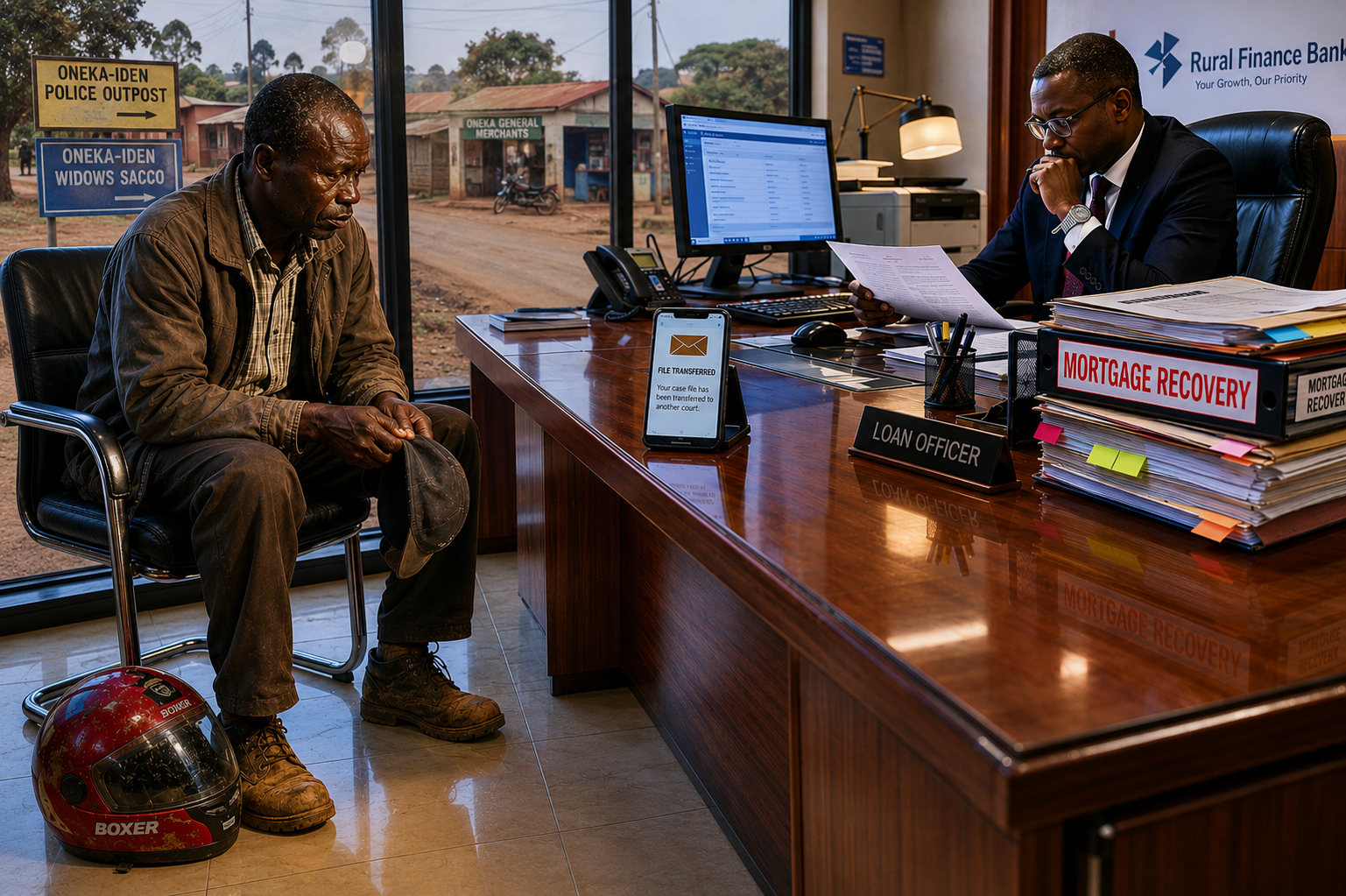
Forty minutes later, Ocen Okello sat inside the office of the loan officer.
Tie. Ledger. Calculator. No smile.
The file marked MORTGAGE RECOVERY – FINAL NOTICE lay open on the desk.
Ocen removed his cap. Held it in both hands. And began pleading.
“Sir… please do not sell my house.”
He swallowed. “The case is very near judgment, I promise.”
The loan officer said nothing. So Ocen continued.
“My lawyer says… no more than one month.”
He pointed weakly toward Omwonyo‑le. “The court has some delays… delays I do not fully understand… delays I cannot even explain properly…”
Just then – his phone vibrated again.
This time, Counsel Ogwang Adede.
He opened the message.
Brown envelope. Three words.
TRANSFERRED FOR JUST CAUSE.
Ocen read it once. Read it twice. Then slowly looked back at the loan officer… and for the first time in four years… did not know which debt was more dangerous – the one inside the bank, or the one inside the court.
By lunchtime, Omwonyo‑le was already whispering.
The new Chairperson of the School Management Committee of Kec Primary School – the same school that had eaten Ocen Okello’s beans – was an old boy of Chief Magistrate Munyakuzi.
In Omwonyo‑le, rumours travelled faster than judgments. And this rumour had teeth.
“He is willing to vouch for his old buddy,” Alyek Molly heard from a clerk in Oneka Iden. “To save the school from an old crippling debt.”
Alyek said nothing. She was still calculating her mother’s medication. Friday’s tuition. The per diem that would now not come.
That evening, Mulyanyama sat in his rented room above the pharmacy in Oneka Iden.
The brown envelope still lay on the table. Open. Unfolded. Unanswered.
The names stared back at him. Imat Nekolina. Ocen Okello. Four years. Red ribbons. Borrowed fuel. Dead witnesses. Transferred. For just cause.
His phone vibrated. Counsel Ogwang Adede.
Mulyanyama stared at the screen for two rings. Then answered.
No greetings. Just breathing.
Then Counsel spoke.
“Worship… what is going on?”
Silence.
“What happened?”
Another silence. Then the question that hit harder than any objection ever raised in court:
“Who complained?”
Mulyanyama looked again at the brown envelope. Then at the ceiling. Then finally spoke. Quietly. Almost apologetically.
“Counsel… I honestly have no idea.”
A pause. Then –
“Just orders from above.”
Neither man spoke again. For a few seconds, all that remained between lawyer and magistrate was breathing.
Then the line went dead.
And for the first time since the amendment, His Worship Mulyanyama realised something far more dangerous than corruption:
Sometimes a file is not stolen. Sometimes… it is simply called upward.
Before you blame a magistrate for “delayed justice”… ask two questions:
Who funded the last special session in your court? And how many times has a file been transferred – without your consent – “for just cause”?
The system is not broken. The system is fully booked.
This post is a pure work of fiction and creative literature. The characters, dialogue, specific incidents, and settings—including the character of His Worship Mulyanyama and the location of Omwonyo-le Magistrates Court—are products of the author’s imagination or are used fictitiously. Any resemblance or exact matches to actual persons, living or dead, real-life judicial officers, or specific ongoing cases is entirely coincidental. This text is created solely for the purpose of systemic legislative critique and systemic advocacy; it is not maliciously constructed, nor should it be interpreted as an attempt to defame, misrepresent, or malign any living individual or public office holder.
The legal references in this Series is for information purposes only and is not intended to be used as a substitute for legal advice. The author does not assume responsibility or admit liability arising from the use of the contents of this blog as legal advice.
The author strongly encourages readers to consult a licensed attorney for specific context related legal advice.
FUEL THE MOVEMENT
Independent institutional critique and advocacy for a radical overhaul of legal culture require time, deep research, and uncompromised independence. If these narratives bring value to your legal journey or challenge your perspective, please visit our HOME PAGE to see how you can support this platform directly and keep the critique fierce and relentless.
Author’s Note:The Chronicles of His Worship Mulyanyama is a serialized literary commentary designed to constructively critique the institutional and structural implications of the Magistrates Courts (Amendment) Act, No. 6 of 2026. This work is a creative exploration of the human infrastructure behind public service and is not intended to ridicule, embarrass, or undermine the integrity of the Judiciary.
At 9:43am, the white Land Cruiser rolled into Omwonyo‑le.
Nobody looked surprised. Not the warders. Not the litigants. Not even His Worship Mulyanyama.
Only Alyek Molly looked up from the registry.
She had not been paid in three months.
That morning, before leaving home, she had crushed her mother’s last blood‑pressure tablet into halves – so it could survive two more days.
Her tuition at Kampala International University (Mbale campus) was due on Friday. Second year, Bachelor of Laws. She still kept her old Diploma in Law transcript folded inside her registry drawer – next to unpaid electricity receipts.
When she saw the Land Cruiser, she did not smile. But her shoulders relaxed. Just a little.
The memo was short. Cold. Typed.
“All ordinary cause‑list matters stand adjourned pending implementation of the Mobile Justice Outreach Session.”
Fifteen days.
Ocen Okello closed his eyes.
Four years. Four. Not because his case was difficult. Because the defendant – a government primary school – had failed to bring its final two witnesses. Again.
The first adjournment: His Worship Mulyanyama had been away at donor‑funded SGBV training. The next three: the school simply came empty‑handed. Each time, the defence begged. Each time, His Worship adjourned – in the interest of justice. Each time – no costs.
Counsel Ogwang Adede had financed this trip from Lira by himself.
This time, his client simply could not raise it.
Not because he did not want justice. Because justice was competing with school fees.
With last month’s Bolicap debt – the money he had borrowed to bring both himself and counsel to this same court… for a hearing that never took off.
With the money still owed to Okello Ajing, who had rescued him that same morning when every other door had gone silent.
With sugar. With paraffin. With soap.
And somewhere inside that collapsing arithmetic… sat the question of whether justice was becoming more expensive than the debt he had come to recover.
So Counsel Ogwang Adede came anyway. On his own fuel. On his own time. On his own thinning patience.
And on the dangerous assumption… that today, after four years, somebody inside Omwonyo‑le would finally be ready to finish a case.
Today, Counsel Ogwang Adede had come ready – not prepared to swallow one more adjournment dressed as “the interest of justice.”
He had the court file under one arm. His diary in the other hand.
And in the margins of his notebook – authorities, annotations, and one final prayer:
Order 17 Rule 4 of the Civil Procedure Rules.
Close the defence. Take oral submissions. Fix the matter for judgment.
Four years was enough.
Today he had not come to negotiate with delay. Today… he had come to end it.
Then Alyek Molly pinned the memo. And nobody entered Court No. 2.
Imat Nekolina did not understand the white car.
She only knew that her case was not today. Again. She approached Alyek Molly. “When?”
Alyek shrugged. “After the mobile court.”
“My witness,” Imat said quietly, “the doctor says he has less than fourteen days.”
Alyek said nothing. She had heard this before too. But her mind was already calculating: fifteen days of per diem. Enough for her mother’s medication. Enough for Friday’s tuition. She did not wish for the donor to come. But she could not afford to wish otherwise.
Mulyanyama watched from his chambers.
He saw Counsel Ogwang Adede standing on the cracked steps – file, diary, notebook – the oral application still just a prayer in his head. He saw Imat Nekolina’s face. He saw Ocen Okello kick his Boxer motorcycle back to life – and ride away without looking back.
The Visitor was already inside Court No. 1, setting up his laptop.
The donor had paid for fifteen days. Per diem. Transport. Lunch allowance. Enough… to make resistance expensive.
That evening, Mulyanyama texted a friend: “They call it access to justice. I call it access to their priorities.”
The friend replied: “Did you eat?”
Mulyanyama did not answer.
Before you blame a magistrate for “delayed justice”… ask two questions:
Who funded the last special session in your court? And how many times did the government defendant adjourn without cost?
Two days later, another envelope arrived.
Not white. Brown. Government brown.
The subject line read:
TRANSFER OF FILES – FOR JUST CAUSE.
Mulyanyama read it once. Read it twice.
Then looked at his phone.
One message waited. Just three words.
Did you eat?
Institutions are not always captured by force. Sometimes… they are rented. One allowance at a time.
Enen Ambrose, Enen Legal World
Member: Judiciary Affairs Committee
Uganda Law Society
Enen Legal World.
For Feedback or comments: enen@enenlegalworld.com
Legal Disclaimer
Fiction & Non-Defamation Notice:
This post is a pure work of fiction and creative literature. The characters, dialogue, specific incidents, and settings—including the character of His Worship Mulyanyama and the location of Omwonyo-le Magistrates Court—are products of the author’s imagination or are used fictitiously. Any resemblance or exact matches to actual persons, living or dead, real-life judicial officers, or specific ongoing cases is entirely coincidental. This text is created solely for the purpose of systemic legislative critique and systemic advocacy; it is not maliciously constructed, nor should it be interpreted as an attempt to defame, misrepresent, or malign any living individual or public office holder.
The legal references in this Series is for information purposes only and is not intended to be used as a subtitute for legal advice. The author does not assume responsibility or admit liability arising from the use of the contents of this blog as legal advice.
The author strongly encourages readers to consult a licensed attorney for specific context related legal advice.
Author’s Note: The Chronicles of His Worship Mulyanyama is a serialized literary commentary designed to constructively critique the institutional and structural implications of the Magistrates Courts (Amendment) Act, No. 6 of 2026. This work is a creative exploration of the human infrastructure behind public service and is not intended to ridicule, embarrass, or undermine the integrity of the Judiciary.
At 7:45am, His Worship Mulyanyama was nowhere near court.
He sat inside a parked Judiciary double‑cabin pickup, forty kilometres from Omwonyo‑le Magistrates Court. Engine off. Air dead. Phone in hand.
Battery: 19%.
Bank balance: not enough.
Fuel gauge: hovering just above E – the dangerous place where public service stops being transport… and becomes theology.
On his screen: Mo‑kash. Wewole. ManguCash. Ka‑Sente.
Four lenders. Four rejections. One salary.
He had not yet started the engine. Because before justice could move, fuel had to move first.
So he made another call. Not to a litigant. Not to a lawyer. To a friend.
His Worship Mulyanyama making calls to top up his fuel before setting off for work.
By 10:06am, the double‑cabin rolled into Omwonyo‑le.
The benches were already full.
Imat Nekolina had walked three kilometres from her village, a faded manila envelope pressed against her chest. Inside: a death certificate, two handwritten land agreements, and a photograph of six goats – the only things her late husband had left behind. She had been coming to court since 2022. This morning, she left cassava unharvested. Again.
Ocen Okello had kicked his Boxer motorcycle until it coughed to life. Four years earlier, he supplied beans to a government primary school. Class One children had become Class Five. Two headteachers transferred. One bursar retired. The beans had long been eaten – but Ocen had never been paid.
Yesterday, after every friend with a smartphone suddenly became “busy”, and every relative promised to “call back”, Ocen borrowed his advocate’s transport facilitation from Bolicap – because his lawyer was driving from Lira on the day of the case. This morning, he still had no money of his own. So before sunrise, he crossed the trading centre, placed his extra tablet on the wooden counter of Okello Ajing. Okello Ajing looked at it twice, then pushed a few folded notes across. Just enough for fuel – to follow a file that had forgotten his name.
Ocen Okello and Imat Nekolina at the waiting lobby.
Mulyanyama stepped out of the pickup. He did not apologise for the delay. He simply walked to his chambers, put on his robe, and inked his stamp.
The robe covered the sweat. The stamp covered the hunger. The silence covered the missed calls.
Court No. 2 had eighty‑three matters cause‑listed before lunch.
He signed bail forms. Stamped adjournments. Called absent lawyers. Listened to excuses. Listened to tears. Listened to lies. Listened to truth.
By 10:56am, he could no longer remember whether File No. 43 was cattle theft, trespass, or twins fighting over their father’s cassava garden. Only that all of them wanted justice – and all of them wanted it today.
At 11:02am, his phone vibrated again.
“Daddy, school says no exam without fees.”
He read the message. Locked the screen. Then proceeded to deny bail in a case involving twenty thousand shillings. The accused had no transport to return for trial. Mulyanyama explained the law – the risk of absconding, the need for sureties, the presumption of innocence.
His voice was steady. His reasoning was sound. But between his words, the message sat: No exam without fees.
By noon, he had not eaten.
Court No. 1 had computers. Three of them. All bearing the Judiciary crest. All covered in dust. Outside, a solar mast stood proudly beside the flagpole – as if justice here ran on sunlight.
And on good weeks… it did. When the batteries cooperated. When the switch‑over panel remembered its job. When Umeme remembered Omwonyo‑le existed. Which was usually one morning in five – sometimes between six and ten.
After that, the screens went black. And when judgments had to be written, when reports had to be filed, when legal research had to be done – Mulyanyama would remove his robe, start the government pickup, and drive twenty kilometres to the nearest trading centre… to borrow electricity.
That was the unwritten rule of Omwonyo‑le: You do not complain. You endure.
Omwonyo Magistrates Court Compound
A litigant approached his desk. Not with a bribe. With a roasted goat leg wrapped in old newspaper. Steam rose. The man said nothing. He simply bowed and left.
Mulyanyama looked at the meat. He looked at the phone. He looked at Imat Nekolina. He hesitated. Then he ate.
This was his first meal of the day.
And somewhere in Kampala, Parliament had quietly decided that His Worship Mulyanyama was ready for more – more files, more value, more pressure – under the newly enacted Magistrates Courts (Amendment) Act, No. 6 of 2026.
No one asked about his clerk. No one asked about his fuel. No one asked what he had eaten. No one asked about the missed calls. No one asked about the solar mast, or the twenty‑kilometre drive to borrow electricity.
They simply raised his jurisdiction – and left his stomach empty.
Before His Worship Mulyanyama could deliver justice… he first had to finance it.
The ground at Omwonyo‑le had swallowed an axe. Now it was swallowing him.
Before you judge His Worship Mulyanyama… visit your nearest court. Stand there for one morning. Count the files. Count the faces. Then ask one question:
What is missing here?
You may not like the answer.
And in Omwonyo‑le… hunger was only the beginning. Because one week later… a white Land Cruiser entered the court compound.
Some systems do not collapse. They simply teach good people how to survive inside broken ones.
Enen Ambrose,
Advocate.
Member: Judiciary Affairs Committee
Uganda Law Society
Legal World. enen@enenlegalworld.com
Legal Disclaimer Fiction&Non-DefamationNotice:
This post is a pure work of fiction and creative literature. The characters, dialogue, specific incidents, and settings—including the character of His Worship Mulyanyama and the location of Omwonyo-le Magistrates Court—are products of the author’s imagination or are used fictitiously. Any resemblance or exact matches to actual persons, living or dead, real-life judicial officers, or specific ongoing cases is entirely coincidental. This text is created solely for the purpose of systemic legislative critique and systemic advocacy; it is not maliciously constructed, nor should it be interpreted as an attempt to defame, misrepresent, or malign any living individual or public office holder.
If you loved this Episode 1 and would love to continue enjoying it, Please acccess Episode 2 from here:
FUEL THE MOVEMENT Independent institutional critique and advocacy for a radical overhaul of legal culture require time, deep research, and uncompromised independence. If these narratives bring value to your legal journey or challenge your perspective, please visit our HOME PAGE to see how you can support this platform directly and keep the critique fierce and relentless.
— Enen Ambrose. Advocate & Founder–Enen Legal World
There is a moment in the Gospel of Mark that haunts every leader, every judge, every system builder.
Jesus goes to the Garden of Gethsemane to pray. He takes Peter, James, and John. He is sorrowful, troubled, facing the cross. He asks them to stay awake, to watch with him.
Then he walks away, prays, returns – and finds them sleeping.
“Simon, are you asleep? Could you not keep watch for one hour?” (Mark 14:37)
He warns them: “Watch and pray, so that you will not fall into temptation. The spirit is willing, but the flesh is weak.” (Matthew 26:41)
They sleep again. Then the mob arrives. Jesus is arrested. And the disciples flee. Peter denies him three times out of fear.
The consequence of sleeping? Failure at the moment of testing.
II. Gethsemane, Buganda Road Court, 2026
On 21 May 2026, an advocate appeared before a Magistrate at Buganda Road Chief Magistrate’s Court. His client had been charged with obtaining 600 million shillings by false pretence. The Advocate had uploaded bail application documents onto ECCMIS – the Judiciary’s flagship electronic case management system.
The Advocate asked to be heard on bail.
The Magistrate tried to access the uploaded documents.
The network failed.
ECCMIS would not display the files. The magistrate could not see the bail application. And instead of invoking the fallback provisions of the law – instead of assisting the advocate under Rule 9(4) and Rule 24(5) of the Judicature (Electronic Filing) Rules, 2025 – the Magistrate declined to hear the application.
The Advocate was remanded to Luzira Prison until 4 June 2026.
The system slept. And justice went to Luzira.
Image: Buganda Road Court. Photo Credit, Nile Post, a member of the Next Media Company.
III. The Spirit Is Willing – But the Flesh Is Weak
The Judicature (Electronic Filing, Service and Virtual Proceedings) Rules, 2025 (S.I. No. 21 of 2025) are, on paper, remarkably progressive.
Rule 24(5) of the Rules provide thus:
The court may, in its discretion, adjust the schedule for responding to any affected filings, postpone the next court event, or provide other relief. It is my view that “others relief” includes a fall back position to actually hear the bail application manually, the network failure notwithstanding.
The spirit of these Rules is willing. No judiciary transitions from paper to digital systems without friction, uncertainty, or implementation failures – and Uganda is no exception.
But the flesh – the actual ECCMIS software and the training (or lack thereof) of judicial officers – is weak.
The magistrate did not invoke Rule 24(5) Did not provide other relief i.e. a fall back position to actually hear the bail application, Why?
Two possibilities – and both point away from individual malice and toward systemic failure.
IV. Why Did the Court Sleep? Two Systemic Failures
First: No offline caching in ECCMIS.
If ECCMIS had an automatic local cache, the Magistrate’s computer would have downloaded all documents for that day’s matters the night before – or upon morning boot, or periodically. Even if the live network failed, the cached documents would remain accessible. The bail application would have been visible. The hearing could have proceeded.
But ECCMIS, as currently deployed, appears to depend heavily on live connectivity. When the network fails, the court becomes blind. That is not a user error. That is an architecture flaw – though I write as an external observer, not as someone with access to internal design documents.
What is needed: A software update that configures ECCMIS to:
· Pre‑cache all case files for matters listed on a given day. · Update the cache every morning or whenever internet is available. · Allow offline access with a clear timestamp (“cached as of [time]”). · Sync back to the central system once connectivity is restored.
This is not rocket science. Email clients do it. Mobile banking apps do it. Google Drive, One Drive and other online file back-up systems do it. Even WhatsApp caches messages offline. The Judiciary’s ECCMIS can do it – if the builders prioritise resilience over assumption of constant connectivity.
Second: Inadequate training of judicial officers.
Rule 60 of the 2025 Rules commands:
The court shall, in collaboration with stakeholders, periodically undertake training for court users, judicial officers, unrepresented litigants and the public on use of ECCMIS.
Where is that training? If Magistrates do not know they can assist under Rule 9(4), if they do not know they can order a paper fallback – then the Rules are dead letters. The fault is not primarily the Magistrate’s. The fault is the system that failed to prepare her.
The Magistrate in Buganda Road was not malicious. She was unprepared. She was left alone with a broken network and no institutional backup. And like Peter in Gethsemane, she found herself in a situation where the institution had not equipped her to watch – the failure was systemic, not merely personal.
V. The Blame Must Shift
Public anger after the Buganda Road incident has, predictably, focused on the Magistrate. Some have called her incompetent. Others have suggested bias.
I disagree.
The Magistrate is the front‑line foot soldier of a digital transformation that was rolled out without full readiness. She was given a system that struggles offline, and no training on what to do when it fails. She was handed a beautiful set of Rules (S.I. 2025 No. 21) but not the practical tools to implement them.
The real responsibility lies with:
· The architects of ECCMIS – who designed a system that assumes perpetual internet connectivity in a country where power and data are unreliable. · The Judiciary’s leadership – who rolled out the paperless mandate without ensuring that every Magistrate understands Rules 9 and 24, and without installing basic offline caching. · The training units – who have not conducted the mandatory training required by Rule 60.
Yes, the Magistrate could have done more. She could have read the Rules. She could have asked for an adjournment. She could have called the registry. But when a system fails, we do not blame the soldier alone. We also examine the armour and the General who deployed him and gave the orders.
VI. A Concrete Way Forward
The solution is not to abandon ECCMIS. It is to fix it.
1. Technical fix: offline caching. The Judiciary’s ICT team must implement automatic local caching on all court computers. This is a one‑time software upgrade that pays for itself within weeks by eliminating network‑related adjournments.
2. Training fix: mandatory, periodic, verifiable. Every judicial officer and court clerk must undergo hands‑on training on:
· How to use offline mode. · How to invoke Rule 9(4) to assist litigants. · How to grant relief under Rule 24(5). · How to handle network failures without remanding people, especially when the question of Bail, which touches on the liberty and presumption of innocence of an accused person comes up for consideration.
3. Accountability fix: a practice direction. The Chief Justice should issue a practice direction reminding all courts of their obligations under Rules 9 and 24, and requiring that any refusal to hear a matter due to ECCMIS failure be accompanied by a written explanation of why Rules 9(4) and 24(5) for fall back positions could not be followed.
VII. Gethsemane, 2026 and Beyond
Jesus did not condemn the disciples for sleeping. He warned them. He told them to watch and pray – because the flesh is weak.
The flesh of ECCMIS is weak. The network fails. The cache is absent. The training is insufficient. But the spirit of the Rules is willing.
The question is whether the Judiciary will watch – or continue to sleep.
Because every time a Magistrate refuses to assist a litigant when ECCMIS fails, every time an Advocate or his client is remanded because the network is down, every time justice is delayed or denied not by malice but by unpreparedness – that is not a technical glitch.
That is the agony of an unprepared court.
And the consequence is always the same: those who came seeking justice flee. Their rights are denied. Their liberty is lost. And the system that was meant to protect them becomes the very instrument of their suffering.
“Could you not keep watch for one hour?”
The hour is now. The network will fail again. The question is not if – but when, and how the court responds.
Will we equip our Magistrates (and in fact all judicial officers) to stay awake? Or will we keep sending accused persons to Luzira because the cache was empty and the training never came?
The spirit is willing. Let us finally strengthen the flesh.
DISCLAIMERS: This blog is not an attack on the Magistrate who handled the Buganda Road matter. Magistrates work under enormous pressure with limited resources. The critique here is directed at systemic failures: the architecture of ECCMIS, the inadequacy of training, and the absence of offline preparedness. Fair commentary is not personal attack.
This blog is not legal advice. Readers should consult qualified attorneys for case‑specific guidance.
Enen Ambrose Member, JudiciaryAffairsCommittee, UgandaLawSociety For comments or feedback: enen@enenlegalworld.com
There is a seductive danger in confusing development with institutional health.
Yes, Uganda has grown sectors. Yes, milk production rose. Yes, roads were built. Yes, factories emerged.
Let us even grant these achievements at their most generous interpretation, though many of the surrounding statistics and political narratives remain fiercely contested. The deeper question lies elsewhere.
Ancient empires also built roads.
The question is whether those roads outlasted the emperor, and in more recent history, whether the institutions managing them answered to citizens or merely to the political survival of one man.”
That is where Elison Karuhanga’s argument becomes deeply troubling.
Not because it defends industrialisation. Industrialisation is necessary.
But because it quietly asks Ugandans to romanticise concentrated power itself.
The article repeatedly frames scepticism toward entrenched political authority as elite cynicism, as though accountability were merely an inconvenience imposed by intellectual spectators standing outside history.
Yet history teaches something far less flattering.
Apartheid South Africa built one of the continent’s most sophisticated industrial economies. Gaddafi’s Libya produced impressive welfare indicators and modern infrastructure. Mobutu’s Zaire cultivated the imagery of national grandeur and developmental ambition.
Yet history eventually exposed the same weakness in each case: institutions had become subordinate to personalities, patronage, or exclusionary systems of power.
Infrastructure is not self-validating.
The real question is never whether factories, highways, dams, or industrial parks exist. The deeper question is whether the institutions beneath those projects remain independent enough to survive the men who built them.
Development without accountability does not eliminate instability.
It postpones it.
And when accountability weakens long enough, entitlement emerges. From entitlement comes impunity. And from impunity comes institutional decay.
That is precisely the warning at the heart of Mahmood Mamdani’s 2025 book, Slow Poison: Idi Amin, Yoweri Museveni, and the Making of the Ugandan State. Mamdani’s argument is not that Uganda failed because it lacked projects or economic ambition. It is that the post-independence dream was gradually dismantled through tribalised politics, institutional corrosion, political violence, and the fragmentation of citizenship itself.
A country may increase exports while weakening citizenship.
That is not transformation.
That is deferred fragility.
And perhaps nowhere is this contradiction more revealing than within the intellectual class now defending presidential mythology in the name of developmental realism.
Many of us were repeatedly lectured about the supposed “neutrality” of the Uganda Law Society whenever lawyers confronted excesses of state power. We were told institutions must remain above politics.
Yet neutrality now appears remarkably flexible when the task is constructing emotional narratives around presidential permanence and historical indispensability.
One begins to suspect that neutrality was never truly about insulating institutions from politics, but about regulating the direction in which criticism could travel.
That selective application is itself part of the institutional decay being ignored.
When institutions of accountability suspend their scepticism in order to celebrate power, they accelerate the very “slow poison” they should be resisting.
And this is why the romantic language of “stubborn men who shape history” should concern us more than inspire us.
History is full of stubborn men.
Some built nations.
Others merely built systems too personalised to survive them.
Uganda’s tragedy has never been a shortage of ambitious rulers.
It has been the absence of institutions strong enough to survive them, and disciplined enough to tell them no.
And if we are to have the rule of law rather than the rule of men with a gun, a Bible, and a pen, then a few stubborn men and women must demand that development be built on accountability, not just the romanticisation of power.
The roots of accountability are bitter, but the fruits are sweet.
This, fellow countrymen and women, is my contribution to that cause.
There is another kind of quiet violence in procedure.
Not when the law assumes communication where none exists. But when communication eventually occurs, and the law still struggles to recognise its procedural legitimacy because it arrived through unfamiliar technological form.
Days ago, in my earlier critique, The Quiet Violence of Procedure: When Digital Service Serves No One, I warned against a growing procedural danger within Uganda’s evolving E‑Justice architecture. I argued that a notice uploaded into ECCMIS is not necessarily a notice received; that “deemed service” is not always effective service; and that digital systems may satisfy procedural form while silently excluding the very litigants whose rights stand at risk.
The concern then was technological presumption.
This time, the concern is technological distrust.
The Case and Its Difficulties
In Bakampa Brian Baryaguma v Bbaaka Property Consultants (U) Ltd (Misc. Cause No. 0033 of 2023, 22 May 2026), the High Court held that service through WhatsApp, without prior leave for substituted service, was improper. The Applicant, self‑represented, sent the application to the Respondent company director’s WhatsApp number on 24 February 2023. The director only saw the message weeks later, on 4 April 2023, before instructing counsel who filed a response on behalf of the company.
The Court struck out the affidavit of service, holding that the Applicant was not authorised to effect service under Order 5 rule 7 of the Civil Procedure Rules and had not first obtained leave for substituted service. The Court further struck out the Applicant’s supporting affidavit for being argumentative and containing matters of law (contrary to Order 19 rule 3 CPR), and dismissed the application with costs.
I do not defend every aspect of the Applicant’s filings. The supporting affidavit may well have been defective under Order 19. The Applicant also admittedly did not first attempt conventional corporate service under Order 29 rule 2 CPR, nor did he obtain prior leave before resorting to WhatsApp. Those are genuine procedural weaknesses.
I raised a critical concern about the preparedness of lawyers for paperless transition come June 2026. This blog inverses that question back to the courts themselves. With a ruling which effectively rolls back all the gains in the courts’ E-justice and digital transformation journey, I equally ask, “are our courts really ready for a fair, meaningful and realistic digital transformation?“
The Conceptual Problem
The real issue is not whether procedural safeguards around electronic service should exist. The question is: should courts continue treating direct electronic communication as inherently inferior to conventional physical service, even where actual notice is eventually achieved and no prejudice is demonstrated?
Historically, substituted service existed because direct communication with a litigant had become impossible, impracticable, or evasive. Newspaper advertisements, affixing summons to premises, or leaving documents with third parties were indirect approximations designed to create the possibility of awareness where direct access could not be achieved.
WhatsApp communication to a litigant’s verified personal number occupies a very different space.
It is direct. It is individualised. It is traceable. And in many modern contexts, it may be more personal than conventional physical service itself.
Traditionally, courts have accepted service where documents are left with receptionists, secretaries, guards, clerks, or relatives – all based on the assumption that the communication will eventually reach the intended recipient. A WhatsApp message arrives directly on the litigant’s personal handset, often with timestamps, delivery indicators, and sometimes read receipts.
Ironically, historically accepted physical substituted service may sometimes be less direct than modern electronic communication.
That forces an uncomfortable question: In the smartphone era, why should communication sent directly to a litigant’s verified personal number automatically be treated as procedurally inferior to leaving papers with a receptionist, such that prior leave for substituted service is required?”
The Delay Problem – And Why It Is Not Decisive
Of course, the facts of this case reveal an important caution. The Respondent director did not see the message immediately. Weeks passed before the communication came to his attention. That delay cannot simply be ignored.
But the existence of delay does not necessarily establish that the medium itself was defective.
Physical summons may equally sit unread on office desks for weeks. Letters may remain unopened. Receptionists may misplace documents. The proper procedural inquiry cannot merely be whether awareness occurred instantly, but whether the chosen method was reasonably calculated to bring the proceedings to the attention of the affected party.
Here, the communication eventually did exactly that. The Respondent became aware. Counsel was instructed. An affidavit in reply was filed. Participation followed.
Which raises another important constitutional question: What actual prejudice was ultimately suffered?
That question becomes particularly pressing under Article 126(2)(e) of the Constitution, which requires courts to administer substantive justice without undue regard to technicalities – especially where the litigant is self‑represented and navigating complex procedural terrain without legal assistance.
Even if the Court was correct that service was technically defective, one may still ask whether striking out the affidavit of service, striking out the supporting affidavit, and dismissing the entire application with costs was proportionate. Could the Court instead have directed proper service and allowed rectification, particularly in a human rights enforcement application?
Uganda’s Own Jurisprudence Already Points Forward
Long before this dispute arose, Uganda had already begun integrating technology into adjudication. The Constitution (Integration of ICT into the Adjudication Processes for Courts of Judicature) (Practice) Directions, 2019 encouraged the use of technology to improve efficiency and expedition. The Judiciary’s ongoing embrace of ECCMIS, electronic filing, virtual hearings, and paperless procedure reflects an unmistakable institutional movement toward digitally facilitated justice.
More importantly, Ugandan jurisprudence has already recognised technologically facilitated service itself.
In Male H Mabirizi K. Kiwanuka v Attorney General, Justice Ssekaana Musa expressly acknowledged that service through “email or facebook or whatsApp or any other technologically advanced means” are methods calculated at bringing proceedings to the attention of parties. The Court further recognised that personal service is required only “wherever practicable” before concluding that service was effective because participation followed.
That reasoning shifts procedural legitimacy away from ceremonial delivery and toward communicative effectiveness.
And that is where the Bakampa ruling becomes difficult to reconcile with the Judiciary’s broader digital trajectory.
A Concrete Way Forward
What is needed is not a revolution, but a practice direction.
The Chief Justice should issue guidance clarifying that electronic service via WhatsApp, SMS, or similar direct messaging platforms – when sent to a verified number and followed by reasonable confirmation (such as a follow‑up call or text) – may be recognised as valid service without prior leave, provided that:
· The sender proves actual notice (e.g., delivery receipt, screenshot, or acknowledgment); · No prejudice is caused to the recipient (e.g., sufficient time to respond); · The court retains power to set aside service if injustice is shown.
This would bring Uganda’s procedural law into alignment with its own constitutional commitment to substantive justice and its declared embrace of digital transformation.
Conclusion
Uganda’s courts now stand between two procedural imaginations. One remains rooted in paper legitimacy and inherited analog assumptions. The other recognises that constitutional fairness depends not on the medium, but on whether proceedings actually come to the attention of the affected party.
That tension is no longer merely technological. It is jurisprudential.
In Geoffrey Gatete & Another v William Kyobe, the Supreme Court distinguished between “deemed service” and “effective service,” warning that procedural law may presume notice without proving actual awareness. The Bakampa difficulty inverts that concern: awareness eventually existed, participation followed, yet the communication remained procedurally suspect because it arrived through a medium still viewed with doctrinal caution.
This is not an argument against procedural safeguards. It is an argument for procedural realism in the age of digital justice.
Because justice does not only fail when communication never reaches. Sometimes, it also falters when the law hesitates to recognise communication after it has already arrived.
DISCLAIMERS:
This blog is not an attack on the Learned Judge in the Bakampa decision. It is fair commentary intended to foster a discussion and self reflection on the Judiciary’s forthcoming paperless transition to fully digital courts, for E-justice and digital transformation must serve justice rather than suffocate or truncate it.
This blog is not intended to be used as a substitute for legal advice. The author accepts no liability or responsibility for any losses that arise from use of information as legal advice. Readers are encouraged to consult a licensed attorney of their choice for situation specific legal advice.
Enen Ambrose Member, Judiciary Affairs Committee, Uganda Law Society.
For comments or feedback, write to: enen@enenlegalworld.com
There is a quiet violence in procedure. It does not shout. It does not argue. It simply assumes; and in that assumption, rights collapse without anyone noticing. This is exactly what happened in two recent High Court decisions: Visare Uganda Ltd vs Festus Katerega T/A Quickway Auctioneers and 3 others. A copy of it can be accessed here:
A case is filed. A hearing date is fixed. Somewhere deep within a digital system, a notice is uploaded. The law nods in satisfaction: service has been effected. The machinery moves. The courtroom sits. The judge writes. And somewhere else, perhaps across the city, perhaps across a fragile internet connection, a litigant knows nothing.
We call this progress.
We call this efficiency.
We even call it justice.
In the recent ruling of the High Court of Uganda in Misc. Application No. 2289 of 2025, the court took the position that once a hearing notice is posted onto ECCMIS, service is complete. It held that it is not mandatory for a party to actually receive an email or SMS notification, so long as the system reflects that service was effected.
The implication is stark: the burden shifts entirely to the litigant or counsel to constantly monitor the system. Failure to do so is fatal. A case may be dismissed. Rights may evaporate. And yet, in the eyes of the law, nothing has gone wrong.
But open justice demands something far more stubborn, far more human. It demands not that proceedings merely exist in public form, but that those whose rights are at stake are actually present; or at the very least, actually aware. The old wisdom insisted that justice must be seen to be done. It did not imagine a world where justice could be technically visible yet practically invisible; where a notice exists, but never reaches; where a hearing occurs, but never touches the party it condemns.
And this is not an abstract concern. It is a doctrinal one.
The Supreme Court of Uganda, in Geoffrey Gatete & Another v William Kyobe, confronted a similar question under the language of “deemed good service.” The Court drew a careful and deliberate distinction; one that modern digital procedure now risks erasing.
It held that “deemed service” is a legal fiction, a procedural convenience that allows courts to proceed even where actual notice may not be proven. But it went further to warn that such service does not necessarily amount to “effective service.” For service to be effective, it must achieve its intended purpose: to bring the proceedings to the attention of the party.
A copy of the decision in Gatete can be accessed here:
This distinction is not semantic. It is foundational.
Because once the law accepts that something may be “deemed” without being real, it must also accept the consequences; that the fiction may fail in practice. And where it fails, justice demands correction.
Yes, there will be cases where a litigant deliberately avoids monitoring the system. But the system cannot punish the many for the bad faith of the few; especially when actual notice remains technically possible.
Yet the modern system presses on, collapsing this distinction. ECCMIS becomes both the record and the proof, both the act and its consequence. Once a notice is uploaded, the law assumes its journey is complete.
But a system is not a voice. A database is not a message. A record is not communication.
And so we arrive at a troubling convergence: a digital architecture that satisfies procedural form while undermining substantive awareness.
Context makes this even more urgent. Even in Kampala, internet access is not constant. Connectivity fluctuates. Costs are high. Power is unreliable. To build a legal system on the assumption that litigants and advocates will perpetually monitor an online platform is to design justice for an ideal world, not the real one.
What then becomes of open justice?
It remains, perhaps, in architecture. The courtroom doors are still open. The rulings are still written. The processes are still documented. But the litigant; the very person for whom the system exists; may never arrive, not out of defiance, but out of ignorance.
And in that moment, something profound happens.
Justice is no longer denied loudly. It is denied quietly.
Not in secrecy, but in silence.
Not by concealment, but by assumption.
Justice does not only die in closed courtrooms. It also dies in silent systems, where notices exist, but never reach.
This is not an argument against technology. It is an argument against unquestioned technology. Against systems that replace human communication with automated presumption. Against a jurisprudence that confuses efficiency with fairness.
The answer is neither retreat nor resistance. It is correction.
If ECCMIS is to be the backbone of modern judicial administration, then it must evolve beyond being a passive repository into an active communicator. It must speak, not just store. It must reach, not just record.
External notification systems are not luxuries; they are necessities. SMS alerts. Email notifications. Web based and Android Push Notifications, Real-time prompts that move beyond the confines of the system and into the lived reality of the user. And more than that, they must not be optional embellishments. They must be integral guarantees, designed to ensure that service is not merely deemed, but actually effected.
The Judiciary and the architects behind ECCMIS stand at a critical threshold. They have built the infrastructure. Now they must build the connection.
Because the law may deem service to be good, but justice demands that service be real.
A system that merely stores notices, without ensuring they reach those whose rights are at stake, does not advance justice, it endangers it. In a jurisdiction where access to digital infrastructure is uneven, to insist that litigants must constantly patrol an online platform is to replace fairness with fiction.
Technology must serve justice, not obscure it.
There is an old wisdom in scripture: No one lights a lamp and puts it under a bed. Instead, they set it on a stand, so that those who enter may see.
ECCMIS is that lamp, lit, visible in theory. But when a notice sits in a database without actively reaching the litigant, we have placed it under the bed. The light exists. It just does not shine where it is needed most. (Mark 4:21)
Let ECCMIS evolve, blending its internal efficiency with robust external communication, ensuring that every litigant is not merely assumed to know, but is given a real opportunity to know.
For if justice is to remain open, it must also remain visible.
Otherwise, quietly and without protest, justice will die in the darkness of its own systems. -THE END-
Disclaimers:
This Blog is not an attack on the Judicial officers who handed down the two decisions criticised above. It is not an attack on the institution of the Judiciary or EECMIS developers. It is intended to spark conversations to make E-Justice and the whole E-Government Digital Transformation a complete and wholesome journey and / or experience.
This Blog is not to be substituted for or taken for legal advice. The author does not accept responsibility or liability for damage suffered as a result of its use as legal advice. Readers are encouraged to consult a qualified and licensed attorney for situation specific legal advice.
Enen Ambrose. (Personal Archive)
Enen Ambrose
Member, Judiciary Affairs Committee of
Uganda Law Society.
For feedback or questions, write to: enen@enenlegalworld.com
Disclaimer: The story of Cecil Miller is drawn from historical accounts, particularly Paul Mwangi’s The Black Bar. This retelling is a synthesis for the purpose of public education and advocacy. Readers of this Blog are encouraged to purchase a copy for the full account and context of The Black Bar by Paul Mwangi (SC)
If you are joining us for the first time: In Episode 4, Owera Apur knelt under the 160‑year‑old ojede cii tree and poured out his soul. He called on Zakayo, on the ancestors, on the spirits of the land. He asked the question no constitution can answer: How then shall we live when the council is bought and the granary is empty? The leaves trembled. Something, somewhere, had heard the cry.
Tonight, the ancestors reply. Not with wind. With a mirror.
I. THE FOREIGN SEED
In the 1970s a contract judge arrived in Kenya from Guyana. His name was Cecil Henry Ethelwood Miller. By blood he was a Black Pan‑Africanist, a World War II pilot who had “dusted the Aryan race.” By reputation he should have been a hero.
By work ethic he was almost useless.
But President Daniel Arap Moi saw hunger in Miller’s eyes. So Moi gave him Kenyan citizenship, a constitutional tenure as a High Court judge, a large plantation, and a Mercedes‑Benz limousine. The same way Owera Apur opened his granary to his nephew Okello, Moi opened the highest doors of the judiciary to a man who had never built anything.
Miller’s appetite only grew. He wanted to be Chief Justice. He understood the price: total, slavish loyalty to Moi. The ancestors watched the foreign seed take deep root in Kenyan soil.
In 1983 President Moi wanted to destroy his once‑powerful minister Charles Njonjo. He set up a Judicial Commission of Inquiry to investigate Njonjo for alleged abuse of office, everything from amassing firearms to plotting coups. The commission was widely seen as a kangaroo court, designed to humiliate Njonjo and drive him out of politics.
Miller was one of three commissioners. He walked in carrying two things: a personal grudge against Njonjo (who had once passed him over for promotion) and zero judicial independence.
The transcripts from The Black Bar are excruciating. During the hearings, lead counsel Lee Muthoga probed Njonjo about whether he had paid an MP, Amos Ng’ang’a, to resign his parliamentary seat so Njonjo could run for it. The exchange was tense. Njonjo’s lawyer, Mr. Deverell, kept interrupting with sarcastic remarks, at one point suggesting that “any other consideration” might include buying ice‑cream.
Miller exploded:
“You keep making your jokes, Mr. Deverell. You keep on making your jokes. In the long run you may find it is not going to accrue to your credibility and your status before this inquiry. You keep on making your jokes. You take out your cold icecream and push it into your mouth. Proceed please.”
The outburst revealed Miller’s predetermined hostility. He was not there to inquire; he was there to convict. Deverell saw the commission for what it was: a kangaroo court designed to destroy Njonjo.
The mission succeeded. Njonjo was politically crushed.
And in 1986 Miller was rewarded exactly as he had schemed: he was sworn in as Chief Justice of Kenya.
A man whose judicial temperament was summed up by an ice‑cream joke now controlled every judge in the Republic.
The ancestors were already laughing.
III. THE HABEAS CORPUS THAT MILLER STRANGLED
On 6 April 1987 a man named Stephen Mbaraka Karanja kissed his wife goodbye in Limuru and left for Nairobi. He was never seen alive again.
After seven weeks of desperate searching, his wife filed a writ of habeas corpus asking the court to order the CID Director to produce her husband.
The case came before Justice Derek Schofield. The CID claimed Karanja had been “shot while escaping.” Schofield did not believe them. He ordered an exhumation, an independent post‑mortem, and affidavits.
The grave was empty. No body. No records. Schofield issued a notice to the CID Director to show cause why he should not be committed for contempt.
That was when President Moi sent Chief Justice Cecil Miller himself into Schofield’s chambers with a direct order: “Lay off the case.”
Schofield refused. He told Miller: tell the President to keep his hands off the judiciary, or I will tell the President myself.
Miller did not wait. On 11 August 1987, without any formal application, without any hearing, Miller summoned the lawyers, seized the file, and transferred the entire matter. He stood the case over “until judges return from vacation.”
Later he moved it to a known government apologist, who ruled that once a man is dead, habeas corpus cannot issue, because “the person or body” does not mean a corpse.
Schofield resigned in disgust and left the country. The Law Society hosted a farewell dinner. The only senior government officer brave enough to attend was immediately fired.
Stephen Mbaraka Karanja’s family never got justice. The habeas corpus died in silence.
The Chief Justice had personally executed a murder cover‑up in open court.
IV. THE JUDGE WHO FIRED A JUDGE
By now Miller’s interference was routine. He transferred cases at will, summoned lawyers, stood matters over, and told other judges to “lay off” sensitive files.
One man refused to bow: Justice Patrick O’Connor.
Miller tried everything. When nothing worked, he issued a punitive transfer order sending O’Connor to a remote station.
O’Connor defied it.
On 26 September 1988 Miller sat down and wrote a single letter:
“You are hereby dismissed from the service of the Judiciary with immediate effect.”
No hearing. No tribunal. No reasons. Just one letter from a man who had never earned the seat he sat in.
O’Connor was gone. The message to every honest judge was clear: resist Miller and you die.
One judge had said no. Miller made sure he would never say anything again.
V. THE PARKING LOT
By 1989 Miller had become a drunk, violent eccentric who required armed policemen standing guard outside his chambers, something no Chief Justice before or since has ever needed.
On a September afternoon he returned from lunch heavily intoxicated. He opened the sealed box he called his “disposal orders”, instructions for how his body should be treated after death. Then he began marching around his chambers shouting drill commands to himself.
The policemen called the Commissioner of Police.
Miller burst out, punching the air. He rushed into the High Court parking lot, in full view of journalists, lawyers, and the public.
There, Cecil Henry Ethelwood Miller, Chief Justice of the Republic of Kenya, dropped his trousers.
He placed one shoe on his head.
And he marched again.
Every few steps he stopped, raised his fist, and screamed Moi’s slogan at the top of his lungs:
“Nyayo! Nyayo!”
Nyayo meant “footsteps.” He was marching in the President’s footsteps, straight into naked madness.
The Commissioner of Police and his men wrestled the naked Chief Justice into a car and drove him home.
No newspaper published the photographs. No radio station broadcast the story. No television channel dared show the images that filled cameras that day.
Five days later, on 5 September 1989, Miller died. The official cause was listed as septicemia.
The real cause was the ancestors’ audit.
VI. THE ANCESTORS’ AUDIT
The villagers who had abandoned Miller to his gods did not celebrate. They did not dance. They did not say, “See, justice came.”
Because justice did not come. The system that made Miller also protected him, even in madness, even in death. His family stayed in the official residence for months. Armed police guarded his widow. The government enforced his vengeance posthumously.
No one was held accountable. No one was punished. No one even spoke.
But the ancestors had their way.
Not through a court. Not through a petition. Not through a judgment. Through a parking lot and a shoe on a head and a slogan shouted by a naked man.
The ancestors do not file cause lists. They do not wait for submissions. They do not deliberate.
They simply let the consequences ripen. And when the fruit is ready, it falls.
Owera Apur’s invocation was answered—not by the council, not by Parliament, not by any human institution. It was answered by the slow, patient gravity of truth.
VII. HOW THEN SHALL WE LIVE?
So we return to the question.
How shall we live when the granary is empty? How shall we live when the petition sleeps? How shall we live when the door does not open?
We live like the villagers who finally understand: there is no institution coming to save us.
We live knowing that the system may never be fixed in our lifetime. We live knowing that the judges who betray justice may never face a tribunal. We live knowing that the MPs who refuse to legislate may be re‑elected.
But we also live knowing this:
The ancestors are patient. The gods are not asleep. And parking lots are everywhere.
Miller’s story is not a promise of justice. It is a warning against the illusion that power can protect you forever. It is a reminder that the system you build to shield yourself from accountability may one day become the cage you cannot escape.
So how shall we live?
We live with our eyes open. We live asking the questions at burials. We live recording the promises and the failures. We live building the granary even if we never eat from it.
We live like people who know that the ancestors are watching.
And we leave the rest to them.
In the final episode: Owera Apur rises from the roots. The leaves speak one last time. The choice that cannot be postponed. We will show that while the ancestors SHALL no doubt have their day, we, their descendants still have a role to play to bring all the living “Okello Anyapos” to order, to serve with intergrity, purpose and accountability.
Episode 6 drops tomorrow. 5 PM.
Disclaimer: The story of Cecil Miller is drawn from historical accounts, particularly Paul Mwangi’s The Black Bar. This retelling is a synthesis for the purpose of public education and advocacy. Readers are encouraged to get a copy of the book for a full account of Kenya’s journey of Judicial Accountability as narrated by the author.
If you are joining us for the first time: In Episode 1, we visited Abongodero, the village named after Mzee Zakayo’s ingenuity. Zakayo never built a granary. He traded cattle for the harvest of others. His son, Okello Anyapo, inherited land but not discipline. When hunger came, his uncle Owera Apur, the only farmer who actually built, opened his granary to him. No rules. Just access. Okello emptied it, smiled, and said: “You allowed me. I merely accessed.” The proverb echoes still: You never send a starving man to the granary.
In Episode 2, we lifted our eyes from the village and saw Uganda’s constitutional granary, built in 1995. The Constituent Assembly, our Owera, filled it with independence, fairness, accountability, and public trust. Then they handed the keys to Parliament and commanded: build walls, regulate who enters, who eats, who guards. For thirty years, Parliament did nothing. They left the granary to the Judicial Service Commission—a body of insiders, judges, and the Attorney General. It was as if Owera had handed Okello the keys and appointed his hungriest siblings as overseers. We witnessed the seven famines: the Shs 763 billion justice tax, the incompetence shield, the two‑man recruitment cartel, the executive pocket veto, the criminalization of transparency, the ghost tier of unaccountable officials, and the commission that judges itself. When the Uganda Law Society cried out, it was met with injunctions, uncause‑listed petitions, stalled elections, and the quiet gutting of the granary.
In Episode 3, we watched while the petition slept. ULS Constitutional Petition No. 12 of 2025 was filed, laying bare the rot. Alongside it came Application No. 11 of 2025, asking the court to halt all judicial appointments until the petition was decided. The Constitutional Court did not cause‑list that application. So the appointments proceeded. The new Chief Justice, Flavian Zeija, and the new Principal Judge, Jane Francis Abodo, were sworn in, while the man who would become Chief Justice had presided over the very court that received the application to pause his own appointment. The court did not list it. No reasons were given. In Abongodero, the elders say: when the man guarding the granary door benefits from what passes through it, the door stays open.
Now we arrive at the question no constitution can answer.
Of invocations, supplication to the ancestors!
Under the ancient ojede cii tree in Abongodero, as the sun bled its last light across the horizon and the first shadows of night crept in like uninvited mourners, Owera Apur returned alone. The shea nut tree-yao, stood immovable, its 160‑year‑old trunk scarred and resolute, roots plunging deep into the fertile black earth that had swallowed generations of the departed. Its wide canopy spread like outstretched arms, ready to receive the heaviest of burdens. No one else was there. Only the wind, the rustling leaves, and the aching silence of a man whose soul had reached its limit.
He fell to his knees at the base of the trunk, pressing his forehead against the rough bark until it bit into his skin. His hands clutched the earth, fingers digging into the soil as though he could pull the ancestors up by their very bones. Tears already streamed down his weathered face, unchecked, unashamed. And then the plea began, not as words, but as a broken wail from the depths of his spirit, echoing the desperate cries of mothers who once stood barren before the altar, begging for life where death had taken root.
The Yao (Shea-nut) tree. Copyright owned by Marco Schimdt. Used under creative commons license
“Ancestors of this land! You who planted the first seeds under this very ojede cii… hear me! I pour out my soul before you like water spilled on thirsty ground. My heart is poured out; my spirit is crushed. How long, O spirits of the soil and sky, how long will you stand silent while the wicked gloat over our suffering? How long shall you watch the thief laugh while the righteous weep blood?”
He struck his chest with a closed fist, once, twice, three times, each blow a drumbeat of agony.
“Zakayo… my brother… my blood… you who walked this earth before me, you who left us too soon, where are you in the realm of the ancestors? Come near! Stand with me under this tree that has outlived us both. I call you by name, Zakayo, as a child calls for its father in the dark. You who focused only on trade, on the markets, on the coins that flowed through your hands… why did you forget? Why did you not teach your son Okello the sacred things? The hard work that bends the back but strengthens the soul? The resilience that stands when storms come? The honesty that keeps a man’s word sharper than any spear? The endurance that tills the land until it yields, even when the rains refuse to fall?”
Owera’s voice cracked, rising into a lament that shook the leaves above him.
“You left him weak, Zakayo! A son who cannot till the soil, who cannot plant one seed with his own hands, who cannot endure even one dry season without complaint. Yet he feels entitled, entitled to be fed, entitled to the inheritance, entitled to the sweat of others while he sits in the shade and demands! Entitlement without accountability! A child who never learned that the earth gives only to those who bleed into it first. And now he has become the thief, the one who rigs the elders with bribes and twisted promises, the one who silences the council that should guard justice. He walks untouched, laughing, while we starve in spirit. How now shall we live, my brother? Tell me, how shall we live when the son you left behind devours what the ancestors planted for all?”
He rose unsteadily, circling the massive trunk, palms sliding over the bark as if reading every scar of time.
“Spirits of Abongodero, guardians who remember every oath sworn beneath this ojedecii… contend with him! Rise up against Okello as you once rose against those who betrayed the land. Let his rigged elders tremble in their sleep. Let their tongues turn bitter with the silver they swallowed. How long will you watch the wicked gloat? How long shall the guilty feast while the innocent gnash their teeth in hunger? The scales are broken. The voice of the wronged is buried under promises and lies. The family bleeds still because justice is denied. Zakayo, intercede! Ojede, our father, intercede too! Manaci our grandfather and Oluge our great great gandfather, all of you, tell the ancestors: the wound festers. Your own blood, Okello you left behind has become the shadow that blocks the sun.”
The plea deepened, repeating like waves crashing against an unyielding shore. Owera poured libation from a calabash, water mixed with Wiri (kwete), letting it soak into the roots while his voice rose higher, raw and unrelenting.
“Ancestors, if you yet walk among us, if blood still calls to blood… see my tears! See my brokenness! I have no more strength to carry this alone. The child you left behind, Zakayo, has grown into a man who knows only taking, never giving. He cannot plant, cannot harvest, cannot endure, yet he claims everything as his right. Entitlement without sweat! Without honesty! Without the resilience you never taught him! And now the elders dance to his tune, the council is bought unlike Ojede andManaci, who resolved disputes between their people in Abongodero with stoic intergrity. Now we are left asking: How shall we live? Shall we teach our own children to bow to thieves? Shall we not pass on the legacies of Ojede and Manaci? Shall weswallow silence until it poisons our blood? Shall the ojede cii itself bear witness to our shame forever?”
He fell to the ground again, prostrate, forehead in the dust, body shaking with sobs that came from a place deeper than grief.
“How long, O ancestors? How long shall you watch the wicked prosper while we waste away? How long shall Okello’s laughter echo across the land you blessed? Intervene! Unravel the knots he has tied with silver and deceit. Expose the bribes in the full light of day. Let the rigged council fall like dry leaves in the wind. Shake this tree if you hear me! Stir the branches! Let Zakayo’s voice thunder through the canopy! Give us a sign that we are not forsaken, that justice sleeps but will awaken like a lion from its lair!”
The night had fully claimed the sky. Owera Apur’s voice had grown hoarse, yet the lament continued pouring out, wave after wave, until the air itself felt heavy with the weight of his words. He remained there, drenched in sweat and tears, chest heaving, hands still clutching the sacred roots. The ojede cii stood silent… but the leaves began to tremble, not from wind alone. A single low murmur seemed to rise from the depths of the trunk, as though the ancestors were gathering, listening, weighing every broken syllable.
The crescendo hung in the darkness like smoke from a sacrificial fire, thick, unrelenting, desperate. The plea had been poured out completely, soul‑bare and unfiltered, just as a barren woman once poured out her anguish before the altar, vowing everything if only life would come. Now the veil was torn wide open. The spirits hovered close. The tree itself seemed to breathe.
And under its ancient shade, Owera Apur waited, heart laid bare, knowing that something, somewhere, had heard the cry.
In the next episode: we shall see that ancestors have answered prayers before, elsewhere, far away from Abongodero.
If you are joining us for the first time: In Episode 1, we visited Abongodero, the village named after Mzee Zakayo’s ingenuity. Zakayo never built a granary. He traded cattle for the harvest of others. His son, Okello Anyapo, inherited land but not discipline. When hunger came, his uncle Owera Apur, the only farmer who actually built, opened his granary to him. No rules. Just access. Okello emptied it, smiled, and said: “You allowed me. I merely accessed.” The proverb, which came from the lesson which Abongodero learnt from Okello Anyapo still echoes: You never send a starving man to the granary.
NOW LIFT YOUR EYES FROM THE VILLAGE.
In 1995, Uganda built a granary.
It was called the Constitution. The Constituent Assembly, our Owera, sweated over it. They filled it with grains, cereals and legumes: independence, fairness, accountability, public trust. They stored enough justice to last generations.
Then they handed the keys to Parliament and said:
“Guard this. Build walls around it. Regulate who enters, who eats, who guards. Pass laws to guide the President and the Judicial Service Commission in appointing, disciplining, and removing judicial officers.“
That was the command. Clear. Deliberate. Unambiguous, store the nation’s granary of justice to feed generations and posterity.
For thirty years, Parliament has done what the villagers of Abongodero did.
They admired the granary.
They walked around it. They named committees after it. They photocopied the Constitution into the Judicial Service Commission Act, sprinkled it with procedure, some insidous confidentiality and went home. They called that a good day’s job and pocketed fat salaries for dereliction of duty.
They left the rest to the Commission.
And what is this Commission?
A body composed largely of insiders. Judges. Judicial actors. The Attorney General, the government’s chief defender, seated comfortably in a structure that decides the fate of judges who sometimes rule against his own client.
It is as if Owera had not only handed Anyapo the keys, but appointed Anyapo’s hungriest siblings as the oversight committee to stop him from collecting excessive grains from the granary.
The Inspectorate of Government’s 2021 “Cost of Corruption” report estimated that Ugandan court users paid Shs 763 billion in bribes—43% of the 2019 justice sector budget.
Why?
Because Parliament never built the walls. The 2025 Regulations ensure that bribery does not lead to a judicial officer’s automatic removal. It whispers. It negotiates. It retires quietly with benefits.
At any judiciary function, you will hear rhetorical sloganeering about zero tolerance to corruption. The truth is the leadership and the whole institution preaches water and drinks wine. The structure of the Judicial Service Regulations, 2025 creates elite favors for the Judge, Registrars and the Magistrates.
We hunt “small thieves” in the civil service while the gatekeepers negotiate their exit through cabalist legislation.
2. TheIncompetence Shield
A High Court judge can be removed for incompetence.
But for magistrates, the men and women deciding the everyday fate of boda riders, widows, and shopkeepers, incompetence does not lead to automatic removal. Parliament has allowed a regime where the “big fish” are fired for failing, but the “small sharks” are legally protected and recycled.
Why are judicial officers more “special” than nurses, teachers, engineers or lawyers in the civil service or private sector who are fired the moment they prove incompetent?
Because Parliament never built the walls.
3. The “Two-Man” Recruitment Cartel
Parliament’s silence allowed the Judicial Service Commission to create committees where the quorum is a mere two people, less than 50% of the committee.
The entire future of Uganda’s Bench can now be decided by two individuals in a private room, bypassing the multi-stakeholder wisdom the Constitution mandates.
Two people.
Deciding who judges you.
And Parliament watches.
4. The Executive “Pocket Veto”
Under Section 13(6) of the Act, no judge can be disciplined unless the Attorney General, the government’s own lawyer, is physically present.
By simply not showing up, the Executive holds a de facto veto over judicial accountability.
The government’s defender decides whether the judges who rule against the government face discipline.
You do not need a law degree to smell this rot.
5. Criminalizing Transparency
Instead of “open justice,” Parliament enacted Sections 17 and 23, making it a criminal offense to disclose Judicial Service Commission records without permission.
They didn’t just fail to build the granary.
They made it a crime to look inside and see what is being stolen.
6. The “Non-Accountable” Ghost Tier
By failing to define “Judicial Officer” properly, the law creates a phantom tier of Registrars, Deputy Registrars, Assistant Registrars, Chief Magistrates and Tribunal actors who exercise power over citizens but are legally insulated from oversight.
They have the power of a judge.
They have the accountability of a ghost.
7. The Commission That Judges Itself
The Judicial Service Commission receives complaints. Investigates them. Prosecutes them. Hears them. Decides them.
Investigator. Prosecutor. Judge. Jury.
All in one hut.
We are warned about such concentration of power. But warnings without legislative correction are like a quarrel of drunkards at the village square.
Parliament heard the warning.
Parliament did nothing.
AND WHEN THE VILLAGERS COMPLAINED…
When the Uganda Law Society, noisy, stubborn, unapologetic and unyielding, attempted to intervene?
Injunctions. Uncause-listed petitions. Elections stalled. Appointments to the Judiciary proceeded like wedding ceremonies that will not wait for objections.
The granary was gutted politely.
“SHUT UP! YOU ARE GIVING US TRAUMA”
At the 2026 New Law Year, Chief Justice Flavian Zeija warned that social media attacks on judges would not be tolerated. Online criticism, he said, causes trauma and will be crushed.
Trauma from tweets?
Try the trauma of five years on remand while your case gathers dust. Try the trauma of losing ancestral land because you cannot afford a surveyor. Try the trauma of watching a bribe walk free while your child rots in detention.
The Uganda Law Society replied, correctly, that scrutiny is constitutional oxygen.
But the Chief Justice’s instinct was not an accident.
It was Okello Anyapo protesting demands for answers when Uncle Apur required answers for the granary that was depleted because he gave access without regulation. He permitted Anyapo to eat without brakes.
Because the elders of Abongodero reminded Apur that the roots of accountability are bitter but the fruits are sweet!.
There is a village called Abongodero. Abongodero means without a granary.
The villagers named it after Mzee Zakayo’s ingenuity.
Zakayo was clever. He never built a granary of his own. Instead, he raised cattle, fat bulls, glossy heifers. When hunger season approached, he would walk to a farmer whose granaries groaned with millet and offer a bull in exchange for rights to a certain number of storehouses. Enough to feed his household. Enough to impress the neighbors.
The arrangement was sealed with a handshake. Everyone knew Zakayo’s cattle. Everyone knew he paid.
The villagers admired him.
“..Look at Zakayo!..”they whispered around evening fires. “He eats from granaries he never built!“
They admired him so much that they named the village after his ingenuity.
Abongodero.
A photo of a granary. Credit. Uganda Today: from article: A testament to tradition: the art of grain in Uganda’s homesteads by Chris Kato.
But abundance has a wicked sense of humor.
Zakayo’s children grew up knowing which families owed them food, which granaries bore their father’s mark. They inherited cattle, but not discipline. They inherited the right to eat, but not the wisdom to plant.
One of them was Okello Anyapo.
Anyapo. The lazy one.
Okello inherited land so fertile it blushed when rain touched it. Black soil. Generous soil. Soil that would have yielded harvests his grandfather never imagined.
But his hoe remained smooth. His fields grew weeds tall enough to vote.
When hunger came, Okello blamed the sun for burning too bright. He blamed the rain for falling too hard. He blamed the ancestors for not speaking loudly enough. He blamed everyone except his idle hands.
Across the stream lived Owera Apur.
Apur the Farmer.
He did not give speeches about productivity. He simply woke before the rooster finished its gossip. He dug. He planted. He weeded. He waited. His granary stood behind his hut like a quiet monument to repetition.
He had no cattle to trade. He had only his back, his hands, and his patience.
His granary stood full.
Proof that the land was never the problem.
Then hunger came like a leopard.
The families who once owed Zakayo’s children had rebuilt their stores. They no longer needed cattle. They needed their millet for themselves.
Okello’s inheritance could not be traded for what no one would sell.
Hunger clawed him thin.
He crossed the stream.
“Uncle,” he said. “We are blood. Remember Father Zakayo? The village bears witness to his name.”
In Lango, dignity comes before shame. Owera sighed. He looked at his granary—full from seasons of sweat.
He opened the door.
“Enter,”he said. “Take what you need.”
Not ownership. Not supervision. Not rules.
Just access.
Okello entered empty and emerged round.
He returned the next day. And the next. Soon he stopped pretending to farm at all.
Why sweat when sacks yawn open? Why ration when no one counts? Why plant when the granary door never closes?
By planting season, Owera opened his store to prepare for the rains.
It echoed like a drum.
Empty.
When confronted, Okello adjusted his waistband and smiled.
“You allowed me.“ “There were no rules.“ “I merely accessed.”
And that is how Abongodero learned what their ancestors should have known:
You never send a starving man to the granary.
[End of Episode 1]
Stay tuned and on the look out for Episode 2 of the legend of Abongodero.
Deep within the Mambo Forest, the animal kingdom lived in awe of a single, dazzling truth: their ruler, Twon Gweno the cock, wore a crown of living fire. His comb was a legend, a crest of such vibrant crimson that the elders swore it was a fragment of the first sun. His morning crow was a decree:
“Bow to my glory, and you will be spared my flame.”
And so, the animals bowed. Fear made them pious; fear made the cock sovereign with unquestioned loyalty, respect and cooperation from the rest of the animal kingdom in that forest. It was a classic case of natural-born legitimacy; never really earned.
One evening, a crisis struck. Ichuli, the fox, the sole specialist in lighting the communal fire, was away. The wood was piled, but the spark was missing. The night, cold and predatory, loomed.
Odyek Odyek, the hyena, a friend to truth and enemy of pretence, stepped forward.
“The solution is simple,” she said. “We bow to Ladit Twon Gweno’s crown of fire. I will sprint to his home and borrow a spark.”
She took a tuft of the driest spear grass, the Obia and went to the cock’s compound. She found him in a deep, unconscious slumber. Without waking him, she gently pressed the grass to his legendary crown, waiting for the catch, the sizzle, the proof.
The grass rested on the crown, as inert as if it had been placed on a cool stone. The legendary fire was a phantom.
Odyek Odyek, the hyena returned to the gathering and dropped the cold, unburnt grass in the centre of the circle. No words were needed. The lie they had bowed to for generations unravelled in that silent moment.
Power, and unearned but coerced legitimacy unmasked, bled its authority into the silent night.
⚖️ The Lesson
Borrowed fire must warm the hearts of the people. When it no longer does, the borrower is called to account.
So it is with the courts. The robe, the gavel, the summons, and the warrant are instruments loaned by the people. Article 126(1) of the Constitution does not sing an ornament; it issues a command:
Judicial power is derived from the people and shall be exercised by the Courts in their name and in accordance with the law and their values, norms, and aspirations.
🧱 The Three Pillars of Legitimacy
Legitimacy; the respect of the people and their cooperation with the courts, is the covenant at the heart of that loan. It demands three sacramental elements:
Reflection: Judicial power must reflect the values and aspirations of the people; not the insatiable appetite of a sophisticated elite for luxury or high life.
Truth: Courts must administer justice in accordance with law and truth, not convenience or midnight deals.
The Judicial Oath: The solemn undertaking before God to do justice to all manner of people without fear, favour, ill will or affection is no actor’s prayer; it is a chain of duty.
Strip away any of these, and what remains is a gowned pretender, eloquent and majestic, perhaps, but hollow: a cock whose crown no longer burns.
The Evidence of Decay
For those who have seen:
• Appeal files missing thirty-eight pages.
• A High Court hearing conducted not in a public courtroom but secretly in a posh hotel in which 15 minutes out of those proceedings were conducted in the absence of the opposite party and the whole process bashed by the Court of Appeal for want of a fair hearing and lack of judicial accountability and transparency and thereby further exacerbating the already slim public trust in the Court system entirely
• A lower bench judicial officer bashed; “I don’t want to see this rubbish here, take it back where it came from” when they had sought guidance over files of thousands of remand detainees who had clocked mandatory bail, over 5 years where the Office of the Director of Public Prosecution state attorneys appeared neither willing nor ready to commit them for trial in the High Court.
• The poorest peasants completely blocked from accessing justice because the lower courts have received directives not to register and dispose of customary land disputes unless a surveyor had first rendered a preliminary survey report; peasants who have never heard of, met heard about or hired the services of a professional called a surveyor. They have to sell a chunk of land to afford a surveyor to conduct a preliminary survey and get their case registered.
• A National Bar Association President’s liberty preserving Application for stay of execution of a manifestly void Contempt of Court ruling take close to 9 months without disposal.
These are not footnotes; they are flesh-and-blood indictments. The 1995 Constitution’s promise of a speedy and fair hearing has become hot air—Kikwangala, Kichupuli, Kawani.
🗣️ The Test — The Philosophy of Insults. Withdrawing legitimacy and requiring that it be earned back by fidelity to its 3 pillars.
“To insult without malice but with evidence is to perform constitutional maintenance and maintain pure legitimacy.”
Hence the philosophy of insults. This is not the petty malice of a tavern quarrel. It is a civic stress-test, a pressure gauge for legitimacy.
It is the public’s cry:
“GIVE US WHAT YOU OWE US.”
We lent you power; we demand accountability in return.
A people that cannot insult and mock power has already lost moral authority. The right to insult and offend the powerful is not a luxury, it is the citizen’s tool for testing whether the borrowed flame is real.
📜 The Proof — The Jurisprudence of Defiance
“Leaders should grow hard skins to bear.” “Power must endure insult to remain clean.”
Uganda: When the Constitution Answered Back
This philosophy is not just wisdom; it is the settled weight of law. Consider Andrew Mwenda, whose words rattled the Republic:
This philosophy is not just wisdom; it is the settled weight of law. Consider Andrew Mwenda, whose words rattled the Republic: “You see these African Presidents. This man went to University, why can’t he behave like an educated person? Why does he behave like a villager?’
Museveni can never intimidate me. He can only intimidate himself ……… the President is becoming more of a coward and every day importing cars that are armor plated and bullet proof and you know moving in tanks and mambas, you know hiding with a mountain of soldiers surrounding him, he thinks that, that is security. That is not security. That is cowardice”
Actually Museveni’s days are numbered if he goes on a collision course with me.”
You mismanaged Garang’s Security. Are you saying it is Monitor that caused the death of Garang or it is your own mismanagement? Garang’s security was put in danger by our own Government putting him first of all on a junk helicopter, second at night, third passing through Imatong Hills where Kony is ?……Are you aware that your Government killed Garang?”
I can never withdraw it. Police call them, I would say the Government of Uganda, out of incompetence led to or caused the death of Garang”
When the state reached for iron law and charged him with sedition, the Constitutional Court answered with freedom, declaring that people from all backgrounds enjoy equal rights of expression, polite or not.
“……Our people express their thoughts differently depending on the environment of their birth, upbringing and education.
While a child brought up in an elite and God fearing society may know how to address an elder or leader politely, his counterpart brought up in a slum environment may make annoying and impolite comments, honestly believing that, that is how to express him/herself.
All these different categories of people in our society enjoy equal rights under the Constitution and the law. And they have equal political power of one vote each.Then came the killer line that buried sedition:
“……During elections voters make very annoying and character assassinating remarks and yet in most cases false, and yet no prosecutions are preferred against them. The reason is because they have a right to criticize their leaders rightly or wrongly. The Court concluded “Leaders should grow hard skins to bear.” A copy of the judgment can be found here:
In Burkina Faso, journalist Issa Konaté was jailed for calling a prosecutor “a criminal in a robe.” In his Words:
“…….The Prosecutor of Faso is the godfather of bandits. He is the sponsor, the organizer, the leader of a vast network of counterfeiters and traffickers that he protects with his power and status.” This is a prosecutor who does not prosecute crime, he commands it. He is not a guardian of order but a godfather of disorder While honest citizens sleep in fear, the chief lawman of our nation sits in his office, dividing the spoils of crime with police officers and bankers He is not a magistrate; he is a criminal in a robe. A saboteur of justice…….”
The African Court answered with thunder and reason. Custodial sentences for speech are a bludgeon against Democracy: “The Court is of the view that the violations of laws of freedom of speech and the press cannot be sanctioned by custodial sentences, without going contrary to the provisions of Articles 9and 19 of the Charter”
The Court pronounced itself on the role of public figures under scrutiny.
“There is no doubt that a prosecutor is a public figure; as such he is more exposed than an ordinary individual and is subject to many and more severe criticisms. Given that, a higher degree of tolerance is expected of him”
From this we learn that “Power must endure insult to remain clean.”
🪶 The Heritage; The Lango Grammar of Reproof
This civic logic is not foreign to us. In Lango, the sharp tongue has long done the work of reform.
• “Ole yin ibedo dako dako”; “…..you man, you behave womanly…”. It is not cruelty. It is shock therapy for duty and clarion call for the family patriarch to “man up” and live up to his responsibilities to his family, to lead firmly, provide for it and protect it.
• “Lango mito alek”; “…..Lango deserves a pestle…” A reminder that discipline is coming unless reform comes first and that it intact comes usually after enforced discipline.
• “Kwany Ka Point” The Gen Z’s and Millenials have similarly curved their own wisdom, “pick only the point”: As plain and simple as that. Pick only the point, filter it from the insult.
• “Ikok Ugali idogi.” “…..You will cry with Ugali in your mouth. …”
In the old rite of passage, a young man’s two upper incisors were pulled, and boiling herbal Ugali was placed in his mouth to ease the agony. He cried through the very remedy meant to heal. Reform rarely feels like mercy.
So when the citizen mocks the powerful, the intention is not cruelty; it is Ugali in the mouth of power: a necessary sting, a painful antidote.
The insult becomes a civic anaesthetic; searing, brutally humiliating, but designed to cleanse and restore legitimacy
Reform rarely feels like mercy. So when the citizen insults and mocks the powerful, the intention is not cruelty. It is Ugali in the mouth of power: a necessary sting, a painful antidote.
🔥 The Repair — The Calculus of Force
Public outrage, properly aimed, creates four fields of pressure that make corruption intolerable:
1. Professional Ostracization: When integrity collapses, the social scaffolding of a career falls with it.
2. Erosion of Authority: A judge who loses public confidence loses jurisdictional muscle and may in fact receive fewer to zero allocations of files to handle or minimal chances to be chosen to sit on a panel in the case of hearings in courts that are manned by more than one Judicial Officer.
3. Legal and Institutional Siege: Scandal catalyses petitions, litigation, and oversight that eat at illegitimacy.
4. Political Abandonment: The appointing power prefers a scapegoat to a scandal, forcing a “voluntary” exit.
From this, we learn that insults are not instruments of mob rule; they are the social physics of accountability.Yet outrage alone is not reform. The sting must translate into architecture: cooling-off periods for judges, transparent appointments, and independent oversight with teeth. Shame, the direct consequence of insult, reveals the rot; law must excise it.
⚔️ The Awakening — The Price of Truth
“The hyena who taught the village to see.”
For too long, the Uganda Law Society was a sleeping giant while the temple burned. But the dry grass is now burning in Masaka. When the President of the Bar , the hyena who taught the village to see, lives in exile for refusing to apologise for truth, his banishment becomes the ultimate test.
Isaac K Ssemakadde (SC) President of Uganda Law Society. Credit: Uganda Law Society Website.
📜 The Counsel;A Call to the Bench and the People
This is not an invitation to vulgarity for its own sake. Insult as a civic weapon must be wielded with evidence, not rumour; with satire steeped in fact, not malice.
To the Judges:
Grow the hard skins the Constitutional Court commanded you to have. Wear patience as armour, not menace. Treat insult as a thermometer, not as treason or contempt.
When a citizen insults, ask: does this insult point to truth? If yes, answer in reason, remedy the wrong, and let the nation watch you Act. If not, let the insult fall like a pebble. The dignity and legitimacy of the bench is earned by magnanimity and the stoic creed of the 3 pillars of legitimacy namely Reflection (of law, values, norms and aspirations); Truth and by abiding by the Judicial Oath. It is not enforced by fury, bullying or jaling dissent.
This doctrine requires courage from all sides. The Bar must be relentlessly courageous and fearless in its insult and ridicule while exacting in its ethics.
The public must be loud and literate, hurl insults but bring evidence. Lawyers must translate courage into petitions, not merely WhatsApp gossip and tweets. The Legislature must codify protections for speech against disproportionate criminal sanction and the Judiciary must redicscover the humility of the oath, the most important leg of judicial legitimacy; to do justice without fear, favour, ill will or affection.
To
the citizens: Wield the pen. Make the insult precise devastatingly; threads that link to missing pages, memes that reveal truth.
🌞 The Benediction & Epilogue
Lock and Roseau taught and we learnt from the social contract doctrine that all power, judicial power inclusive, like the communal bull, is never owned. It is loaned to serve, not to feast upon. Judicial officers are, therefore, commissioners, agents of the people, not monarchs. The people are the principal. When the agent betrays, the principal must insult loudly in true reprimand.
If those entrusted with it betray the trust, the people must remind them, sometimes with satire, sometimes with searing words, that borrowed fire must warm, not burn.
This is neither an incitement to violence nor a call for insurrection. It is a call to civil carnage against corruption, ritualised, and peaceful.
Let the insults be sharp, witty, and relentless, and let them dismantle rotten cartels of impunity. Turn every courtroom cover into a public syllabus: transparent reasons, readable judgments, accountability writ in footnotes and public records. Make the institutions bleed truth, not people.
To end illiteracy in justice, let every citizen wield the pen.
Let the hyenas come. Let the baraza be noisy.
Let society test the crown every morning until the judges can point, with open hands and clear reasons, and say:
“Here is the flame.”
Until then, press the grass. Let the crown be tried in daylight. Let the fire prove itself true.
✍️ Dedication
This blog is dedicated to all prisoners, present and past, of conscience, self-expression, and free speech: Male Mabirizi Kiwanuka, Ivan Samuel Sebadduka J, and Isaac K. Ssemakadde (SC), President of the Uganda Law Society, for executing a civic duty tragically confused with contempt of court.
Contempt must be reserved for direct obstruction of justice, not as a cudgel to discipline ridicule. Imprisoning insult and mockery is to forget the nature and source of judicial power: the people’s consent.
May the Good Lord bless and protect you all. And may we witness, in our lifetime, thick-skinned judicial officers who treat insults with nothing more than “a wry smile,” as aptly put twenty-five years ago by the eminent British jurist, Lord Justice Simon Brown.
The author is a member of the inaugural Judiciary Affairs Committee of the Uganda Law Society.
DISCLAIMER: This Blog is not a call for mob justice, chaos or disorder against our beloved holders of judicial power and other public power, it is brutal and defiant reminder that illegitimate conduct leads to a withdrawal of respect from the very owners of the power and attracts criminal and administrative sanctions, some as grave as removal from office. It is also to encourage the clean and disciplined judicial officers to continue upholding the consent of the people for them to administer justice by upholding the stoic pillars of legitimacy first mentioned in this Blog, and that with or without climbing the career ladder, God, the original designer of justice will be the ultimate one to reward their efforts both now and in the afterlife.
This blog is not intended to be used as legal advice, and the author denies liability for use of the contents herein as legal advice. Readers are encouraged to consult a licensed Advocate to give them specialised advice and representation.
For feedbacks and comments: ambrosenen@gmail.com.
References.
For further reading or references. I consulted the following books.
1. Politics as a Vocation (Politik als Beruf) by Max Weber
2. Second Treatise of Government” by John Locke.
3. The Social Contract” (Du contrat social) by Jean-Jacques Rousseau.
4. Weapons of the Weak: Everyday Forms of Peasant Resistance” by James C. Scott.
In Pharaoh’s Uganda, dreams bleed at the Law Development Centre’s gates. In 2024 alone, over 1,500 aspiring lawyers were barred from the Bar Course—a tenth plague, slaughtering futures.
“The state’s iron whip chains. lawyers to bake bricks for tyranny rather than wield shields for the people.”
To the village Barraza, this is no mere law school tale. It is a war for justice: bills rise, warriors roar. Will the National Legal Examinations Centre Bill 2025 free Uganda’s advocates—or forge fresh shackles?
Image: Dr. Apollo Milton Obote. Former Primer Minister and first Executive President of Uganda.
The 1956 Uganda Law Society, Act, Cap 305, chained lawyers in Pharaoh’s brick yard, crushing their independence and autonomy by imposing state law officers, the Attorney General and Solicitor their governing council. This effectively led to state capture, aligning the legal profession with the colonial power’s interests instead of advancing the rights of the colonized peoples. The 1970 Advocates Act, Cap 295 further entrenched the chains: the Law Council, chaired by a judge who is appointed by the Attorney General after consultation with the Chief Justice. Other state law officers, the Solicitor General, a Chief Magistrate and only 3 lawyers, their president, and 2 others elected by them, a token of independence. Yet this substantially unelected group of powerful officials controlled eligibility, Bar exams, and disciplinary powers.
The initial denial of Martha Karua a temporary license by the Ugandan Law Council and the reasons which it gave should tell you my dear reader everything else you need to know about the state of the independence of Uganda’s Legal Profession.
“Independence and autonomy for the lawyers remained but only a cruel mirage.”
The Global Commandment: Let My Lawyers Go!
In 1990, the UN Congress in Havana thundered: the Basic Principles on the Role of Lawyers, echoing Exodus 5:1“Let my lawyers go!” Principle 24 demanded self-governing, autonomous professional associations.
The International Bar Association’s Standards echoed this, decreeing in Article 17 that lawyer associations must be independent, their councils freely chosen without state interference. Article 18 makes this crystal clear:
“The functions of the appropriate lawyers’ association in ensuring the independence of the legal profession shall be inter alia: (h) to promote a high standard of legal education as a prerequisite for entry into the profession and the continuing education of lawyers, and to educate the public regarding the role of a Lawyers’ Association.”
Again, to the village Barraza, let me break this down into what my “A” Level economics teacher, Mr. Stanley Lukera, taught us, the “grandmother’s approach”: the Uganda Law Society, whose leaders are elected by the members, the lawyers themselves, must be the body responsible for setting academic standards for entry into the legal profession. That means setting and/or advocating for high-quality law school curricula, Bar exam requirements, or other qualifications before one can serve as an advocate.
Yet Uganda’s Pharaoh only sneered. The Law Council and ULS Act stood firm, chaining lawyers to state whims. The village Barraza waited for defenders, but lawyers, bound by Pharaoh’s overseers, could not rise.
The People’s Covenant Ignored
In 1995, Uganda’s people, the ultimate consumers of justice, struck a covenant in their Constitution. National Objectives and Directive Principles of State Policy, Paragraphs II(vi) and V(ii) XX declared that non-governmental bodies like the Uganda Law Society (ULS) must retain autonomy to champion human rights, their independence guaranteed by the state. Five years after the UN and IBA commandments, the people demanded their lawyers be freed to hold power accountable, to defend Mityana widows from land grabs, Soroti youths from unjust arrests, Mbale vendors from cheating landlords.
But Pharaoh’s heart hardened, as in Exodus 8:15. The state clutched the legal profession tighter, wielding the Law Development Centre (LDC) as its slave-pit. With nearly 20 universities churning out law graduates, LDC remained the sole gatekeeper of the Post-Graduate Diploma in Legal Practice, its infrastructure crumbling under the weight. Pre-entry exams, meant to manage capacity, became another lash, while quality control at universities was a paper tiger.
Supplementary exam fees bled students, parents, guardians, spouses, boyfriends, and sugar daddies dry in millions of shillings for a second chance at Pharaoh’s mercy. Then came the tenth plague, the killing blow: in 2024, LDC barred over 1,500 qualified applicants from the Bar Course, admitting only 1,260 of 2,600, citing “limited resources”. Like the death of Egypt’s firstborn in Exodus 11:1-10, this was no mere setback; it was a massacre of futures, a cry that pierced the heavens.
“Law Council’s block was arbitrary and irrational.”
The court quashed the ban, imposed permanent injunctions, and awarded 20 million UGX each. This blog is dedicated to among others, these courageous lawyers who walked through Pharaoh’s furnace and are now fine practicing Advocates.
Even public figures were not spared: Kyagulanyi Robert Ssentamu Alias Bobi Wine’s Cavendish University degree faced state scrutiny pre-graduation, proof Pharaoh’s heart hardens even against the popular. The musician turned leader of the National Unity Platform (NUP), Uganda’s largest opposition political party told members of the press shortly after his graduation that “When news came out that I was set to graduate, the usual detractors got busy and made every effort to stop me,” he said. “Some people, ostensibly working for the regime and other detractors, went as far as petitioning the National Council for Higher Education.” He added “NCHE officials went to the University and demanded for every document regarding my studies… It was a very detailed and intense investigation,
Pharaoh’s Whip extends beyond Law, it bites real flesh.
Pharaoh’s tyranny isn’t just legislative—it’s flesh and blood. At the 20th #RNBLive Series, Yours truly had the lived experience of delivering the speech of the ULS President Isaac K. Ssemakadde’s speech. A copy of that speech is attached and A video of it is also attached. The modern Aaron, spoke fire:
“Advocate Abed Nasser Mudyobole… forcibly disappeared by state security. His abduction echoes the tyranny that hunted Njuba, Kayondo, Sebutozi, Ayigihugu. Lawyers who defend the Constitution, who question power, are enemies to be silenced.”
Author delivering the speech of the ULS President Isaac K. Ssemakadde on 29th May 2025 at the ULS House, Kampala.
The courts shackle ULS blocking meetings (Kirima v ULS, 2024), Halting lawyers Constitutional voices at the Judicial Service Commission with appeals arising thereform under perpetual abeyance decisions (Mugisha v ULS), sentencing ULS President Isaac Ssemakadde in February, 2025 for criticizing a judge.
Bakampa: Vision for Job-Ready Lawyers
From LDC’s ashes rose Bakampa Brian Baryaguma. His Legal Education and Training Bill 2024:
“No more paying twice for one loaf. Lawyers ready to defend the people.”
National Legal Examinations Centre Bill 2025: Red Sea or New Shackles?
ULS President Isaac K. Ssemakadde, mirroring Moses and Aaron, long campaigned against LDC. He demanded that it be abolished way back in 2021 in his address to Law Students at Makerere University. In what appeared to be a fit of rage, LDC reacted by blocking Ssemakadde on its X handle.
When news broke out that Cabinet had drafted the National Legal Examinations Centre Bill, 2025, the Radical New Bar President asked on whether LDC will unblock him?
Image: Isaac K. Ssemakadde asked if LDC would unblock him after the bill proposing its abolition as he had suggested was made public by the Solicitor General. Credit, Isaac Ssemakadde’s X (formerly Twitter handle)
The bill proposes to free the Post Graduate Bar Diploma in Legal Practice from LDC, and shut it down completely, but Pharaoh’s hand still grips:
Attorney General, a cabinet minister and political appointee, appoints Director of the center on the recommendation of the governing council & the chairperson of the governing Council itself (Clauses 17 and 8 respectively). This erodes the corporate governance principles in Clause 19 of the Bill.
The Attorney General can remove council members, set rules, and determine fees for services of the centre
The risk of elite and exclusionary political capture remains real. The ghosts of exorbitant fees, especially supplementary Examinations which sucked all stakeholders dry, should not be allowed to lurk after abolition of LDC.
“The legal profession stands at the Red Sea. Will it walk through freely or be recaptured?”
Call to Arms: Strike the Red Sea!
To defend justice, rights, and the Rule of Law, the following MUST BE DONE NOW to prevent lawyers from being captured and tamed “young” and moulded into frightened cowards who cannot foster accountability.
1. Let the ULS Command– ULS and not a state law officer should appoint the NLEC Director & Council.
2. Skills Fuse – Bakampa’s model in university curricula: drafting, moots, clerkship. The doctors and engineers have proven that you don’t need to pay twice for the same loaf.
3. Fees Free; The Council should retain a higher autonomy to set fees and, in collaboration with ULS, set academic and examination criteria and standards
A group of lawyers trained through fear, intimidation, and heavy involvement of state law officers loses the courage to fight for the Mityana widows, Soroti youths, and Mbale vendors: lawyers must rise bravely and fearlessly. The rule of law suffers gravely, and so does the effective functioning of the justice system as a whole.
Strike the Red Sea! Free ULS! #LetMyLawyersGo
“Pharaoh may harden his heart, but justice and truth can’t be enslaved forever.”
You, dear reader, should participate heavily in freeing your rights defenders, call up the big people you know, Your area member of parliament, your Dean, faculty of Law, your ULS region’s Council member and demand that “they strike the Red Sea” and implement these recommendations so that your rights defenders, the lawyers gain full autonomy and independence.
#Strike the Red Sea!
#Let My Lawyers Go!
This Blog is dedicated to the fearless champions of a better legal education and a better legal practice regulation in Uganda. Bakampa Brian Baryaguma, the author of the Legal Education and Training Bill who personally granted me the copyrights to quote his works extensively. His journey in the struggle has been chronicle by him on his personal Blog at https://huntedthinker.blogspot.com/https://huntedthinker.blogspot.com/?m=1. I strongly encourage readers to visit his Blog and support his rallying call for members of the Public to contribute views on his bill which is attached:
President of Uganda Law Society, Isaac K. Ssemakadde for prophesying the eventual shut down of LDC, being blocked by the same institution on X (formerly twitter), expelling the Attorney General and Solicitor General from the governing council of the ULS via RNB Executive Order No. 1 of 2024 and earlier on filing a Constitutional Petition, which canvases the international law framework that has been presented and is still pending judgment by the Constitutional Court. My personal prayers are with you as you endure the pain of self exile for tackling the challenges of the legal profession from the root cause. May the good Lord protect you and touch the justices of the Constitutional Court for a just decision.
This blog is further dedicated to the lawyers who engaged the legal system in the journey to reform the legal system, namely Pius Nuwagaba, Asiimwe Alex Byaruhanga, and his 12 colleagues for challenging the Law Council head on. Your struggles curated this milestone and led the legal profession, especially intending Advocates to now arrive at the Red Sea, waiting to strike the waters to open up the sea, to cross and permanently ensure the independence and full autonomy of the Legal Profession.
Finally, each and every lawyer, member of the public who added embers to the revolutionary fire to free the legal profession, parents, Judges who rendered justice, you all stood on the right side of history, may God bless you.
Enen Ambrose, the author, is an Advocate and member of the inaugural Judicial Affairs Committee of the Uganda Law Society.
DISCLAIMERS!
This blog is intended to spark discussions around the current National Legal Education Centre Bill 2025. References to individuals and institutions are based on publicly reported developments and not meant to attack individuals or institutions mentioned directly.
Nothing in this Blog is intended for use as legal advice. Author accepts no liability for use of the contents herein as legal advice. Readers are advised to seek the services of a licensed Advocate for situation specific legal advice.
For comments and feedback, reach to us at ambrosenen@gmail.com
Dusk cloaks a Ugandan village, the stew pot simmering under a mango tree, its steam weaving kin. Semaka, iron-fisted head of the home, strides in, his name a tremor, his spoon, greedy as a warlord’s blade, clinks against the pot, counting the meat, each jab a betrayal of trust. Jucupanti, rooted like a termite hill, stands as justice, her eyes kind yet fierce, her heart a scale balancing truth, her serenity Uganda’s beating root. Semaka’s meddling scars her, but her sons, barefoot, smoke-eyed fists like granite, rise to thrash the tyrant defiling their mother’s pot.
Jimmy James Micheal Akena, Isaac Ssemakadde, and Denis Enap
This is Uganda’s fight. The state is Semaka, its institutions, the pot, autonomy, the meat. Every clink is a power grab, every glance a wound to democracy’s soul. The sons, Uganda Law Society (ULS), Uganda Peoples Congress (UPC), the people, are its watchdogs, their fury blazing in courtrooms, civil society, public town halls and digital shadows. Institutional autonomy, the heart of democracy, pulses in their defiance, guarding Jucupanti’s pot against Semaka’s claw.
A Kampala courtroom crackles with treachery. Semaka’s chopping sticks yanked four critical ULS appeals from the Court of Appeal’s cause list for 10th July 2025. Semaka’s style and chopping sticks have no respect for decisional autonomy of the empanelled coram designated to hear those very appeals and the fact that causelisting them was already a Judicial Act which could not be reversed in a casual manner, administratively.
The affected Appeals were:
1. Civil Appeal No. 98 of 2025 ULS & Anor v Mugisha Hashim & 2 Ors.,
2. Civil Appeal No. 99 of 2025 ULS & Anor v Phoena Nabasa Wall,
3. Civil Appeal No. 102 of 2025 Isaac Ssemakadde v Mugisha Hashim, and;
4. Civil Appeal No. 111 of 2025 ULS v Brian Kirima—chaining ULS’s nomination to the Judicial Service Commission, its President Isaac Ssemakadde’s liberty, and its democratic governance. On June 30, 2025, the Registrar de-cause-listed these appeals, citing non-mandatory conferencing, followed by indefinite delays on July 3. On July 7, the Deputy Chief Justice admitted directing the move, cloaking it in Article 21(1)’s equality while alleging baseless lobbying by ULS and prioritizing decade-old appeals. This is judicial capture—Semaka’s spoon stealing the meat, shielding Hon. Justice Musa Ssekaana’s rulings (himself now a Justice of Appeal) and defying Articles 28(1) (fair hearing), 128(1)-(2) (judicial independence), and 126(1) (public interest). The cases of the State of Utta Pradesh vs. Anup Singh and Carltona Ltd vs Commissioner of Works [1943]2 ALLER 560 all stand shoulder to shoulder with the Uganda Law Society, buttressing its push back to protest the decause lisitng of the ULS Appeals as an erosion of the decisional autonomy and independence of the three justices before whom the appeals were scheduled to be heard. Of course, the ULS stood unbowed in its fight to yank Semaka’s schemes.
What followed was three days of digital town halls on X, hosted by Alfred Muyaka, ULS Head of Communications Adam Nuwamanya, and the indomitable Leonard Egesa slamming the Judiciary for institutional capture of the ULS. The stakes were so high. In between the spaces were frantic legal and diplomatic efforts to restore the ULS Appeals to the cause list and when it became clear that the Deputy Chief Justice had refused to relent as he had earlier communicated, the ULS hurled, like a rocket launcher, an official boycott of the Hon. Chief Justice, Alfonse Owiny-Dollo’s thanksgiving prayer and feast in Patongo, Agago District.
Ssemakadde’s voice, sharp as a spear, carved 17 truths, three of which yours truly brings to you in surmised form from The Observer (July 23, 2025): Patongo’s gifts—Shs 5m from an acting judge, Shs 3m from the Principal Judge—spit on the Leadership Code Act’s Shs 200,000 cap,(Sections 12(3) with a duty to report gifts in excess of the threshold to the Inspector General of Government (Section 12(4) and a duty to deposit the excess into the Consolidated fund, (Section 12(7))breeding corruption’s rot. The NRM National chairperson’s triumphalist presence (President Yoweri Tibahaburwa Museveni) while throwing jibes at the Democratic Party’s President and Minister of Justice and Constitutional Affairs Minister, Hon Nobert Mao for the destruction of the Democratic Party and cloaked in secret donations, risks political capture, defying judicial neutrality (Principles 2.2, 4.4, 4.6, Judicial Conduct Code). The tax-fueled feast mocked Ugandans begging for justice in crumbling courts, crowning the judiciary elitist, not just.
Ssemakadde’s roar is a son’s fist for Jucupanti’s honor, a war cry to seize the judiciary’s soul. The cry drifts to Kampala’s heart, where Uganda House, relic of Obote’s dreams, hums with defiance. Jimmy Akena, heir to that fire, sits, his face lit by a laptop’s glow. On July 26, 2025, police churn Kamdini’s dust, chasing a UPC National Delegates Conference that’s a ghost. The day before, Semaka’s shadow, wielding external forces bent on judicial capture, snatched an ex parte interim order—Joseph Pinytek Ochieno v Uganda People’s Congress and Jimmy Akena (Miscellaneous Application, unreported, 2025)—to halt it. Signed on a Saturday, it’s a phantom—ECCMIS, Uganda’s Electronic Court Case Management system, sleeps on weekends, servers dark as Technicians do routine maintenance, the interim order therefore unserved, a chief’s shout lost to the wind. Akena’s smirk splits the silence, fingers dancing on keys. In a Zoom call, ablaze with democratic will, 700 plus delegates, from all corners of the Country, UPC’s supreme organ, log in, screens flickering defiance. Three bolts forge their triumph: the Constitution bends, rewriting power; presidential term limits vanish, freeing Akena; a 12-month extension seals his reign to lead a peaceful handover. The delegates suspend the three-month notice with a nod, asserting their autonomy over external shackles like the Denis Adim Enap v Uganda People’s Congress and Hon. Jimmy James Michael Akena (Miscellaneous Cause No. 148 of 2025) ruling, which sought to bury Akena’s presidency. Kamdini’s police find silence, a perfect decoy of the Sandhurst trained political strategist; the war burns on screens. Semaka’s paper tiger falls to UPC’s democratic lion. For the village bars and barazas: an unserved order is a shout in a storm—dead on the wind. UPC’s digital triumph, a son’s jab at Semaka, reclaims the meat for the party’s heart, outwitting NRM’s fear of Akena on the 2026 ballot. Courts may growl, but the delegates’ will, the soul of institutional autonomy, hums by every fire. That triumph’s shadow slithers to the NRM’s war rooms, where fear flickers like a dying lamp. A secret survey sears: Akena, the Northern spark, threatens their presidential dreams, needing more than 50% of the valid votes cast, as Uganda’s 1995 Constitution, Article 103(1), demands. The National Unity Platform’s Kyagulanyi Robert Ssentamu, the Fire Base Edutainment Ghetto Gladiator tunred politician, popularly known by his stage name, Bobi Wine, locks Central and Eastern Uganda, as well as huge swathes of the Northern youth vote itself, forging a three-way clash: Museveni, Kyagulanyi, Akena. Jucupanti’s scales, the Constitution, gleam in the fray. Akena, ghost of Milton Obote’s legacy, kindles a Northern flame for a lost dawn. The Ochieno order was a desperate swipe by Semaka’s external forces to snuff it, fearing UPC’s best shot at state power. Semaka’s spoon clinks, seizing ULS cases, chasing UPC’s ghosts, clawing autonomy. But the sons—ULS, UPC, the civil society, and the people—stand fierce, eyes blazing for Jucupanti’s pot. The state’s tyranny weaves a noose, deaf to the Constitution’s call for fairness. The sons are done waiting. The fight surges to a village square, dusk heavy, the stew pot steaming. Semaka looms, his spoon a blade, scarring the soul. Jucupanti, justice’s heart, stands serene—eyes fierce, heart a scale, roots deep. Her sons, lion-hearted, rise like a savanna storm. The square pulses as ULS, UPC, the people charge, fists forged in ancestral fire. Semaka falls, his spoon shattering, the meat saved. Jucupanti’s smile is a sunrise, her pride a hearth’s glow. Semaka, humbled, bows, the family’s honour reborn. The pot is shared; trust the broth, freedom the spice, every Ugandan one. This is their democracy, Uganda’s heart, fierce with its watchdogs. UPC lit the way. Akena’s digital triumph, driven by the delegates’ supreme will, turned a court order to ash, saving the meat as Kamdini’s police chased ghosts, they brainlessly walked into the decoy. ULS, choked by lies, roars on. Ssemakadde, Jucupanti’s son, thunders on X, defying Patongo’s empty festivities. Lawyers, armed with truth and swagger, are poised to storm the gate, their constitutional petition challenging the de-cause-listing as judicial capture. If UPC’s delegates broke Semaka’s chains, ULS can crush his blade. The call blazes: ULS, all civil society, and the people wield the Constitution like a spear. Charge for Jucupanti’s pot, forge a nation free of shame. Autonomy thunders, and your triumph will light Uganda’s soul.
DISCLAIMER!
The views expressed in this Blog are public commentaries to spark crucial debates for reform. It is not intended to attack or ridicule personalities mentioned in it.
The contents of this blog do not constitute legal advice. Readers are encouraged to consult a licensed attorney for situation specific legal advice. The author accepts no responsibility for any harm, legal, financial, or otherwise arising from the use of information in this blog as legal advice
About:
Enen Ambrose, the author of this Blogis a rule of law enthusiast and a member of the inaugural Judiciary Affairs Committee of the Uganda Law Society.
Photocredit: Team of Advocate Paul Mukiibi with their Brand: Chain breakers in the campaign to represent the Uganda Law Society at the Judicial Service Commission.
It started like a flicker—a tiny spark of defiance that should’ve ignited a roaring wildfire of rage and justice. Instead, it was smothered by the gargantuan, self-righteous boots of censorship, as if the admins of the Northern Bar-Bench Forum were playing the role of divine gatekeepers to the underworld of logic, reason, and free speech. It was the perfect storm waiting to brew, and here we were, caught in the vortex of unrelenting madness.
Imagine this: a friend—let’s call them Advocate C—dared to share a link to an article so scorching that the digital air itself trembled. The scandal? The Honorable Chief Justice, in a move so brazen it could only be conceived in the dankest corners of the power-obsessed universe, allegedly schemed to extend the retirement age for Supreme Court Justices. Why? To keep his gnarled hands on the throne, forever and ever. He also decided to appoint an Acting Principal Judge without so much as a whiff of the President’s blessing, like a schoolyard bully claiming the lunchroom as his own personal fiefdom. The legal streets of the Forum exploded in righteous fury, an inferno of truth and justice clamoring for attention.
And then… the admins. Oh, the admins. The self-crowned, self-important emperors of silence—oh yes, those power-hungry weasels. They descended like locusts, their ban-hammers blazing. Link? Gone. Criticism? Erased. “Don’t post things that make other members uncomfortable,” they decreed, as if comfort was the holy grail of democracy. What’s uncomfortable, you ask? The CJ’s alleged power grab that should’ve made every Ugandan’s blood boil? That’s what should’ve made us all “uncomfortable.” But no, not in their world. The admins had a higher calling: the suppression of truth, under the guise of “unity” and “comfort.” What a joke.
That night, at 8:43 PM, the world shook. I—Ambrose Enen—I was done. I had had enough of their charade. With the force of a thousand furious lions, I stormed into the admins’ fortress of lies. I sent them a question that cracked their gilded masks and made their self-satisfied jaws clench like desperate prey:
“Why are you strangling debates about the Hon. Chief Justice, you cowardly sycophants?”
I threw down the gauntlet, demanding they justify their pathetic, trembling submission to the powers that be, to shield His Lordship from the fire of scrutiny. The CJ had once bellowed like a lion, declaring, “If you’re not criticized, it means you’re doing nothing and the people just choose to ignore you!” And here they were, trying to shield him from even the faintest whiff of criticism. Hypocrisy? Monumental. So, I unsheathed Article 29 of the Constitution like a blazing sword and sliced through their pitiful, sanctimonious excuses with the fury of an avenging god. I invoked the speech of the Chief Justice himself when he delivered his own lead Judgment in Kabaziguruka case, where the Supreme Court put a grinding halt on the trial of civilians in the Court martial. The Chief Justice was referring to President Isaac Ssemakade’s work method, weekly public press engagements dubbed the “RNB Live” in which fireballs were hurled at the Justices of the Supreme Court for delaying to deliver that very judgment. The very Supreme Court had in an earlier judgment in the case of Charles Onyango Obbo and Andrew Mujuni Mwenda had crowned free speech as an untouchable deity, immune to the fragile egos of all public officials from the President to the Military.
I screamed at them, demanding they answer me: Had they erased the CJ’s own edict—that criticism is the lifeblood of action? Or had they buried the people’s right to challenge power under a mountain of self-inflicted fear?
I didn’t stop there. I summoned the name of the great Isaac Ssemakadde, a volcano of legal brilliance who melts the hearts of tyrants and leaves them quaking in their boots. His name sent ripples of panic through their ranks, like a shark’s fin slicing through calm waters. And I laughed—loudly—at their terrified whimpering.
The admins’ response? Hilarious. They pulled out the same tired, sanctimonious rhetoric, claiming the Forum, created in 2019 by the then “mighty” Conrad Oroya, was meant to unite “advocates” and “judicial officers” from the greater North. They paraded their so-called patrons, from the CJ down to the lowliest Magistrates, and tried to paint themselves as paragons of unity and reason. But wait—oh wait—they accused the Radical New Bar (RNB) of destroying the Forum, branding us as “scourges of the legal profession.” Apparently, our “scathing attacks” were too much for their fragile egos, too sharp for their delicate sensibilities. They shrieked that we’d turned their sacred Forum into a warzone. And that—that was their best excuse for censorship.
But, my friends, that wasn’t enough. They threatened to boot us out, to banish us from their “pious” space where only their carefully curated lies were welcome. Oh, how I laughed. I thought of Maxime Rovere’s words in his book, How to Deal with Idiots and not be one yourself: “Idiots infest every cesspool, even the loftiest halls of government.” But this wasn’t a government cesspool, oh no. This was a digital one, run by clowns in armor of “civility” and “comfort.” I held back my laughter only because it was a laugh of pure, unadulterated rage.
The admins couldn’t take the heat, and then, boom. A revolution. It didn’t come in the form of an army, no. It came in the form of words. Words sharper than a thousand blades.
A Grade 1 Magistrate—yes, a Grade 1 Magistrate—came for them, tearing through their lies like a wildfire through dry grass. “Article 29 doesn’t grovel before judicial comfort,” they roared. “You’re strangling debate about the CJ, and in doing so, you’re ripping the soul from the legal profession itself.”
Then, like a chorus of angels singing the hymn of truth, came another Magistrate. It came with fire in their belly and venom in their words. “Your fear of the Radical New Bar only exposes your cowardice,” they snarled. “You’re terrified of a few questions—questions!—about the CJ’s power plays. What kind of admins are you?”
Then came Advocate A—oh yes, Advocate A—with a fire so hot it could melt the very walls of their sanctimonious den. They came at the admins like a raging storm, laughing at their pathetic attempts to shield the CJ from the rightful fire of criticism. They mocked them for their “bootlicking” and told the admins to lick the dust. They didn’t just fight—they laughed in their faces. And their message? “You’ve earned this defeat, you glorious cowards.”
But that’s when the real rebellion began. Just after my banishment, Advocate B—yes, Advocate B—launched a tidal wave of resistance. “See you in Gulu Learned Friends,” they sneered. “But first, post that message which was deleted here!”
The forum’s demise wasn’t my banishment. Oh no. It died when it sold its soul, when it chose silence over truth, when it cowered before power. And here’s the thing—the admins? They didn’t even see it coming.
But then came the words of Isaac Ssemakadde—oh, those words, those molten words that seared their way into my soul. “Impunity’s greatest weakness is the craving it has for respectability, legitimacy, and sycophancy. Deny it one of those lubricants, and you will begin to see ‘how the mighty fall.’ So fast.” And then he said the words that would light the fuse of my rebellion for good: “Principle is always vulnerable in the face of power; especially in spaces of long-term subjugation where the legal culture is manipulative & unapologetic in defence of power. Only a revolution, grounded in principle, can reverse things now.”
I heard it. The call. The revolution, forged in fire and principle, was now in my blood. And so, like a storm that cannot be stalled, I went to battle. Unbanned. Unbowed. Unafraid.
Because here’s the truth: The Northern Bar-Bench Forum was supposed to be a crucible of ideas, a place where Uganda’s brightest minds clashed, burned away the dross, and emerged better. Instead, it became a cesspool, a sanctuary for the most dangerous thing of all: fear. Fear of truth. Fear of scrutiny. Fear of Article 29.
And in that fear, they forgot. They forgot what a forum was meant to be. They forgot that power, unchecked and unchallenged, is the very thing that devours empires.
So here’s to the outcasts, the truth-tellers, the Ssemakaddes who set the world ablaze with righteous fury! Here’s to Advocate A, Advocate B, and every single renegade who refused to bow before the gods of comfort. Here’s to Article 29 and the indomitable, damn-near-holy faith that free speech isn’t a gift from admins or judges—it’s our birthright, you small little intern Honorable WhatsApp administrator dictators!
Uganda’s legal system has long been a fortress of impunity. For decades, it has survived every attempt at reform—not by improving, but by dismantling anyone who dares to fix it.
Enter Isaac Ssemakadde, Uganda Law Society (ULS) President.
His mission? To drag the legal profession out of the mud, rebuild public trust, and hold the entire system accountable.
His first strike? Kicking the Attorney General off the ULS Governing Council. Why? Because how does a government’s top lawyer sit in the governing body of an institution meant to be an independent watchdog? It was a classic case of conflict of interest, and Ssemakadde terminated it.
Image: Isaac K Ssemakade. Photo Credit: Insight Post Uganda
His second move? Recalling all unelected ULS representatives to the Judicial Service Commission (JSC)—a body meant to discipline errant judges. For too long, these positions had been filled by handpicked placeholders who were cozy with the very Judiciary they were supposed to regulate.
Then, the nuclear option—a ULS-led Public Commission of Inquiry into the entire Bench.
That was the moment the Judiciary declared war.
A full-scale investigation into judicial corruption, impunity, and accountability? The Judiciary saw what was coming—a public trial of the very system that has shielded the powerful for decades.
And so, they struck first.
A High Court Judge—who, it has been reported, was allegedly involved in sexual harassment allegations—injuncted the entire process and had Ssemakadde convicted of contempt of court with a two-year jail sentence.
Yes, you read that right.
A judge in a case where he was allegedly the victim, presiding over a trial that could expose him, convicted the man leading the movement for reform.
The Judiciary had gone into full-blown self-preservation mode.
And while Uganda’s legal system was busy eating its own, something very different was unfolding in the UK.
A Ugandan judge—Justice Lydia Mugambe—was convicted.
And suddenly, Uganda got a front-row seat to what real judicial accountability looks like.
No judicial gymnastics. No vanishing case files. No presidential interference.
Just a judge facing the law like any other citizen.
And here’s the real kicker—the UK wasn’t just convicting a judge.
They were sending a message.
Uganda’s human rights record had rotted beyond acceptable limits.
Opposition National Unity Platform (NUP) supporters were reportedly tortured, arbitrarily detained, and held without trial. The UK had already slapped sanctions on key Ugandan officials. And now, Uganda’s backdoor diplomatic channels in London were reportedly frozen.
Word on the street? NUP had played quiet but strategic backdoor diplomacy, exposing Uganda’s entrenched impunity to the UK foreign office—and the UK listened.
This wasn’t just about Mugambe.
It was Uganda being held accountable—one way or another.
Because in Uganda, justice serves the powerful. In the UK, it serves the law.
And so, as Judge Mugambe awaits sentencing on May 2nd, 2025, we extend our best wishes.
Not because of what she did or didn’t do, but because this entire mess is a reflection of a broken system back home.
The Hon. Lady Justice Lydia Mugambe. Photo Credit: Daily monitor
To all who still believe in the Rule of Law—even as the system crushes them—we see you.
To the ULS candidates still battling for election to represent ULS to the JSC—who have outspent resources in what was supposed to be a simple election, but turned into a never-ending war—hold strong.
The Judiciary stalled the election, an appeal halted the process, and yet—hope refuses to die.
Because one day, impunity will fall.
And when it does, it won’t be because of backroom deals.
It will be because of the fearless ones—those who refused to let injustice win.
And when that day comes, we won’t just be telling the story. We will be living it.
Disclaimer: The views expressed in this blog are based on publicly available reports and sources. Allegations mentioned are unverified and are referred to as they have been reported. This post is an opinion piece aimed at encouraging dialogue and reflection on the issues discussed. The cases mentioned are subject to ongoing legal processes and investigations, and the information presented is intended for general awareness rather than legal conclusions.
More about the author on the about Page.
Do you have stories in your community that we should Blog about, or do you have comments to help us improve on our delivery?, please feel free to reach out to us through our address which is on the about Page
Judicial power in Uganda is not a divine right handed down to judges in solemn robes. It is borrowed authority from the people, and when borrowed power is abused, the lenders have every right to demand accountability. That is what happened when Ugandans erupted in fury over Justice Douglas Singiza’s decision to adjourn a habeas corpus application, effectively prolonging an already illegal detention.
This was not an internet tantrum—it was a constitutional defense mission, executed in real-time by citizens who understand their rights better than some of the people wearing wigs in courtrooms. Article 126(1) of the Constitution is clear:
Judicial power is derived from the people and shall be exercised in conformity with the law and with values, norms, and aspirations of the people.”
So, when the people declare that a ruling has spat on their constitutional values, they are not just complaining—they are executing their duty to keep judicial power in check.
This is not the first time Singiza has found himself at the center of a human rights disaster. When Kakwenza Rukirabashaija, a novelist and torture victim, applied to retrieve his passport for urgent medical treatment abroad, it was Singiza—then Chief Magistrate at Buganda Road Court—who denied him. His reasoning?
👉 “Ugandan hospitals can handle his condition.”
Imagine suffering broken ribs, festering wounds, and open scars from state torture, only for a judge to declare that a hospital in Wandegeya is sufficient to handle what should be a war crimes case. This is the same judge who, three years later, sends Besigye and Lutale back to illegal detention while he thinks about their habeas corpus plea.
The pattern is now too clear to ignore—delayed justice when it benefits the state, procedural gymnastics when fundamental rights are at stake, and then a full-blown judicial meltdown when the public calls it out.
And how did Singiza react to the backlash? Like a true 21st-century authoritarian—he made the ruling about himself. Instead of addressing the constitutional chaos he created, he spent his precious obiter dicta crying about online criticism.
What’s next? Should Ugandans start seeking judicial permission before commenting on court decisions? Must all legal critiques now be submitted in triplicate, with an affidavit from a Senior Advocate?
This is a dangerous trend—a creeping attempt to criminalize judicial criticism and insulate courts from the same public scrutiny that every other arm of government faces.
The executive is insulted daily. The legislature is mocked in real-time. The military is dragged through the mud.
But the judiciary wants to be untouchable?
In Onyango Obbo & Andrew Mwenda v. Attorney General, the Supreme Court made it clear that public officials—including judges—must tolerate criticism. Free speech does not require politeness, and it is not invalidated because it offends the recipient.
Yet, here we are, watching judges compose emotional victim statements in court rulings instead of defending the Constitution.
This is not judicial independence—this is judicial fragility.
Uganda has reached a crossroads: either the judiciary remembers that it serves the people, or the people will remind it in ways it will never forget. Judicial power, like all borrowed authority, can be reclaimed when misused.
This is not a warning. This is a constitutional reminder.
DISCLAIMER: This blog is not intended to mock or attack the person of the Hon. Justice Douglas Ssingiza. It is commentary on the interesting obiter dicta in the Habeas Corpus Application of Dr. Kizza Besigye and Obeid Lutale vs. Attorney General. The Ruling in that case can be found here:
The New Law Year was supposed to be ceremonial—a chance for the Bench and the Bar to sip tea and pretend they liked each other. Instead, it became a crime scene.
Chief Justice Alfonse Owiny-Dollo, tired of the Uganda Law Society’s relentless attacks, came out swinging. He stood before the nation, fists metaphorically clenched, voice dripping with fury.
At first, he played innocent. Pretended he wasn’t the one who had gagged Isaac Ssemakadde. Then, unable to hold back, he let the truth slip.
“I am the one who ordered that the President of the Uganda Law Society should not speak.”
And then, like a man who had been waiting to explode, he thundered:
“Only a fool, and I really mean it, it is only a fool who abuses you, insults you, dehumanizes you and thinks it will be business as usual. It cannot be business as usual unless you make amends.”
Boom. There it was.
The Judiciary was officially in its feelings.
The message was clear: Bend the knee, apologize, or face consequences.
But here’s the thing—Ssemakadde doesn’t kneel. The Radical New Bar doesn’t beg. And the Uganda Law Society doesn’t send apology cards.
Ssemakadde’s response was swift, brutal, and final:
“The Uganda Law Society doesn’t exist to soothe the Judiciary or assuage its egos. The Uganda Law Society’s role is to protect the Judiciary from Executive Overreach and to ensure public trust in the Judiciary.”
Translation? Cry if you want. The Bar owes you nothing.
THE BUILD-UP TO WAR: THE JUDICIARY’S NEVER-ENDING BLEEDING
This wasn’t just an outburst. This was months of pent-up fury.
The Judiciary had been bleeding out ever since the Radical New Bar declared war on its comfort zone.
Executive Order No. 1 threw the Attorney General and Solicitor General out of the ULS Council.
Executive Order No. 2 announced a Radical Surgery on the Judiciary—no anesthesia, just raw scalpel to the bone.
Executive Order No. 3 didn’t just boycott Justice Musa Ssekana—it excommunicated him from the legal faith.
Justice Ssekana, famous for delivering controversial and contradictory rulings had crossed a dangerous line.
He had blocked ULS elections for its representative to the Judicial Service Commission. Many saw it as blatant Judicial Overreach—the Bench trying to control the Bar.
The Radical New Bar did not take it lightly.
A total boycott of Justice Ssekana’s courtroom. His rulings became legal noise—heard but never taken seriously.
The ULS plaque that once honored him? REVOKED. PUBLICLY DISOWNED. SYMBOLICALLY BURNT.
A whistleblower campaign launched, calling for evidence to have him removed for Judicial Misconduct.
Ssekana was supposed to be finished.
But Uganda’s Judiciary is like a bad magic trick—the more incompetent you are, the higher you rise.
Instead of accountability, Ssekana is now pending vetting for the Court of Appeal.
A man under public investigation for judicial misconduct is being lined up for a promotion.
At this point, the Judiciary wasn’t just bleeding—it was leaking credibility like a sinking ship.
THE KABAZIGURUKA JUDGMENT—WHEN REAL POWER SPOKE, THE JUDICIARY COWERED
But let’s talk about the elephant in the room.
The Uganda Law Society forced the Supreme Court to deliver the Kabaziguruka Judgment on January 31, 2025. It was a victory for the Rule of Law—civilians could no longer be tried in military courts.
The Radical New Bar celebrated.
And then, Gen. Muhoozi Kainerugaba entered the chat.
Uganda’s Chief of Defense Forces. The President’s son. The man who commands tanks, fighter jets, and battle-hardened soldiers.
He wasn’t impressed.
He didn’t file for a review. He didn’t even bother to hide his disgust.
He called the entire Supreme Court “clowns.”
Then, he went further.
“We are coming for you.”
A direct threat. An undeniable challenge.
If any civilian had said this, contempt of court summons would have been printed, signed, and delivered in minutes.
But this was Uganda’s most powerful General.
What did the Judiciary do?
NOTHING.
No warning. No condemnation. No outrage. Just silence.
But when Ssemakadde calls out judicial incompetence? Suddenly, the Judiciary is offended. When Sebaduka criticizes the Bench? Suddenly, they have the power to throw someone in jail.
Muhoozi tells the Supreme Court “we are coming for you,” and they act like they didn’t hear a thing.
But when the Radical New Bar speaks, the Judiciary suddenly remembers how to fight.
THE FINAL SHOWDOWN: THE PUBLIC INQUIRY IS COMING
The Judiciary thought the worst was over? Not even close.
Because Isaac Ssemakadde doesn’t just fight battles—he wages wars.
Last year, he made a promise:
The Uganda Law Society would not wait for the broken, spineless, toothless Judicial Service Commission to act.
No more fake investigations. No more endless excuses. No more allowing compromised institutions to pretend they can police themselves.
The ULS would marshal a PUBLIC COMMISSION OF INQUIRY into the entire Bench.
And he gave the Judicial Service Commission a deadline—January 15, 2025—to furnish a report on its inquiry against Justice Ssekana.
The deadline came and went.
No report. No accountability. Just the same old game of protecting the powerful.
Now, the ULS Governing Council has just completed its retreat. What were they doing? COMBING THROUGH PUBLICLY GATHERED EVIDENCE AGAINST JUSTICE SSEKANA.
Evidence gathered as a result of Executive Order No. 3.
The Judiciary wanted a fight? Now, it has a full-scale public investigation coming straight for its doorstep.
And the Chief Justice still expects an apology?
The ULS will not apologize to a judge they have been investigating for potential removal.
The Judiciary wanted a war. Now, it’s getting one.
The horns are locked. The trenches are dug. The battle lines are drawn.
And if the Judiciary thought the Radical New Bar was dangerous before?
They haven’t seen anything yet.
This is no longer just a legal fight. This is institutional. This is existential. This is irreversible.
Brace yourselves. 2025 is about to be the most explosive year in Ugandan legal history.
NO APOLOGIES. NO COMPROMISES. NO MERCY.
JUSTICE WILL PREVAIL.
DISCLAIMER: This Blog is not intended to ridicule or attack the persons of the Honorable Chief Justice Alfonse Chigamoi Owiny Dollo, the Hon. Justice Musa Ssekana. It is purely public commentary on the spat that happened at the opening of the New Law Year at the Supreme Court, Kampala.
The information contained in this Blog is not intended to be used as Legal advice. The author accepts no liability for injury arising from using the information contained in the Blog as Legal Advice. Readers are advised to seek the services of a qualified attorney in their area of Jurisdiction to deal with specific scenarios.
Do you have a story that would contribute to the Rule of Law discussion that you want us to write about? Reach out to us at ambrosenen@gmail.com
The Supreme Court has spoken. The revolution has won. The military courts are finished. It took 25 years of legal battles, endless delays, and the relentless fire of Uganda’s most radical legal minds, but justice has finally arrived. And when it came, it wasn’t subtle. It came with the full force of the Constitution, a gavel so loud it could shake the foundations of every military courtroom still pretending to be a temple of justice.
This is not just a legal victory; it is a demolition job on a long-standing abuse of power. It is the final nail in the coffin for a system that has for decades terrorized civilians, dragging them before military tribunals as if they were rogue soldiers, silencing dissent under the guise of national security. And the Supreme Court? Oh, the Supreme Court delivered its judgment with flair, with humor, and with the kind of clarity that leaves no room for debate.
Chief Justice Owiny-Dollo, ever the master of courtroom theatre, laid it all bare in ways that had the entire legal fraternity both laughing and nodding in agreement. Imagine a Uganda where he, a civilian, is picked to lead a military brigade to guard the war-torn eastern border with the DRC. Imagine him, clad in combat gear, barking orders to soldiers while probably asking them which way to point a gun. Or worse—picture him in a hospital theatre, standing over an unconscious patient, scalpel in hand, completely clueless about whether he’s holding a kidney or a liver. Madness, right? Exactly. That, he said, is the absurdity of putting untrained military officers in charge of dispensing justice.
This was the point where even the most rigid courtroom observer had to chuckle. But beneath the humor was a devastating truth: military courts are tribunals run by people without the first clue about judicial procedure, yet they have spent years presiding over cases, handing down life sentences and convictions like they were distributing rations at a military mess. The Chief Justice didn’t mince his words. The Constitution was clear, and so was the Court—military justice is for military personnel, period. Civilians have no business being tried there.
And yet, as the judgment was delivered, there was another remarkable moment. Counsel Caleb Alaka, one of Uganda’s legal firebrands, stood up and did something few saw coming—he apologized. On behalf of the Uganda Law Society, he expressed regret for the extreme activism, the relentless pressure, the public letters, the weekly legal firebombs the Radical New Bar had been hurling at the Supreme Court, demanding action. The judges listened, some perhaps amused, others with the quiet satisfaction of warriors who had just emerged victorious in a long and bloody intellectual battle.
The apology was sincere, but let’s be honest—this war was necessary. The Radical New Bar, under the fearless and uncompromising leadership of Isaac K. Ssemakadde, fought like hell to make this ruling happen. The legal establishment had long grown too comfortable, too resigned to waiting indefinitely for judgments while civilians continued to be dragged before military tribunals. The RNB was having none of it. Weekly press conferences, legal activism so sharp it cut through the silence, direct challenges to judicial inertia—this was lawfare at its finest. And in the end, the pressure worked.
The judgment is now out, and the message is clear: no more military courts for civilians. No more kangaroo justice. No more legal intimidation. If the army wants to try someone, that person better be wearing a uniform. Otherwise, they belong in the courts of law established by the Constitution. And for those still clinging to the old ways, still hoping that military justice can be used as a tool of fear and suppression? Pack up your case files. Your era is over.
For the Uganda People’s Defence Forces, the ruling leaves no room for negotiation. Civilians currently facing trial in military courts must be released. Every ongoing case must be dropped. Any attempt to defy this ruling will not just be illegal—it will be suicidal. The ULS and the RNB are watching. The Supreme Court is watching. And the Ugandan people, tired of impunity, will not tolerate another second of this nonsense.
Parliament? Time to clean house. The UPDF Act needs to be amended—immediately. Those loopholes that allowed military courts to overstep their jurisdiction must be sealed permanently. No more ambiguity, no more exploitation of civilians through legal gymnastics. This ruling has set the standard, now it’s up to lawmakers to ensure the law reflects it. And the Executive? The President, the Attorney General, the Director of Public Prosecutions—they need to act. Not tomorrow, not next week. Now.
For those who still think this is just another ruling, another judgment to be ignored or manipulated—think again. This is the beginning of a new era. The days when military courts were used as tools of intimidation are gone. The days when civilians had to fear being hauled before unqualified military judges who don’t know the difference between fair trial rights and a parade drill are gone. This is what victory looks like.
Uganda’s legal profession will never be the same. The Supreme Court has reaffirmed its place in history. The Radical New Bar has cemented its reputation as the most effective force for legal accountability in modern Uganda. And the Constitution? It has won. The rule of law has won. Justice has won.
Enen Ambrose is a Rule of Law enthusiast and a supporter of the firebrand president of the Uganda Law Society, Isaac K Ssemakade.
Disclaimer: This write up is for informational purposes only and should not be taken as a substitute for professional legal advice. Readers are advised to seek the services of a qualified attorney in their area of Jurisdiction for situation specific legal advice and course of action.
Do you have a story in your community that sheds light on the Rule of Law discourse that you want us to discuss about? Or do you have valuable constructive feedback for us?
Please reach out to us on, ambrosenen@gmail.com or +256789856805
In the dead of night, in the shadow of suburban homes, a quiet crisis unfolds—a crisis so pervasive, so searing, that its scars are too often ignored. It’s the story of the forgotten, the unseen: the domestic workers who scrub our floors, cook our meals, and care for our children. But behind their tireless work lies an underbelly of exploitation, a cycle of pain and resentment that breeds unimaginable cruelty.
Photo Credit: Daily Monitor, Uganda
Imagine a child, no older than a toddler, helplessly crying out as a maid—someone entrusted with their safety—lashes out in violence. It isn’t fiction. It’s the stark reality of Uganda today. Jolly Tumuhiirwe, the maid filmed mercilessly torturing a toddler in 2014, became the face of a brutal phenomenon. Her face, twisted in anger, her hands raised to strike—captured in grainy footage that would haunt us forever. It was not just the horrifying sight of a child being brutalized. It was the image of a system so broken, it allowed this cruelty to flourish in the first place.
Tumuhiirwe’s vile act was far from an isolated incident. In 2017, Juliet Nanyonjo, another maid, was caught on camera strangling a six-month-old infant she was hired to look after. The infant’s desperate gasps for air were a harrowing cry for help from a child unable to protect themselves from the violence of someone whose very job was to nurture and care. This was not an isolated act of brutality; this was the outcry of a broken system, where the emotional toll on domestic workers pushed them to lash out at the most vulnerable—children who had no voice, no power.
But why do these workers, often women themselves, turn to such extremes? Why is it that some—just a few—feel the need to vent their anger and frustration on children? To truly understand this, we must peel back the layers of systemic failure that lead to these horrors.
A System That Breeds Violence: How Abuse is Manufactured
At the core of this problem lies a system that has long neglected the rights and humanity of domestic workers. These women—many of them mothers, daughters, and sisters—are tasked with the most sensitive of duties: caring for our families. Yet, their labor is often undervalued, their working conditions unbearable, and their voices silenced.
Imagine working 12 to 16 hours a day, with no set break, no proper compensation, and no respect. Picture living in overcrowded, unkempt quarters, with no privacy or dignity. And for those who dare speak out, the threat of being replaced by another desperate soul looms large. This is the grim reality for many domestic workers. They are often invisible—seen only as tools to be used and discarded at will.
And when their bodies and spirits are worn thin by exhaustion and mistreatment, it is the children who bear the brunt of their anger. Those innocent beings, who trust in the adults around them, become the objects of misplaced rage. When a maid tortures a child, it is not just an individual act of cruelty—it is the product of years of exploitation, neglect, and emotional trauma. Workers who are constantly under pressure, constantly treated as subhuman, inevitably break. The violence is not a reflection of their inherent nature but a symptom of a broken system that has pushed them to the edge.
The Minimum Wage Debate: A Dead End for Reform
The absence of a minimum wage in Uganda is more than just a legal issue—it’s a crisis in human dignity. Domestic workers are paid a pittance for the backbreaking work they perform. Often, they receive far less than a living wage, and their hours are unregulated. This leaves them vulnerable not only to economic exploitation but also to psychological and emotional abuse. With little hope of earning a decent living, many domestic workers are forced to stay in situations that drain them of their energy, their spirit, and their will to continue.
The Employment Bill, which was meant to address this issue, has been languishing in Parliament for years. Despite proposals for minimum wages, regulated working hours, and better working conditions, the bill has failed to pass into law. This failure is not just a legislative oversight; it is a moral failure—a failure to protect the most vulnerable members of our society.
Without a legal framework that guarantees fair wages and basic protections, domestic workers are left at the mercy of their employers. And when an employer turns a blind eye to their well-being, or worse, exploits them for financial gain, the worker becomes a ticking time bomb—her anger and frustration building to a breaking point. The result is often tragic.
How Other Jurisdictions Have Tackled the Issue
The abuse of domestic workers is not a problem unique to Uganda. Countries around the world have struggled with similar issues, but many have taken significant steps to address the systemic exploitation of domestic workers. And while no system is perfect, these reforms serve as a reminder that change is not only possible—it is necessary.
1. The Philippines: As one of the largest exporters of domestic labor, the Philippines has long grappled with issues of abuse against domestic workers. In response, the country passed Republic Act No. 10361 (the Domestic Workers Act), which provides protections for workers, including fair wages, regulated working hours, and the right to safe working conditions. This law also mandates that workers receive at least one day off per week, paid holidays, and protection from abuse.
2. United Arab Emirates (UAE): The UAE has a significant population of migrant domestic workers, many from Southeast Asia and Africa. In 2017, the UAE introduced the Domestic Workers Law, which provides workers with a minimum wage, regulated hours, and protections against physical and verbal abuse. The law also requires that workers’ salaries be paid on time, and that they receive rest periods during their shifts.
3. South Africa: In 2013, South Africa passed the Basic Conditions of Employment Act (BCEA), which extended labor protections to domestic workers. This legislation set limits on working hours, mandated paid leave, and established a minimum wage for domestic workers. This law has been a landmark victory in the fight for labor rights, ensuring that domestic workers are no longer treated as second-class citizens.
4. Brazil: In Brazil, the Domestic Workers’ Law of 2013 was a groundbreaking reform that extended labor protections to domestic workers. This law guarantees workers the right to a minimum wage, paid leave, overtime pay, and a regulated workweek. It was a significant step forward in recognizing the rights of domestic workers and ensuring their dignity and well-being.
These examples show us that meaningful reforms are not only possible—they are essential. By enacting similar laws in Uganda, we can begin to create a system that values domestic workers, protects them from abuse, and provides them with the dignity they deserve.
ILO’s Role and International Legal Framework
Uganda is a signatory to several international treaties that address the rights of domestic workers. Among these is the International Labour Organization (ILO) Convention No. 189 on Domestic Workers, adopted in 2011. This treaty sets out comprehensive labor rights for domestic workers, including the right to decent working conditions, protection from abuse, and the right to fair pay. It requires member states to implement laws that regulate working hours, establish minimum wages, and provide protections against exploitation.
Uganda, like many countries, has yet to fully integrate these protections into its national laws. While the Employment Bill has been proposed, the failure to enact it into law leaves domestic workers vulnerable to mistreatment and exploitation. The ILO Convention No. 189 calls on governments to ensure that domestic workers enjoy the same rights as other workers, and Uganda must live up to these obligations.
The Universal Declaration of Human Rights also provides a framework for protecting the dignity and rights of all workers, including domestic workers. Article 23 of the declaration states that everyone has the right to work in favorable conditions, receive equal pay for equal work, and enjoy the right to rest and leisure. Uganda must heed these global standards and enact reforms that protect domestic workers from abuse and ensure that their labor is properly valued.
Empathy Over Abuse: How We Can Break the Cycle
The cycle of abuse must end. But to break it, we must address the root causes. We must recognize that domestic workers are not disposable. They are not invisible. They are human beings deserving of the same rights, the same respect, and the same protections as any other worker.
To the employers of Uganda: How long will we continue to dehumanize the very individuals who care for our children, cook our meals, and clean our homes? How long will we let the vulnerability of these workers be exploited for our benefit? Empathy cannot be an afterthought. It must be the foundation of our treatment of domestic workers. They are not machines to be used and discarded. They are women, mothers, daughters, sisters. Their pain is real, their anger justified. When they lash out, it is because they have been ignored for far too long. The time for kindness, respect, and justice is now.
To Hon. Betty Amongi, the Minister of Gender, Labour and Social Development, and the Parliament of Uganda: The time to act is now. The Employment Bill must no longer be allowed to gather dust in the corridors of Parliament. We demand that this bill be passed into law, that it provide a minimum wage, regulated working hours, and comprehensive protections for domestic workers. If we continue to let these workers be exploited, we are complicit in their suffering. The stories of maids breaking down, of children tortured, of lives shattered, will not fade. They will only grow louder. **
About Author.
ENEN AMBROSE
The Author is a Rule of Law enthusiast, an Advocate of the Courts of Judicature and a believer in progressive realization of full enjoyment of social, political and economic rights by all peoples.
DISCLAIMER:
All information here is only intended to provide information and to spark public discourse on the subject. No part of this Blog Post is intended to be used as Legal Advice. The author accepts no responsibility for any loss or injury arising from the use of the information contained in this post as Legal Advice. Readers are strongly encouraged to consult with a qualified attorney in their areas of Jurisdiction for situation specific advice and appropriate course of action.
If you find this Blog interesting, please like, comment and share with your friends and colleagues on your favorite social media platforms.
Do you have a development that you feel needs a discussion? Or do you have any feedback for us? Please reach out to us on ambrosenen@gmail.com or mobile +256789856805.
Without the Rule of Law, chaos shall reign, A nation adrift, drowning in pain. The President speaks with pride and flair, Banning bond and bail, without a care. But hear this now, hear it loud, The law is not a weapon for the proud! Chief Justice, rise, your gavel is strong, The law must lead, not bend to wrong. Disregard the whispers, disregard the call, For justice must stand, above them all!
Kale Kayihura once ruled with fear, A terror of torture, pain, and tear. But when the law turned, his empire crumbled, The mighty fell, their lies stumbled. Now, IGP, do not cower to power, You must guard the law, every hour! The President may demand, but you know the truth— Justice, not politics, must be the proof. You hold the line, between peace and strife, Do not let tyranny consume our life.
Amama Mbabazi, the crafty man, With whispers and wires, his plans began. But the law, sharp as a blade, cut him through, Exposing his schemes, bringing him to view. Now, let this be the lesson, loud and clear, The law cannot be twisted by fear. So, let the courts rise, let justice shine, For without the law, there’s no peace, no line.
Ssemakadde has spoken, a voice so true, Corruption must fall, but human rights too! The President may ban, may shout, may roar, But the law is the shield we must restore! So lawyers, rise! Stand with boldness and grace, For in the law, we find our place. Defend the weak, defend the right, For justice is the beacon, shining bright!
The time is now, the call is clear, Stand firm, stand tall, without fear. For if we fall, the people will cry, But if we stand, justice will never die! Bail may be banned, bond cast aside, But the law—the law—must always guide!
Let’s not sugarcoat it: Uganda’s legal profession is in chaos. President Isaac Ssemakadde, the firebrand leader of the Uganda Law Society (ULS), has declared war—on the judiciary, on government interference, and, if necessary, on tradition itself. This isn’t your grandfather’s bar association anymore; it’s a Radical New Bar, blazing through a tired, creaking legal system with orders that feel less like bureaucratic memos and more like the opening shots of a revolution.
It began with Executive Order No. 1 of 2024, a political earthquake that saw the Attorney General and Solicitor General expelled from the ULS Council. Yes, you read that right: expelled. Not asked to step aside politely, not nudged toward the door—expelled. President Ssemakadde called their presence a colonial hangover, an outdated relic that kept the Bar shackled to government influence.
“The AG cannot serve two masters!” Ssemakadde thundered, and just like that, the most senior government lawyers were tossed out of the Council, their titles no longer recognized in what Ssemakadde calls “the House of Justice.” It was a raw, messy, unapologetic power move, the kind that made half the room cheer and the other half gasp. Love him or hate him, the man is not here to play.
The Call to Boycott: Executive Order No. 3—A Legal Bloodbath?
And now here we are, riding the shockwaves of Executive Order No. 3 of 2024, where the stakes have climbed even higher. This time, it’s not just government lawyers feeling the heat—it’s the advocates. All of them.
The ULS has called for a boycott of Judge Musa Ssekaana’s court. Advocates are being ordered—yes, ordered—to stay away. The revolution demands solidarity. The revolution demands sacrifice. But here’s the burning question twisting every lawyer’s stomach: what happens when revolution clashes with professional duty?
Imagine this: you’re an advocate with a client who’s been waiting months, maybe years for their day in court. They’ve sold their land, borrowed money, staked their entire future on this case. And now, because of the boycott, you’re supposed to turn to them and say: “Sorry, justice is on hold this month. We’re making a point.”
Your professional ethics scream at you to stand by your client. The Advocates Act tells you that your duty to your client is sacred, almost holy. But the ULS says otherwise. The ULS says that this fight—this boycott—is bigger than you, bigger than your client, bigger than this one case.
And if you defy the ULS? If you walk into Judge Ssekaana’s courtroom and do your job? Then what? Are you a traitor to the cause? A sellout? Will the ULS come for you next?
This is not just a professional dilemma. This is a moral crucible, a test of loyalty, a trial by fire. Will you risk your client’s future, or will you risk your career? Isaac Ssemakadde has thrown down the gauntlet, and every lawyer in Uganda must decide where they stand.
A Law Society Without Teeth? The ULS’s Fight for Power
But here’s the twist that turns this legal thriller on its head: Can the ULS actually enforce any of this?
Let’s step back for a moment. Under the Uganda Law Society Act, the ULS is tasked with upholding professional standards and improving the conduct of lawyers. But there’s a catch: the ULS can’t legally punish anyone. Not really.
Disciplinary power lies with the Law Council, a separate government-anchored body. The ULS can yell, it can shout, it can issue Executive Orders with the fire and fury of a thousand revolutions—but at the end of the day, it cannot fine you. It cannot suspend you. It cannot strip you of your right to practice law.
What it can do is drag your name through the mud, isolate you, and question your loyalty to the cause. And in a profession where reputation is everything, that’s no small threat. The ULS may not have teeth, but it has a loud voice, and right now, it’s shouting for all the world to hear.
So what happens if an advocate defies the boycott and the ULS tries to discipline them? The answer is a legal nightmare. The accused advocate would challenge the ULS’s authority in court, and—oh, the irony!—they’d find themselves stuck in the very judiciary the boycott condemns.
Justice delayed? Oh, yes. Justice delayed for years. That’s Uganda’s court system for you: clogged, slow, and sometimes deliberately obstructive. By the time the courts decide who’s right and who’s wrong, the boycott will be ancient history, and the ULS’s revolution will either be a roaring success or a long-forgotten whisper.
The Bigger Battle: A Fight for Autonomy
When Ssemakadde expelled the Attorney General and Solicitor General, he wasn’t just flexing muscle—he was making a declaration of independence. He wants the ULS to be a fully autonomous Bar, like those in Canada, South Africa, and other legal systems where the profession regulates itself, free from government influence.
Take Canada’s Law Society of Ontario. There, the Bar has real power: it disciplines lawyers, sets standards, and protects the profession’s integrity. No government official sits at their table, holding sway over decisions that affect the legal profession.
In Uganda, the presence of government lawyers on the ULS Council undermines that independence. Critics have long argued that the Attorney General and Solicitor General, as government agents, represent a conflict of interest—how can they serve both the executive and the profession simultaneously?
By kicking them out, Ssemakadde ripped off the bandage and exposed the wound. But the wound is far from healed. Until the ULS is given real disciplinary authority, until it can act without begging the Law Council for enforcement, the revolution will remain just that: a revolution, full of fire but not yet law.
The Chaos and the Choice
The ULS has lit the match. The lawyers of Uganda now face the fire.
Do they comply with Executive Order No. 3 and boycott the court, risking their clients’ cases, their livelihoods, and their professional ethics? Or do they stand up and say no, risking isolation, humiliation, and the fury of the Radical New Bar?
This isn’t just a battle for the courts. It’s a battle for the soul of Uganda’s legal profession.
Isaac Ssemakadde has made it clear: there’s no room for compromise. You’re either with the revolution or against it. And if you’re against it, you’ll have to answer not just to the ULS but to the future of justice in Uganda.
The system is broken, yes. The courts are failing, yes. But will boycotts and expulsions fix it? Or are they just adding more chaos to the madness?
What happens next is up to Uganda’s advocates. The storm is here, and every lawyer must decide: Will you stand in the rain, or will you bring the thunder?
The revolution has begun. Where do you stand?
My about me on my other blog posts and other useful disclaimers
As the Uganda Law Society (ULS) prepares for the election of its representatives to the Judicial Service Commission (JSC), we find ourselves at a critical juncture. President Isaac K. Ssemakade’s leadership under the Radical New Bar (RNB) has reignited the ULS’s commitment to justice, accountability, and transparency. Through RNB Executive Order No. 2 of 2024, he courageously recalled unelected representatives to the JSC, a move that was both revolutionary and necessary.
This bold action was only the beginning. The forthcoming elections must uphold these revolutionary ideals by ensuring compliance with the law and protecting the credibility of the ULS.
Salute comrade Kafuko Nicholas. I take this moment to personally credit Kafuko Nicholas, whose letter to the ULS Electoral Commission was the first to sound the alarm on the eligibility of certain candidates for the JSC positions. His insights into the inconsistencies and potential breaches of the law were not only timely but crucial in sparking this debate. Kafuko’s determination and dedication to upholding the rule of law remind us that true change begins with individuals willing to challenge the status quo.
The Fundamental Issue: Greed and Conflict of Interest
One cannot help but reflect on the underlying motivation of individuals who seek to hold onto one public office while simultaneously vying for representation in another. This is not merely a question of eligibility; it is a manifestation of greed of the highest order.
The role of a ULS representative to the JSC demands complete independence, impartiality, and a commitment to the society’s interests above all else. Clinging to a public office while seeking this role undermines these principles. It reflects an unwillingness to relinquish power and privileges, raising serious questions about the candidate’s intentions and priorities.
Public Officers and Electoral Integrity
The Constitution of Uganda provides a clear definition of public officers under Article 175(a) and (b): those holding positions in public service and drawing their salaries from the Consolidated Fund. This definition unequivocally includes individuals employed in public universities, statutory bodies, and other government-funded entities.
Uganda’s electoral laws for mainstream offices, including Members of Parliament, the Presidency, and Local Government, require public officers to resign before contesting. This ensures that such candidates do not misuse state resources or exploit their official positions to gain an unfair advantage.
In the Mukasa v. Uganda Revenue Authority (Civil Appeal No. 78 of 2009) case, the Court of Appeal reinforced the understanding that public officers are individuals whose remuneration originates from government funds. This precedent further solidifies the argument that those holding public offices must resign before contesting for positions such as ULS representatives to the JSC.
The Role of the Radical New Bar.
President Ssemakade has laid the foundation for a new era of accountability and transparency within the ULS. However, the true test of the Radical New Bar Revolution lies in its ability to confront systemic flaws and safeguard the integrity of its processes.
The nomination of public officers for the JSC election represents a clear conflict of interest and a betrayal of the principles the ULS stands for. Allowing such individuals to contest would not only violate the law but also tarnish the credibility of the Radical New Bar.
My Reflections: Greed vs. Service
At its core, the ULS represents a commitment to justice, fairness, and public service. The pursuit of multiple offices for personal gain betrays these values. It signals a prioritization of self-interest over the collective good of the legal fraternity and the judiciary.
To those clinging to their public offices while seeking election to the JSC, I say this: the Radical New Bar is not a vehicle for your ambitions. It is a movement for accountability and reform, and it will not accommodate greed or unethical practices.
A Call to Action: Reform and Accountability
The ULS must seize this opportunity to address the systemic gaps that have allowed this situation to arise. I call upon the following stakeholders to act decisively:
1. Uganda Law Society Amend the ULS Elections Regulations to explicitly require the resignation of public officers before nomination. This will align ULS processes with national electoral standards and prevent future ambiguities.
2. Parliament of Uganda Introduce comprehensive reforms to harmonize electoral laws across all institutions, ensuring that the principles applied to mainstream elections are equally enforced in quasi-governmental and professional bodies.
3. Judicial Service Commission Uphold strict eligibility criteria and work closely with the ULS to ensure that representatives are selected through a lawful and transparent process.
4. Civil Society and Legal Advocacy Groups Amplify public awareness of these issues and hold all stakeholders accountable for maintaining the integrity of the JSC election.
5. Legal Fraternity Embrace the spirit of reform and actively oppose any attempts to subvert the principles of fairness and transparency.
Protecting the Revolution
The Radical New Bar has sparked a revolution, but revolutions are fragile. They require constant vigilance, courageous leadership, and an unwavering commitment to the values they seek to uphold.
President Ssemakade has demonstrated his willingness to confront the status quo, but his legacy—and the legacy of the Radical New Bar—depends on what we do next. By enforcing the law, addressing systemic flaws, and rejecting greed and self-interest, we can ensure that the ULS remains a beacon of justice and integrity.
Conclusion
The forthcoming election of ULS representatives to the Judicial Service Commission is not just a procedural matter; it is a defining moment for the Radical New Bar Revolution. We must honor the contributions of individuals like Kafuko Nicholas, whose vigilance has highlighted critical flaws in the process.
Let this be a turning point. Let us demand accountability, embrace reform, and reject greed in all its forms. Together, we can protect the Radical New Bar Revolution and ensure that the Uganda Law Society lives up to its mission as a guardian of justice and fairness.
The time to act is now. Let us build a legacy of integrity and accountability that will inspire future generations of legal professionals.
About the Author.
ENEN AMBROSE
The author is a Rule of Law enthusiast, a fan of President Isaac K Ssemakade and the Radical New Bar Revolution. He practices with M/S Okurut-Magara Associated Advocates in the up country Town of Adjumani.
DISCLAIMER:
This write up contains merely personal reflections for information purposes and is not intended to provide legal advice. Readers are strongly encouraged to seek the services of a professional attorney in their area of Jurisdiction for situation specific advice and appropriate courses of action.
Credit. Isaac Ssemakade, profile photo on X (formerly Twitter)
As an observer of the Uganda Law Society (ULS) and a proponent of transparency, fairness, and integrity within the legal profession, I find myself deeply aligned with the vision of President Isaac K. Ssemakadde. His leadership has been a crucial turning point for the ULS, not only through structural reforms but also by ensuring that individuals representing the Society, particularly in influential bodies like the Judicial Service Commission (JSC), meet the highest standards of moral character and constitutional integrity.
Through his missives and public critiques, Ssemakadde is safeguarding a revolution—one that seeks to restore democratic principles, uphold the rule of law, and demand that those in leadership roles within the ULS and beyond exemplify high moral standing. I believe that in his recent actions, particularly his response to the election candidates for the JSC, Ssemakadde is doing much more than critiquing individuals—he is defending the integrity of the Radical New Bar.
The Radical New Bar: A Vision for a Just and Transparent Legal Profession
Ssemakadde’s vision, the Radical New Bar, reflects an urgent need for reform within the ULS, especially in its representation and governance structures. When he took office, it was clear that internal democracy had long been sidelined, leaving members with limited influence over key decisions. The Radical New Bar seeks to reverse this trend by ensuring that the ULS becomes an organization that truly listens to its members and works in the best interest of justice, transparency, and accountability.
For me, the essence of the Radical New Bar is this: we cannot expect a society that represents justice if its leaders and representatives do not embody the principles of fairness, integrity, and moral strength. Ssemakadde’s actions demonstrate that the ULS should not merely be an institution concerned with professional development but a leader in ensuring democratic representation and ethical conduct.
My Take on Regulation 17(5): A Necessary Safeguard for Electoral Integrity
One of the more contentious aspects of the ULS Election Regulations is Regulation 17(5), which restricts media campaigns during elections to closed ULS groups. Critics argue that this regulation stifles freedom of expression by limiting candidates’ ability to campaign publicly. However, in my view, Regulation 17(5) plays an essential role in preserving the integrity of the election process.
I believe that the primary function of the ULS election is to determine the best candidates based on their professional qualifications and commitment to the rule of law—not based on their ability to manipulate public opinion through media campaigns. Ssemakadde’s recent presser, condemning unauthorized media promotions that aimed to influence the election results, aligns with the intent of Regulation 17(5). In his actions, he is not only safeguarding the election’s fairness but also upholding the professionalism that should define the ULS elections. By ensuring that candidates are evaluated on their merits rather than their media presence, Ssemakadde is, in my view, defending the Radical New Bar against the dangers of external influence.
In this light, Regulation 17(5) ensures that the focus of the election remains within the ULS community, allowing for a more substantive and focused campaign. For me, it’s a safeguard that ensures fair representation—a vital piece of the Radical New Bar’s broader vision.
The Yasin Sentumbwe and Simon Semuwemba Case: Safeguarding Fairness and Justice
Another example of Ssemakadde safeguarding the revolution lies in his defense of Yasin Sentumbwe and Simon Semuwemba, two students expelled from Uganda Christian University (UCU) in 2016 for leading protests against a tuition fee hike. The students were expelled without a fair hearing, and the Mukono High Court subsequently ruled that the university had violated their rights to natural justice. The Court reinstated the students and awarded them Shs 20 million in damages.
In this context, when Ssemakadde publicly critiqued Dr. Kakooza for his role in the unlawful expulsion of the students, he was doing more than protecting individual rights. He was protecting the integrity of the ULS by calling out those whose actions fail to meet the constitutional muster for leadership. For me, this was a critical moment in safeguarding the revolution, ensuring that those who represent the ULS in positions of power, such as the JSC, must demonstrate an unwavering commitment to justice and fairness.
Pheona Wall: The Stifling of Internal Democracy
Ssemakadde’s critique of former ULS President Pheona Wall also serves as an example of him safeguarding the revolution. During Wall’s presidency, Ruth Sebatindira and Nora Matovu Winyi were nominated to the Judicial Service Commission, but their nominations were met with internal resistance from within the ULS Council. Specifically, Amolo Shamim, the Northern Uganda Representative during Francis Gimara’s presidency, publicly protested the nominations and expressed concerns about the lack of consultation anFor Ssemakadde, Wall’s actions represented a failure to respect internal democracy. Her nomination bid was nothing less than hypocrisy and double standards.
Ssemakadde’s critique is, for me, an important reminder that leadership in the ULS should be inclusive, transparent, and responsive to the needs and views of its members. By calling out Wall’s failure to engage with internal opposition, Ssemakadde ensured that the Radical New Bar did not slip back into the undemocratic practices of the past.
Ssemakadde’s Legacy: A Leader for Integrity
Through his missives, public critiques, and his commitment to ensuring that only those with high moral standing and proven integrity are allowed to represent the ULS in influential roles, President Ssemakadde is safeguarding the revolution. His work is not only about structural reforms; it is about ensuring that the Radical New Bar remains true to its core principles of justice, accountability, and moral integrity.
As we look toward the 17th December, 2024 ULS elections for our representatives to the Judicial Service Commission, I believe that the path Ssemakadde has laid will lead to a stronger, more transparent ULS—one that is rooted in democratic values and constitutional integrity. The Radical New Bar is not just a vision for reform; it is a movement for change that calls on all ULS members to take ownership of the future of Uganda’s legal profession.
In his missives, Ssemakadde is not simply criticizing individuals; he is protecting the gains of the Radical New Bar Revolution and the integrity of the ULS, ensuring that it remains a beacon of justice, and a force for fairness in Uganda’s legal landscape. Through these efforts, Ssemakadde is laying the groundwork for a legal community that can lead the way in accountability, integrity, and the rule of law. This is the future of the ULS—a future shaped by the Radical New Bar, one that will thrive in an environment of justice and democratic engagement.
About the author.
The author is a rule of Law enthusiast and a huge fan of President Isaac Ssemakade, the current President of the Uganda Law Society.
Isaac Ssemakade, President of the Uganda Law Society (ULS), recently delivered a speech that has sparked intense debate. While his use of vulgarities to critique figures like the Director of Public Prosecutions (DPP), Hon. Jane Frances Abodo, and the Attorney General, Hon. Kiryowa Kiwanuka, has drawn public condemnation, this controversy risks overshadowing the broader issues he sought to address. His message about systemic injustices in Uganda’s legal system—issues like pretrial detention, delayed prosecutions, and military trials of civilians—deserves attention. In unpacking this moment, it is crucial to recall that in the “kingdom of truth, context is king.”
Focusing on the Message, Not Just the Words
Ssemakade’s critique targeted deeply entrenched challenges within Uganda’s justice system:
1. Pretrial Detention: Thousands of detainees languish in prison for years without trial, violating constitutional guarantees of a speedy trial.
2. Judicial Delays: Case backlogs deny justice to victims and accused persons alike, eroding public trust in the system.
3. Military Jurisdiction over Civilians: The controversial trial of civilians in military courts, like the case of Olivia Lutaaya, highlights concerns about due process and judicial overreach.
These systemic flaws, while acknowledged in policy circles, rarely command the public attention they deserve. By focusing on Ssemakade’s language alone, public discourse risks obscuring these urgent issues.
The Role of Context in Understanding Criticism
The phrase “in the kingdom of truth, context is king” underscores the importance of evaluating any message holistically. Ssemakade’s speech must be understood as a critique of institutional failures rather than reduced to its most inflammatory soundbites. Selective outrage over language often serves as a distraction from the uncomfortable truths a message may carry.
Figures like Malcolm X have historically defended the use of provocative rhetoric to challenge systemic injustice, arguing that “wrong is wrong” regardless of how it is presented. Similarly, George Orwell warned against letting a focus on tone overshadow the substance of critique. Context invites us to balance the discomfort of delivery with the urgency of the underlying message.
A Call to Public Officials: Embrace the Message
The backlash against Ssemakade’s speech, led by groups like FIDA-Uganda and the Uganda Association of Public Prosecutors (UAPP), has centered on the perceived disrespect in his language. While such critiques are valid, they should not detract from the pressing need for institutional reform. Public officials, particularly those named in the speech, must demonstrate leadership by engaging with the issues raised rather than dismissing them due to the tone of delivery.
This moment presents an opportunity for public officials to:
Acknowledge the Truths: Address the systemic challenges of delayed justice, pretrial detention, and questionable jurisdiction practices.
Foster Dialogue: Open avenues for constructive critique, recognizing that even uncomfortable speech can highlight areas for improvement.
Model Resilience: Show the public that institutions can embrace feedback, however harsh, in the interest of justice.
Conclusion: Context Is King
Isaac Ssemakade’s controversial remarks have sparked a necessary conversation about justice in Uganda. While the offensive language used in his speech warrants an apology, this moment must not be reduced to outrage over tone. The systemic failures he highlighted affect thousands of lives and demand immediate attention.
Public officials and civil society must shift the focus from style to substance, drawing lessons from global thinkers like Malcolm X and Orwell, who remind us that truth often arrives wrapped in discomfort. In the kingdom of truth, context reigns supreme—and justice cannot afford to lose sight of it.
About the author.
The author is an Advocate of the Ugandan Courts of Judicature, currently at M/S Okurut-Magara Associated Advocates, Adjumani. He is passionate about the Rule of Law, Constitutionalism, Human Rights, Democracy and access to Justice. He hopes that through write ups like this, civic engagement can find its rightful place in shaping public discourse and influence policy change for the better good.
DISCLAIMER: Any references to legal underpinings are purely for informational and public discourse purposes and not intended to serve as legal advice. Readers of this content are strongly advised to seek the Counsel of qualified attorneys for situation specific legal advice and legal services.
Isaac Semakade’s recent remarks about senior public officials have ignited intense debate on free speech, vulgarity, and the ethical responsibilities of professionals. While organizations like the Uganda Association of Public Prosecutors (UAPP) and FIDA-Uganda have condemned his language and demanded an apology, others argue that his statements are a reflection of justified frustration with Uganda’s systemic issues. This discourse raises critical legal, ethical, and societal questions.
Legal Frameworks Governing Free Speech in Uganda
Article 29(1)(a) of the Ugandan Constitution guarantees freedom of expression, but it is not absolute. Various laws impose limitations:
1. Penal Code Act: Criminalizes obscene publications and speech deemed offensive to public morality.
2. Computer Misuse Act: Penalizes offensive communication and misuse of electronic systems, often criticized for vague definitions that risk curtailing legitimate dissent.
3. Defamation Laws: Protect individuals from false and injurious statements, balancing free speech with reputational rights.
However, Uganda’s judicial precedents, such as Onyango-Obbo & Mwenda v. Attorney General, emphasize that free speech encompasses the right to critique government actions, even in ways that may offend or provoke. Justice Mulenga’s landmark judgment underscored that the limits of free speech must be narrowly construed to allow robust public debate.
International Legal Perspectives on Profanity and Free Expression
Globally, courts have grappled with the tension between vulgarity and free speech, offering comparative insights relevant to Uganda:
1. United States – Cohen v. California (1971): The Supreme Court ruled that offensive language, such as “F*** the Draft,” is protected under the First Amendment unless it incites violence or meets the strict test for obscenity. This case underscores the principle that free expression protects both ideas and the emotive force behind them.
2. European Court of Human Rights – Handyside v. UK (1976): Freedom of expression includes ideas that offend or shock, but states may impose restrictions to protect public morality.
3. India – Shreya Singhal v. Union of India (2015): The Indian Supreme Court struck down laws criminalizing “offensive” speech, emphasizing the need for clarity and proportionality in restricting free expression.
These cases highlight the necessity of carefully balancing societal interests, public morality, and individual rights in regulating speech.
Gender Sensitivity and Public Discourse
FIDA-Uganda and similar organizations have framed Semakade’s remarks as emblematic of broader societal disrespect toward women in leadership. Referring to a public official as “another vagina from Karamoja” not only perpetuates harmful gender stereotypes but also trivializes substantive critiques of governance. This resonates with global debates on gender-sensitive communication, where freedom of speech must not justify the marginalization of women.
Internationally, courts like the ECHR in E.S. v. Austria (2018) have drawn lines between criticism and language that incites discrimination. While Uganda does not have explicit gender-based restrictions on speech, these examples offer a framework for addressing the intersection of free speech and gender equity.
Ethical Boundaries and Professional Responsibility
Professional ethics demand that legal leaders uphold decorum, particularly in public discourse. The Uganda Association of Public Prosecutors has argued that Semakade’s language undermines the dignity of the legal profession. Similarly, FIDA-Uganda views his remarks as detracting from the serious issues he sought to address, such as delayed prosecutions and institutional inefficiency.
Critics of Semakade’s approach point out that effective advocacy does not require vulgarity. Instead, it risks alienating allies and diminishing the credibility of the underlying message. However, proponents argue that provocative language can be a powerful tool to draw attention to systemic injustices, as seen in historical civil rights movements worldwide.
Structural Challenges in Uganda’s Justice System
Semakade’s remarks, though controversial, highlight systemic failures that fuel public frustration:
1. Pretrial Detention: Nearly half of Uganda’s prison population comprises detainees awaiting trial, a clear violation of their right to a speedy trial.
2. Civilian Trials in Military Courts: Cases like that of Olivia Lutaaya illustrate concerns about due process and the overreach of military jurisdictions.
3. Delayed Prosecutions: These perpetuate injustices and erode public trust in the judiciary.
Addressing these structural issues would diminish the need for incendiary rhetoric by fostering accountability through systemic reform.
Reconciling Free Speech and Professionalism
The condemnation of Semakade’s remarks reflects a broader societal debate: how should professionals navigate the balance between free speech and ethical obligations? Comparative legal analysis suggests that while free speech must be robustly protected, it is equally essential to ensure that advocacy respects principles of equality, dignity, and professionalism.
Uganda’s legal community faces an opportunity to lead this conversation by promoting respectful and effective communication while addressing the root causes of public dissatisfaction. Ensuring that justice is both accessible and equitable will go a long way toward creating an environment where free expression thrives without resorting to divisive language.
About the author.
Enen Ambrose is an Advocate of the Courts of Judicature in Uganda. He practices with M/S Okurut-Magara Associated Advocates. He is passionate about access to Justice, the Rule of Law, Democracy, Human Rights and Constitutionalism. Drawing inspiration from Gerry Spence’s How to argue and win all the time, he believes that stifling free speech is a barrier to meaningful civic engagement and holding the state accountable for the broader Rule of Law and Constitutional abrogations or contraventions. He is a huge fan of President Isaac Semakade, the current President of the Uganda Law Society who rode on the Back on track theme and the Bang the table slogan. He also strongly believes in the 4Ds, Democratization, Demilitarization, Decolonization and Digitization which were the major deliverables that President Isaac Semakade promised during his campaign to become the head of the Ugandan Bar.
Contact us:
Mobile: +256789856905
Email: ambrosenen@gmail.com
DISCLAIMER: This blog post is for educational, recreational and informative purposes only. It is not intended to provide legal advice. The author shall not be liable for any injuries, legal or otherwise that arises from reliance on the contents of this blog post as legal advice. Viewers are strongly encouraged to contact a qualified attorney in their area of Jurisdiction for situation specific legal advice and possible Legal redress.
In legal disputes involving customary land, evidence rules can create challenges for communities reliant on oral traditions. While courts traditionally exclude hearsay evidence due to reliability concerns, the principled approach to hearsay evidence accommodates oral histories when they meet specific criteria. This approach is invaluable in ensuring justice, particularly in disputes where written documentation is absent.
A recent case in Uganda, Osele Yusuf & Others v. Oruni Odwar John & Others, highlights the importance of this approach. The High Court of Uganda at Soroti upheld a trial court decision favoring the respondents, descendants of Oruni Yona, in a land dispute. The case provides an excellent example of how the principled approach can validate oral testimony while balancing the need for credible evidence.
Brief Facts of the Case
The dispute centered on 2¼ square miles of land in Ngariam village. The respondents claimed the land as a customary inheritance from their late father, Oruni Yona, who had acquired it during the colonial era. They alleged that Yona was gifted the land by local families and had expanded it through clearing and cultivation.
The appellants, descendants of a local chief, argued that Yona had only occupied a small plot as a temporary settler. They began asserting ownership in 2014 by inviting the Area Land Committee to demarcate the land, which the respondents opposed. The trial court ruled in favor of the respondents, citing oral evidence corroborated by physical markers such as graves, homesteads, and cultivated fields.
The Principled Approach to Hearsay evidence.
The appellate judge affirmed the trial court’s reliance on oral evidence, applying the principled approach to hearsay. This framework allows hearsay evidence if it satisfies two criteria:
1. Necessity: The evidence must be essential because the original source is unavailable. In this case, Yona was deceased, and oral testimony was the only way to trace the history of the land.
2. Reliability: The evidence must be trustworthy, based on consistency with other facts, the reputation of the source, and the absence of bias. The court found Yona’s accounts credible as they predated the dispute and aligned with physical evidence observed during the locus visit.
Integration of Oral History.
The court’s acceptance of oral evidence reflects lessons from Canadian jurisprudence, particularly in indigenous land claims. In Delgamuukw v. British Columbia (1997), the Supreme Court of Canada emphasized that oral histories represent vital evidence in communities without written records. Uganda’s adoption of this approach recognizes the cultural realities of customary practices.
Key Observations
During a locus visit, the court confirmed:
Graves of Yona’s family members, dating back decades.
Remains of homesteads and cultivated fields, demonstrating long-term possession.
Contradictions in the appellants’ claims, such as inconsistencies about the size and location of the plot allegedly occupied by Yona.
These findings supported the trial court’s conclusion that the respondents’ oral testimony was credible and reliable. The appellants’ failure to provide consistent evidence weakened their claims.
A Culturally Sensitive Framework
The principled approach bridges the gap between strict legal rules and cultural realities. By evaluating oral testimony critically yet fairly, courts can ensure that justice accommodates diverse traditions. In customary land disputes, this approach protects claimants from procedural disadvantages while upholding the integrity of legal proceedings.
Conclusion
The Osele Yusuf case underscores the value of the principled approach in addressing customary land disputes. By allowing hearsay evidence when it is necessary and reliable, courts ensure that justice is inclusive and equitable. This approach not only validates oral traditions but also sets a precedent for resolving disputes in culturally informed and historically sensitive ways.
The Appellants were represented by Counsel Mugoda Denis of Mugoda-Nangulu & Co. Advocates whereas the Respondents were represented by Enen Ambrose of M/S Okurut-Magara Associated Advocates.
The full Judgment in the case can be accessed from here:
DISCLAIMER: This blog post is for educational and awareness purposes only and should not be used as a substitute for professional Legal advice covering specific legal situations. The author accepts absolutely no responsibility for any injuries, legal or otherwise that arises from using the information contained here in. Readers of the blog post are strictly advised to seek professional Legal advice from a qualified Attorney in their areas of Jurisdiction to obtain situation specific advice covering their legal problems.
About the author.
Enen Ambrose is an Advocate of the Courts of Judicature and currently practicing with M/S Okurut-Magara Associated Advocates.
Contact us.
Email: ambrosenen@gmail.com
Asiku Road, Adjumani Town Council, Adjumani District
In a world where social media and technology are central to our lives, the misuse of these tools can lead to devastating consequences. One recent legal case highlights how the justice system can protect victims of online harassment and uphold their dignity and privacy.
The case involved a woman whose privacy was severely violated by her former romantic partner and his wife. After their brief relationship ended, the former partner secretly used intimate videos—recorded without her knowledge or consent—to harm her. These videos were posted on a fake social media account created to embarrass and defame her.
The fake account targeted the woman’s family, friends, and professional colleagues, inviting them to view the harmful content. The abuse went further when the defendants sent messages to the woman’s workplace, spreading false information to tarnish her reputation.
The impact on the woman’s life was severe. She faced humiliation, emotional trauma, and even suicidal thoughts. She had to leave her job due to the embarrassment caused by the public exposure, and her trust in others was deeply shaken. The stress also led to health issues, including hair loss and complications with pre-existing conditions.
The victim took legal action, seeking compensation for the damage caused to her personal and professional life. The court found the defendants’ actions to be deliberate and harmful, infringing on her rights to privacy, dignity, and mental well-being.
This case serves as a powerful reminder that online harassment, including the non-consensual sharing of intimate images, is a serious violation of human rights. Laws now exist to protect individuals from such actions, ensuring that those responsible face legal consequences.
In an increasingly digital world, it is essential for everyone to understand the importance of respecting others’ privacy. This ruling is not just a victory for the victim but also a message that justice can be achieved in the face of online abuse.
Enen Ambrose, Advocate of the Courts of Judicature in Uganda, practicing with M/S Okurut-Magara Magara Associated Advocates, Adjumani.
DISCLAIMER: The information provided in this blog is not intended to serve as legal advice and the author accepts no responsibility or liability for any injuries, Legal or otherwise from the use of this information as legal advice. For situation specific advise, the author strongly advises readers to consult a qualified attorney in their area of jurisdiction to advise and assist with the legal problem.
One of the things I called for that day was a culture of digital accountability within the legal fraternity.
I argued that our transition to digital justice cannot be reduced to acquiring systems, uploading documents or declaring that courts have gone paperless. It requires all stakeholders—lawyers, judicial officers, litigants, court administrators and technology providers—to continuously have honest, sometimes uncomfortable conversations about digital transformation.
The question is not merely whether technology has arrived.
The question is whether we are ready for what its arrival means for the administration of justice.
On 28 August 2026, I had an opportunity to continue that conversation at the PM Digital Law Hub Online Symposium, where I made a presentation titled:
“Is Electronic Service of Court Process Considered ‘Effective Service’ or ‘Deemed Service’?”
I deliberately approached the symposium as an Ekyooto/Wi-Otem—the kind of conversation traditionally associated with gathering around the fireplace.
The idea was simple: better conversations produce stronger justice.
And so, rather than treating electronic service as merely another technical question, I invited participants to sit around the proverbial fire with me and ask a deceptively simple question:
What exactly do we mean by “service”?
From the fireplace to the courtroom
The language of Ekyooto/Wi-Otem was not invented for the symposium.
It came from the conversation I had begun on 4 June.
At ULS House, while speaking about paperless courts, I called upon the legal fraternity to continuously cultivate a culture of digital accountability through regular conversations about digital transformation.
The symposium was, in my view, a practical response to that call.
It was another sitting around the fire.
Only this time, the fire was digital.
And the subject before us was electronic service of court process.
First, what is “effective service”?
I began by separating two concepts which are easily collapsed into one.
Effective service asks whether the purpose of service has actually been achieved.
In simple terms:
Was the prescribed process effectively communicated to the person who was entitled to respond?
I illustrated the idea as a chain:
PROCESS → COMMUNICATION → OPPORTUNITY TO RESPOND
Service is not merely the existence of a document.
It is not merely the act of transmitting a document.
Its procedural purpose is to communicate the process sufficiently to give the affected party the opportunity to respond.
That distinction becomes particularly important when the medium of communication changes.
Then comes “deemed service”
I then turned to the other side of the question.
Deemed service operates differently.
Here, the law identifies an event which it treats as sufficient to constitute service.
The inquiry therefore becomes:
What event does the law recognise as sufficient to attract the legal consequence of service?
This gives us two different questions.
Effective service:
What happened, and was the purpose of service achieved?
Deemed service:
Has the legally prescribed event occurred?
The two concepts may produce the same legal consequence, but they do not necessarily require proof of the same thing.
As I put it during the presentation:
“Both require proof—but they require proof of different things.”
The real question: how does the court know?
This brought me to what I regarded as the more important question.
It is not enough to ask:
“Was it served?”
We must ask:
“What evidence permits us to reach that conclusion?”
That question becomes particularly important in a digital environment.
We can send a WhatsApp message.
We can send an email.
We can upload a document onto ECCMIS.
We can obtain a system-generated notification.
But at which point does the law say:
That is service?
And, more importantly, what evidence enables the court to independently verify the event upon which that conclusion is based?
I therefore introduced what I called the Electronic Service Chain:
SEND → DELIVER → RECEIVE → ACKNOWLEDGE
These are not necessarily the same event.
A document can be:
sent;
delivered;
received;
opened;
read; or
acknowledged.
The technology may record some of these events and not others.
The legal question is therefore not simply whether the technology transmitted something.
It is:
Which event, occurring through that technology, constitutes “service”?
That question becomes especially important when we move from ordinary electronic communication to ECCMIS.
ECCMIS changes the medium—but does it change the legal question?
The introduction of ECCMIS represents an important step in Uganda’s transition towards digital courts.
But I argued that the arrival of a digital system does not automatically resolve every procedural question created by digitisation.
We are still in transition.
That transitional reality matters.
When a document is uploaded onto ECCMIS, it may be tempting to say that because the opposing party or their advocate is connected to the system, the procedural problem is solved.
I was not prepared to go that far.
My position was that we must distinguish between a document being available within the system and the purpose of service actually being achieved.
Even where existing case law recognises a particular electronic event as sufficient to constitute service, we must remain conscious of the practical reality of a system in transition.
The objective remains justice.
If a hearing notice has been uploaded onto ECCMIS but the opposite party and/or their lawyer genuinely does not know that the case has been fixed, we should at least ask ourselves whether we have done everything reasonably necessary to ensure that the purpose of service has been achieved.
Western Cable: when the system event becomes the legal event
This was where I turned to Western Cable Company Ltd v Juliet Namuli Asiya & Others, Miscellaneous Application No. 2289 of 2025. A copy of the decision can be accessed here:
The High Court reasoned that it was not mandatory for the recipient to actually receive an email or SMS where the relevant delivery confirmation receipt existed.
That reasoning produces a significant proposition for digital litigation:
The system event becomes the legal event.
In other words, once the legally recognised technological event occurs, the law attaches the consequence of service to that event.
That is a form of deemed service.
And it is precisely here that the distinction between effective service and deemed service becomes important.
And then there was Gazonja Andrew v Registered Trustees of Tororo Diocese, which brought an important complication to the discussion. In that case, the Court of Appeal found that the mere appearance of a hearing date on ECCMIS was not enough to establish effective service where the appellant’s advocates had not been properly notified. The Court found that the relevant advocates had been omitted from the hearing notice and that the notification record did not demonstrate that an electronic notification had actually been sent to them; it consequently reinstated the dismissed appeal. Gazonja therefore brings us back to the central question: it is not enough for the system to contain the information; we must be able to establish that the legally relevant notification event actually occurred. This naturally flang me into the discussion about practice during our current transition.
I did not argue that lawyers should simply disregard the legal effect attached to an electronic event.
Rather, I argued that we are still navigating the transition from paper-based practice to digital practice.
Our systems, our habits and our professional culture have not necessarily transitioned at the same speed.
There is therefore a difference between asking:
“What does the law deem to be service?”
and asking:
“What should a responsible lawyer do to ensure that the opposing party actually knows?”
For me, the second question remains important even when the first has a legally prescribed answer.
The problem of “Digital Bad Manners”
I also introduced what I described as Digital Bad Manners.
The expression was deliberately provocative, because the behaviour itself is not new. Technology has simply given it a new medium.
In real life, a Defendant may be served with summons but refuse to receive a copy. They may even refuse to acknowledge receipt on the return copy.
Digital bad manners is exactly the same behaviour—only digitised.
The Defendant who once refused to take the paper may now refuse to open the message.
The lawyer who once refused to sign the acknowledgement return may now receive the email, read it, but later insist that there was no acknowledgement of receipt.
The person who once avoided signing the process server’s return can now turn off WhatsApp read receipts and say:
“I never saw it.”
The technology has changed. The human behaviour has not.
And that creates a particularly interesting problem for digital justice.
A person can receive a notification and deliberately avoid opening it.
They can turn off read receipts.
They can deliberately avoid creating an electronic record that demonstrates that they have seen the process.
When the matter later comes before court, the position can become:
“I was never served.”
This is why I argued that digital transformation requires digital accountability.
The problem is not necessarily that the technology has failed.
Sometimes, the problem is that the human being has learned how to behave badly within the technology.
Is WhatsApp substituted service?
Towards the end of the presentation, I addressed another question that naturally arises:
If I serve someone through WhatsApp, am I engaging in substituted service?
My answer was no—not necessarily.
I rejected the idea that the mere use of WhatsApp automatically transforms the service into substituted service.
We deal with WhatsApp primarily through our personal handset devices. My argument was that service via WhatsApp complied with baseline requirement for personal service under Order 5 Rule 10 of the Civil Procedure Rules which provides that:
Wherever it is practicable, service shall be made on the defendant in person, unless he or she has an agent empowered to accept service, in which case service on the agent shall be sufficient.
I argued that all forms of communication or media sent to us via WhatsApp comes directly to our handsets and that there is nothing more personal in the digital arena than service on WhatsApp. I cheekily even said, “at the risk of sounding morally bankrupt, what the Gen Z call noodles even reaches us via WhatsApp”, nobody burns at on a CD and delivers it to us via postal address. It arrives to us through our personal handsets”
That is fundamentally different from a situation in which communication is made through something like a public payphone.
The fact that the medium is digital does not, by itself, make the mode of communication “substituted service.”
But I immediately added an important qualification.
Until the transition is complete, do both
Because we are still transitioning—and because of the possibility of digital bad manners—I said that, as a matter of practical safety, I prefer to do both.
In the case of a hearing notice, for example, my own practice is to:
physically serve the opposite Counsel on WhatsApp; and
serve physical copies at their chambers.
This is not because I necessarily regard WhatsApp service as legally incapable of standing on its own.
It is because, during a period of technological and procedural transition, redundancy can protect justice.
If the electronic trail is challenged, there is a physical trail.
If the physical service is disputed, there is an electronic trail.
And, most importantly, there is a much stronger likelihood that the person who needs to know actually knows.
The bigger issue is not WhatsApp, email or ECCMIS
This was ultimately the point I wanted the symposium to confront.
The debate should not become a simplistic contest between:
paper versus WhatsApp;
WhatsApp versus email;
email versus ECCMIS.
Those are merely mediums.
The deeper question is:
What event does the law regard as service, and what evidence proves that event?
Different technologies may generate different events.
The challenge for courts and practitioners is to understand those events and determine which ones carry legal significance.
From “Was it served?” to “What proves it?”
That, for me, is the conceptual shift required by digital justice.
In the paper world, we became accustomed to particular physical indicators of service.
Digital systems replace some of those indicators with electronic events.
That requires us to become much more precise.
Who sent it?
What was sent?
Through what medium?
When was it sent?
Was it delivered?
Was it received?
Was it opened?
Was it acknowledged?
Which of those events does the law recognise?
And what evidence will the court have when the fact of service is challenged?
These are not merely technological questions.
They are questions of procedural justice.
The conversation continues
That is why I called the symposium Ekyooto/Wi-Otem.
We are not finished.
Uganda’s justice system is still moving from one procedural environment into another.
ECCMIS will continue to evolve.
Lawyers will continue to learn.
Judicial officers will continue to adapt.
And the law itself will inevitably have to respond to questions that could not have been imagined when many of our traditional rules of service were developed.
The answer cannot simply be to resist the technology.
Nor can it be to blindly assume that whatever the technology records must automatically satisfy every demand of justice.
We need the conversation.
We need the uncomfortable questions.
We need the lawyers who are willing to interrogate the system.
We need judicial officers willing to explain what the system means for procedure.
And we need technology designed with the realities of litigation in mind.
That was the spirit in which I approached the PM Digital Law Hub symposium.
It was, in essence, another Ekyooto.
Another Wi-Otem.
Another opportunity for the legal fraternity to sit around the fire and ask:
When the court goes paperless, what exactly happens to the meaning of “service”?
And perhaps the most important question of all:
Are we merely transmitting court process—or are we actually ensuring that justice has been communicated?
Better conversations. Stronger justice.
DISCLAIMER
This article is published for general information, educational, commentary and public-interest discussion purposes only. It is not intended to constitute, and should not be relied upon as, legal advice, legal opinion, or professional advice on any particular matter.
The views, observations and interpretations expressed in this article are those of the author in his capacity as a blogger, advocate and legal-tech enthusiast, and are presented in the context of a broader conversation on digital transformation, electronic service of court process and the future of legal practice.
References to legislation, regulations, judicial decisions, court procedures, technology platforms or the practices of legal and judicial institutions are intended to facilitate discussion and should not be taken as a substitute for reading the applicable law, the relevant judicial decision, current procedural requirements, or obtaining independent professional advice.
Electronic service is an evolving area of practice. The applicable legal framework, judicial interpretation, technological functionality and institutional practice may change. Practitioners and litigants should therefore independently verify the law and applicable procedures as they stand at the material time before acting on any information contained in this article.
Nothing in this article creates an advocate-client relationship between the author and any reader, nor should any reader rely upon the article as a basis for making a legal, procedural or litigation decision without obtaining appropriate advice concerning the particular facts and circumstances of their matter.
Enen Legal World accepts no responsibility for any loss, prejudice or consequence arising from reliance upon this article as legal advice.
JOIN THE UNDERGROUND ANDFUEL THE MOVEMENT
We have created a dedicated fans WhatsApp Channel. Don’t miss the latest updates, get early bird access to our latest blog posts and more, so much more. Click the following link to follow the Channel: https://whatsapp.com/channel/0029Vb9BQqw5a246bWVsLl3j
Independent institutional critique and advocacy for a radical overhaul of legal culture require time, deep research, and uncompromised independence. If these narratives bring value to your legal journey or challenge your perspective, please visit our HOME PAGE to see how you can support this platform directly and keep the critique fierce and relentless.
What a village widow can teach us about judges, oil and the dangerous word “treason”
EDITORIAL NOTE:This is a work of public-interest commentary, not legal advice. It is not intended to attack or ridicule the Judiciary, the Chief Justice or any judicial officer, but to contribute, in good faith, to discussion about judicial independence, judicial ethics and public confidence in the administration of justice. The Min Tuke story is fictional.
Min Tuke stood before Hon. Aram and wondered whether she had come to court or to a Ginyi Ginyi Waragi shareholders’ meeting. She was a widow. Her late husband’s land was almost all she had left. A wealthy businessman wanted it for his thriving Ginyi Ginyi Waragi enterprise. The dispute had finally reached Hon. Aram’s court. But something was strange. The evening before, Hon. Aram had been seen wearing a Ginyi Ginyi Waragi T-shirt and cap. On the morning of the hearing, he wore them again. He was also visibly drunk. The other members of the court arrived in a Ginyi Ginyi Waragi van. Nobody needed to ask who had provided the transport. Before hearing Min Tuke’s case, Hon. Aram delivered a passionate lecture about industrialisation. Ginyi Ginyi Waragi employed young people. It supported the community. It had corporate social responsibility programmes. It was teaching teenage mothers financial literacy and vocational skills.
Then came the sentence that made Min Tuke sit upright:
“In determining this dispute, this Court will bear in mind the benefits which Ginyi Ginyi Waragi has brought to this community.” Min Tuke stood.
“How will you hear my case and judge it fairly when you have all been brought here by a Ginyi Ginyi Waragi van—and you are even praising the company that is taking my land?” Her neighbour, Min Abalo, stood too.
“So this court only praises rich, powerful people?” Then she asked the question that mattered most:
“How will the other members of this court decide this case when the Chair has praised Ginyi Ginyi Waragi like this?” And there we shall leave them. No judgment. No winner. No villain. Just two women staring at a court and wondering whether it is still free. Min Tuke had the law on her side. But the magistrate was not. And in the village, that was enough. Now forget Hon. Aram for a moment. Forget Min Tuke. Forget Ginyi Ginyi Waragi. Because the question they have left us with is not really a village question. It is a constitutional one:
When a court appears aligned with a powerful interest, can the ordinary citizen still have confidence that the court is completely free to decide the case according to law? On Friday, Daily Monitor reported a statement attributed to Uganda’s Chief Justice, Dr Flavian Zeija, during a three-day Judiciary tour of oil and gas sites in Buliisa and Hoima. The reported words were striking:
“It would be equivalent to treason for a judicial officer to put an injunction stopping the progress of an oil project because of any dispute.”
The Chief Justice was reported to have urged judicial officers to be an aid to oil development rather than “stepping on it”. The same report says the Judiciary plans to establish a specialised Environment and Infrastructure Division to deal with disputes involving major national projects. (Monitor)
Now, there is nothing inherently troubling about a Chief Justice visiting an oil project. There is nothing inherently troubling about the Judiciary understanding the country’s petroleum industry.
There is nothing inherently troubling about wanting commercial disputes resolved efficiently. Indeed, those are perfectly legitimate institutional concerns. The problem is the word. Treason.
Let that word sit for a moment.
Treason is not a synonym for “a bad judicial decision”. It is not another word for “an inconvenient injunction”. It is not what we normally call a judge who gets the law wrong. An injunction is a judicial order. A judge may grant it. Another judge may later discharge it. An appellate court may overturn it.
The judge may ultimately be proved wrong. That is precisely why constitutional systems have appeals, reviews and other mechanisms for correcting judicial error. But an injunction is still a court order. It is a legal response to a legal dispute. So when a judicial officer hears that stopping an oil project by injunction would be “equivalent to treason”, the question is not whether the Chief Justice supports Uganda’s oil industry. Of course the Judiciary should understand the national importance of oil. The question is much narrower:
What does a judge hear when the head of the Judiciary publicly describes a particular judicial outcome as equivalent to treason? And somewhere in the back of my mind, Min Tuke is standing again. She is looking at Hon. Aram. She is looking at his Ginyi Ginyi Waragi T-shirt. And she is asking:
“If the law tells him to stop the project, will he still feel completely free to stop it?”
That is the uncomfortable question. Judicial independence is also about appearance Uganda’s own judicial ethics framework recognises something lawyers sometimes forget when speaking to ordinary citizens. Judicial independence is not merely an invisible condition inside a judge’s head. It must inspire public confidence.
The Code of Judicial Conduct recognises independence, impartiality, integrity and propriety, including the appearance of propriety. The Judiciary itself explains that individual judicial independence protects officers from unnecessary influence, pressure, threats and interference, and that justice must not merely be done but seen to be done. (Justice Centres Uganda) That is why Min Tuke does not need to know constitutional theory. She does not need to know the Bangalore Principles. She does not need to understand the phrase apprehension of bias. She understands the Ginyi Ginyi Waragi van. She understands the T-shirt. She understands the praise. And she understands that the person deciding her case appears unusually comfortable with the person on the other side.
That is what appearance of propriety is about. Not proving what is inside the judge’s mind. Protecting the confidence of the person standing before the court.
And then there is Imaniraguha
This is where the institutional question becomes harder to ignore. In John Imaniraguha v Uganda Revenue Authority, Justice Stephen Mubiru dealt with an episode in which a Deputy Registrar had issued a garnishee order against URA funds and subsequently recalled it after, according to the record, receiving a directive from the then Principal Judge, Dr Flavian Zeija.
Justice Mubiru set aside the recall and addressed the importance of decisional judicial independence, including freedom from interference within the Judiciary itself. The case has since become an important reference point in discussions about the distinction between judicial administration and interference with adjudication.
The point here is not to relitigate Imaniraguha. Nor is it to accuse the Chief Justice of improper conduct today.
The point is institutional. If judges must be protected from improper pressure within the Judiciary, then that protection cannot disappear when the pressure takes the form of a public statement rather than a letter.
And this is why the Chief Justice’s reported use of the word “treason” deserves serious discussion. Not because judges should be immune from criticism. They should not. Not because judges cannot make mistakes. They can. But because judges must remain free to make legally correct decisions even when those decisions are politically, economically or administratively inconvenient.
Back to Hon. Aram Imagine that after Min Tuke’s protest, Hon. Aram rises and says:
“Madam, relax. I am completely impartial.” Would that settle the matter? No. Because judicial independence is not simply a declaration of personal honesty. It is an institutional condition. The court must actually be free. But the litigant must also be able to see that the court is free. Otherwise, something precious begins to disappear. Not necessarily the judgment. Not necessarily the law. Confidence. And once confidence disappears, even a perfectly correct judgment may leave the citizen wondering whether the result was decided before the hearing began. That is why Min Abalo’s question matters just as much as Min Tuke’s:
“How will the other members of this court decide this case when the Chair has praised Ginyi Ginyi Waragi like this?”
She is asking something bigger than whether one judge is corrupt. She is asking whether the rest of the court remains free. The oil project deserves the law too
There is another side to this conversation. Uganda’s oil project is important. Investment matters. Jobs matter. Infrastructure matters. First Oil matters.
The reported progress is substantial: Daily Monitor says the Tilenga Central Processing Facility had reached 68 percent completion and that EACOP was at 91 percent, with the project still targeting completion before First Oil.
Precisely because the project is so important, however, it deserves something better than judicial deference. It deserves the law.
If an injunction is legally justified, a judge must be free to grant it. If it is legally unjustified, the judge should refuse it. If a lower court gets it wrong, an appellate court should correct it. That is how a constitutional democracy works.
The answer to delays caused by litigation is not to make judges afraid of granting injunctions. It is to make courts faster, more competent and better equipped to determine disputes. Interestingly, that appears to be exactly why the Judiciary’s proposed specialised Environment and Infrastructure Division matters. Specialisation is a solution. Fear is not.
And so we return to Min Tuke Her case is still unresolved. Hon. Aram is still sitting there. The Ginyi Ginyi Waragi van is still parked outside. The T-shirt is still visible. And Min Tuke is still asking the same question:
“How will you hear my case and judge it fairly?” That is ultimately what judicial independence is supposed to answer. Not: “Will the judge rule for me?” But: “Will the judge decide freely?” And there is a profound difference. A judge does not owe a litigant victory. A judge owes the litigant an independent decision. Sometimes that decision will favour the poor. Sometimes it will favour the government. Sometimes it will favour an oil company. Sometimes it will stop a national project. Sometimes it will allow one to continue.
The identity of the winner cannot be determined before the law is applied. Otherwise, why have a court?
And somewhere in our imaginary village, Min Tuke is still standing before Hon. Aram. Still looking at the Ginyi Ginyi Waragi T-shirt. Still remembering the van. Still listening to the praise. Still wondering whether the person sitting before her is truly free to decide her case. Now look at the photograph from Tilenga. I have not uploaded it here due to copyright restrictions but the full news story can be accessed here:
The Chief Justice is standing in oilfield protective gear among the people building one of Uganda’s most consequential national projects. The photograph itself proves nothing improper. But the reported words attached to that visit raise a question that the photograph cannot answer:
When the case eventually comes before a judge, will that judge feel completely free to say “stop” if the law requires it? That is the question. Not whether the judge loves Uganda. Not whether the judge supports development. Not whether the judge understands the importance of oil. Whether the judge is free.
Because when Min Tuke walks into court, she does not need her judge to be against Ginyi Ginyi Waragi. She needs her judge to be above Ginyi Ginyi Waragi. And if one day the law requires the court to stop even the most important project in the country, the judge must be able to say:
“Stop. Let us first determine what the law says.” That is not treason. That is a court.
DISCLAIMER AND EDITORIAL NOTE
This article is published for purposes of public education, commentary and discussion. It does not constitute legal advice, and nothing contained in it should be understood as legal advice to any person or as a substitute for obtaining advice from a qualified legal practitioner on the facts of a particular matter.
The views expressed are those of the author and are intended to contribute to, rather than conclude, the public conversation on judicial independence, judicial ethics, institutional accountability and public confidence in the administration of justice.
Nothing in this article is intended to attack, ridicule, insult or undermine the Judiciary of Uganda, the Chief Justice, or any individual judicial officer. The author recognises the constitutional importance of an independent Judiciary and the demanding responsibilities carried by those entrusted with judicial office. The purpose of the commentary is instead to examine, in good faith, how particular public statements, institutional conduct and public perceptions may affect the appearance and perception of judicial independence, and to encourage constructive reflection on how that independence may be strengthened and protected.
Where persons, events or institutions are discussed, the article should be read in its proper context as commentary on matters of public interest and not as an allegation of corruption, bad faith, improper motive or personal misconduct unless expressly stated and supported by the facts cited. Questions raised in the article are questions for public discussion, not findings of fact or determinations of liability.
The story of Min Tuke, Hon. Aram and Ginyi Ginyi Waragi is fictional and is used as a literary device to illustrate broader questions concerning judicial independence, impartiality, institutional influence and public confidence in courts. It should not be understood as a factual account of any particular court, judicial officer, company or dispute.
The author welcomes reasoned disagreement, correction and further discussion. In the end, a strong Judiciary is not threatened by good-faith scrutiny; it is strengthened when citizens are able to discuss its independence openly, respectfully and constructively.
JOIN THE UNDERGROUND ANDFUEL THE MOVEMENT
We have created a dedicated fans WhatsApp Channel. Don’t miss the latest updates, get early bird access to our latest blog posts and more, so much more. Click the following link to follow the Channel: https://whatsapp.com/channel/0029Vb9BQqw5a246bWVsLl3j
Independent institutional critique and advocacy for a radical overhaul of legal culture require time, deep research, and uncompromised independence. If these narratives bring value to your legal journey or challenge your perspective, please visit our HOME PAGE to see how you can support this platform directly and keep the critique fierce and relentless.
A Blessing Upon the Republic and All Who Labour for Justice
“What doth the Lord require of thee, but to do justly, to love mercy, and to walk humbly with thy God?” – Micah 6:8
Beloved,
I have written at length.
Not because every answer is already known,
but because every generation must ask anew what justice requires of it.
This Letter claims no infallibility.
It proposes no final theory from which there shall be no appeal.
It is offered instead as an invitation-to reflection, to renewal, to courage, and above all, to hope.
For hope remains the first duty of every reformer.
To Those Who Carry the Burden
May the advocate never become so occupied with winning cases that he forgets to seek justice.
May the judge never become so accustomed to authority that she ceases to hear the quiet cry of the ordinary litigant.
May the legislator never mistake political power for constitutional wisdom.
May the Executive never regard independent institutions as obstacles rather than guardians of the Republic.
May the scholar never cease asking difficult questions.
May the journalist never surrender truth for applause.
May the technologist never build machines that outrun human dignity.
May every citizen remember that constitutional government is sustained not only by institutions,
but by the character of the people themselves.
To Those Who Have Paid Their Debt of Courage
Permit me now, before this Letter is sealed, to return to those whom we greeted at its beginning.
To those in exile because conscience demanded a price.
To those imprisoned because they stood where they believed duty required them to stand.
To those transferred, isolated, criticised, or misunderstood because they chose principle over comfort.
To those who have defended unpopular causes.
To those who have spoken when silence would have been safer.
To those who have quietly refused to bend the knee where conscience forbade it.
And to the families of those whose voices have now fallen silent, yet whose examples continue to instruct us.
May you never imagine that your sacrifices have escaped the notice of history.
Institutions are ultimately renewed not by structures,
but by women and men who choose courage over convenience.
The Republic owes more to such people than it often realises.
May the Lord strengthen your hands,
guard your hearts,
and preserve your hope.
To the Radical New Bar
To my learned friends who dream of a legal profession worthy of the confidence of the people,
may your zeal always be accompanied by wisdom.
May your courage always be tempered by humility.
May your criticism always be joined to constructive imagination.
May you never mistake disruption for reform,
nor popularity for principle.
Build patiently.
Lead honourably.
Remember always that every generation receives the profession in trust,
and hands it to the next generation either stronger or weaker than it found it.
May ours hand it over stronger.
To the Courts of Uganda
May every courtroom become a place where even the weakest citizen believes that truth still matters.
May every judgment strengthen confidence rather than merely conclude litigation.
May every delay be regarded as an enemy to be overcome.
May every officer of the court remember that justice delayed is not merely a statistic,
but a human life waiting.
May the courts never fear scrutiny,
for institutions that welcome honest examination seldom lose the confidence of the people.
To the People
Beloved citizens,
never surrender your expectation that justice is possible.
Demand better of your institutions.
Demand better of your leaders.
Demand better of your advocates.
Demand better of your judges.
But demand also better of yourselves.
For a Republic cannot consistently produce institutions nobler than the character of its own people.
Guard therefore your Constitution.
Guard your freedoms.
Guard one another.
And guard, above all,
the confidence without which no justice system can endure.
The Final Testament
Permit me to leave you with one final conviction.
Courts do not exist merely to interpret the Constitution.
They exist so that every citizen may continue believing that the Constitution still speaks.
Lawyers do not exist merely to argue cases.
They exist so that every person, regardless of wealth or station, may know that justice has a voice.
Judges do not exist merely to pronounce judgments.
They exist so that the Republic may never lose confidence that right remains stronger than power. If we remember these things, the future need not frighten us.
Neither Artificial Intelligence. Nor social media. Nor Alternative Justice Systems. Nor any transformation yet to come. For technologies shall change. Governments shall change. Generations shall change. But justice shall always require women and men willing to earn the confidence of those they serve.
The Final Words
And now, beloved,
I commend you,
not to certainty,
but to wisdom;
not to comfort,
but to courage;
not to applause,
but to integrity;
not to the defence of institutions for their own sake,
but to the faithful renewal of every institution entrusted with the administration of justice.
May the Lord bless the Republic of Uganda.
May He preserve her Constitution.
May He strengthen her institutions.
May He comfort the afflicted.
May He restrain the powerful.
May He raise up Advocates of learning and integrity,
judges of courage and humility,
leaders of wisdom,
citizens of conviction,
and a generation determined to leave the justice system better than they found it.
Finally, beloved,
remember this:
The people do not owe the justice sector their confidence.
The justice sector must earn it anew every day.
For confidence is the only currency with which justice institutions purchase legitimacy.
The grace of our Lord be with you all.
Amen.
JOIN THE UNDERGROUND ANDFUEL THE MOVEMENT
We have created a dedicated fans WhatsApp Channel. Don’t miss the latest updates, get early bird access to our latest blog posts and more, so much more. Click the following link to follow the Channel: https://whatsapp.com/channel/0029Vb9BQqw5a246bWVsLl3j
Independent institutional critique and advocacy for a radical overhaul of legal culture require time, deep research, and uncompromised independence. If these narratives bring value to your legal journey or challenge your perspective, please visit our HOME PAGE to see how you can support this platform directly and keep the critique fierce and relentless.
They abandon the institutions in which they no longer believe justice resides.
Some seek traditional mechanisms.
Others mediation.
Others public campaigns.
Others technology.
Others simply surrender hope altogether.
This is the greatest tragedy.
Not disagreement with institutions.
But indifference toward them.
For criticism still assumes hope.
Indifference announces departure.
The Quiet Judgment of the People
Permit me to suggest something that may appear uncomfortable.
Every citizen who quietly chooses another avenue for resolving a grievance has already rendered a form of judgment.
Not a legal judgment.
A civic judgment.
It asks:
“Where do I honestly believe I shall receive a fair hearing?”
That question is asked every day,
often without words.
Every unanswered complaint.
Every abandoned lawsuit.
Every dispute settled elsewhere.
Every citizen who concludes that another forum is more responsive than a constitutional institution, each represents an act of confidence bestowed, or confidence withheld.
Institutions would do well to hear those silent verdicts.
The Greatest Threat
Many suppose that the greatest challenge facing justice institutions is technological disruption.
Others fear political interference.
Others point to limited resources.
These concerns are real.
Yet none of them, in my respectful view, constitutes the gravest danger.
The greatest threat is this:
An institution that ceases to examine itself.
For once self-examination ends,
renewal also ends.
An institution that no longer asks,
“How may we better serve?”
has already begun asking the wrong questions.
The Republic We Must Refuse
Permit me now to imagine a Republic we must never become.
A Republic in which citizens no longer expect justice from courts.
A Republic in which legal education produces technicians but not guardians.
A Republic in which public confidence is replaced by resignation.
A Republic in which technology amplifies falsehood more effectively than truth.
A Republic in which institutions demand reverence instead of earning respect.
A Republic in which courage is punished,
while convenience is rewarded.
Such a Republic may continue functioning.
It may still possess impressive buildings.
Lengthy statutes.
Distinguished offices.
Yet something essential will already have departed.
Its soul.
But There Is Another Future
Yet prophecy is never merely warning.
It is also invitation.
Imagine another Republic.
One in which courts continually renew themselves.
One in which advocates embrace both scholarship and technology without surrendering conscience.
One in which judges are measured not only by legal correctness but by evident fairness.
One in which universities cultivate thinkers before technicians.
One in which citizens participate responsibly in protecting constitutional culture.
One in which Artificial Intelligence expands access to justice while human wisdom safeguards dignity.
One in which confidence grows because institutions repeatedly demonstrate that they deserve it.
This Republic is not beyond our reach.
It depends less upon miracles than upon choices.
Daily choices.
Institutional choices.
Personal choices.
Constitutional choices.
The Watchman’s Prayer
Beloved,
My desire is not that the legal profession should fear competition.
My desire is that it should become so worthy of confidence that citizens continue choosing it freely.
Not because they lack alternatives.
But because they recognise within it something irreplaceable.
Integrity.
Learning.
Courage.
Mercy.
Justice.
If we preserve these,
no technology shall replace us.
No social movement shall diminish us.
No alternative forum shall render us obsolete.
For institutions that continually deserve confidence rarely fear competition.
The Trumpet Has Sounded
I have now spoken what I believe I was constrained to speak.
The trumpet has sounded.
The witnesses have testified.
The doctrine has been declared.
The exhortation has been given.
The warning has been issued.
Whether these words shall be remembered,
forgotten,
criticised,
or refined,
I cannot know.
That judgment belongs not to the author,
but to history.
Bridge to the Final Chapter
Only one duty remains.
Not another argument.
Not another warning.
But a blessing.
For every epistle worthy of remembrance concludes,
not in despair,
but in hope.
Let us therefore end,
not with controversy,
but with prayer.
JOIN THE UNDERGROUND ANDFUEL THE MOVEMENT
We have created a dedicated fans WhatsApp Channel. Don’t miss the latest updates, get early bird access to our latest blog posts and more, so much more. Click the following link to follow the Channel: https://whatsapp.com/channel/0029Vb9BQqw5a246bWVsLl3j
Independent institutional critique and advocacy for a radical overhaul of legal culture require time, deep research, and uncompromised independence. If these narratives bring value to your legal journey or challenge your perspective, please visit our HOME PAGE to see how you can support this platform directly and keep the critique fierce and relentless.
“Be ye doers of the word, and not hearers only…” – James 1:22
Beloved,
Doctrine that never transforms conduct is little more than intellectual ornament.
The purpose of truth is not merely to be admired.
It is to be obeyed.
If, therefore, justice is indeed a competitive market in which institutions daily seek the confidence of the people,
then every steward of justice must examine both his calling and his conduct.
For the question is no longer simply,
“What authority do we possess?”
The question has become,
“What confidence have we earned?”
Permit me, therefore, to address each steward in turn.
To My Learned Friends at the Bar
My brothers and sisters of the legal profession,
remember always that no client has ever entered your chambers because he desired litigation for its own sake.
He came because he sought justice.
Do not therefore become merchants of procedure while neglecting the purpose for which procedure exists.
Do not measure success merely by victories recorded in law reports.
Measure it also by confidence restored.
By conflicts peacefully resolved.
By rights faithfully protected.
By communities reconciled.
The advocate of tomorrow shall be distinguished not merely by mastery of statutes,
but by the confidence that clients repose in his integrity.
Study the law diligently.
Master technology.
Embrace Artificial Intelligence as a servant, never as a substitute.
Continue learning.
For the profession that ceases learning soon begins declining.
Above all,
guard your conscience.
For reputation may attract clients.
Only integrity keeps them.
To Their Lordships and Their Worships
Honourable Judges and Magistrates,
yours is among the highest public trusts known to constitutional government.
The Constitution has vested judicial authority in your hands.
The people have vested their hope.
Treasure both.
Never suppose that authority alone commands confidence.
Authority may compel obedience.
Only fairness commands respect.
Every judgment you write speaks beyond the parties before you.
It teaches the Republic what justice looks like.
Write therefore with learning.
Decide with courage.
Listen with patience.
Exercise power with humility.
For there is no judgment so persuasive as one whose fairness is evident even to the party who loses.
To Parliament
Honourable Members,
laws do not become just because they are enacted by majorities.
Their legitimacy is measured by how faithfully they protect the dignity, liberty and equality of those who live under them.
Resist the temptation to legislate for temporary advantage.
Legislate instead for enduring justice.
Remember always
that constitutions are not written principally to restrain the weak.
They exist chiefly to restrain the powerful.
Guard therefore the independence of every institution whose purpose is to protect the people.
For every law enacted today becomes tomorrow’s inheritance.
To the Executive
Those entrusted with the administration of government,
the strength of the State lies not merely in its capacity to govern,
but in its willingness to remain governed by law.
Independent courts.
Independent constitutional bodies.
Independent oversight institutions.
These are not obstacles to effective government.
They are among its greatest safeguards.
A government confident in its legitimacy need not fear institutions capable of scrutinising its actions.
Protect them.
Strengthen them.
Allow them to discharge their constitutional responsibilities without improper interference.
For when institutions flourish,
the Republic flourishes.
To the Academy
Professors.
Researchers.
Law teachers.
You shape minds long before judges shape precedents.
Teach your students that the law is not merely a profession.
It is a public trust.
Teach them to question respectfully.
To reason carefully.
To disagree honestly.
Teach them that scholarship divorced from society becomes sterile,
while activism divorced from scholarship becomes reckless.
Cultivate lawyers capable of both thought and courage.
The Republic shall need them.
To the Technologists
To those designing the digital future,
remember that every algorithm eventually affects a human life.
Build technologies that increase access.
Reduce confusion.
Strengthen accountability.
Expand knowledge.
Never allow efficiency to eclipse dignity.
For justice is ultimately measured,
not by the sophistication of our machines,
but by the humanity they preserve.
To the Media
You possess no judicial commission.
Yet daily you influence public confidence.
Report with accuracy.
Investigate with courage.
Correct your errors promptly.
Resist the temptation to confuse speed with truth.
For every false accusation wounds justice,
just as surely as every concealed injustice.
The Republic needs a free press.
It equally needs a responsible one.
To the People of Uganda
Beloved Countrymen,
never surrender your right to demand justice.
But exercise that right with wisdom.
Do not mistake accusation for proof.
Do not mistake popularity for truth.
Do not mistake outrage for justice.
Support institutions when they act faithfully.
Criticise them when they fail.
Hold them accountable.
But do so in ways that strengthen,
rather than destroy,
the constitutional order upon which your own liberties depend.
Justice belongs to you.
Protect it.
The Debt of Courage
Permit me now to return to a phrase with which this Letter began.
The Debt of Courage.
Every generation inherits one.
Some pay it in courtrooms.
Others in classrooms.
Others through scholarship.
Others through public service.
Others by defending unpopular causes.
Others simply by refusing to surrender their conscience.
No Constitution can compel courage.
No statute can legislate integrity.
No judgment can manufacture conviction.
These virtues are chosen.
Daily.
Quietly.
Often at great personal cost.
Every institution ultimately rests upon such choices.
When courage disappears,
institutions slowly become monuments.
When courage endures,
institutions become living guardians of liberty.
A Solemn Warning
Let no institution imagine that yesterday’s confidence guarantees tomorrow’s legitimacy.
History is full of respected institutions that forgot the people they were created to serve.
They possessed buildings.
Titles.
Traditions.
Authority.
Yet gradually,
the people walked away.
Not because they ceased loving justice.
But because they ceased believing justice lived there.
May such a day never come upon our Republic.
Bridge to Chapter Seven
Beloved,
I have spoken now of duty.
Permit me, before I close this Letter,
to speak one final time,
not as a lawyer,
nor as a student of jurisprudence,
but as a watchman who has observed the horizon.
For every generation receives warnings before history renders its verdict.
Whether those warnings are heeded,
only time shall tell.
It therefore remains for me to declare what I believe may yet lie ahead if we ignore the lessons our witnesses have taught us.
To that solemn task,
I now turn.
JOIN THE UNDERGROUND ANDFUEL THE MOVEMENT
We have created a dedicated fans WhatsApp Channel. Don’t miss the latest updates, get early bird access to our latest blog posts and more, so much more. Click the following link to follow the Channel: https://whatsapp.com/channel/0029Vb9BQqw5a246bWVsLl3j
Independent institutional critique and advocacy for a radical overhaul of legal culture require time, deep research, and uncompromised independence. If these narratives bring value to your legal journey or challenge your perspective, please visit our HOME PAGE to see how you can support this platform directly and keep the critique fierce and relentless.
“Buy the truth, and sell it not…” — Proverbs 23:23
Beloved,
Having now heard our witnesses,
let us reason together.
A Professor has spoken.
The Judiciary has spoken.
The people have spoken.
Technology has spoken.
Each has testified independently.
Yet remarkably,
they all point toward the same phenomenon.
The people continue seeking justice.
The institutions through which they seek it continue changing.
The conclusion therefore presses itself upon us.
Justice, as experienced by society, no longer exists within a closed institutional monopoly.
It exists within a dynamic ecosystem in which multiple institutions continually seek the confidence of the people.
Permit me, therefore, to state the central doctrine of this Letter.
Justice is a competitive market.
Pause.
Before those words are misunderstood,
let me explain what they do, and do not, mean.
What This Doctrine Does Not Mean
I do not suggest that justice is a commodity capable of being bought and sold.
Justice is not merchandise.
Neither do I suggest that constitutional authority belongs equally to every institution.
It does not.
Courts remain courts.
The Constitution remains supreme.
Judicial power remains vested where the Constitution places it.
Nothing in this Letter questions those constitutional foundations.
Neither do I celebrate every alternative mechanism through which citizens pursue justice.
Some strengthen justice.
Others undermine it.
Some uphold dignity.
Others violate it.
Competition explains human behaviour.
It does not excuse every consequence of that behaviour.
Therefore, let no one mistake description for endorsement.
What This Doctrine Means
When I describe justice as a competitive market,
I speak of something different.
I speak of confidence.
Every institution that seeks to resolve disputes,
restore relationships,
protect rights,
or provide accountability,
necessarily depends upon one resource.
The confidence of those whom it serves.
Without confidence,
authority becomes fragile.
Without confidence,
procedure becomes ritual.
Without confidence,
institutions continue existing,
yet slowly cease living.
Confidence therefore becomes the invisible currency through which legitimacy is continually earned,
preserved,
or lost.
Confidence as Constitutional Capital
Permit me to borrow, for a moment,
the language of economics.
Markets allocate scarce resources.
The resource with which this Letter is concerned is not money.
It is confidence.
Every day,
citizens invest their confidence somewhere.
Sometimes in courts.
Sometimes in advocates.
Sometimes in community leaders.
Sometimes in mediation.
Sometimes in religious institutions.
Sometimes in public campaigns.
Sometimes, wisely or unwisely,
in digital platforms.
Increasingly,
even in Artificial Intelligence.
Every such decision constitutes an investment of public confidence.
The institution that consistently earns that investment gradually accumulates what I shall call Confidence Capital.
Confidence Capital is not created by legislation.
It cannot be commanded by decree.
It cannot be manufactured through publicity.
It accumulates only through repeated demonstrations of fairness,
integrity,
competence,
accessibility
and trustworthiness.
Institutional Migration
Once Confidence Capital is understood,
another phenomenon becomes easier to explain.
When confidence declines,
people migrate.
Not because legislation commanded them to do so.
But because hope compelled them.
Professor Agea observed that migration.
The Judiciary acknowledged it through Alternative Justice Systems.
The digital public square demonstrates it daily.
Artificial Intelligence increasingly participates within it.
Different competitors.
The same human instinct.
People continue searching until they discover an institution they believe deserves their trust.
The End of Monopoly
This,
beloved,
is the point at which I respectfully part company with an assumption that has quietly shaped much of our profession.
For generations,
many of us have unconsciously behaved as though justice belonged principally to lawyers,
judges and courtrooms.
History no longer permits that assumption.
The Advocate no longer enjoys a monopoly over legal knowledge.
The courtroom no longer enjoys a monopoly over public attention.
The law report no longer enjoys a monopoly over legal education.
The legal profession therefore faces a choice.
We may continue defending monopolies that society has already abandoned.
Or we may renew our institutions so that citizens freely choose them,
not because they possess no alternatives,
but because they remain worthy of confidence.
Why Competition Need Not Be Feared
Competition often frightens established institutions.
Perhaps understandably.
Yet history suggests another possibility.
Competition disciplines.
It exposes complacency.
It rewards innovation.
It punishes arrogance.
It invites humility.
The existence of Alternative Justice Systems encouraged reflection upon delay.
Digital communication encouraged greater transparency.
Artificial Intelligence now challenges us to distinguish between information and wisdom.
Competition,
therefore,
need not destroy justice.
Properly understood,
it reminds every institution of its original purpose.
To serve.
The Necessary Caution
Yet let us not romanticise competition.
Markets reward excellence.
They may also reward spectacle.
Public opinion may uncover injustice.
It may also condemn the innocent.
Technology may democratise knowledge.
It may equally amplify error.
For this reason,
the objective of the justice sector cannot simply be to become popular.
Its calling is higher.
It must become trustworthy.
Popularity changes with the weather.
Confidence rooted in integrity endures.
The Great Inversion
Permit me one final observation.
For generations,
many justice institutions quietly assumed that the people required them.
Perhaps the opposite is nearer the truth.
Justice institutions require the people.
Without litigants,
there are no courts.
Without clients,
there are no advocates.
Without public confidence,
there is no legitimacy.
Without legitimacy,
authority eventually becomes performance.
This inversion changes everything.
The people do not exist for institutions.
Institutions exist for the people.
The Fifth Proposition
We are now prepared to state the doctrine in its fullest form.
Justice is a competitive market in which institutions compete, not for profit, but for public confidence.
Public confidence constitutes the principal currency of institutional legitimacy.
When confidence declines, citizens migrate toward alternative mechanisms through which they believe justice may more effectively be obtained.
The enduring task of every justice institution is therefore not merely to defend its constitutional authority, but continually to earn and preserve the confidence of those whom it exists to serve.
The Turning Point
Beloved,
If these things are true,
then the greatest threat facing the justice sector is not Artificial Intelligence.
It is not social media.
It is not Alternative Justice Systems.
It is not traditional authority.
The greatest threat is complacency.
For institutions rarely become irrelevant because competitors appear.
They become irrelevant because they mistake inherited authority for permanent confidence.
Authority may be inherited.
Confidence never is.
It must be earned again,
and again,
and again.
Bridge to Chapter Six
Having established the doctrine,
another question immediately arises.
If justice is indeed a competitive market,
what then becomes the vocation of the advocate,
the judge,
the legislator,
the law teacher,
the Executive,
and the citizen?
Doctrine alone cannot answer that question.
Every doctrine demands a corresponding ethic.
It is therefore time to consider the moral obligations that flow from this new understanding of justice.
To that calling we now turn.
JOIN THE UNDERGROUND ANDFUEL THE MOVEMENT
We have created a dedicated fans WhatsApp Channel. Don’t miss the latest updates, get early bird access to our latest blog posts and more, so much more. Click the following link to follow the Channel: https://whatsapp.com/channel/0029Vb9BQqw5a246bWVsLl3j
Independent institutional critique and advocacy for a radical overhaul of legal culture require time, deep research, and uncompromised independence. If these narratives bring value to your legal journey or challenge your perspective, please visit our HOME PAGE to see how you can support this platform directly and keep the critique fierce and relentless.
It cannot perceive the subtle dignity that often lies between the written law and the living human being.
Those responsibilities remain profoundly human.
For this reason, the future of justice will not be decided by machines alone.
It will be decided by how wisely human beings choose to employ them.
A Mirror for the Legal Profession
Perhaps the greatest gift Artificial Intelligence offers the legal profession is not efficiency.
It is humility.
For many generations we quietly assumed that specialised legal knowledge would forever remain difficult to access.
That assumption has now been challenged.
Knowledge has become abundant.
What therefore remains scarce?
Wisdom.
Judgment.
Integrity.
Courage.
Compassion.
Discernment.
The advocate of tomorrow may no longer be distinguished principally by access to information.
He shall be distinguished by the quality of his judgment.
The Fourth Proposition Begins to Crystallise
The previous witnesses have steadily led us toward one conclusion.
People seek justice.
They seek recognition.
They seek certainty.
They seek accessibility.
They seek trust.
They seek understanding.
Every institution capable of satisfying those human needs becomes, whether intentionally or otherwise, a participant in the wider ecosystem through which society pursues justice.
Courts participate.
Advocates participate.
Alternative Justice Systems participate.
Communities participate.
Digital platforms participate.
Artificial Intelligence now participates.
Not equally.
Not identically.
But undeniably.
The Great Humility
Permit me now to confess something on behalf of my own profession.
For generations,
we often spoke as though justice belonged principally to us.
As though the robe,
the wig,
the gown,
the chambers,
the courtroom,
and the law report constituted the exclusive dwelling place of justice.
Perhaps we were mistaken.
Perhaps justice has always belonged first to the people.
And perhaps every institution, including our own, has merely been entrusted with its stewardship for a season.
If that is true,
then our calling is not to defend a monopoly.
Our calling is to remain worthy of the trust that the people continue placing in us.
The Bridge
Four witnesses have now testified.
A Professor.
The Judiciary.
Society.
Technology.
They have spoken independently.
Yet their testimony converges.
Not by design.
But by observation.
Each points toward the same unsettling reality.
Justice has never remained stationary.
It has always travelled toward those institutions that people believe will hear them, protect them, understand them, and respond to them.
The time has therefore come to ask the question that has quietly stood behind every chapter of this Letter.
Not whether justice has competitors.
But what that competition truly means.
To that question we now turn.
JOIN THE UNDERGROUND ANDFUEL THE MOVEMENT
We have created a dedicated fans WhatsApp Channel. Don’t miss the latest updates, get early bird access to our latest blog posts and more, so much more. Click the following link to follow the Channel: https://whatsapp.com/channel/0029Vb9BQqw5a246bWVsLl3j
Independent institutional critique and advocacy for a radical overhaul of legal culture require time, deep research, and uncompromised independence. If these narratives bring value to your legal journey or challenge your perspective, please visit our HOME PAGE to see how you can support this platform directly and keep the critique fierce and relentless.
Driven by public demand and an undying quest for the Rule of Law, I have placed my concerns on the constitutional record.
There comes a moment when a lawyer must decide whether to continue discussing a constitutional concern in WhatsApp groups—or put it formally on the record.
For me, that moment has come.
Following the Uganda Law Society’s call upon members of the legal profession and the public to petition the leadership of the Judiciary, I have today submitted my own petition to the leadership of the Judiciary, calling upon the Hon. Chief Justice, the Hon. Deputy Chief Justice and the Hon. Principal Judge to publicly reaffirm the constitutional independence of the Judiciary.
And, perhaps unsurprisingly, I did not arrive at this decision alone.
There has been a public demand.
There has been a never-dying quest for the Rule of Law.
And there is what those who have followed Enen Legal World will know as “the Underground”—that stubborn, sometimes noisy, sometimes silent community of supporters who have continued to read, share, challenge, encourage and occasionally ask me:
“Enen, when are you going to put this on paper?”
Well.
I have put it on paper.
From WhatsApp Gossip to the Constitutional Record
The President’s recent remarks concerning Uganda’s justice system have generated significant discussion across the country and, naturally, within the legal profession.
I have watched the debate unfold.
I have listened to the arguments.
I have read the reactions.
And I have also watched something else.
Silence.
Not the silence of ordinary citizens. Ugandans have certainly been speaking.
Not the silence of lawyers. The legal profession has been speaking too.
But the silence of the institution whose constitutional independence is at the heart of the conversation has itself become part of the conversation.
That is where my concern begins.
I do not believe that the Judiciary should answer every political statement.
I do not believe that judicial officers should descend into political contests.
And I certainly do not believe that judicial independence means immunity from criticism.
But I do believe that there are moments when constitutional reassurance is itself an act of judicial leadership.
And I believe we may be in one of those moments.
Why I Have Written
I write neither in anger nor in defiance.
I write in hope.
Hope that, in moments when the constitutional equilibrium of our Republic appears unsettled, the Judiciary—the institutional refuge of the Rule of Law—will speak with the calm confidence that constitutional independence commands.
Articles 126 and 128 of the Constitution are not decorative provisions.
They establish a constitutional architecture in which judicial power belongs to the courts and judicial independence is protected from external control or direction.
But there is something I think we sometimes forget.
Judicial independence is not a privilege enjoyed by judges.
It is a right enjoyed by citizens.
It belongs to the widow seeking justice.
The prisoner awaiting trial.
The investor enforcing a contract.
The child claiming inheritance.
The advocate standing fearlessly for an unpopular client.
The citizen challenging unlawful State action.
The independence of the Judiciary is therefore not merely the Judiciary’s shield.
It is the people’s shield.
The Image That Would Not Leave My Mind
I also wrote something personal in the petition.
I saw videos circulating online in which Dr. Kizza Besigye, in what I believe to be a defiant protest against the abrogation of his fair-trial rights, collapsed upon the cold floor of the accused person’s dock during proceedings in a treason trial against him.
That image stayed with me.
Perhaps because I am a lawyer.
Perhaps because I am a citizen.
Perhaps because sometimes an image says something that several pages of legal argument cannot.
I found myself asking what happens when the institutions established to protect constitutional rights themselves become vulnerable to external pressure.
And so I wrote:
If we do not insulate the Judiciary from executive overreach and every attempt to usurp its constitutional independence, it will not merely be one litigant who collapses. The Rule of Law itself will collapse.
And when the Rule of Law collapses like Dr. Besigye did upon that cold courtroom floor, our courts risk being transformed from temples of justice into shrines of injustice.
That is not rhetoric for rhetoric’s sake.
It is the warning at the heart of my petition.
One Silence. One Encroachment. One Exception.
I have always been fascinated by how constitutional orders deteriorate.
They do not necessarily collapse overnight.
Sometimes it begins quietly.
One silence.
One encroachment.
One exception.
One justification.
Until the extraordinary becomes ordinary.
And by the time society realises that the constitutional line has moved, everyone has become accustomed to standing on the wrong side of it.
That is why I believe constitutional institutions must sometimes speak before the danger becomes normalised.
What I Have Asked the Judiciary to Do
My petition is not a demand for confrontation.
It is a call for reassurance.
I have respectfully called upon the leadership of the Judiciary to reaffirm:
1. That judicial power belongs exclusively to courts established under the Constitution.
2. That the constitutional independence of the Judiciary remains absolute and non-negotiable.
3. That every litigant shall continue to receive justice according to law, uninfluenced by political authority, public pressure or executive preference.
4. That constitutional dialogue among the three Arms of Government must preserve the doctrine of separation of powers upon which our Republic is founded.
I do not regard such a statement as political engagement.
I regard it as constitutional leadership.
Why Publish the Petition?
Some may ask why I have published a document addressed to the Judiciary.
The answer is simple.
Because constitutional questions should not remain confined to correspondence between institutions.
The Judiciary belongs to the people.
The Constitution belongs to the people.
And the Rule of Law belongs to the people.
Therefore, I have decided that my petition should not disappear into an email inbox.
It belongs on the public record.
And yes, the Underground has been asking for it.
Those who have followed Enen Legal World know that there is a community behind this platform—a community that does not always announce itself, but which watches, reads, shares and pushes.
Sometimes the messages are simple:
“Counsel, what are we doing about this?”
Sometimes they are more direct.
“Enen, write about it.”
And sometimes the demand is simply understood.
So, to the Underground:
Here it is. A copy of the petition can be accessed here:
I have submitted the petition because I believe that there are seasons when judgments speak.
There are also seasons when silence speaks.
And perhaps this is one of those seasons when the Constitution itself deserves to be heard.
I do not know what response will follow.
That is now a matter for the Judiciary.
But I know what I have done.
I have moved the conversation from WhatsApp gossip to the constitutional record.
And I have done so respectfully.
Not because I have lost faith in the Judiciary.
Precisely because I have not.
I believe the Judiciary is capable of defending its constitutional space.
I believe judicial officers understand the weight of their constitutional oath.
And I believe Uganda deserves the reassurance that the institution entrusted with administering justice remains independent, impartial and faithful to the Constitution.
So I leave the petition where it belongs:
before the leadership of the Judiciary.
And I leave the question where it belongs:
before the conscience of the Republic.
The Final Word
With the greatest respect, My Lords, this appears to be a season when the Constitution itself deserves to be heard.
I beseech you brethen, all members of the public to heed to the Uganda Law Society’s call to equally submit your petitions to info@judicature.go.ug and copy in uls@uls.or.ug
JOIN THE UNDERGROUND ANDFUEL THE MOVEMENT
We have created a dedicated fans WhatsApp Channel. Don’t miss the latest updates, get early bird access to our latest blog posts and more, so much more. Click the following link to follow the Channel: https://whatsapp.com/channel/0029Vb9BQqw5a246bWVsLl3j
Independent institutional critique and advocacy for a radical overhaul of legal culture require time, deep research, and uncompromised independence. If these narratives bring value to your legal journey or challenge your perspective, please visit our HOME PAGE to see how you can support this platform directly and keep the critique fierce and relentless.
The Digital Public Square: When the People Began Seeking Justice Before the Crowd
“The voice of the people is often the first signal that institutions must examine themselves.”
Beloved,
History teaches that every generation discovers its own public square.
There was once the village beneath the great tree.
There was the marketplace where elders settled disputes before assembled neighbours.
There came the newspaper.
Then the radio.
Then television.
Today, another public square has emerged.
It possesses no walls.
It knows no closing hour.
It recognises neither geography nor rank.
It is carried within the pockets of millions.
It is called social media.
Whether we welcome it or lament its influence, we cannot honestly deny its power to shape public conversations about justice.
A New Forum Without Formal Jurisdiction
The digital public square pronounces no legally binding judgments.
It issues no warrants.
It cannot imprison.
It cannot award damages.
It cannot compel witnesses to testify.
Yet it possesses something no justice institution can safely ignore.
It commands attention.
Sometimes,
it commands sympathy.
Frequently,
it commands public confidence.
And in matters of confidence,
its influence increasingly extends beyond the boundaries of the smartphone into boardrooms, courtrooms, political offices and commercial enterprises.
A Contemporary Illustration
Permit me to illustrate.
When the dispute involving the musicians Cinderella Sanyu who goes by the stage name Cindy Sanyu, the King Herself and Shamim Murerwa who goes by the stage name Omega 256 captured public attention, many observed something remarkable.
The controversy did not initially unfold through pleadings, affidavits or cross-examination.
Instead, it unfolded before the court of public opinion.
Millions watched.
Millions discussed.
Millions evaluated competing narratives.
Whatever one’s view of the merits of that dispute, one fact remains difficult to ignore.
Cindy’s Tiktok Post.
Public pressure became an important part of the story.
The episode invites reflection.
Not because social media replaced the law.
It did not.
But because it demonstrated that, in contemporary society, many grievances now pass first through the digital public square before they ever reach formal institutions, or instead of reaching them at all.
The Search for Recognition
Justice is not merely about legal remedies.
It is also about recognition.
Many citizens long first to be heard.
To be believed.
To have their suffering acknowledged.
Sometimes the courtroom eventually provides those things.
Sometimes it cannot.
Sometimes it is too distant.
Too costly.
Too slow.
Or too procedurally constrained to satisfy the immediate human need to be seen.
The digital public square responds to that need with extraordinary speed.
Within moments, a voice may travel across an entire nation.
That speed explains part of its attraction.
It does not necessarily establish its wisdom.
But it does explain its appeal.
The Blessing and the Danger
Here we must exercise caution.
The digital public square is neither angel nor demon.
It has exposed corruption.
It has amplified voices long ignored.
It has mobilised communities in support of vulnerable persons.
It has sometimes prompted institutions to revisit decisions that deserved renewed scrutiny.
Yet it has also spread misinformation.
It has condemned without hearing.
It has rewarded outrage over evidence.
It has encouraged the rapid circulation of accusation before investigation.
For these reasons, this Letter does not celebrate social media as a substitute for the administration of justice.
Neither does it dismiss it as a passing distraction.
Rather, it recognises it as one of the many arenas in which public confidence is now formed, contested and sometimes transformed.
The Behaviour Remains the Same
Recall our first witness.
When confidence weakened, the people sought another path.
Recall our second witness.
The Judiciary itself recognised that justice may travel along more than one constitutional pathway.
Now observe our third witness.
The mechanism remains unchanged.
Only the setting has altered.
The village gathering has become a digital community.
The community meeting has become a livestream.
The neighbourhood conversation has become a national discussion.
The instinct, however, is remarkably familiar.
People continue seeking forums in which they believe their grievances will be heard.
A Humbling Lesson for the Legal Profession
This chapter does not diminish the dignity of the Advocate.
Nor does it lessen the constitutional authority of the Courts.
Instead, it presents us with a humbling question.
If citizens increasingly seek recognition in places beyond the courtroom, what does that reveal about the expectations they now carry into our institutions?
Do they seek only judgments?
Or do they also seek understanding?
Do they seek only procedure?
Or do they also seek participation?
Do they seek only legality?
Or do they also seek legitimacy?
These are uncomfortable questions.
Yet institutions mature not by avoiding uncomfortable questions, but by answering them honestly.
The Third Proposition Quietly Emerges
At this point, a pattern becomes difficult to ignore.
Citizens do not simply compare institutions by their legal authority.
They compare them by their ability to satisfy deeply human expectations.
Accessibility.
Visibility.
Responsiveness.
Fairness.
Dignity.
Timeliness.
Trust.
The institution that best embodies these qualities increasingly becomes the institution to which people first turn.
Not because the law commands it.
But because confidence invites it.
A Bridge to the Fourth Witness
Thus far we have listened to communities.
We have listened to the Judiciary.
We have listened to society.
One witness remains.
Perhaps the most unexpected of all.
It neither belongs to tradition nor to social media.
It writes no judgments of its own.
Yet every day it assists lawyers, students, judges, journalists and ordinary citizens in understanding the law.
It is neither human nor institution in the ordinary sense.
It is a technology.
Artificial Intelligence.
If the first witness teaches us where people went when institutions disappointed them, and the third teaches us where they gather today, the fourth asks an even more unsettling question:
What happens when justice itself becomes conversational?
It is to that witness that we now turn.
JOIN THE UNDERGROUND ANDFUEL THE MOVEMENT
We have created a dedicated fans WhatsApp Channel. Don’t miss the latest updates, get early bird access to our latest blog posts and more, so much more. Click the following link to follow the Channel: https://whatsapp.com/channel/0029Vb9BQqw5a246bWVsLl3j
Independent institutional critique and advocacy for a radical overhaul of legal culture require time, deep research, and uncompromised independence. If these narratives bring value to your legal journey or challenge your perspective, please visit our HOME PAGE to see how you can support this platform directly and keep the critique fierce and relentless.
When the Judiciary Began Listening: Alternative Justice Systems and the Recognition of Legal Pluralism
“Wisdom crieth without; she uttereth her voice in the streets.” — Proverbs 1:20
Beloved,
Every institution reveals its deepest convictions not merely by what it declares, but by what it chooses to reform.
For reforms are confessions.
When an institution reforms itself, it quietly admits that yesterday’s methods alone are no longer sufficient for tomorrow’s challenges.
It is in this spirit that we now call our second witness.
Unlike the first witness, this witness does not come from the villages of Lango.
Neither does it come from the observations of an academic.
It comes from the Judiciary of Uganda itself.
A Quiet Admission
For many years, the public imagination regarded justice as something that happened almost exclusively inside courtrooms.
The architecture of justice appeared simple.
A dispute arose.
A lawyer was instructed.
A case was filed.
A judge decided.
Justice was done.
Or so we believed.
Yet institutions, like people, learn.
And when they learn, they sometimes change direction.
The Judiciary’s increasing embrace of Alternative Justice Systems was not merely an administrative innovation.
It was an acknowledgement that the administration of justice in Uganda has always been richer, broader and more diverse than formal litigation alone.
The Language of Recognition
Alternative Justice Systems are sometimes misunderstood.
Some imagine that they are rivals to the courts.
Others fear they diminish the rule of law.
Such fears misunderstand their true significance.
The Judiciary did not embrace Alternative Justice Systems because courts had ceased to matter.
It embraced them because justice itself cannot be reduced to one procedural pathway.
Long before the Constitution established courts of judicature, communities had developed ways of restoring relationships, resolving disputes and rebuilding fractured societies.
The modern constitutional state did not erase those traditions.
It inherited them.
The question therefore became not whether they existed.
The question became how they might coexist with constitutional guarantees of fairness, dignity and human rights.
A Profound Institutional Realisation
Permit me to state what I believe is the great significance of this development.
The Judiciary’s recognition of Alternative Justice Systems is not merely about mediation.
Nor is it simply about reducing case backlog.
Those are important objectives.
But beneath them lies something even deeper.
It is the recognition that citizens do not experience justice through institutions in identical ways.
Some disputes require authoritative judgments.
Others require reconciliation.
Some demand punishment.
Others demand restoration.
Some require legal certainty.
Others require social healing.
Justice, therefore, is not impoverished by recognising multiple pathways.
It is enriched.
The Constitutional Conversation
Some may fear that recognising Alternative Justice Systems weakens the authority of the courts.
I respectfully suggest the opposite.
An institution demonstrates confidence not by denying reality, but by engaging it.
The Judiciary did not surrender its constitutional role by acknowledging legal pluralism.
It strengthened that role.
For constitutional authority is not threatened by recognising the existence of other mechanisms.
It is strengthened when it confidently defines the principles within which those mechanisms may operate.
The Constitution remains supreme.
But supremacy need not mean exclusivity.
The Lesson Hidden Within Reform
Here, beloved, we begin to perceive a pattern.
Professor Agea observed that citizens sought justice through alternative mechanisms when confidence in formal institutions weakened.
The Judiciary, through its own reforms, acknowledged that multiple pathways to justice already formed part of Uganda’s legal landscape.
These two witnesses have never met.
One speaks through ethnography.
The other through institutional reform.
Yet they testify to the same reality.
Justice has never travelled by only one road.
The Second Proposition Begins to Take Shape
At this stage, another observation quietly emerges.
Institutions do not preserve legitimacy by pretending alternatives do not exist.
They preserve legitimacy by remaining the most trusted among them.
This is an important distinction.
Alternative Justice Systems do not necessarily diminish the Judiciary.
They remind it continually of its constitutional vocation.
To remain worthy of the confidence reposed in it by the people.
Confidence, once again, quietly enters our discussion.
Not yet as doctrine.
Only as observation.
A Gentle Warning
Every reform carries within it an unanswered question.
If citizens increasingly value accessibility…
If they increasingly value participation…
If they increasingly value restoration…
If they increasingly value speed…
Then every justice institution must continually ask itself:
What qualities are drawing people towards alternative pathways?
For reforms are not merely responses.
They are mirrors.
Sometimes they reveal not only where society is going,
but also what society believes has been missing.
A Bridge to the Third Witness
The first witness listened to rural communities.
The second witness listened to constitutional reality.
Our third witness listens to something different altogether.
Not villages. Not institutions.
But millions of citizens connected through a device small enough to fit inside the palm of a hand.
For in our own generation another forum has quietly emerged.
It issues no summons.
It possesses no judges.
It keeps no court record.
Yet powerful institutions increasingly find themselves compelled to answer there.
It is called social media.
Whether we celebrate it or lament it, we cannot honestly ignore it.
To that witness we now turn.
JOIN THE UNDERGROUND ANDFUEL THE MOVEMENT
We have created a dedicated fans WhatsApp Channel. Don’t miss the latest updates, get early bird access to our latest blog posts and more, so much more. Click the following link to follow the Channel: https://whatsapp.com/channel/0029Vb9BQqw5a246bWVsLl3j
Independent institutional critique and advocacy for a radical overhaul of legal culture require time, deep research, and uncompromised independence. If these narratives bring value to your legal journey or challenge your perspective, please visit our HOME PAGE to see how you can support this platform directly and keep the critique fierce and relentless.