Category: Magistrates Courts Act Amendment Act 2026

  • Chronicles of His Worship Mulyanyama — Episode 4

    Chronicles of His Worship Mulyanyama — Episode 4

    When the Accused Becomes an Ornament

    A procedure that turns courts into shrines of injustice, where freedom is a fairy tale and land is lost


    Author’s Note: The Chronicles of His Worship Mulyanyama is a serialized literary commentary designed to constructively critique the institutional and structural implications of the Magistrates Courts (Amendment) Act, No. 6 of 2026. This work is a creative exploration of the human infrastructure behind public service and is not intended to ridicule, embarrass, or undermine the integrity of the Judiciary.


    The stack of criminal files had not moved in eight years.

    One hundred of them.
    One hundred human beings.
    One hundred stories of land, hunger, and a law that refused to die.

    His Worship Mulyanyama picked the top two files.

    File No. 67 – Yokoyadi Okello. Charge: Aggravated Robbery.
    File No. 68 – Emmanuel Odongo. Charge: Murder.

    The State had never filed committal bundles. The accused had been on remand since before the last census. Neither could be granted bail – not by Mulyanyama. Only the High Court could do that. And the High Court had done nothing.


    Yokoyadi’s Hoe – Eight Years

    Yokoyadi was the elder brother of Ocen Okello – the bean supplier who had been chasing a school’s debt for four years. When their parents died during the LRA insurgency, Yokoyadi dropped out of school. He worked as a porter, a brickmaker, a night guard. He never went to court. He only wanted to protect the three acres their grandfather had cleared with a machete.

    Then Majutu arrived. An urban elite. A man who bought land after the war and spoke of “development.” Majutu wanted Yokoyadi’s plot. He offered a pittance. Yokoyadi refused.

    One morning, Majutu’s workers came to mark the boundary. Yokoyadi ran out with his hoe. He did not swing it at anyone. He struck the ground between them. He shouted: “Either you kill me first, or I die on this land. It will not leave my family.”

    That evening, Majutu called a police officer he knew. He reported aggravated robbery. He claimed Yokoyadi had threatened him with a deadly weapon – the hoe – and attempted to steal his mobile phone. There were no witnesses except Majutu’s own workers.

    Yokoyadi was arrested. Remanded. The State never filed proper committal papers. The case did not move.

    Eight years later.
    Majutu had erected a fence. He had built a guest house. He had planted eucalyptus where Yokoyadi’s father was buried.

    Yokoyadi had not seen a judge in five years. The file sat on Mulyanyama’s desk – a monument to a hoe that had become a life sentence.


    The Pastor’s Form – Eight Years

    Micaki was a widow. She could not read or write. She trusted people in uniforms – including Pastor Solomon, who ran a Pentecostal church in the trading centre.

    One afternoon, Pastor Ayak visited Micaki. He told her the government was giving free money to elderly vulnerable persons. He had a form. He just needed her thumbprint. She was grateful. She dipped her thumb in the stamp pad.

    Just as she was about to press it on the paper, her son Emmanuel walked in. He had returned from Lira for a visit. He saw the form. He yanked it from the pastor’s hand. He read it. It was not a government grant. It was a gift inter vivos – a transfer of ten acres to the pastor’s church foundation entirely for free!

    Emmanuel shouted. He demanded that the pastor leave. He chased him out of the compound. He did not touch him. He did not threaten his life. He simply raised his voice and pointed to the road.

    Two weeks later, a vagrant was found dead near the pastor’s church – a man known to drink at the local bar. Pastor Ayak went to the police. He told them Emmanuel had threatened him, that Emmanuel was violent, that Emmanuel must have killed the vagrant in a robbery.

    There was no evidence. No witness placed Emmanuel near the body. But the pastor was influential. His church had friends in the district. Emmanuel was arrested. Charged with murder. Capital offence. No bail.

    Eight years later.
    Pastor Ayak had built a primary school and a church on Micaki’s land. A banner read: “New Hope Pentecostal School – Transforming Lives.”

    Micaki sat on the roadside, watching children play where her cassava used to grow.

    Emmanuel had never been tried. The State had no witnesses. The file would not die.


    The Attempt

    Mulyanyama could not grant bail. He could not dismiss the charges. The law said he could only communicate the charges and call up the file for mention – to track the status of police inquiries or investigations. He could not provide any effective remedy for freedom – even though the law said every suspect was innocent until proven guilty or until conviction.

    He was not a magistrate. He was a warehouse for human beings.

    So he bundled the 100 files. He wrote a cover letter to the Resident Judge of the High Court Circuit. He asked for supervisory intervention. He personally drove the files to the High Court registry.

    A week later, his phone rang. He did not recognise the number. He answered.

    “Worship Mulyanyama.”

    The voice was tired. Not cruel. Tired.

    “This is the Resident Judge.”

    Mulyanyama straightened. “Good afternoon, my Lord.”

    “I am looking at your letter. The one about the committal files.”

    “Yes, my Lord. The accused have been on remand for eight years. The State has not filed commital papers. I cannot grant bail. I cannot dismiss the charges. I was hoping your Lordship could exercise supervisory –”

    The Judge cut him off.

    “I have murder sessions across four districts. I have bail applications from two prisons. I have a donor‑funded SGBV session starting next week. I do not have time for one hundred twenty one files that should have been dealt with at your level.”

    Mulyanyama: “With respect, my Lord, the law does not permit me to –”

    “Then the law is an ass.”

    Silence.

    Listen to me, Worship. I am not your appeal court. I am not your clerk. Those files are your problem. Deal with them.”

    The line went dead.

    Mulyanyama stared at his phone. He understood now: the Judge was not cruel. He was simply drowning. And the 100 files were the first to sink.


    The Interns

    One afternoon, a group of internship students from Gulu University arrived at Omwonyo‑le. They were bright, eager, and armed with notebooks. Their supervisor had assigned them to sensitise remand inmates about their rights – the right to be presumed innocent, the right to legal representation, the right to a speedy trial.

    Mulyanyama allowed it. He had no power to refuse. He also had no power to help.

    The students sat with Yokoyadi. They explained Article 28 of the Constitution. They spoke of bail, of committal, of the State’s duty to file papers.

    Yokoyadi listened. Then he asked: “If all that is true, why have I been here eight years?” ,”Is there anything you can do to assist me?

    The students had no answer. They were not qualified advocates. The law did not permit them to file anything, to apply for anything, to demand anything. They could only teach rights – not enforce them.

    They visited Emmanuel. He did not speak. He stared at the wall. One student tried to hold his hand. He pulled away.

    That evening, the students sat outside the court, silent. Their supervisor told them: “You have seen the gap between the law on paper and the law in practice. Now you must decide if you still want to be lawyers.”

    Mulyanyama watched them leave. He thought of the innocence of these brilliant Bachelor of Laws Degree students and what the future of Law and Legal practice probably held in store for these “emiti emito”– Luganda, his mother tongue’s proverbial expression of “children”. He thought of the 100 accused persons who had appeared before him for periods ranging between 7 to 8 years.

    He did not write in his diary that night. There was nothing left to say.


    Before you ask why justice delays… ask these questions:

    How many Yokoyadis are waiting in your local prison – eight years, ten years, twelve? How many Emmanuels are on remand because a wealthy, influential, highly connected and malicious complainant whispered a lie? And why does the law still force a magistrate to hold a hearing that serves no purpose?


    Eight years is not a delay.
    Eight years is a sentence – served without conviction.

    Enen Ambrose. Advocate. Member: Judiciary Affairs Committee of Uganda Law Society.

    If you missed the start of this journey, you can catch up on the systemic breakdown of the Magistrates Courts in Chronicles of His Worship Mulyanyama — Episode 3

    Legal Disclaimer Fiction & Non-Defamation Notice:

    This post is a pure work of fiction and creative literature. The characters, dialogue, specific incidents, and settings—including the character of His Worship Mulyanyama and the location of Omwonyo-le Magistrates Court—are products of the author’s imagination or are used fictitiously. Any resemblance or exact matches to actual persons, living or dead, real-life judicial officers, or specific ongoing cases is entirely coincidental. This text is created solely for the purpose of systemic legislative critique and systemic advocacy; it is not maliciously constructed, nor should it be interpreted as an attempt to defame, misrepresent, or malign any living individual or public office holder.

    The legal references in this Series is for information purposes only and is not intended to be used as a substitute for legal advice. The author does not assume responsibility or admit liability arising from the use of the contents of this blog as legal advice.

    The author strongly encourages readers to consult a licensed attorney for specific context related legal advice.

    JOIN THE UNDERGROUND AND FUEL THE MOVEMENT

    We have created a WhatsApp Channel. Don’t miss the latest updates, get early bird access to our latest episodes and more, so much more. Click the following link to follow the Channel: https://whatsapp.com/channel/0029Vb9BQqw5a246bWVsLl3j

    Independent institutional critique and advocacy for a radical overhaul of legal culture require time, deep research, and uncompromised independence. If these narratives bring value to your legal journey or challenge your perspective, please visit our HOME PAGE to see how you can support this platform directly and keep the critique fierce and relentless.

    Enen Ambrose. Advocate & Founder–Enen Legal World
  • Chronicles of His Worship Mulyanyama — Episode 3

    Chronicles of His Worship Mulyanyama — Episode 3

    When “Just Cause” Entered the Registry


    Author’s Note: The Chronicles of His Worship Mulyanyama is a serialized literary commentary designed to constructively critique the institutional and structural implications of the Magistrates Courts (Amendment) Act, No. 6 of 2026. This work is a creative exploration of the human infrastructure behind public service and is not intended to ridicule, embarrass, or undermine the integrity of the Judiciary.

    The brown envelope had not lied.

    TRANSFER OF FILES – FOR JUST CAUSE.
    No explanation. No appeal. Just a signature from the Chief Magistrate and a list of file numbers.

    Among them: File No. 43. The twins fighting over cassava. Imat Nekolina’s envelope. Ocen Okello’s breach of contract case for the supply of beans to Kec Primary School.

    All of them, transferred. To whom? For what reason? The envelope did not say.

    Mulyanyama set the letter down. He did not call the Chief Magistrate. He simply stared at his phone.


    Counsel Ogwang Adede woke before sunrise.

    He had spent 200,000 shillings on fuel the previous evening – a calculated investment. Today, he would drive from Lira to Omwonyo‑le for Ocen Okello’s case. Four years of beans. Four years of adjournments. Today, he would close the defence under Order 17 Rule 4.

    He checked his phone.

    A message from the headmaster: “Fees balance remains. Your son cannot sit exams.”

    He silenced it. First, court. Then fees.


    Then he opened the Lira High Court WhatsApp group.

    NOTICE: The Honourable Judge will not sit this week. He has been deployed to Omwonyo‑le for a donor‑funded SGBV session. All matters stand adjourned.

    He refreshed. The Omwonyo‑le Magistrates Court group had a new notice:

    NOTICE: His Worship Mulyanyama has been designated Registrar for the forthcoming SGBV session. Additionally, a donor‑funded plea bargaining session will run for two weeks. No judicial officer will be at Omwonyo‑le during this period.

    He scrolled further.

    UPDATE: All other magistrates and the Registrar have travelled for a Judiciary conference. Only those excused for donor conditionalities remain in session.

    Counsel Ogwang Adede stared at the screen.

    In Lira – no Judge.
    In Omwonyo‑le – no Mulyanyama.
    No Magistrate. No Registrar. No court.
    Two weeks.

    He had spent 200,000 shillings on fuel. But that was not the worst of it.

    That morning, he had been expecting a deposit of 30,000,000 shillings in taxed costs from a judgment debtor – Okullo Aram. The matter was coming up for Notice to Show Cause before the Registrar of the High Court in Lira. Okullo had called last evening, panicking, begging not to be thrown into civil prison. He was prepared to deposit the money in front of the Registrar.

    Then Okullo sent a message: a photo of a notice from the Registrar’s chambers. The Registrar had travelled to Kampala overnight – for a donor‑funded workshop on case management.

    After sending the notice, Okullo’s phone went silent.

    Counsel Ogwang Adede called back. Twice. Three times. Nothing.

    Later, he learned that Okullo Aram had five children in university and three in secondary school. The money that was meant for taxed costs had been redirected – to tuition fees, to accommodation, to books.

    The debtor had not fled. He had simply reprioritised. And the law could not touch him – because the Registrar was not there to hear the Notice to Show Cause.

    His clerk’s salary would wait.
    His legal assistant’s salary would wait.
    The headmaster’s message about his son’s exams would not wait.


    Then his firm WhatsApp group buzzed.

    A calling letter. From His Worship Munyakuzi, Chief Magistrate of Oneka Iden – the Chief Magisterial area under which Omwonyo‑le fell.

    TRANSFER OF FILE – FOR JUST CAUSE.
    On the court’s own motion, Ocen Okello’s case is transferred to my court for hearing.

    No application from any party. No consent. No explanation.
    Just just cause.

    Counsel read it twice. His hands did not shake. They had done this before.


    Mulyanyama had also seen the letter.

    He picked up his phone and called Munyakuzi.

    “Sir, with respect… those are live matters. Judicial independence –”

    A pause. Then Munyakuzi laughed.

    “Worship, did you not read Section 217A of the amendment? I have powers to transfer those files to my Court.”

    The line went dead.

    Mulyanyama stared at his phone. The ground at Omwonyo‑le had swallowed an axe. Now the law was swallowing itself.


    Ocen Okello did not learn about the transfer from a noticeboard.

    He learned it from Alyek Molly.

    He had not even reached the bank. His Boxer motorcycle was still coughing dust somewhere between Abako and Oneka Iden when his phone vibrated.

    He smiled when he saw the name. Alyek Molly – Registry. He answered immediately.

    “My daughter… how is today?”

    For a second, Alyek said nothing. Then her voice came – soft, tired, almost apologetic.

    “Mzee… don’t come to court.”

    Silence.

    “I have already told your lawyer.”

    Ocen slowed the motorcycle. “What now?”

    Alyek looked through the registry window before answering. “His Worship has two critical assignments.” She lowered her voice. “He has been designated Registrar for the SGBV session… and after that… another plea bargain project. Two hundred files. Fifteen days.”

    Ocen said nothing.

    Alyek swallowed. “Mzee… save your fuel.”

    The line went dead.


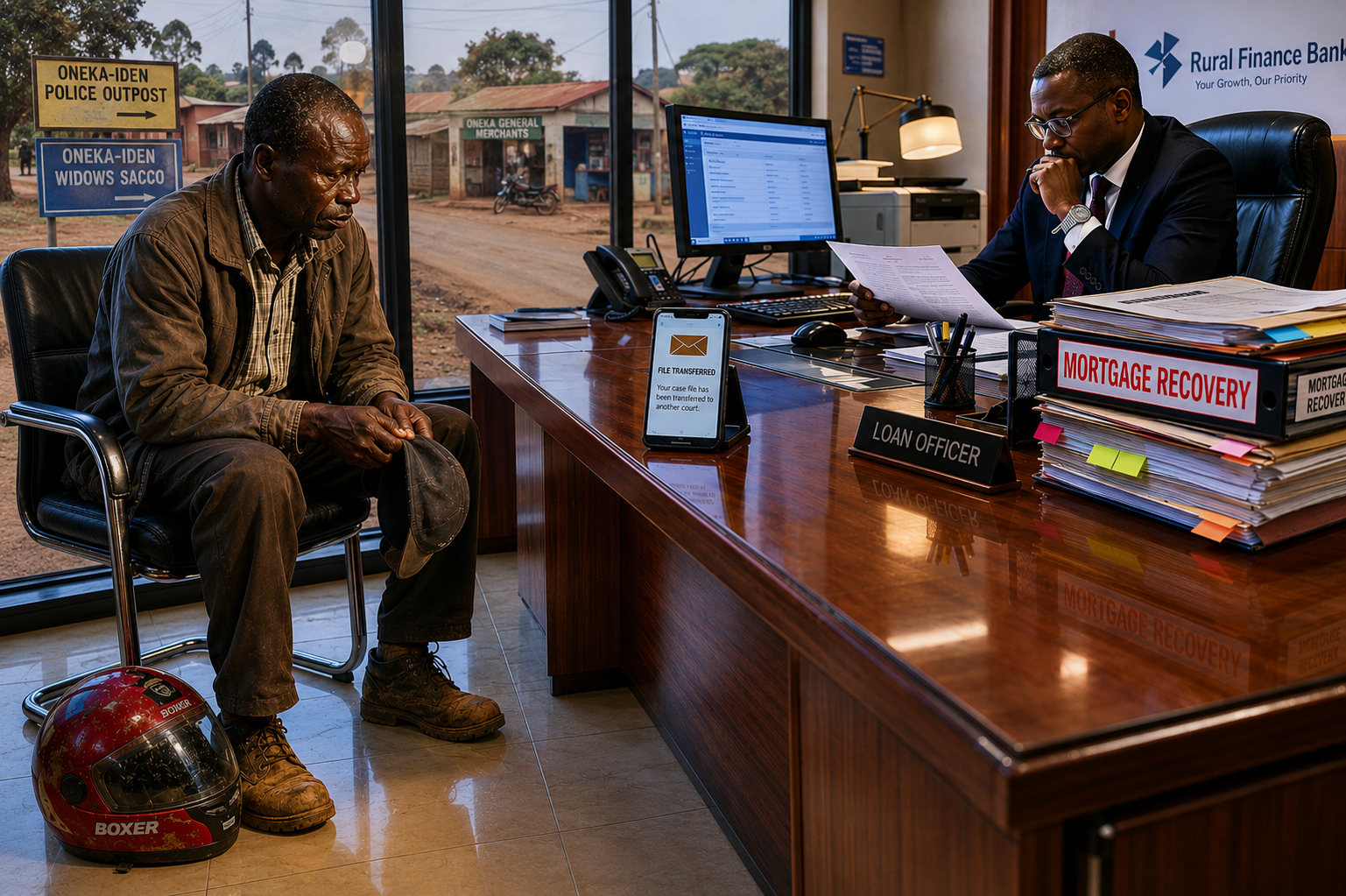
    Forty minutes later, Ocen Okello sat inside the office of the loan officer.

    Tie. Ledger. Calculator. No smile.

    The file marked MORTGAGE RECOVERY – FINAL NOTICE lay open on the desk.

    Ocen removed his cap. Held it in both hands. And began pleading.

    “Sir… please do not sell my house.”

    He swallowed. “The case is very near judgment, I promise.”

    The loan officer said nothing. So Ocen continued.

    “My lawyer says… no more than one month.”

    He pointed weakly toward Omwonyo‑le. “The court has some delays… delays I do not fully understand… delays I cannot even explain properly…”

    Just then – his phone vibrated again.

    This time, Counsel Ogwang Adede.

    He opened the message.

    Brown envelope. Three words.

    TRANSFERRED FOR JUST CAUSE.

    Ocen read it once. Read it twice. Then slowly looked back at the loan officer… and for the first time in four years… did not know which debt was more dangerous – the one inside the bank, or the one inside the court.


    By lunchtime, Omwonyo‑le was already whispering.

    The new Chairperson of the School Management Committee of Kec Primary School – the same school that had eaten Ocen Okello’s beans – was an old boy of Chief Magistrate Munyakuzi.

    In Omwonyo‑le, rumours travelled faster than judgments.
    And this rumour had teeth.

    “He is willing to vouch for his old buddy,” Alyek Molly heard from a clerk in Oneka Iden. “To save the school from an old crippling debt.”

    Alyek said nothing. She was still calculating her mother’s medication. Friday’s tuition. The per diem that would now not come.


    That evening, Mulyanyama sat in his rented room above the pharmacy in Oneka Iden.

    The brown envelope still lay on the table.
    Open. Unfolded. Unanswered.

    The names stared back at him.
    Imat Nekolina. Ocen Okello.
    Four years. Red ribbons. Borrowed fuel. Dead witnesses.
    Transferred. For just cause.

    His phone vibrated.
    Counsel Ogwang Adede.

    Mulyanyama stared at the screen for two rings. Then answered.

    No greetings. Just breathing.

    Then Counsel spoke.

    “Worship… what is going on?”

    Silence.

    “What happened?”

    Another silence. Then the question that hit harder than any objection ever raised in court:

    “Who complained?”

    Mulyanyama looked again at the brown envelope. Then at the ceiling. Then finally spoke. Quietly. Almost apologetically.

    “Counsel… I honestly have no idea.”

    A pause. Then –

    “Just orders from above.”

    Neither man spoke again. For a few seconds, all that remained between lawyer and magistrate was breathing.

    Then the line went dead.

    And for the first time since the amendment, His Worship Mulyanyama realised something far more dangerous than corruption:

    Sometimes a file is not stolen. Sometimes… it is simply called upward.


    Before you blame a magistrate for “delayed justice”… ask two questions:

    Who funded the last special session in your court? And how many times has a file been transferred – without your consent – “for just cause”?

    The system is not broken.
    The system is fully booked.

    Enen Ambrose

    Advocate

    Member: Judiciary Affairs Committee

    Uganda Law Society,

    For feedback or comments: enen@enenlegalworld.com

    If you missed the start of this journey, you can catch up on the systemic breakdown of the Magistrates Courts in Chronicles of His Worship Mulyanyama — Episode 2

    Legal Disclaimer Fiction & Non-Defamation Notice:

    This post is a pure work of fiction and creative literature. The characters, dialogue, specific incidents, and settings—including the character of His Worship Mulyanyama and the location of Omwonyo-le Magistrates Court—are products of the author’s imagination or are used fictitiously. Any resemblance or exact matches to actual persons, living or dead, real-life judicial officers, or specific ongoing cases is entirely coincidental. This text is created solely for the purpose of systemic legislative critique and systemic advocacy; it is not maliciously constructed, nor should it be interpreted as an attempt to defame, misrepresent, or malign any living individual or public office holder.

    The legal references in this Series is for information purposes only and is not intended to be used as a substitute for legal advice. The author does not assume responsibility or admit liability arising from the use of the contents of this blog as legal advice.

    The author strongly encourages readers to consult a licensed attorney for specific context related legal advice.

    FUEL THE MOVEMENT

    Independent institutional critique and advocacy for a radical overhaul of legal culture require time, deep research, and uncompromised independence. If these narratives bring value to your legal journey or challenge your perspective, please visit our HOME PAGE to see how you can support this platform directly and keep the critique fierce and relentless.

    Enen Ambrose. Advocate & Founder–Enen Legal World


  • Chronicles of His Worship Mulyanyama — Episode II

    Chronicles of His Worship Mulyanyama — Episode II

    The Mobile Court That Ate the Diary


    Author’s Note: The Chronicles of His Worship Mulyanyama is a serialized literary commentary designed to constructively critique the institutional and structural implications of the Magistrates Courts (Amendment) Act, No. 6 of 2026. This work is a creative exploration of the human infrastructure behind public service and is not intended to ridicule, embarrass, or undermine the integrity of the Judiciary.


    At 9:43am, the white Land Cruiser rolled into Omwonyo‑le.

    Nobody looked surprised.
    Not the warders.
    Not the litigants.
    Not even His Worship Mulyanyama.

    Only Alyek Molly looked up from the registry.

    She had not been paid in three months.

    That morning, before leaving home, she had crushed her mother’s last blood‑pressure tablet into halves – so it could survive two more days.

    Her tuition at Kampala International University (Mbale campus) was due on Friday. Second year, Bachelor of Laws. She still kept her old Diploma in Law transcript folded inside her registry drawer – next to unpaid electricity receipts.

    When she saw the Land Cruiser, she did not smile.
    But her shoulders relaxed. Just a little.


    The memo was short. Cold. Typed.

    “All ordinary cause‑list matters stand adjourned pending implementation of the Mobile Justice Outreach Session.”

    Fifteen days.


    Ocen Okello closed his eyes.

    Four years.
    Four.
    Not because his case was difficult.
    Because the defendant – a government primary school – had failed to bring its final two witnesses. Again.

    The first adjournment: His Worship Mulyanyama had been away at donor‑funded SGBV training.
    The next three: the school simply came empty‑handed. Each time, the defence begged. Each time, His Worship adjourned – in the interest of justice.
    Each time – no costs.

    Counsel Ogwang Adede had financed this trip from Lira by himself.

    This time, his client simply could not raise it.

    Not because he did not want justice.
    Because justice was competing with school fees.

    With last month’s Bolicap debt – the money he had borrowed to bring both himself and counsel to this same court… for a hearing that never took off.

    With the money still owed to Okello Ajing, who had rescued him that same morning when every other door had gone silent.

    With sugar.
    With paraffin.
    With soap.

    And somewhere inside that collapsing arithmetic… sat the question of whether justice was becoming more expensive than the debt he had come to recover.

    So Counsel Ogwang Adede came anyway.
    On his own fuel.
    On his own time.
    On his own thinning patience.

    And on the dangerous assumption… that today, after four years, somebody inside Omwonyo‑le would finally be ready to finish a case.

    Today, Counsel Ogwang Adede had come ready – not prepared to swallow one more adjournment dressed as “the interest of justice.”

    He had the court file under one arm.
    His diary in the other hand.

    And in the margins of his notebook – authorities, annotations, and one final prayer:

    Order 17 Rule 4 of the Civil Procedure Rules.

    Close the defence.
    Take oral submissions.
    Fix the matter for judgment.

    Four years was enough.

    Today he had not come to negotiate with delay.
    Today… he had come to end it.

    Then Alyek Molly pinned the memo.
    And nobody entered Court No. 2.


    Imat Nekolina did not understand the white car.

    She only knew that her case was not today. Again.
    She approached Alyek Molly. “When?”

    Alyek shrugged. “After the mobile court.”

    “My witness,” Imat said quietly, “the doctor says he has less than fourteen days.”

    Alyek said nothing. She had heard this before too.
    But her mind was already calculating: fifteen days of per diem. Enough for her mother’s medication. Enough for Friday’s tuition.
    She did not wish for the donor to come. But she could not afford to wish otherwise.


    Mulyanyama watched from his chambers.

    He saw Counsel Ogwang Adede standing on the cracked steps – file, diary, notebook – the oral application still just a prayer in his head.
    He saw Imat Nekolina’s face.
    He saw Ocen Okello kick his Boxer motorcycle back to life – and ride away without looking back.

    The Visitor was already inside Court No. 1, setting up his laptop.

    The donor had paid for fifteen days.
    Per diem. Transport. Lunch allowance.
    Enough… to make resistance expensive.

    That evening, Mulyanyama texted a friend:
    “They call it access to justice. I call it access to their priorities.”

    The friend replied: “Did you eat?”

    Mulyanyama did not answer.


    Before you blame a magistrate for “delayed justice”… ask two questions:

    Who funded the last special session in your court? And how many times did the government defendant adjourn without cost?


    Two days later, another envelope arrived.

    Not white.
    Brown.
    Government brown.

    The subject line read:

    TRANSFER OF FILES – FOR JUST CAUSE.

    Mulyanyama read it once.
    Read it twice.

    Then looked at his phone.

    One message waited.
    Just three words.

    Did you eat?


    Institutions are not always captured by force.
    Sometimes… they are rented.
    One allowance at a time.

    Enen Ambrose, Enen Legal World

    Member: Judiciary Affairs Committee

    Uganda Law Society

    Enen Legal World.

    For Feedback or comments: enen@enenlegalworld.com


    Legal Disclaimer

    Fiction & Non-Defamation Notice:

    This post is a pure work of fiction and creative literature. The characters, dialogue, specific incidents, and settings—including the character of His Worship Mulyanyama and the location of Omwonyo-le Magistrates Court—are products of the author’s imagination or are used fictitiously. Any resemblance or exact matches to actual persons, living or dead, real-life judicial officers, or specific ongoing cases is entirely coincidental. This text is created solely for the purpose of systemic legislative critique and systemic advocacy; it is not maliciously constructed, nor should it be interpreted as an attempt to defame, misrepresent, or malign any living individual or public office holder.

    The legal references in this Series is for information purposes only and is not intended to be used as a subtitute for legal advice. The author does not assume responsibility or admit liability arising from the use of the contents of this blog as legal advice.

    The author strongly encourages readers to consult a licensed attorney for specific context related legal advice.

    If you missed Episode 1 of this series, You can access it here: Chronciles of His Worship Mulyanyama Episode 1


  • Chronicles of His Worship Mulyanyama — Episode I

    Chronicles of His Worship Mulyanyama — Episode I

    The Magistrate Who Never Carried Lunch

    Enen Legal World Logo

    Author’s Note: The Chronicles of His Worship Mulyanyama is a serialized literary commentary designed to constructively critique the institutional and structural implications of the Magistrates Courts (Amendment) Act, No. 6 of 2026. This work is a creative exploration of the human infrastructure behind public service and is not intended to ridicule, embarrass, or undermine the integrity of the Judiciary.

    At 7:45am, His Worship Mulyanyama was nowhere near court.

    He sat inside a parked Judiciary double‑cabin pickup, forty kilometres from Omwonyo‑le Magistrates Court. Engine off. Air dead. Phone in hand.

    Battery: 19%.

    Bank balance: not enough.

    Fuel gauge: hovering just above E – the dangerous place where public service stops being transport… and becomes theology.

    On his screen: Mo‑kash. Wewole. ManguCash. Ka‑Sente.

    Four lenders. Four rejections. One salary.

    He had not yet started the engine. Because before justice could move, fuel had to move first.

    So he made another call. Not to a litigant. Not to a lawyer. To a friend.


    His Worship Mulyanyama making calls to top up his fuel before setting off for work.

    By 10:06am, the double‑cabin rolled into Omwonyo‑le.

    The benches were already full.

    Imat Nekolina had walked three kilometres from her village, a faded manila envelope pressed against her chest. Inside: a death certificate, two handwritten land agreements, and a photograph of six goats – the only things her late husband had left behind. She had been coming to court since 2022. This morning, she left cassava unharvested. Again.

    Ocen Okello had kicked his Boxer motorcycle until it coughed to life. Four years earlier, he supplied beans to a government primary school. Class One children had become Class Five. Two headteachers transferred. One bursar retired. The beans had long been eaten – but Ocen had never been paid.

    Yesterday, after every friend with a smartphone suddenly became “busy”, and every relative promised to “call back”, Ocen borrowed his advocate’s transport facilitation from Bolicap – because his lawyer was driving from Lira on the day of the case. This morning, he still had no money of his own. So before sunrise, he crossed the trading centre, placed his extra tablet on the wooden counter of Okello Ajing. Okello Ajing looked at it twice, then pushed a few folded notes across. Just enough for fuel – to follow a file that had forgotten his name.

    Ocen Okello and Imat Nekolina at the waiting lobby.

    Mulyanyama stepped out of the pickup. He did not apologise for the delay. He simply walked to his chambers, put on his robe, and inked his stamp.

    The robe covered the sweat. The stamp covered the hunger. The silence covered the missed calls.


    Court No. 2 had eighty‑three matters cause‑listed before lunch.

    He signed bail forms. Stamped adjournments. Called absent lawyers. Listened to excuses. Listened to tears. Listened to lies. Listened to truth.

    Stamped. Signed. Stamped. Signed. Stamped. Signed.

    By 10:56am, he could no longer remember whether File No. 43 was cattle theft, trespass, or twins fighting over their father’s cassava garden. Only that all of them wanted justice – and all of them wanted it today.

    At 11:02am, his phone vibrated again.

    “Daddy, school says no exam without fees.”

    He read the message. Locked the screen. Then proceeded to deny bail in a case involving twenty thousand shillings. The accused had no transport to return for trial. Mulyanyama explained the law – the risk of absconding, the need for sureties, the presumption of innocence.

    His voice was steady. His reasoning was sound. But between his words, the message sat: No exam without fees.

    By noon, he had not eaten.

    Court No. 1 had computers. Three of them. All bearing the Judiciary crest. All covered in dust. Outside, a solar mast stood proudly beside the flagpole – as if justice here ran on sunlight.

    And on good weeks… it did. When the batteries cooperated. When the switch‑over panel remembered its job. When Umeme remembered Omwonyo‑le existed. Which was usually one morning in five – sometimes between six and ten.

    After that, the screens went black. And when judgments had to be written, when reports had to be filed, when legal research had to be done – Mulyanyama would remove his robe, start the government pickup, and drive twenty kilometres to the nearest trading centre… to borrow electricity.

    That was the unwritten rule of Omwonyo‑le: You do not complain. You endure.

    Omwonyo Magistrates Court Compound

    A litigant approached his desk. Not with a bribe. With a roasted goat leg wrapped in old newspaper. Steam rose. The man said nothing. He simply bowed and left.

    Mulyanyama looked at the meat. He looked at the phone. He looked at Imat Nekolina. He hesitated. Then he ate.

    This was his first meal of the day.

    And somewhere in Kampala, Parliament had quietly decided that His Worship Mulyanyama was ready for more – more files, more value, more pressure – under the newly enacted Magistrates Courts (Amendment) Act, No. 6 of 2026.

    No one asked about his clerk.
    No one asked about his fuel.
    No one asked what he had eaten.
    No one asked about the missed calls.
    No one asked about the solar mast, or the twenty‑kilometre drive to borrow electricity.

    They simply raised his jurisdiction – and left his stomach empty.

    Before His Worship Mulyanyama could deliver justice… he first had to finance it.

    The ground at Omwonyo‑le had swallowed an axe.
    Now it was swallowing him.

    Before you judge His Worship Mulyanyama… visit your nearest court. Stand there for one morning. Count the files. Count the faces. Then ask one question:

    What is missing here?

    You may not like the answer.

    And in Omwonyo‑le… hunger was only the beginning.
    Because one week later… a white Land Cruiser entered the court compound.

    Some systems do not collapse.
    They simply teach good people how to survive inside broken ones.

    Enen Ambrose,

    Advocate.

    Member: Judiciary Affairs Committee

    Uganda Law Society

    Legal World. enen@enenlegalworld.com

    Legal Disclaimer
    Fiction & Non-Defamation Notice:

    This post is a pure work of fiction and creative literature. The characters, dialogue, specific incidents, and settings—including the character of His Worship Mulyanyama and the location of Omwonyo-le Magistrates Court—are products of the author’s imagination or are used fictitiously. Any resemblance or exact matches to actual persons, living or dead, real-life judicial officers, or specific ongoing cases is entirely coincidental. This text is created solely for the purpose of systemic legislative critique and systemic advocacy; it is not maliciously constructed, nor should it be interpreted as an attempt to defame, misrepresent, or malign any living individual or public office holder.

    If you loved this Episode 1 and would love to continue enjoying it, Please acccess Episode 2 from here:

    Chronicles of His Worship Mulyanyama The Mobile Court That Ate the Diary— Episode II

    FUEL THE MOVEMENT Independent institutional critique and advocacy for a radical overhaul of legal culture require time, deep research, and uncompromised independence. If these narratives bring value to your legal journey or challenge your perspective, please visit our HOME PAGE to see how you can support this platform directly and keep the critique fierce and relentless.

    — Enen Ambrose. Advocate & Founder–Enen Legal World