

Dear Colleagues,
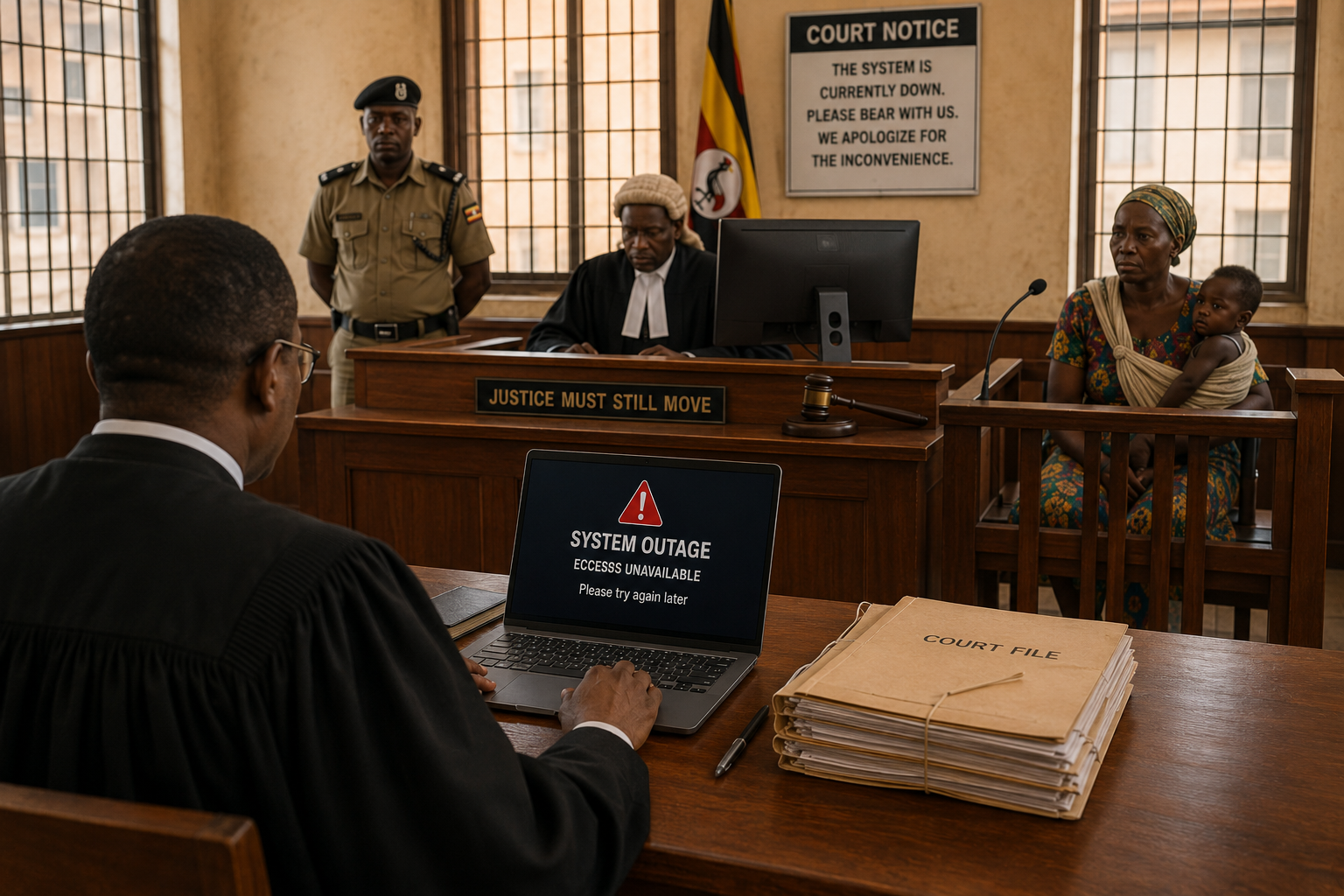
A court file can disappear.
A server can crash.
A network cable can be cut.
Yet justice must still move.
That, in many ways, was the question hanging over the inaugural ECCMIS Symposium that I recently attended as a member of the Judiciary Affairs Committee of the Uganda Law Society, a technology enthusiast, and perhaps most importantly, a practising advocate who has experienced firsthand both the promise and frustrations of Uganda’s digital transition.
This newsletter is a continuation of my earlier reflections on the necessity of technological adoption within our profession. Then, I argued that lawyers must embrace technology or risk being left behind. Today, however, I wish to discuss a different concern: how we ensure that digital transformation does not leave people behind.

The Bar Speaks
Our ULS leadership—President Isaac Ssemakadde, SC, and VP Anthony Asiimwe—were clear: while the Bar supports modernization, we must prioritize accountability and interoperability. As Vice President Asiimwe noted, deadlines continue to run even when the system fails, creating a dangerous procedural environment for advocates. The leadership emphasized that a digital system that cannot guarantee the safety of our filings is, for all practical purposes, a liability to the Rule of Law.
Beyond the Headlines
Much has already been said about ECCMIS, the Judiciary’s flagship case management system. The symposium brought together judicial officers, ICT specialists, researchers, and members of the Bar to discuss the realities of implementation. What emerged was neither a story of triumph nor failure, but one of transition.
Mr. David Sunday Kikabi, Director of ICT at the Judiciary, clarified that the transition remains phased, operating in 49 court stations, representing roughly twenty percent of the Judiciary’s footprint. Hon. Justice Christopher Madrama reminded participants that meaningful criticism must appreciate the operational realities of implementing a national digital infrastructure. Lady Justice Immaculate Busingye offered a historical reminder that ECCMIS was born from the Bar’s outcry over missing court files and administrative inefficiencies.
The Day Technology Sent Me Home
Several years ago, I dispatched my legal assistant to certify specific company records for use as evidence. The process had migrated to digital URSB portals, and the traditional method was no longer available.

Looking back, the issue was not the technology itself, but the lack of preparedness and notice. We arrived at a destination only to discover the road had been moved.
The Walk of Shame
This experience mirrors a reality we have lived or heard of: a lawyer travels with a client, fully prepared, to file court a client’s case, including an urgent application for an interim injunction, a high stakes life and death-last minute filing where the plan is to secure an urgent exparte interim relief, only to be guided that manual filing is nolonger being accepted, rather that everything is being filed online and worst of all, the system is itself down!. The “walk of shame” of the lawyer and his client back to chambers to figure out what to do next undermines the dignity of our profession and erodes trust.
The Namukasa Test
Perhaps the most profound contribution came from Lady Justice Monica Mugyenyi, who asked: Can Namukasa use it? If our justice system is technologically sophisticated but socially inaccessible, it has merely transformed the appearance of the problem, not solved it.
What the Research Revealed
Research presented during the symposium identified recurring concerns, including bandwidth limitations, intermittent outages, server congestion, and user-experience challenges. In some instances, courts equipped for ECCMIS have reverted to manual processes due to operational interruptions. These findings should not be viewed as evidence of failure. Rather, they remind us that digital transformation is a process of continuous refinement.
A copy of the report can be found here:
Building Two Bridges
Waiting for perfection is not a strategy; building bridges is.
- Bridge One: Training the Profession. I am championing a volunteer-led Trainer-of-Trainers programme to bring practical ECCMIS training to regional bars. I invite the Judiciary’s ICT Directorate to collaborate in developing a standardised framework to equip advocates with the skills to navigate the digital environment confidently.
- Bridge Two: Interoperable Solutions. During the symposium, Riyale Tech Solutions showcased the Riyale Legal Suite, an ECCMIS-integrated practice management platform that helps law firms manage and track ECCMIS updates, court cases, hearing dates, documents, clients, billing and invoicing, court schedules, and day-to-day operations. By streamlining legal workflows and digitizing firm operations, Riyale Legal Suite supports the transition to a paperless practice and improves efficiency across the firm. Paperless courts need paperless law firms, and Riyale Legal Suite bridges the gap. Having reviewed the platform, I believe it offers practical solutions for many of the challenges currently facing firms during the transition to digital practice. If you missed symposiom, Access the Riyale Tech Presentation here. Advocates interested in exploring the platform further may contact me for demonstrations, implementation support, and licensing arrangements.
The Road Ahead
The future of justice will undoubtedly be digital. The question is whether it will also remain accessible.
If Namukasa can navigate the system with confidence, if advocates can serve their clients without fear of technological paralysis, and if justice can continue moving even when a server fails, then ECCMIS will have achieved something far greater than digitisation. It will have expanded access to justice. And that is a future worth building.
Now let me be equally clear. I hold no equity, ownership, employment, or decision-making role in Riyale Tech Solutions or any affiliated legal technology provider discussed in this article. Any professional introductions that may arise between practitioners and technology providers do not influence the opinions expressed here, which remain independently formed.
Let us build the connections that matter.
Enen Ambrose
Advocate & Member, Judiciary Affairs Committee, Uganda Law Society
Phone/WhatsApp: 0789856805 | Email: enen@enenlegalworld.com or ambrosenen@gmail.com
 enenlegalworld