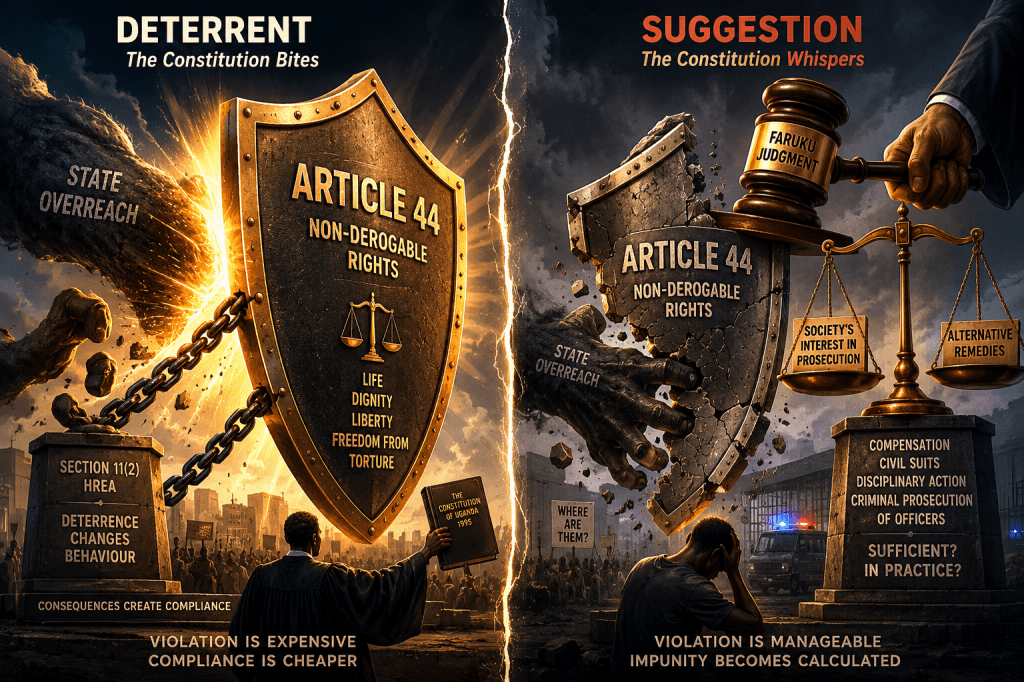
Constitutionalism, Deterrence and the Price of Violating Non-Derogable Rights

Constitutional courts shape legal culture. Some decisions expand the reach of rights. Others contract it. Some become monuments to constitutional progress. Others become warnings from history.
The Constitutional Court’s decision in Faruku Muhamed & Others v Attorney General belongs to the latter category.
Indeed, it may come to be remembered as one of the most consequential constitutional regressions since the promulgation of the 1995 Constitution.
The judgment has already generated intense debate. Supporters praise it as a restoration of balance between the rights of accused persons and society’s legitimate interest in the prosecution of crime. Critics view it as a retreat from the robust protection of non-derogable rights that Ugandan courts painstakingly developed over the last two decades.
I count myself among the latter.
Not because I underestimate the importance of criminal accountability.
Not because I believe every constitutional violation should automatically free every accused person.
But because I believe the Court has fundamentally misunderstood the constitutional function of consequences.
At its heart, Faruku is not a case about criminals.
It is a case about incentives.
It is a case about deterrence.
It is a case about the price the State must pay when it violates the Constitution.
And once one understands that, the implications become profoundly unsettling.
THE FORGOTTEN PURPOSE OF SECTION 11(2)
Much of the commentary surrounding Section 11(2) of the Human Rights (Enforcement) Act proceeds from a mistaken premise.
The provision was never principally about rewarding accused persons.
It was never principally about frustrating criminal trials.
Nor was it intended to create technical escape routes for the guilty.
Its purpose was institutional.
Its purpose was preventative.
Its purpose was deterrent.
Every legal system creates incentives.
A police officer deciding how to obtain evidence responds to incentives.
An investigator deciding whether to respect constitutional safeguards responds to incentives.
A security agency deciding whether compliance is worth the inconvenience responds to incentives.
The genius of Section 11(2) was that it altered those incentives.
It communicated a simple message:
If you violate non-derogable rights, you may lose the prosecution altogether.
That message did not exist to protect criminals.
It existed to discipline power.
It existed to ensure that constitutional compliance became the cheapest option available to the State.
The Court has now substantially weakened that discipline.
THE DOCTRINAL ERROR: WHEN A DETERRENT BECOMES A SUGGESTION
The central problem with Faruku is doctrinal before it is political.
Section 11(2) was not merely a remedy available to an accused person after a violation had occurred.
It was a prophylactic rule.
A constitutional deterrent.
A bright-line consequence designed to influence institutional behaviour before violations occurred.
The provision did not merely compensate victims.
It regulated power.
By emphasizing alternative remedies such as compensation, civil suits, administrative sanctions and criminal proceedings against offending officers, the Court transformed a deterrent into a suggestion.
That distinction matters.
A deterrent commands compliance.
A suggestion invites balancing.
A deterrent changes behaviour.
A suggestion merely expresses disapproval.
The practical consequence is that the constitutional cost of violating non-derogable rights has been reduced.
Rights rarely disappear overnight.
More often, they remain on paper while their practical force is quietly diminished.
That is why Faruku is so significant.
The issue is not whether rights still exist.
The issue is whether violating them has become cheaper.
ARTICLE 44 WAS WRITTEN IN BLOOD, NOT THEORY
Perhaps the most troubling feature of the judgment is its apparent detachment from the constitutional history that produced Article 44 itself.
Article 44 did not emerge from academic theory.
It did not emerge from abstract constitutional philosophy.
It emerged from Uganda’s encounter with arbitrary power.
It emerged from detention without trial.
It emerged from torture.
It emerged from disappearances.
It emerged from constitutional crises that taught painful lessons about what happens when power operates without meaningful restraint.
The framers of the 1995 Constitution understood something simple:
Power rarely restrains itself.
That understanding explains why certain rights were elevated beyond ordinary balancing exercises.
The Constitution does not merely describe freedom from torture as important.
It describes it as non-derogable.
That distinction is critical.
A right that may be balanced against competing interests is fundamentally different from a right that may not.
The Court repeatedly invokes society’s interest in prosecution.
But Article 44 itself represents a balancing exercise already undertaken by the framers.
They considered the demands of security.
They considered public order.
They considered law enforcement.
They nevertheless chose to place certain rights beyond derogation.
The question therefore is not whether courts should rebalance those interests today.
The question is whether courts are free to rebalance what the Constitution has already balanced.
That question deserves far greater attention than it has thus far received.
LEGAL CULTURE: A PERSONAL OBSERVATION
Years ago, I appeared before a Chief Magistrate in a criminal matter that had stagnated for nearly three years.
I argued that the accused person’s constitutional right to a fair and speedy trial had been violated.
The Magistrate looked at me and asked:
“Are you sure the Constitution says the hearing must be speedy?”
I answered in the affirmative.
A copy of the Constitution was produced.
The word was found.
The Magistrate then asked:
“But Counsel, why are you over-lawyering?, I thought you are in a hurry and have other things to do? Me I want to adjourn my matters today and travel for the weekend”
Many younger lawyers would find that exchange difficult to believe.
That is precisely the point.
For the last two decades Uganda’s legal culture has been evolving.
Slowly.
Imperfectly.
Painfully.
But undeniably.
Rights increasingly ceased to be aspirations.
They increasingly became enforceable commands.
Lawyers became bolder.
Judges became more receptive.
Constitutional litigation became more meaningful.
Decisions such as Uganda Law Society v Attorney General, Uganda vs Ssekabira Robert and 11 others, and others collectively contributed to that transformation.
The cases were not identical.
The rights involved were not identical.
But together they built something larger than individual precedents.
They built a culture.
A culture in which State actors increasingly understood that constitutional violations carry consequences.
Faruku teaches a different lesson.
THE COURT’S BALANCING EXERCISE
To criticize the judgment honestly, one must first acknowledge its strongest argument.
Society possesses a legitimate interest in the prosecution of crime.
Victims possess rights.
Public safety matters.
Few reasonable people would celebrate a system in which serious offenders automatically escape accountability because constitutional violations occurred during investigation.
That concern deserves respect.
I do not pretend the question is easy.
There are undoubtedly hard cases at the margins.
But the answer to a difficult question is not to abandon deterrence altogether.
The Court’s solution effectively transfers the cost of constitutional violations away from the State and onto the victim of those violations.
The Court assures us that alternative remedies remain available.
Compensation.
Civil litigation.
Administrative sanctions.
Criminal prosecution of offending officers.
In theory, this appears balanced.
In practice, it appears detached from reality.
How many torture survivors successfully litigate compensation claims after years of detention, trial, imprisonment, poverty and trauma?
How many possess the resources necessary to commence fresh proceedings against the very institutions that violated their rights?
The remedy exists on paper.
Life exists in reality.
The two are not always the same.
THE REALITY PROBLEM
Constitutional theory cannot be divorced from constitutional reality.
Uganda is not debating torture in a vacuum.
Uganda is not debating arbitrary detention in a vacuum.
Uganda is not debating abuse of power in a vacuum.
We are debating these issues within a society where allegations of torture remain common, where unlawful detention continues to generate public controversy and where citizens routinely question whether constitutional safeguards are sufficient to restrain State power.
Perhaps the most chilling symbol of this reality is linguistic.
Ugandans now speak of “drones” not as aircraft but as a particular form of feared encounter with power.
Think about that.
Think about how much constitutional failure must occur before a society casually incorporates the language of disappearance into everyday conversation.
That normalization did not happen by accident.
It happened because constitutional safeguards increasingly appeared uncertain.
The question is whether Faruku strengthens those safeguards or weakens them.
I fear it does the latter.
FROM BROWN TO PLESSY
The analogy may appear provocative.
It is intended to be.
In 1896, the United States Supreme Court decided Plessy v Ferguson.
The Court did not abolish equality.
It merely reinterpreted it in a manner that dramatically reduced its practical force.
Rights remained on paper.
Their effectiveness diminished in reality.
Fifty-eight years later, Brown v Board of Education repudiated that approach.
The lesson is not about race.
The lesson is about constitutional trajectories.
Constitutional progress is not inevitable.
Rights expand.
Rights contract.
Courts advance liberty.
Courts retreat from it.
Faruku does not abolish Article 44.
It does something more subtle.
And therefore potentially more consequential.
It preserves the right while reducing the consequences of violating it.
That is the structural similarity.
In neither case was the constitutional right formally erased.
Instead, the practical cost of ignoring it became negotiable.
That is how constitutional regressions often occur.
Not through dramatic declarations.
Not through open hostility to rights.
But through incremental reductions in consequence.
History teaches that constitutional decline rarely begins when courts announce that rights no longer matter.
It begins when courts assure us that rights still matter while simultaneously reducing the cost of violating them.
CONCLUSION
The Supreme Court may reverse Faruku.
It may not.
That question will be answered in due course.
The more profound question concerns constitutional culture.
For two decades Uganda appeared to be moving toward a constitutional order in which rights carried consequences and power carried limits.
Faruku signals movement in the opposite direction.
Whether that signal becomes a turning point or merely a temporary detour remains unknown.
History will answer that question.
The rest of us must live through it.
If future generations inherit a stronger constitutional culture, Faruku will be remembered as a wrong turn that was eventually corrected.
If they inherit a weaker one, where torture remains illegal but increasingly inexpensive for the State, they may remember it differently.
Not as the day constitutional rights disappeared.
But as the day violating them became cheaper.
Not as the day the Constitution died.
But as the day it was asked to whisper where once it could roar.
DISCLAIMER:
The contents of this Blog are not intended to be used as a substitute for legal advice. The author shall not accept liability for use of the contents of this Blog as legal advice. Readers are encuraged to consult qualified advocates for real life situations for legal advice.
JOIN THE UNDERGROUND AND FUEL THE MOVEMENT

We have created a dedicated fans WhatsApp Channel. Don’t miss the latest updates, get early bird access to our latest blog posts and more, so much more. Click the following link to follow the Channel: https://whatsapp.com/channel/0029Vb9BQqw5a246bWVsLl3j
Independent institutional critique and advocacy for a radical overhaul of legal culture require time, deep research, and uncompromised independence. If these narratives bring value to your legal journey or challenge your perspective, please visit our HOME PAGE to see how you can support this platform directly and keep the critique fierce and relentless.
Enen Ambrose. Advocate
Member, Judiciary Affairs Committee,
Uganda Law Society
& Founder–Enen Legal World
 enenlegalworld