Tag: history

  • A Paperless Judiciary: Why Aren’t We Ready?

    A Paperless Judiciary: Why Aren’t We Ready?

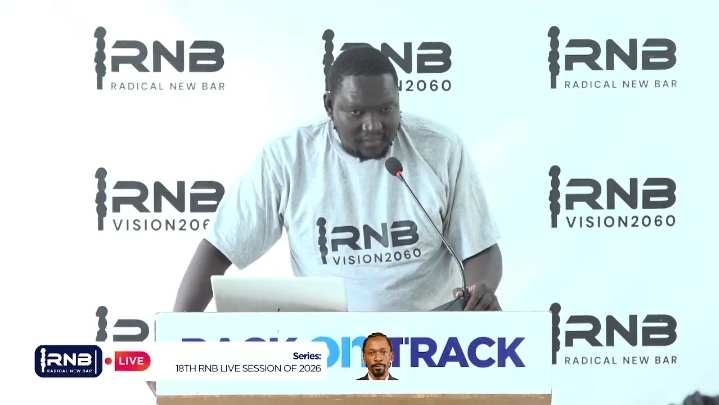
    A speech I presentd at the 18th RNB Live on 4th June, 2026 at ULS House, Kampala
    Paperless Judiciary: Why Aren’t We Ready?

    A speech presented by Enen Ambrose, blogger at www.enenlegalworld.com at the 18th RNB Live on 4th June, 2026 at ULS House, Kampala

    The President of the Uganda Law Society, Isaac K. Ssemakadde SC, the Most Perpendicular Vice President, Anthony Asiimwe, my Northern Uganda Representative to the ULS Governing Council, Egaru Emmanuel Omiat, who I believe is following this discussion online,the General Secretary Salim Babu, together with fellow members of the ULS RNB Governing Council — whom I prefer to call the ULS RNB High Command — the highly distinguished members of the medical fraternity present with us today, colleagues, fellow officers of the court, distinguished guests, and fellow citizens both here in the hall and watching us online:

    I was invited to speak in my capacity as a blogger at www.enenlegalworld.com on the theme: A Fully Paperless Judiciary — Why Aren’t We Ready?

    I stand before you today with deep humility and sincere concern. As a technology enthusiast who believes that technology must facilitate access to justice rather than impede it, I have witnessed firsthand the challenges that arise when we rush into a fully paperless system without adequately preparing the people it is meant to serve.

    What I have observed is not mere technical inconvenience. It is something far more serious — a subtle but damaging form of harm which I prefer to call “the quiet violence of procedure” being done to the very people we are sworn to serve.

     Part I: The Quiet Crisis

    This is not the violence of guns or angry mobs. It is the quiet, daily violence of a system that pretends everything is working when it clearly isn’t.

    Just three days ago, on 1st June 2026, the Judiciary’s deadline for crossing into full paperless operations came and went. Yet the Judiciary’s ICT Director confirmed that the system will only be rolled out to 49 courts — just 20% of the total.

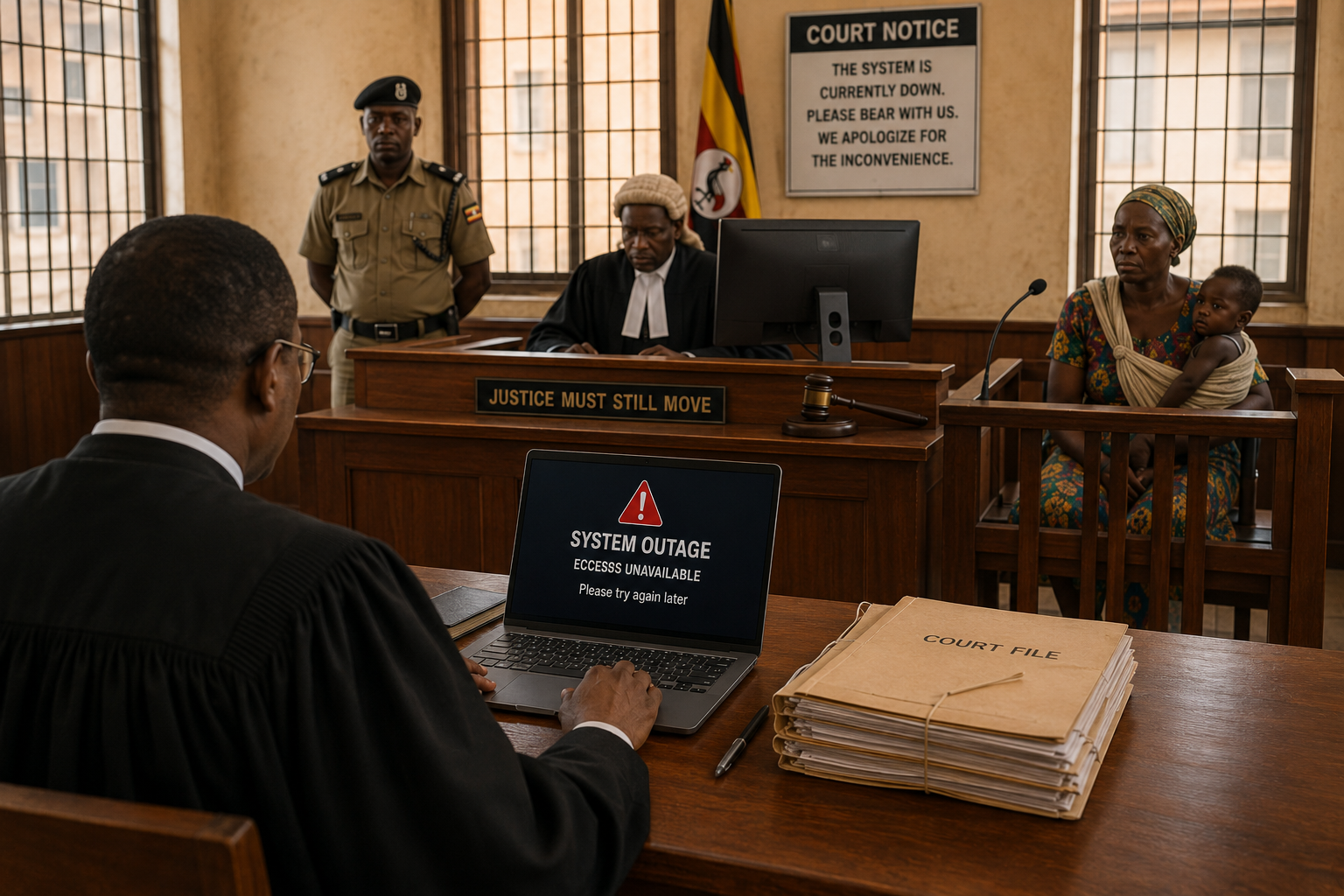
    Imagine a magistrate who cannot access a bail application because the network has failed. The system coldly declares “the file is not before court.” Yet the accused — whether a poor market vendor, a struggling farmer, or a respected professional — stands right there in the dock.

    When this recently happened to an advocate, that person was remanded to Luzira Prison.

    We have always been told that justice delayed is justice denied. But what do we call justice that has simply disappeared from the screen?

    We are rushing into a paperless judiciary while many citizens, and even many lawyers, still cannot navigate it. If a poor person cannot understand their case without a single sheet of paper, have we really advanced, or have we simply replaced one barrier with a more expensive, more frustrating one?

     Part II: The Evidence on the Ground

    My concerns are not theoretical. A recent survey by the PM Digital Law Hub revealed worrying numbers:

    – 87% of judicial officers and advocates have experienced frequent system disruptions. 

    – 78% say technical support is unreliable. 

    – 67% were not confident we would be ready for the June 1st deadline. 

    – 59% have received no formal training at all.

    Let me give you a picture of what these numbers mean. My firm once sent a bright, confident legal assistant to the Gulu branch of the Uganda Registration Services Bureau. His task was to certify company records we needed as evidence in court. He knew the registry. He knew the clerk. He was polished and fully prepared.

    But when he arrived, the physical counter was still there — yet the records had already moved online. The staff of URSB turned him back empty-handed. That day, we had no choice but to force ourselves to adapt to the new technology.

    That, colleagues, is exactly where many of us are today with ECCMIS. We are still walking the old path, trusting the old counters, while the world has moved on.

    Let me tell you another story — one that has not happened yet, but will happen if we are not careful. I want you to meet a lawyer. She is experienced. She has practised for fifteen years. One afternoon, she receives an urgent call. A client is about to be evicted. A temporary injunction must be filed before 5:00 p.m. She knows the High Court Registry well. She has done this a hundred times. But when she arrives, the counters are gone. The clerks point to a sign: “All filings electronic. Use ECCMIS. No paper accepted.” She does not have her laptop. The courthouse Wi‑Fi is down. Her phone battery is low. She tries to log in — she has forgotten her password. She calls her clerk. No answer. The clock shows 4:47 p.m. Her client will be evicted tomorrow. And there is nothing she can do. Colleagues, come July 2026, if the paperless mandate is fully enforced without the changes we are demanding, this will happen. I guarantee it. Our lady lawyer will stand in that registry, fully unarmed and disempowered. In that moment, like our legal assistant at URSB, she will learn the hard way: how she was trained for the profession is no longer relevant. She must upgrade her digital skills — or risk being rendered irrelevant.

    In 2026, we still have judicial officers reaching for the Civil Procedure Rules of 1929 to determine the validity of a summons delivered through a WhatsApp message, while the entire body of laws enacted to facilitate the digital transformation of the Judiciary gathers dust.

    Without a clear Practice Direction from the Chief Justice, and without digital competence forming part of performance evaluation, even this limited rollout to only 49 courts risks a spectacular failure.

     Part III: The Human Cost

    The Nocturnal Lawyer

    Our advocates are now working at 2:00 a.m. not because they are dedicated, but because the system is too slow and congested during the day. We have, in effect, outsourced government server problems to the sleep and mental health of lawyers.

    This is not digital transformation. It is like constructing a magnificent house without laying a proper foundation — impressive on the surface, but unsustainable and harmful to those who must live in it.

    A new digital underclass

    As Advocate Madira Jimmy from Arua warned me, many lawyers in the North risk being reduced to “local assistants” for Kampala-based lawyers who have better internet and support.

    The same law degree, the same oath, but a completely different playing field. This is creating a dangerous hierarchy inside our own profession.

    The Vanishing File

    Under the old physical system, a file could be traced. Today, an urgent application can simply “disappear” in the ECCMIS system.

    A judicial officer who does not wish to attend to a matter no longer needs to hide a physical file. They can simply say, “The system shows nothing.” And who can argue with a screen they cannot see?

    We recently experienced this when the Uganda Law Society filed an urgent Human Rights Application concerning the Ggaba trial. That application was effectively not attended to.

    In my humble view, this incident points not only to a potential case of misconduct against the concerned judicial officers, but more importantly, to a deeper and disturbing lack of accountability in our digital justice system.

    If this can be done to the Uganda Law Society itself, one wonders: who else is suffering the same fate — ordinary citizens who have no voice and no remedy at all?

    Part IV: What We Must Do

    I am not here to condemn the Bar or the Bench, nor am I here as a doomsayer. My critique is directed across the board — at all of us who have a role to play in the successful adoption of digital transformation in the administration of justice.

    1. Mandate Offline Functionality — Every court computer must be able to pre-cache daily files and work when the network fails. Our banking, email apps, file backup systems like Google Drive already do this.
    1. Mandatory Training — No more “learning on the job.” Every judicial officer, clerk, and advocate must undergo verifiable digital training.
    1. Recognise Modern Communication — Issue a Practice Direction accepting service via WhatsApp and SMS to verified numbers. The court can always set aside service where injustice is shown.
    1. True Hybrid System — Do not treat paper as the enemy. A genuine hybrid approach beyond the current 20% rollout is wisdom, not weakness.
    1. Citizen-Centred Design — The system must work for the widow in Amudat who has never opened a PDF.
    1. Cultivate a Transformed Legal Culture — Digital transformation without a corresponding culture of accountability and citizen-centred justice is merely digitising the old bad manners. We must deliberately build a new legal culture where technology serves justice rather than concealing injustice.
    2. Embrace Technology at Individual and Institutional Level — We must consciously cultivate a new culture of embracing technology at both personal and institutional levels. A lawyer who boasts that they never read their emails or deliberately switches off their WhatsApp blue ticks is no different from a judicial officer who conveniently claims “the system shows nothing.” True digital transformation demands personal responsibility from all of us.

     Part V: A Call to Action

    To my fellow advocates: We must continue having honest and regular conversations about digital transformation and the development of a new digital legal culture. Our shared goal is to ensure that technology truly enhances access to justice for all. Let us speak up constructively, with one voice, for the good of our clients and the future of our profession.

    To judicial officers: My clarion call to you today is this — many of you are working under very difficult conditions. Let us join hands and fight together for better tools, better infrastructure, and better support.

    As the ancient proverb teaches us — and I have merely adapted it here — “the roots of accountability are bitter, but the fruits are sweet.” (A variation of Aristotle’s famous saying on education). Let us therefore courageously cultivate, at both personal and institutional levels, a new legal culture of accountability and genuine digital transformation.

    To the people of Uganda: Walk with us. The widow in Amudat — who has never opened a PDF — the accused in Luzira, whose bail application vanished from a screen, and the nocturnal lawyer, awake at 2am fighting a congested server — they need us to get this right.

    The spirit is willing. Let us now strengthen the flesh of this system.

    Thank you.

    I remain Enen Ambrose of Enen Legal World, a legal literacy blog which you can find at www.enenlegalworld.com and I say this for God and My Country.

    ENEN AMBROSE

    www.enenlegalworld.com

    A copy of the speech can be found here:

    JOIN THE UNDERGROUND AND FUEL THE MOVEMENT

    We have created a dedicated fans WhatsApp Channel. Don’t miss the latest updates, get early bird access to our latest blog posts and more, so much more. Click the following link to follow the Channel: https://whatsapp.com/channel/0029Vb9BQqw5a246bWVsLl3j

    Independent institutional critique and advocacy for a radical overhaul of legal culture require time, deep research, and uncompromised independence. If these narratives bring value to your legal journey or challenge your perspective, please visit our HOME PAGE to see how you can support this platform directly and keep the critique fierce and relentless.

    Enen Ambrose. Advocate

    Member, Judiciary Affairs Committee,

    Uganda Law Society

    & Founder–Enen Legal World
  • FROM BROWN TO PLESSY: WHY FARUKU MAY BECOME THE MOST CONSEQUENTIAL CONSTITUTIONAL REGRESSION OF THE LAST TWO DECADES

    FROM BROWN TO PLESSY: WHY FARUKU MAY BECOME THE MOST CONSEQUENTIAL CONSTITUTIONAL REGRESSION OF THE LAST TWO DECADES

    Constitutionalism, Deterrence and the Price of Violating Non-Derogable Rights

    Constitutional courts shape legal culture. Some decisions expand the reach of rights. Others contract it. Some become monuments to constitutional progress. Others become warnings from history.

    The Constitutional Court’s decision in Faruku Muhamed & Others v Attorney General belongs to the latter category.

    Indeed, it may come to be remembered as one of the most consequential constitutional regressions since the promulgation of the 1995 Constitution.

    The judgment has already generated intense debate. Supporters praise it as a restoration of balance between the rights of accused persons and society’s legitimate interest in the prosecution of crime. Critics view it as a retreat from the robust protection of non-derogable rights that Ugandan courts painstakingly developed over the last two decades.

    I count myself among the latter.

    Not because I underestimate the importance of criminal accountability.

    Not because I believe every constitutional violation should automatically free every accused person.

    But because I believe the Court has fundamentally misunderstood the constitutional function of consequences.

    At its heart, Faruku is not a case about criminals.

    It is a case about incentives.

    It is a case about deterrence.

    It is a case about the price the State must pay when it violates the Constitution.

    And once one understands that, the implications become profoundly unsettling.

    THE FORGOTTEN PURPOSE OF SECTION 11(2)

    Much of the commentary surrounding Section 11(2) of the Human Rights (Enforcement) Act proceeds from a mistaken premise.

    The provision was never principally about rewarding accused persons.

    It was never principally about frustrating criminal trials.

    Nor was it intended to create technical escape routes for the guilty.

    Its purpose was institutional.

    Its purpose was preventative.

    Its purpose was deterrent.

    Every legal system creates incentives.

    A police officer deciding how to obtain evidence responds to incentives.

    An investigator deciding whether to respect constitutional safeguards responds to incentives.

    A security agency deciding whether compliance is worth the inconvenience responds to incentives.

    The genius of Section 11(2) was that it altered those incentives.

    It communicated a simple message:

    If you violate non-derogable rights, you may lose the prosecution altogether.

    That message did not exist to protect criminals.

    It existed to discipline power.

    It existed to ensure that constitutional compliance became the cheapest option available to the State.

    The Court has now substantially weakened that discipline.

    THE DOCTRINAL ERROR: WHEN A DETERRENT BECOMES A SUGGESTION

    The central problem with Faruku is doctrinal before it is political.

    Section 11(2) was not merely a remedy available to an accused person after a violation had occurred.

    It was a prophylactic rule.

    A constitutional deterrent.

    A bright-line consequence designed to influence institutional behaviour before violations occurred.

    The provision did not merely compensate victims.

    It regulated power.

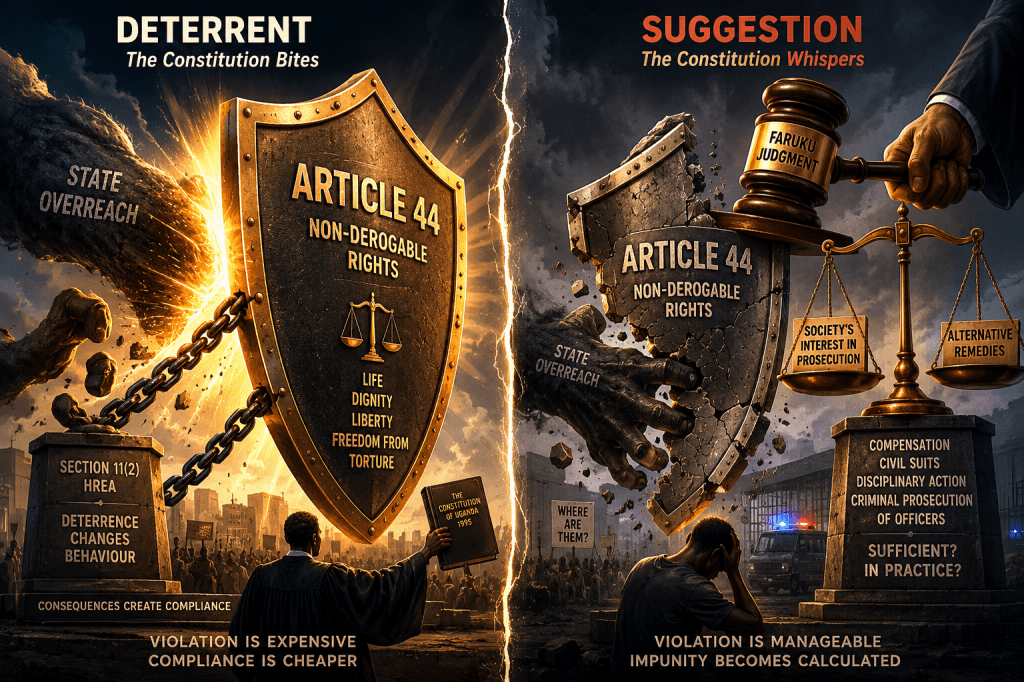
    By emphasizing alternative remedies such as compensation, civil suits, administrative sanctions and criminal proceedings against offending officers, the Court transformed a deterrent into a suggestion.

    That distinction matters.

    A deterrent commands compliance.

    A suggestion invites balancing.

    A deterrent changes behaviour.

    A suggestion merely expresses disapproval.

    The practical consequence is that the constitutional cost of violating non-derogable rights has been reduced.

    Rights rarely disappear overnight.

    More often, they remain on paper while their practical force is quietly diminished.

    That is why Faruku is so significant.

    The issue is not whether rights still exist.

    The issue is whether violating them has become cheaper.

    ARTICLE 44 WAS WRITTEN IN BLOOD, NOT THEORY

    Perhaps the most troubling feature of the judgment is its apparent detachment from the constitutional history that produced Article 44 itself.

    Article 44 did not emerge from academic theory.

    It did not emerge from abstract constitutional philosophy.

    It emerged from Uganda’s encounter with arbitrary power.

    It emerged from detention without trial.

    It emerged from torture.

    It emerged from disappearances.

    It emerged from constitutional crises that taught painful lessons about what happens when power operates without meaningful restraint.

    The framers of the 1995 Constitution understood something simple:

    Power rarely restrains itself.

    That understanding explains why certain rights were elevated beyond ordinary balancing exercises.

    The Constitution does not merely describe freedom from torture as important.

    It describes it as non-derogable.

    That distinction is critical.

    A right that may be balanced against competing interests is fundamentally different from a right that may not.

    The Court repeatedly invokes society’s interest in prosecution.

    But Article 44 itself represents a balancing exercise already undertaken by the framers.

    They considered the demands of security.

    They considered public order.

    They considered law enforcement.

    They nevertheless chose to place certain rights beyond derogation.

    The question therefore is not whether courts should rebalance those interests today.

    The question is whether courts are free to rebalance what the Constitution has already balanced.

    That question deserves far greater attention than it has thus far received.

    LEGAL CULTURE: A PERSONAL OBSERVATION

    Years ago, I appeared before a Chief Magistrate in a criminal matter that had stagnated for nearly three years.

    I argued that the accused person’s constitutional right to a fair and speedy trial had been violated.

    The Magistrate looked at me and asked:

    “Are you sure the Constitution says the hearing must be speedy?”

    I answered in the affirmative.

    A copy of the Constitution was produced.

    The word was found.

    The Magistrate then asked:

    “But Counsel, why are you over-lawyering?, I thought you are in a hurry and have other things to do? Me I want to adjourn my matters today and travel for the weekend”

    Many younger lawyers would find that exchange difficult to believe.

    That is precisely the point.

    For the last two decades Uganda’s legal culture has been evolving.

    Slowly.

    Imperfectly.

    Painfully.

    But undeniably.

    Rights increasingly ceased to be aspirations.

    They increasingly became enforceable commands.

    Lawyers became bolder.

    Judges became more receptive.

    Constitutional litigation became more meaningful.

    Decisions such as Uganda Law Society v Attorney General, Uganda vs Ssekabira Robert and 11 others, and others collectively contributed to that transformation.

    The cases were not identical.

    The rights involved were not identical.

    But together they built something larger than individual precedents.

    They built a culture.

    A culture in which State actors increasingly understood that constitutional violations carry consequences.

    Faruku teaches a different lesson.

    THE COURT’S BALANCING EXERCISE

    To criticize the judgment honestly, one must first acknowledge its strongest argument.

    Society possesses a legitimate interest in the prosecution of crime.

    Victims possess rights.

    Public safety matters.

    Few reasonable people would celebrate a system in which serious offenders automatically escape accountability because constitutional violations occurred during investigation.

    That concern deserves respect.

    I do not pretend the question is easy.

    There are undoubtedly hard cases at the margins.

    But the answer to a difficult question is not to abandon deterrence altogether.

    The Court’s solution effectively transfers the cost of constitutional violations away from the State and onto the victim of those violations.

    The Court assures us that alternative remedies remain available.

    Compensation.

    Civil litigation.

    Administrative sanctions.

    Criminal prosecution of offending officers.

    In theory, this appears balanced.

    In practice, it appears detached from reality.

    How many torture survivors successfully litigate compensation claims after years of detention, trial, imprisonment, poverty and trauma?

    How many possess the resources necessary to commence fresh proceedings against the very institutions that violated their rights?

    The remedy exists on paper.

    Life exists in reality.

    The two are not always the same.

    THE REALITY PROBLEM

    Constitutional theory cannot be divorced from constitutional reality.

    Uganda is not debating torture in a vacuum.

    Uganda is not debating arbitrary detention in a vacuum.

    Uganda is not debating abuse of power in a vacuum.

    We are debating these issues within a society where allegations of torture remain common, where unlawful detention continues to generate public controversy and where citizens routinely question whether constitutional safeguards are sufficient to restrain State power.

    Perhaps the most chilling symbol of this reality is linguistic.

    Ugandans now speak of “drones” not as aircraft but as a particular form of feared encounter with power.

    Think about that.

    Think about how much constitutional failure must occur before a society casually incorporates the language of disappearance into everyday conversation.

    That normalization did not happen by accident.

    It happened because constitutional safeguards increasingly appeared uncertain.

    The question is whether Faruku strengthens those safeguards or weakens them.

    I fear it does the latter.

    FROM BROWN TO PLESSY

    The analogy may appear provocative.

    It is intended to be.

    In 1896, the United States Supreme Court decided Plessy v Ferguson.

    The Court did not abolish equality.

    It merely reinterpreted it in a manner that dramatically reduced its practical force.

    Rights remained on paper.

    Their effectiveness diminished in reality.

    Fifty-eight years later, Brown v Board of Education repudiated that approach.

    The lesson is not about race.

    The lesson is about constitutional trajectories.

    Constitutional progress is not inevitable.

    Rights expand.

    Rights contract.

    Courts advance liberty.

    Courts retreat from it.

    Faruku does not abolish Article 44.

    It does something more subtle.

    And therefore potentially more consequential.

    It preserves the right while reducing the consequences of violating it.

    That is the structural similarity.

    In neither case was the constitutional right formally erased.

    Instead, the practical cost of ignoring it became negotiable.

    That is how constitutional regressions often occur.

    Not through dramatic declarations.

    Not through open hostility to rights.

    But through incremental reductions in consequence.

    History teaches that constitutional decline rarely begins when courts announce that rights no longer matter.

    It begins when courts assure us that rights still matter while simultaneously reducing the cost of violating them.

    CONCLUSION

    The Supreme Court may reverse Faruku.

    It may not.

    That question will be answered in due course.

    The more profound question concerns constitutional culture.

    For two decades Uganda appeared to be moving toward a constitutional order in which rights carried consequences and power carried limits.

    Faruku signals movement in the opposite direction.

    Whether that signal becomes a turning point or merely a temporary detour remains unknown.

    History will answer that question.

    The rest of us must live through it.

    If future generations inherit a stronger constitutional culture, Faruku will be remembered as a wrong turn that was eventually corrected.

    If they inherit a weaker one, where torture remains illegal but increasingly inexpensive for the State, they may remember it differently.

    Not as the day constitutional rights disappeared.

    But as the day violating them became cheaper.

    Not as the day the Constitution died.

    But as the day it was asked to whisper where once it could roar.

    DISCLAIMER:

    The contents of this Blog are not intended to be used as a substitute for legal advice. The author shall not accept liability for use of the contents of this Blog as legal advice. Readers are encuraged to consult qualified advocates for real life situations for legal advice.

    JOIN THE UNDERGROUND AND FUEL THE MOVEMENT

    We have created a dedicated fans WhatsApp Channel. Don’t miss the latest updates, get early bird access to our latest blog posts and more, so much more. Click the following link to follow the Channel: https://whatsapp.com/channel/0029Vb9BQqw5a246bWVsLl3j

    Independent institutional critique and advocacy for a radical overhaul of legal culture require time, deep research, and uncompromised independence. If these narratives bring value to your legal journey or challenge your perspective, please visit our HOME PAGE to see how you can support this platform directly and keep the critique fierce and relentless.

    Enen Ambrose. Advocate

    Member, Judiciary Affairs Committee,

    Uganda Law Society

    & Founder–Enen Legal World
  • THE DIGITAL JUSTICE CROSSROADS: REFLECTIONS FROM THE ECCMIS SYMPOSIUM

    THE DIGITAL JUSTICE CROSSROADS: REFLECTIONS FROM THE ECCMIS SYMPOSIUM

    Dear Colleagues,

    A court file can disappear.

    A server can crash.

    A network cable can be cut.

    Yet justice must still move.

    That, in many ways, was the question hanging over the inaugural ECCMIS Symposium that I recently attended as a member of the Judiciary Affairs Committee of the Uganda Law Society, a technology enthusiast, and perhaps most importantly, a practising advocate who has experienced firsthand both the promise and frustrations of Uganda’s digital transition.

    This newsletter is a continuation of my earlier reflections on the necessity of technological adoption within our profession. Then, I argued that lawyers must embrace technology or risk being left behind. Today, however, I wish to discuss a different concern: how we ensure that digital transformation does not leave people behind.

    The Bar Speaks

    Our ULS leadership—President Isaac Ssemakadde, SC, and VP Anthony Asiimwe—were clear: while the Bar supports modernization, we must prioritize accountability and interoperability. As Vice President Asiimwe noted, deadlines continue to run even when the system fails, creating a dangerous procedural environment for advocates. The leadership emphasized that a digital system that cannot guarantee the safety of our filings is, for all practical purposes, a liability to the Rule of Law.

    Beyond the Headlines

    Much has already been said about ECCMIS, the Judiciary’s flagship case management system. The symposium brought together judicial officers, ICT specialists, researchers, and members of the Bar to discuss the realities of implementation. What emerged was neither a story of triumph nor failure, but one of transition.

    Mr. David Sunday Kikabi, Director of ICT at the Judiciary, clarified that the transition remains phased, operating in 49 court stations, representing roughly twenty percent of the Judiciary’s footprint. Hon. Justice Christopher Madrama reminded participants that meaningful criticism must appreciate the operational realities of implementing a national digital infrastructure. Lady Justice Immaculate Busingye offered a historical reminder that ECCMIS was born from the Bar’s outcry over missing court files and administrative inefficiencies.

    The Day Technology Sent Me Home

    Several years ago, I dispatched my legal assistant to certify specific company records for use as evidence. The process had migrated to digital URSB portals, and the traditional method was no longer available.

    Looking back, the issue was not the technology itself, but the lack of preparedness and notice. We arrived at a destination only to discover the road had been moved.

    The Walk of Shame

    This experience mirrors a reality we have lived or heard of: a lawyer travels with a client, fully prepared, to file court a client’s case, including an urgent application for an interim injunction, a high stakes life and death-last minute filing where the plan is to secure an urgent exparte interim relief, only to be guided that manual filing is nolonger being accepted, rather that everything is being filed online and worst of all, the system is itself down!. The “walk of shame” of the lawyer and his client back to chambers to figure out what to do next undermines the dignity of our profession and erodes trust.

    The Namukasa Test

    Perhaps the most profound contribution came from Lady Justice Monica Mugyenyi, who asked: Can Namukasa use it? If our justice system is technologically sophisticated but socially inaccessible, it has merely transformed the appearance of the problem, not solved it.

    What the Research Revealed

    Research presented during the symposium identified recurring concerns, including bandwidth limitations, intermittent outages, server congestion, and user-experience challenges. In some instances, courts equipped for ECCMIS have reverted to manual processes due to operational interruptions. These findings should not be viewed as evidence of failure. Rather, they remind us that digital transformation is a process of continuous refinement.

    A copy of the report can be found here:

    Building Two Bridges

    Waiting for perfection is not a strategy; building bridges is.

    1. Bridge One: Training the Profession. I am championing a volunteer-led Trainer-of-Trainers programme to bring practical ECCMIS training to regional bars. I invite the Judiciary’s ICT Directorate to collaborate in developing a standardised framework to equip advocates with the skills to navigate the digital environment confidently.
    2. Bridge Two: Interoperable Solutions. During the symposium, Riyale Tech Solutions showcased the Riyale Legal Suite, an ECCMIS-integrated practice management platform that helps law firms manage and track ECCMIS updates, court cases, hearing dates, documents, clients, billing and invoicing, court schedules, and day-to-day operations. By streamlining legal workflows and digitizing firm operations, Riyale Legal Suite supports the transition to a paperless practice and improves efficiency across the firm. Paperless courts need paperless law firms, and Riyale Legal Suite bridges the gap. Having reviewed the platform, I believe it offers practical solutions for many of the challenges currently facing firms during the transition to digital practice. If you missed symposiom, Access the Riyale Tech Presentation here. Advocates interested in exploring the platform further may contact me for demonstrations, implementation support, and licensing arrangements.

    The Road Ahead

    The future of justice will undoubtedly be digital. The question is whether it will also remain accessible.

    If Namukasa can navigate the system with confidence, if advocates can serve their clients without fear of technological paralysis, and if justice can continue moving even when a server fails, then ECCMIS will have achieved something far greater than digitisation. It will have expanded access to justice. And that is a future worth building.

    Now let me be equally clear. I hold no equity, ownership, employment, or decision-making role in Riyale Tech Solutions or any affiliated legal technology provider discussed in this article. Any professional introductions that may arise between practitioners and technology providers do not influence the opinions expressed here, which remain independently formed.

    Let us build the connections that matter.

    Enen Ambrose

    Advocate & Member, Judiciary Affairs Committee, Uganda Law Society

    Phone/WhatsApp: 0789856805 | Email: enen@enenlegalworld.com or ambrosenen@gmail.com

  • EPISODE 1: THE LEGEND OF ABONGODERO

    EPISODE 1: THE LEGEND OF ABONGODERO

    Enen Legal World Logo


    There is a village called Abongodero. Abongodero means without a granary.

    The villagers named it after Mzee Zakayo’s ingenuity.

    Zakayo was clever. He never built a granary of his own. Instead, he raised cattle, fat bulls, glossy heifers. When hunger season approached, he would walk to a farmer whose granaries groaned with millet and offer a bull in exchange for rights to a certain number of storehouses. Enough to feed his household. Enough to impress the neighbors.

    The arrangement was sealed with a handshake. Everyone knew Zakayo’s cattle. Everyone knew he paid.

    The villagers admired him.

    “..Look at Zakayo!..”they whispered around evening fires. “He eats from granaries he never built!

    They admired him so much that they named the village after his ingenuity.

    Abongodero.

    A photo of a granary.  Credit. Uganda Today: from article: A testament to tradition: the art of grain in Uganda’s homesteads by Chris Kato.

    But abundance has a wicked sense of humor.

    Zakayo’s children grew up knowing which families owed them food, which granaries bore their father’s mark. They inherited cattle, but not discipline. They inherited the right to eat, but not the wisdom to plant.

    One of them was Okello Anyapo.

    Anyapo. The lazy one.

    Okello inherited land so fertile it blushed when rain touched it. Black soil. Generous soil. Soil that would have yielded harvests his grandfather never imagined.

    But his hoe remained smooth. His fields grew weeds tall enough to vote.

    When hunger came, Okello blamed the sun for burning too bright. He blamed the rain for falling too hard. He blamed the ancestors for not speaking loudly enough. He blamed everyone except his idle hands.

    Across the stream lived Owera Apur.

    Apur the Farmer.

    He did not give speeches about productivity. He simply woke before the rooster finished its gossip. He dug. He planted. He weeded. He waited. His granary stood behind his hut like a quiet monument to repetition.

    He had no cattle to trade. He had only his back, his hands, and his patience.

    His granary stood full.

    Proof that the land was never the problem.

    Then hunger came like a leopard.

    The families who once owed Zakayo’s children had rebuilt their stores. They no longer needed cattle. They needed their millet for themselves.

    Okello’s inheritance could not be traded for what no one would sell.

    Hunger clawed him thin.

    He crossed the stream.

    “Uncle,” he said. “We are blood. Remember Father Zakayo? The village bears witness to his name.”

    In Lango, dignity comes before shame. Owera sighed. He looked at his granary—full from seasons of sweat.

    He opened the door.

    Enter,”he said. “Take what you need.”

    Not ownership. Not supervision. Not rules.

    Just access.

    Okello entered empty and emerged round.

    He returned the next day. And the next. Soon he stopped pretending to farm at all.

    Why sweat when sacks yawn open?
    Why ration when no one counts?
    Why plant when the granary door never closes?

    By planting season, Owera opened his store to prepare for the rains.

    It echoed like a drum.

    Empty.

    When confronted, Okello adjusted his waistband and smiled.

    You allowed me.
    There were no rules.
    “I merely accessed.”

    And that is how Abongodero learned what their ancestors should have known:

    You never send a starving man to the granary.

    [End of Episode 1]

    Stay tuned and on the look out for Episode 2 of the legend of Abongodero. 

  • LET MY LAWYERS GO!, the National Legal Education Center Bill and the Independence Journey of Uganda’s Legal Profession.

    LET MY LAWYERS GO!, the National Legal Education Center Bill and the Independence Journey of Uganda’s Legal Profession.

    In Pharaoh’s Uganda, dreams bleed at the Law Development Centre’s gates. In 2024 alone, over 1,500 aspiring lawyers were barred from the Bar Course—a tenth plague, slaughtering futures.

    The state’s iron whip chains.    lawyers to bake bricks for tyranny rather than wield shields for the people.”

    To the village Barraza, this is no mere law school tale. It is a war for justice: bills rise, warriors roar. Will the National Legal Examinations Centre Bill 2025 free Uganda’s advocates—or forge fresh shackles?

    The Brickyard of Colonial Chains

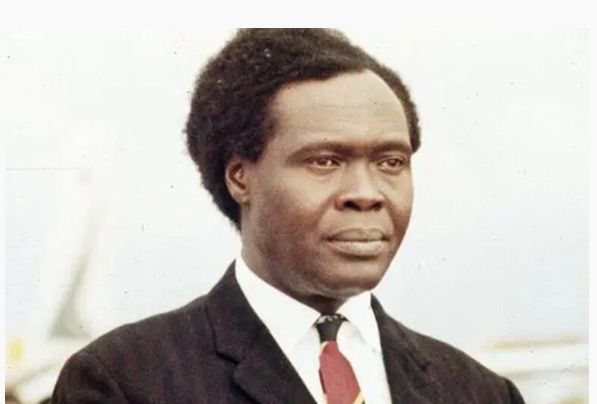
    Before independence, the British Pharaoh feared lawyers. In the 1940s, Apollo Milton Obote’s law scholarship was blocked; The British did not want him or someone from Lango to study law at the time. He later championed the struggle for Uganda’s independence alongside other nationalists like I.K Musaazi and Jolly Joe Kiwanuka, among others. The political Independence came in 1962, but lawyers remained baking bricks, facilitating dictatorship rather than defending rights.

    Image: Dr. Apollo Milton Obote. Former Primer Minister and first Executive President of Uganda.

    The 1956 Uganda Law Society,   Act, Cap 305, chained lawyers in Pharaoh’s brick yard, crushing their independence and autonomy by imposing state law officers, the Attorney General and Solicitor their governing council. This effectively led to state capture, aligning the legal profession with the colonial power’s interests instead of advancing the rights of the colonized peoples. The 1970 Advocates Act, Cap 295 further entrenched the chains: the Law Council, chaired by a judge who is appointed by the Attorney General after consultation with the Chief Justice. Other state law officers, the Solicitor General, a Chief Magistrate and only 3 lawyers, their president, and 2 others elected by them, a token of independence. Yet this substantially unelected group of powerful officials controlled eligibility, Bar exams, and disciplinary powers.

    The initial denial of Martha Karua a temporary license by the Ugandan Law Council and the reasons which it gave should tell you my dear reader everything else you need to know about the state of the independence of Uganda’s Legal Profession.

    Read more about it here.

    Reflections of the Uganda Law Council’s Refusal to License Martha Karua by Enen Ambrose at Enen Legal World.

    Independence and autonomy for the lawyers remained but only a cruel mirage.”


    The Global Commandment: Let My Lawyers Go!

    In 1990, the UN Congress in Havana thundered: the Basic Principles on the Role of Lawyers, echoing Exodus 5:1 “Let my lawyers go!” Principle 24 demanded self-governing, autonomous professional associations.

    The International Bar Association’s Standards echoed this, decreeing in Article 17 that lawyer associations must be independent, their councils freely chosen without state interference. Article 18 makes this crystal clear:

    The functions of the appropriate lawyers’ association in ensuring the independence of the legal profession shall be inter alia: (h) to promote a high standard of legal education as a prerequisite for entry into the profession and the continuing education of lawyers, and to educate the public regarding the role of a Lawyers’ Association.”

    Again, to the village Barraza, let me break this down into what my “A” Level economics teacher, Mr. Stanley Lukera, taught us, the “grandmother’s approach”: the Uganda Law Society, whose leaders are elected by the members, the lawyers themselves, must be the body responsible for setting academic standards for entry into the legal profession. That means setting and/or advocating for high-quality law school curricula, Bar exam requirements, or other qualifications before one can serve as an advocate.

    Yet Uganda’s Pharaoh only sneered. The Law Council and ULS Act stood firm, chaining lawyers to state whims. The village Barraza waited for defenders, but lawyers, bound by Pharaoh’s overseers, could not rise.

    The People’s Covenant Ignored

    In 1995, Uganda’s people, the ultimate consumers of justice, struck a covenant in their Constitution. National Objectives and Directive Principles of State Policy, Paragraphs II(vi) and V(ii)  XX declared that non-governmental bodies like the Uganda Law Society (ULS) must retain autonomy to champion human rights, their independence guaranteed by the state. Five years after the UN and IBA commandments, the people demanded their lawyers be freed to hold power accountable, to defend Mityana widows from land grabs, Soroti youths from unjust arrests, Mbale vendors from cheating landlords.

    But Pharaoh’s heart hardened, as in Exodus 8:15. The state clutched the legal profession tighter, wielding the Law Development Centre (LDC) as its slave-pit. With nearly 20 universities churning out law graduates, LDC remained the sole gatekeeper of the Post-Graduate Diploma in Legal Practice, its infrastructure crumbling under the weight. Pre-entry exams, meant to manage capacity, became another lash, while quality control at universities was a paper tiger.

    Plagues of the Slave-Pit

    The LDC’s tyranny rained plagues on aspiring lawyers, not the state. Failure rates soared to 90% in 2021 and several other years. Dreams shattered like stolen straw. Sex-for-marks scandals led to the expulsion of Academic Registrar Everest Turyakihayo, in 2022; a stain on justice’s robe.

    Supplementary exam fees bled students, parents, guardians, spouses, boyfriends, and sugar daddies dry in millions of shillings for a second chance at Pharaoh’s mercy. Then came the tenth plague, the killing blow: in 2024, LDC barred over 1,500 qualified applicants from the Bar Course, admitting only 1,260 of 2,600, citing “limited resources”. Like the death of Egypt’s firstborn in Exodus 11:1-10, this was no mere setback; it was a massacre of futures, a cry that pierced the heavens.

    Yet some struck back. In 2017, Gulu and Cavendish graduates denied exams thumpchested and invited  Pharaoh to the wrestling ring in Asiimwe Alex Byaruhanga & 12 Ors v Law Council & 3 Ors. Justice Wolayo thundered:

    “Law Council’s block was arbitrary and irrational.”

    The court quashed the ban, imposed permanent injunctions, and awarded 20 million UGX each. This blog is dedicated to among others, these courageous lawyers who walked through Pharaoh’s furnace and are now fine practicing Advocates.

    Even public figures were not spared: Kyagulanyi Robert Ssentamu Alias Bobi Wine’s Cavendish University degree faced state scrutiny pre-graduation, proof Pharaoh’s heart hardens even against the popular. The musician turned leader of the National Unity Platform (NUP), Uganda’s largest opposition political party told members of the press shortly after his graduation that “When news came out that I was set to graduate, the usual detractors got busy and made every effort to stop me,” he said. “Some people, ostensibly working for the regime and other detractors, went as far as petitioning the National Council for Higher Education.” He added “NCHE officials went to the University and demanded for every document regarding my studies… It was a very detailed and intense investigation,


    Pharaoh’s Whip extends beyond Law, it bites real flesh.

    Pharaoh’s tyranny isn’t just legislative—it’s flesh and blood. At the 20th #RNBLive Series, Yours truly had the lived experience of delivering the speech of the ULS President Isaac K. Ssemakadde’s speech. A copy of that speech is attached and A video of it is also attached. The modern Aaron, spoke fire:

    Advocate Abed Nasser Mudyobole… forcibly disappeared by state security. His abduction echoes the tyranny that hunted Njuba, Kayondo, Sebutozi, Ayigihugu. Lawyers who defend the Constitution, who question power, are enemies to be silenced.”

    Author delivering the speech of the ULS President Isaac K.  Ssemakadde on 29th May 2025 at the ULS House, Kampala.


    The courts shackle ULS blocking meetings (Kirima v ULS, 2024), Halting lawyers Constitutional voices at the Judicial Service Commission with appeals arising thereform under perpetual abeyance decisions (Mugisha v ULS), sentencing ULS President Isaac Ssemakadde in February, 2025 for criticizing a judge.


    Bakampa: Vision for Job-Ready Lawyers

    From LDC’s ashes rose Bakampa Brian Baryaguma. His Legal Education and Training Bill 2024:

    Decentralizes Bar training to universities

    Infuses practical skills: drafting, moots, clerkship

    Mandates one-year pupillage and national Bar exam

    Repeals the LDC Act

    “No more paying twice for one loaf. Lawyers ready to defend the people.”

    National Legal Examinations Centre Bill 2025: Red Sea or New Shackles?

    ULS President Isaac K. Ssemakadde, mirroring Moses and Aaron, long campaigned against LDC. He demanded that it be abolished way back in 2021 in his address to Law Students at Makerere University. In what appeared to be a fit of rage, LDC reacted by blocking Ssemakadde  on its X handle.

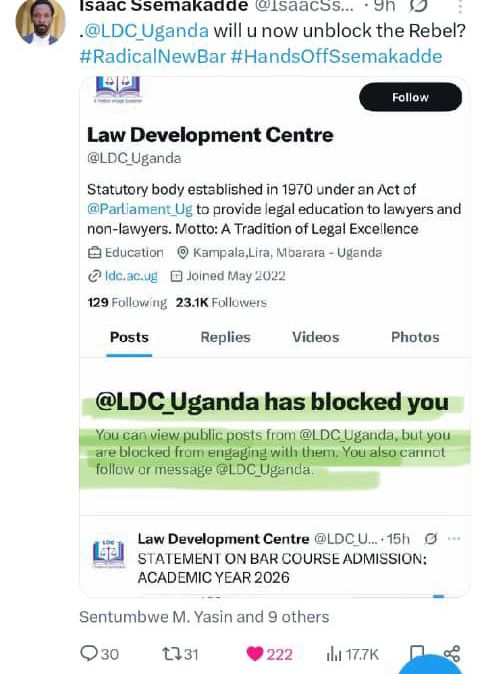
    When news broke out that Cabinet had drafted the National Legal Examinations Centre Bill, 2025, the Radical New Bar President asked on whether LDC will unblock him?

    Image: Isaac K. Ssemakadde asked if LDC would unblock him after the bill proposing its abolition as he had suggested was made public by the Solicitor General.  Credit, Isaac Ssemakadde’s X (formerly Twitter handle)

    The bill proposes to free the Post Graduate Bar Diploma in Legal Practice from LDC, and shut it down completely, but Pharaoh’s hand still grips:

    Attorney General, a cabinet minister and political appointee, appoints Director of the center on the recommendation of the governing council & the  chairperson of the governing Council itself (Clauses 17 and 8 respectively). This erodes the corporate governance principles in Clause 19 of the Bill.

    The Attorney General can remove council members, set rules, and determine fees for services of the centre

    The risk of elite and exclusionary political capture remains real. The ghosts of exorbitant fees, especially supplementary Examinations which sucked all stakeholders dry, should not be allowed to lurk after abolition of LDC.


    “The legal profession stands at the Red Sea. Will it walk through freely or be recaptured?”

    Call to Arms: Strike the Red Sea!

    To defend justice, rights, and the Rule of Law, the following MUST BE DONE NOW to prevent lawyers from being captured and tamed “young” and moulded into frightened cowards who cannot foster accountability.

    1. Let the ULS Command– ULS and not a state law officer should appoint the NLEC Director & Council.


    2. Skills Fuse – Bakampa’s model in university curricula: drafting, moots, clerkship. The doctors and engineers have proven that you don’t need to pay twice for the same loaf.


    3. Fees Free;  The Council should retain a higher autonomy to set fees and, in collaboration with ULS, set academic and examination criteria and standards

    A group of lawyers trained through fear, intimidation, and heavy involvement of state law officers loses the courage to fight for the Mityana widows, Soroti youths, and Mbale vendors: lawyers must rise bravely and fearlessly. The rule of law suffers gravely, and so does the effective functioning of the justice system as a whole. 

    Strike the Red Sea! Free ULS!  #LetMyLawyersGo

    Pharaoh may harden his heart, but justice and truth can’t be enslaved forever.”

    You, dear reader, should participate heavily in freeing your rights defenders, call up the big people you know, Your area member of parliament, your Dean, faculty of Law, your ULS region’s Council member and demand that “they strike the Red Sea” and implement these recommendations so that your rights defenders, the lawyers gain full autonomy and independence.

    #Strike the Red Sea!

    #Let My Lawyers Go!

    This Blog is dedicated to the fearless champions of a better legal education and a better legal practice regulation in Uganda. Bakampa Brian Baryaguma,  the author of the Legal Education and Training Bill who personally granted me the copyrights to quote his works extensively. His journey in the struggle has been chronicle by him on his personal Blog at https://huntedthinker.blogspot.com/https://huntedthinker.blogspot.com/?m=1. I strongly encourage readers to visit his Blog and support his rallying call for members of the Public to contribute views on his bill which is attached:

    as well as the version presented by the cabinet, which is attached below:

    President of Uganda Law Society, Isaac K. Ssemakadde for prophesying the eventual shut down of LDC,  being blocked by the same institution on X (formerly twitter), expelling the Attorney General and Solicitor General from the governing council of the ULS via RNB Executive Order No. 1 of 2024 and earlier on filing a Constitutional Petition, which canvases the international law framework that has been presented and is still pending judgment by the Constitutional Court. My personal prayers are with you as you endure the pain of self exile for tackling the challenges of the legal profession from the root cause. May the good Lord protect you and touch the justices of the Constitutional Court for a just decision.

    This blog is further dedicated to the lawyers who engaged the legal system in the journey to reform the legal system, namely Pius Nuwagaba, Asiimwe Alex Byaruhanga, and his 12 colleagues for challenging the Law Council head on. Your struggles curated this milestone and led the legal profession, especially intending Advocates to now arrive at the Red Sea, waiting to strike the waters to open up the sea, to cross and permanently ensure the independence and full autonomy of the Legal Profession.

    Finally, each and every lawyer, member of the public who added embers to the revolutionary fire to free the legal profession,  parents, Judges who rendered justice,  you all stood on the right side of history,  may God bless you.

    Enen Ambrose, the author, is an Advocate and member of the inaugural Judicial Affairs Committee of the Uganda Law Society.

    DISCLAIMERS!

    This blog is intended to spark discussions around the current National Legal Education Centre Bill 2025. References to individuals and institutions are based on publicly reported developments and not meant to attack individuals or institutions mentioned directly.

    Nothing in this Blog is intended for use as legal advice. Author accepts no liability for use of the contents herein as legal advice. Readers are advised to seek the services of a licensed Advocate for situation specific legal advice.

    For comments and feedback, reach to us at ambrosenen@gmail.com