
When the Accused Becomes an Ornament
A procedure that turns courts into shrines of injustice, where freedom is a fairy tale and land is lost

Author’s Note: The Chronicles of His Worship Mulyanyama is a serialized literary commentary designed to constructively critique the institutional and structural implications of the Magistrates Courts (Amendment) Act, No. 6 of 2026. This work is a creative exploration of the human infrastructure behind public service and is not intended to ridicule, embarrass, or undermine the integrity of the Judiciary.
The stack of criminal files had not moved in eight years.
One hundred of them.
One hundred human beings.
One hundred stories of land, hunger, and a law that refused to die.
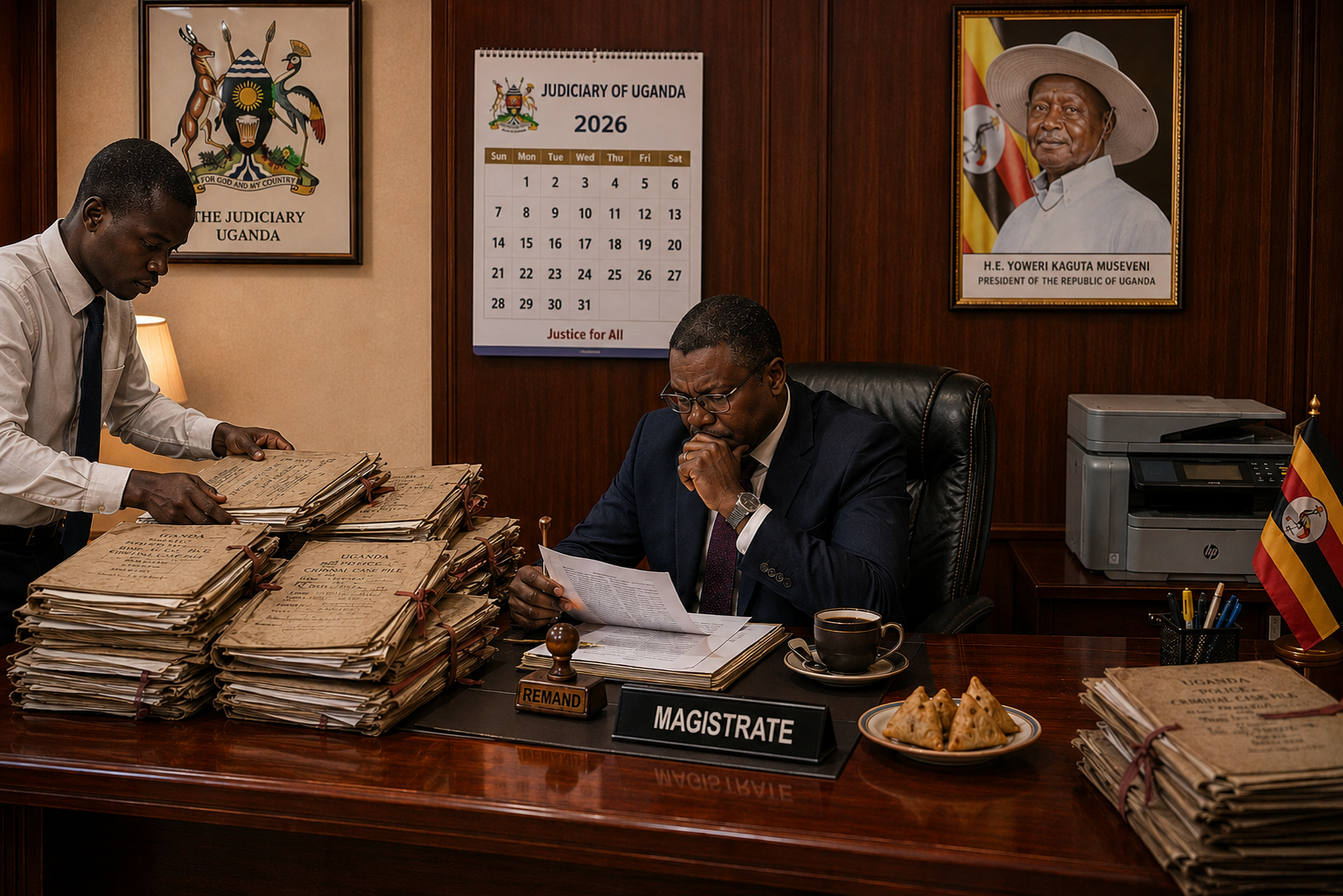
His Worship Mulyanyama picked the top two files.
File No. 67 – Yokoyadi Okello. Charge: Aggravated Robbery.
File No. 68 – Emmanuel Odongo. Charge: Murder.
The State had never filed committal bundles. The accused had been on remand since before the last census. Neither could be granted bail – not by Mulyanyama. Only the High Court could do that. And the High Court had done nothing.
Yokoyadi’s Hoe – Eight Years
Yokoyadi was the elder brother of Ocen Okello – the bean supplier who had been chasing a school’s debt for four years. When their parents died during the LRA insurgency, Yokoyadi dropped out of school. He worked as a porter, a brickmaker, a night guard. He never went to court. He only wanted to protect the three acres their grandfather had cleared with a machete.
Then Majutu arrived. An urban elite. A man who bought land after the war and spoke of “development.” Majutu wanted Yokoyadi’s plot. He offered a pittance. Yokoyadi refused.
One morning, Majutu’s workers came to mark the boundary. Yokoyadi ran out with his hoe. He did not swing it at anyone. He struck the ground between them. He shouted: “Either you kill me first, or I die on this land. It will not leave my family.”

That evening, Majutu called a police officer he knew. He reported aggravated robbery. He claimed Yokoyadi had threatened him with a deadly weapon – the hoe – and attempted to steal his mobile phone. There were no witnesses except Majutu’s own workers.
Yokoyadi was arrested. Remanded. The State never filed proper committal papers. The case did not move.
Eight years later.
Majutu had erected a fence. He had built a guest house. He had planted eucalyptus where Yokoyadi’s father was buried.
Yokoyadi had not seen a judge in five years. The file sat on Mulyanyama’s desk – a monument to a hoe that had become a life sentence.
The Pastor’s Form – Eight Years
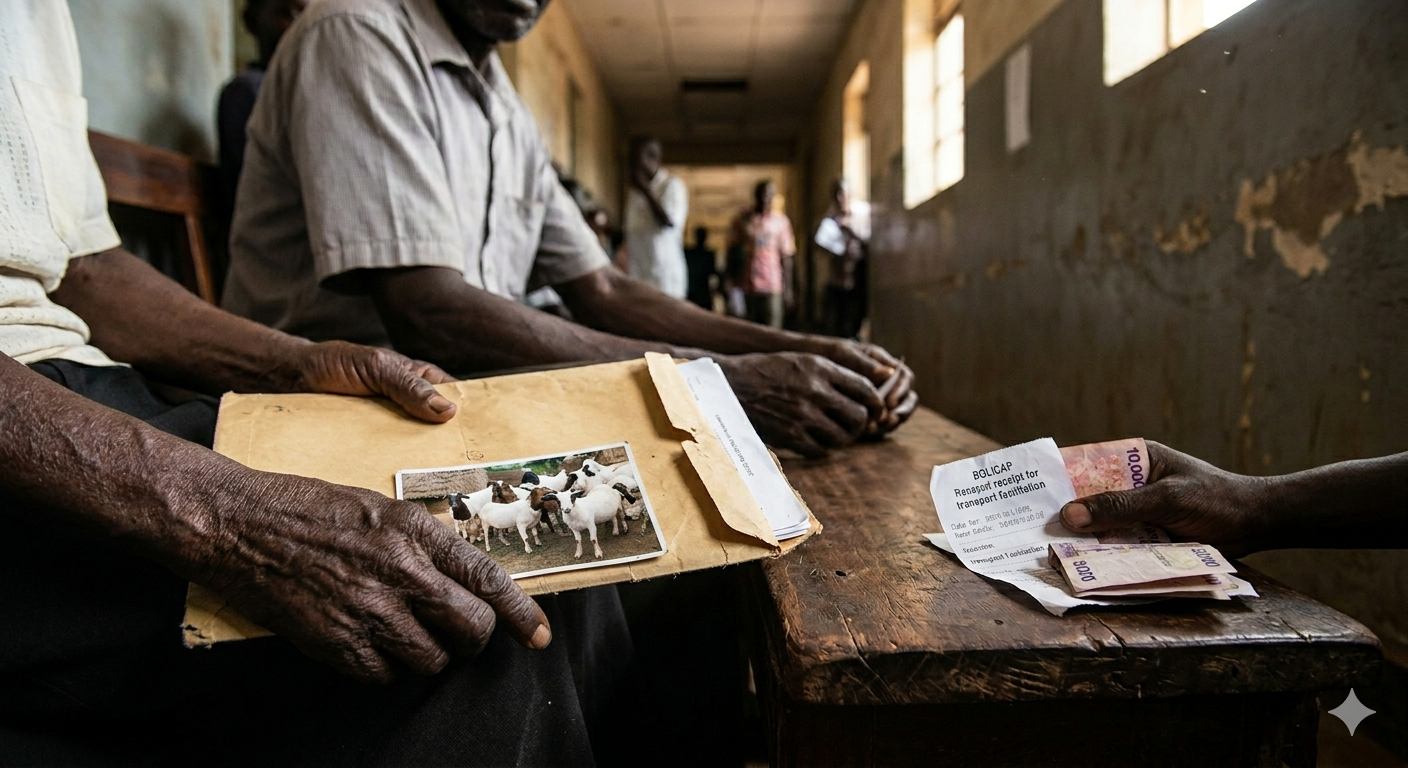
Micaki was a widow. She could not read or write. She trusted people in uniforms – including Pastor Solomon, who ran a Pentecostal church in the trading centre.
One afternoon, Pastor Ayak visited Micaki. He told her the government was giving free money to elderly vulnerable persons. He had a form. He just needed her thumbprint. She was grateful. She dipped her thumb in the stamp pad.
Just as she was about to press it on the paper, her son Emmanuel walked in. He had returned from Lira for a visit. He saw the form. He yanked it from the pastor’s hand. He read it. It was not a government grant. It was a gift inter vivos – a transfer of ten acres to the pastor’s church foundation entirely for free!
Emmanuel shouted. He demanded that the pastor leave. He chased him out of the compound. He did not touch him. He did not threaten his life. He simply raised his voice and pointed to the road.
Two weeks later, a vagrant was found dead near the pastor’s church – a man known to drink at the local bar. Pastor Ayak went to the police. He told them Emmanuel had threatened him, that Emmanuel was violent, that Emmanuel must have killed the vagrant in a robbery.
There was no evidence. No witness placed Emmanuel near the body. But the pastor was influential. His church had friends in the district. Emmanuel was arrested. Charged with murder. Capital offence. No bail.
Eight years later.
Pastor Ayak had built a primary school and a church on Micaki’s land. A banner read: “New Hope Pentecostal School – Transforming Lives.”
Micaki sat on the roadside, watching children play where her cassava used to grow.

Emmanuel had never been tried. The State had no witnesses. The file would not die.
The Attempt
Mulyanyama could not grant bail. He could not dismiss the charges. The law said he could only communicate the charges and call up the file for mention – to track the status of police inquiries or investigations. He could not provide any effective remedy for freedom – even though the law said every suspect was innocent until proven guilty or until conviction.
He was not a magistrate. He was a warehouse for human beings.
So he bundled the 100 files. He wrote a cover letter to the Resident Judge of the High Court Circuit. He asked for supervisory intervention. He personally drove the files to the High Court registry.
A week later, his phone rang. He did not recognise the number. He answered.
“Worship Mulyanyama.”
The voice was tired. Not cruel. Tired.
“This is the Resident Judge.”
Mulyanyama straightened. “Good afternoon, my Lord.”
“I am looking at your letter. The one about the committal files.”
“Yes, my Lord. The accused have been on remand for eight years. The State has not filed commital papers. I cannot grant bail. I cannot dismiss the charges. I was hoping your Lordship could exercise supervisory –”
The Judge cut him off.
“I have murder sessions across four districts. I have bail applications from two prisons. I have a donor‑funded SGBV session starting next week. I do not have time for one hundred twenty one files that should have been dealt with at your level.”
Mulyanyama: “With respect, my Lord, the law does not permit me to –”
“Then the law is an ass.”
Silence.
“Listen to me, Worship. I am not your appeal court. I am not your clerk. Those files are your problem. Deal with them.”
The line went dead.
Mulyanyama stared at his phone. He understood now: the Judge was not cruel. He was simply drowning. And the 100 files were the first to sink.
The Interns
One afternoon, a group of internship students from Gulu University arrived at Omwonyo‑le. They were bright, eager, and armed with notebooks. Their supervisor had assigned them to sensitise remand inmates about their rights – the right to be presumed innocent, the right to legal representation, the right to a speedy trial.
Mulyanyama allowed it. He had no power to refuse. He also had no power to help.
The students sat with Yokoyadi. They explained Article 28 of the Constitution. They spoke of bail, of committal, of the State’s duty to file papers.
Yokoyadi listened. Then he asked: “If all that is true, why have I been here eight years?” ,”Is there anything you can do to assist me?“
The students had no answer. They were not qualified advocates. The law did not permit them to file anything, to apply for anything, to demand anything. They could only teach rights – not enforce them.
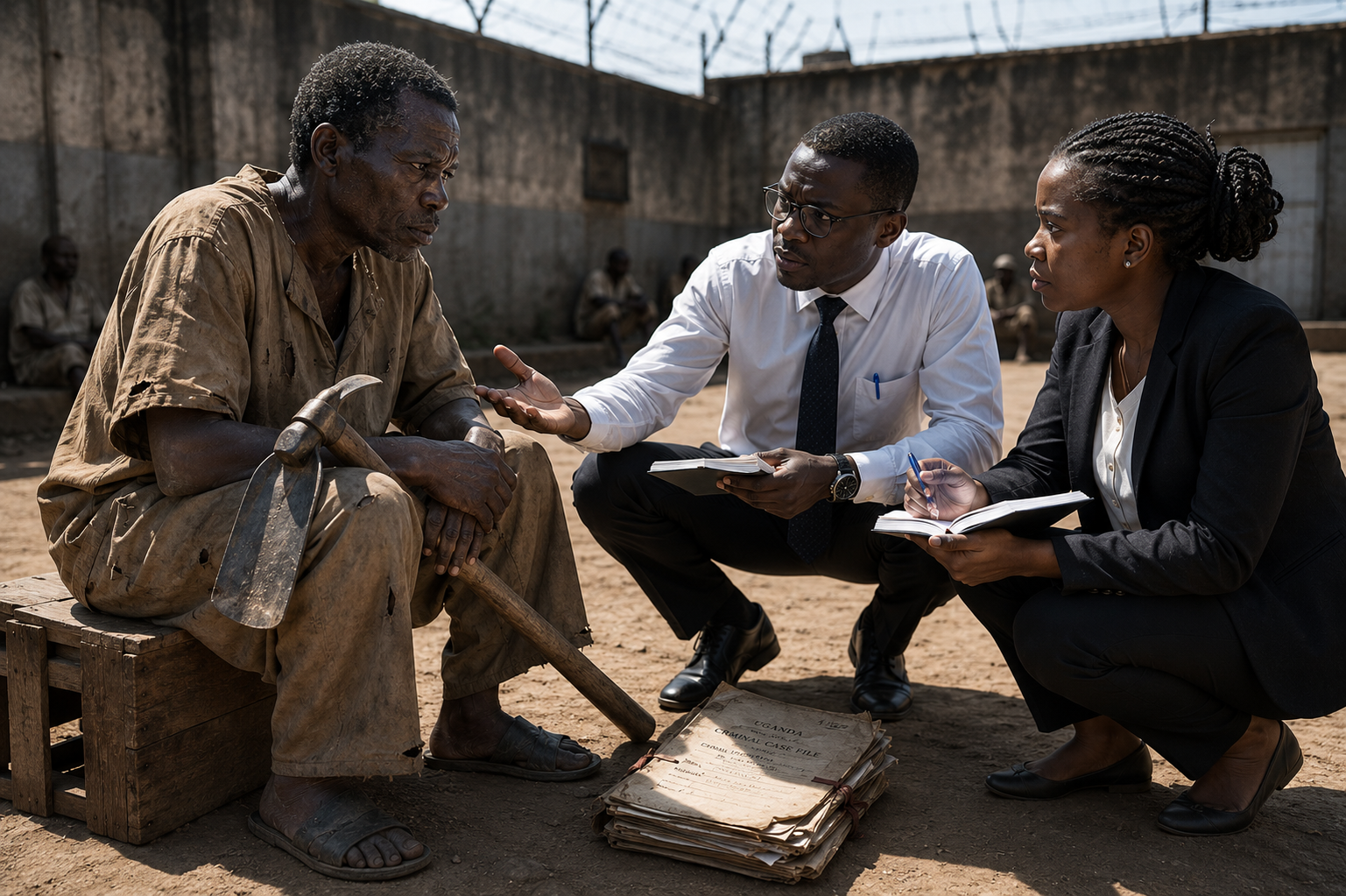
They visited Emmanuel. He did not speak. He stared at the wall. One student tried to hold his hand. He pulled away.
That evening, the students sat outside the court, silent. Their supervisor told them: “You have seen the gap between the law on paper and the law in practice. Now you must decide if you still want to be lawyers.”
Mulyanyama watched them leave. He thought of the innocence of these brilliant Bachelor of Laws Degree students and what the future of Law and Legal practice probably held in store for these “emiti emito”– Luganda, his mother tongue’s proverbial expression of “children”. He thought of the 100 accused persons who had appeared before him for periods ranging between 7 to 8 years.
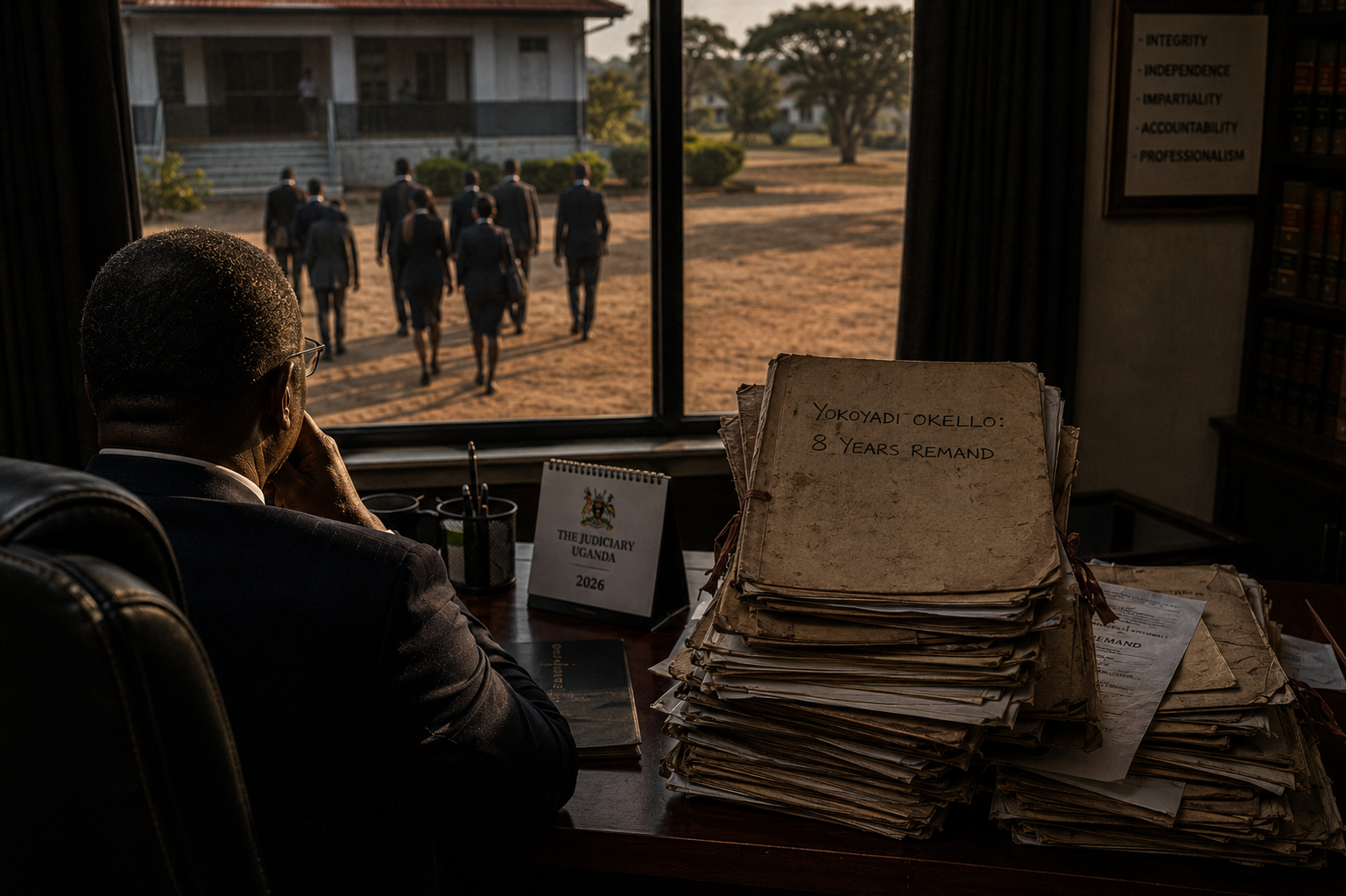
He did not write in his diary that night. There was nothing left to say.
Before you ask why justice delays… ask these questions:
How many Yokoyadis are waiting in your local prison – eight years, ten years, twelve? How many Emmanuels are on remand because a wealthy, influential, highly connected and malicious complainant whispered a lie? And why does the law still force a magistrate to hold a hearing that serves no purpose?
Eight years is not a delay.
Eight years is a sentence – served without conviction.
Enen Ambrose. Advocate. Member: Judiciary Affairs Committee of Uganda Law Society.
If you missed the start of this journey, you can catch up on the systemic breakdown of the Magistrates Courts in Chronicles of His Worship Mulyanyama — Episode 3
Legal Disclaimer Fiction & Non-Defamation Notice:
This post is a pure work of fiction and creative literature. The characters, dialogue, specific incidents, and settings—including the character of His Worship Mulyanyama and the location of Omwonyo-le Magistrates Court—are products of the author’s imagination or are used fictitiously. Any resemblance or exact matches to actual persons, living or dead, real-life judicial officers, or specific ongoing cases is entirely coincidental. This text is created solely for the purpose of systemic legislative critique and systemic advocacy; it is not maliciously constructed, nor should it be interpreted as an attempt to defame, misrepresent, or malign any living individual or public office holder.
The legal references in this Series is for information purposes only and is not intended to be used as a substitute for legal advice. The author does not assume responsibility or admit liability arising from the use of the contents of this blog as legal advice.
The author strongly encourages readers to consult a licensed attorney for specific context related legal advice.
JOIN THE UNDERGROUND AND FUEL THE MOVEMENT

We have created a WhatsApp Channel. Don’t miss the latest updates, get early bird access to our latest episodes and more, so much more. Click the following link to follow the Channel: https://whatsapp.com/channel/0029Vb9BQqw5a246bWVsLl3j
Independent institutional critique and advocacy for a radical overhaul of legal culture require time, deep research, and uncompromised independence. If these narratives bring value to your legal journey or challenge your perspective, please visit our HOME PAGE to see how you can support this platform directly and keep the critique fierce and relentless.
Enen Ambrose. Advocate & Founder–Enen Legal World



 enenlegalworld