Category: Dr. Kiza Besigye

  • I HAVE PETITIONED THE JUDICIARY: WHEN SILENCE SPEAKS

    Driven by public demand and an undying quest for the Rule of Law, I have placed my concerns on the constitutional record.

    There comes a moment when a lawyer must decide whether to continue discussing a constitutional concern in WhatsApp groups—or put it formally on the record.

    For me, that moment has come.

    Following the Uganda Law Society’s call upon members of the legal profession and the public to petition the leadership of the Judiciary, I have today submitted my own petition to the leadership of the Judiciary, calling upon the Hon. Chief Justice, the Hon. Deputy Chief Justice and the Hon. Principal Judge to publicly reaffirm the constitutional independence of the Judiciary.

    And, perhaps unsurprisingly, I did not arrive at this decision alone.

    There has been a public demand.

    There has been a never-dying quest for the Rule of Law.

    And there is what those who have followed Enen Legal World will know as “the Underground”—that stubborn, sometimes noisy, sometimes silent community of supporters who have continued to read, share, challenge, encourage and occasionally ask me:

    “Enen, when are you going to put this on paper?”

    Well.

    I have put it on paper.


    From WhatsApp Gossip to the Constitutional Record

    The President’s recent remarks concerning Uganda’s justice system have generated significant discussion across the country and, naturally, within the legal profession.

    I have watched the debate unfold.

    I have listened to the arguments.

    I have read the reactions.

    And I have also watched something else.

    Silence.

    Not the silence of ordinary citizens. Ugandans have certainly been speaking.

    Not the silence of lawyers. The legal profession has been speaking too.

    But the silence of the institution whose constitutional independence is at the heart of the conversation has itself become part of the conversation.

    That is where my concern begins.

    I do not believe that the Judiciary should answer every political statement.

    I do not believe that judicial officers should descend into political contests.

    And I certainly do not believe that judicial independence means immunity from criticism.

    But I do believe that there are moments when constitutional reassurance is itself an act of judicial leadership.

    And I believe we may be in one of those moments.


    Why I Have Written

    I write neither in anger nor in defiance.

    I write in hope.

    Hope that, in moments when the constitutional equilibrium of our Republic appears unsettled, the Judiciary—the institutional refuge of the Rule of Law—will speak with the calm confidence that constitutional independence commands.

    Articles 126 and 128 of the Constitution are not decorative provisions.

    They establish a constitutional architecture in which judicial power belongs to the courts and judicial independence is protected from external control or direction.

    But there is something I think we sometimes forget.

    Judicial independence is not a privilege enjoyed by judges.

    It is a right enjoyed by citizens.

    It belongs to the widow seeking justice.

    The prisoner awaiting trial.

    The investor enforcing a contract.

    The child claiming inheritance.

    The advocate standing fearlessly for an unpopular client.

    The citizen challenging unlawful State action.

    The independence of the Judiciary is therefore not merely the Judiciary’s shield.

    It is the people’s shield.


    The Image That Would Not Leave My Mind

    I also wrote something personal in the petition.

    I saw videos circulating online in which Dr. Kizza Besigye, in what I believe to be a defiant protest against the abrogation of his fair-trial rights, collapsed upon the cold floor of the accused person’s dock during proceedings in a treason trial against him.

    That image stayed with me.

    Perhaps because I am a lawyer.

    Perhaps because I am a citizen.

    Perhaps because sometimes an image says something that several pages of legal argument cannot.

    I found myself asking what happens when the institutions established to protect constitutional rights themselves become vulnerable to external pressure.

    And so I wrote:

    If we do not insulate the Judiciary from executive overreach and every attempt to usurp its constitutional independence, it will not merely be one litigant who collapses. The Rule of Law itself will collapse.

    And when the Rule of Law collapses like Dr. Besigye did upon that cold courtroom floor, our courts risk being transformed from temples of justice into shrines of injustice.

    That is not rhetoric for rhetoric’s sake.

    It is the warning at the heart of my petition.


    One Silence. One Encroachment. One Exception.

    I have always been fascinated by how constitutional orders deteriorate.

    They do not necessarily collapse overnight.

    Sometimes it begins quietly.

    One silence.

    One encroachment.

    One exception.

    One justification.

    Until the extraordinary becomes ordinary.

    And by the time society realises that the constitutional line has moved, everyone has become accustomed to standing on the wrong side of it.

    That is why I believe constitutional institutions must sometimes speak before the danger becomes normalised.


    What I Have Asked the Judiciary to Do

    My petition is not a demand for confrontation.

    It is a call for reassurance.

    I have respectfully called upon the leadership of the Judiciary to reaffirm:

    1. That judicial power belongs exclusively to courts established under the Constitution.

    2. That the constitutional independence of the Judiciary remains absolute and non-negotiable.

    3. That every litigant shall continue to receive justice according to law, uninfluenced by political authority, public pressure or executive preference.

    4. That constitutional dialogue among the three Arms of Government must preserve the doctrine of separation of powers upon which our Republic is founded.

    I do not regard such a statement as political engagement.

    I regard it as constitutional leadership.


    Why Publish the Petition?

    Some may ask why I have published a document addressed to the Judiciary.

    The answer is simple.

    Because constitutional questions should not remain confined to correspondence between institutions.

    The Judiciary belongs to the people.

    The Constitution belongs to the people.

    And the Rule of Law belongs to the people.

    Therefore, I have decided that my petition should not disappear into an email inbox.

    It belongs on the public record.

    And yes, the Underground has been asking for it.

    Those who have followed Enen Legal World know that there is a community behind this platform—a community that does not always announce itself, but which watches, reads, shares and pushes.

    Sometimes the messages are simple:

    “Counsel, what are we doing about this?”

    Sometimes they are more direct.

    “Enen, write about it.”

    And sometimes the demand is simply understood.

    So, to the Underground:

    Here it is. A copy of the petition can be accessed here:


    When Silence Speaks

    I have submitted the petition because I believe that there are seasons when judgments speak.

    There are also seasons when silence speaks.

    And perhaps this is one of those seasons when the Constitution itself deserves to be heard.

    I do not know what response will follow.

    That is now a matter for the Judiciary.

    But I know what I have done.

    I have moved the conversation from WhatsApp gossip to the constitutional record.

    And I have done so respectfully.

    Not because I have lost faith in the Judiciary.

    Precisely because I have not.

    I believe the Judiciary is capable of defending its constitutional space.

    I believe judicial officers understand the weight of their constitutional oath.

    And I believe Uganda deserves the reassurance that the institution entrusted with administering justice remains independent, impartial and faithful to the Constitution.

    So I leave the petition where it belongs:

    before the leadership of the Judiciary.

    And I leave the question where it belongs:

    before the conscience of the Republic.


    The Final Word

    With the greatest respect, My Lords, this appears to be a season when the Constitution itself deserves to be heard.

    I beseech you brethen, all members of the public to heed to the Uganda Law Society’s call to equally submit your petitions to info@judicature.go.ug and copy in uls@uls.or.ug

    JOIN THE UNDERGROUND AND FUEL THE MOVEMENT

    We have created a dedicated fans WhatsApp Channel. Don’t miss the latest updates, get early bird access to our latest blog posts and more, so much more. Click the following link to follow the Channel: https://whatsapp.com/channel/0029Vb9BQqw5a246bWVsLl3j

    Independent institutional critique and advocacy for a radical overhaul of legal culture require time, deep research, and uncompromised independence. If these narratives bring value to your legal journey or challenge your perspective, please visit our HOME PAGE to see how you can support this platform directly and keep the critique fierce and relentless.

    Enen Ambrose. Advocate

    Member, Judiciary Affairs Committee,

    Uganda Law Society

    & Founder–Enen Legal World

    Justice Ignited. Courage Unleashed.

    www.enenlegalworld.com | enen@enenlegalworld.com

  • INTERNATIONAL BAR BODIES PETITION UNITED NATIONS OVER TREATMENT OF LAWYERS IN UGANDA

    INTERNATIONAL BAR BODIES PETITION UNITED NATIONS OVER TREATMENT OF LAWYERS IN UGANDA


    Madrid Bar Association and World Jurist Association seek urgent UN intervention over alleged interference with Besigye defence team.

    Two international legal organisations have formally petitioned the United Nations, urging urgent intervention over what they describe as a sustained pattern of state interference targeting lawyers representing Dr. Kizza Besigye and Hajji Obeid Lutale in ongoing treason-related proceedings before Ugandan courts.

    The communication was jointly submitted by the Human Rights Section of the Madrid Bar Association (Ilustre Colegio de la Abogacía de Madrid – ICAM) and the Human Rights Institute of the World Jurist Association (WJA). It is addressed to the United Nations Special Rapporteur on the Independence of Judges and Lawyers and the United Nations Working Group on Arbitrary Detention through the Office of the United Nations High Commissioner for Human Rights (OHCHR).

    The Lawyers’ Complaint

    According to the petition, the international organisations argue that the reported arrest, detention, prosecution and alleged ill-treatment of Kampala Lord Mayor and senior advocate Erias Lukwago, together with earlier incidents affecting other members of the defence team, form part of what they characterise as an escalating pattern of interference with the independence of the legal profession in Uganda.

    The communication states that the pattern cannot be understood by looking at Mr. Lukwago’s case in isolation. Instead, it points to a sequence of events involving retired Major Ronald Iduuli, advocate Eron Kiiza, Kenyan Senior Counsel Martha Karua, and the subsequent attempt to provide state-selected lawyers after members of the original defence team became unavailable.

    Martha Karua’s Deportation

    The petition also highlights the events of 22 June 2026, when Kenyan Senior Counsel Martha Karua travelled to Uganda to participate in the defence but was denied entry at Entebbe International Airport and returned to Kenya. The communication argues that her exclusion raises questions concerning the right of accused persons to legal representation by counsel of their own choosing and references the East African Court of Justice’s earlier decision in Samuel Mukira Mohochi v Attorney General of Uganda.

    State-Appointed Counsel

    A significant portion of the communication focuses on the issue of legal representation after the arrest of Mr. Lukwago and the exclusion of Ms. Karua.

    According to the petition, the accused declined representation from lawyers proposed through state channels, maintaining that the absence of their preferred advocates resulted from actions taken against those advocates themselves. The communication argues that compelling acceptance of substitute counsel would undermine the constitutional right to legal representation by a lawyer of one’s own choice.

    Read also: LET MY LAWYERS GO!, the National Legal Education Center Bill and the Independence Journey of Uganda’s Legal Profession.

    You can access the petition here:

    International Legal Standards

    The communication grounds its arguments in both domestic and international law.

    Among the authorities cited are:

    • Article 28(3)(d) of the Constitution of Uganda.
    • Article 14 of the International Covenant on Civil and Political Rights (ICCPR).
    • Article 7 of the African Charter on Human and Peoples’ Rights.
    • Principles 16 and 18 of the United Nations Basic Principles on the Role of Lawyers.

    According to the petition, these instruments require that lawyers be able to perform their professional functions without intimidation, harassment or improper interference.

    What the Petition Seeks

    The Madrid Bar Association and the World Jurist Association request the United Nations to:

    • transmit an urgent appeal to the Government of Uganda;
    • seek clarification regarding Martha Karua’s exclusion from Uganda;
    • request an independent investigation into the arrest of Ronald Iduuli;
    • urge the Government not to impose state-selected counsel on accused persons who have rejected such representation;
    • call upon Uganda to guarantee the independence of lawyers in accordance with domestic and international legal obligations; and
    • monitor proceedings before the High Court of Uganda, including the hearing scheduled for 29 July 2026.

    A Wider Debate

    The petition comes amid continuing discussion about the independence of the legal profession in Uganda and the ability of advocates to represent clients in politically sensitive proceedings without fear of intimidation or interference.

    Whether the United Nations Special Rapporteur or the Working Group on Arbitrary Detention will take action in response to the communication remains to be seen.

    Enen Legal World will continue monitoring developments relating to this matter and provide further News Bytes and legal analysis as events unfold.

    JOIN THE UNDERGROUND AND FUEL THE MOVEMENT

    We have created a dedicated fans WhatsApp Channel. Don’t miss the latest updates, get early bird access to our latest blog posts and more, so much more. Click the following link to follow the Channel: https://whatsapp.com/channel/0029Vb9BQqw5a246bWVsLl3j

    Independent institutional critique and advocacy for a radical overhaul of legal culture require time, deep research, and uncompromised independence. If these narratives bring value to your legal journey or challenge your perspective, please visit our HOME PAGE to see how you can support this platform directly and keep the critique fierce and relentless.

    Enen Ambrose. Advocate

    Member, Judiciary Affairs Committee,

    Uganda Law Society

    & Founder–Enen Legal World

    enen@enenlegalworld.com


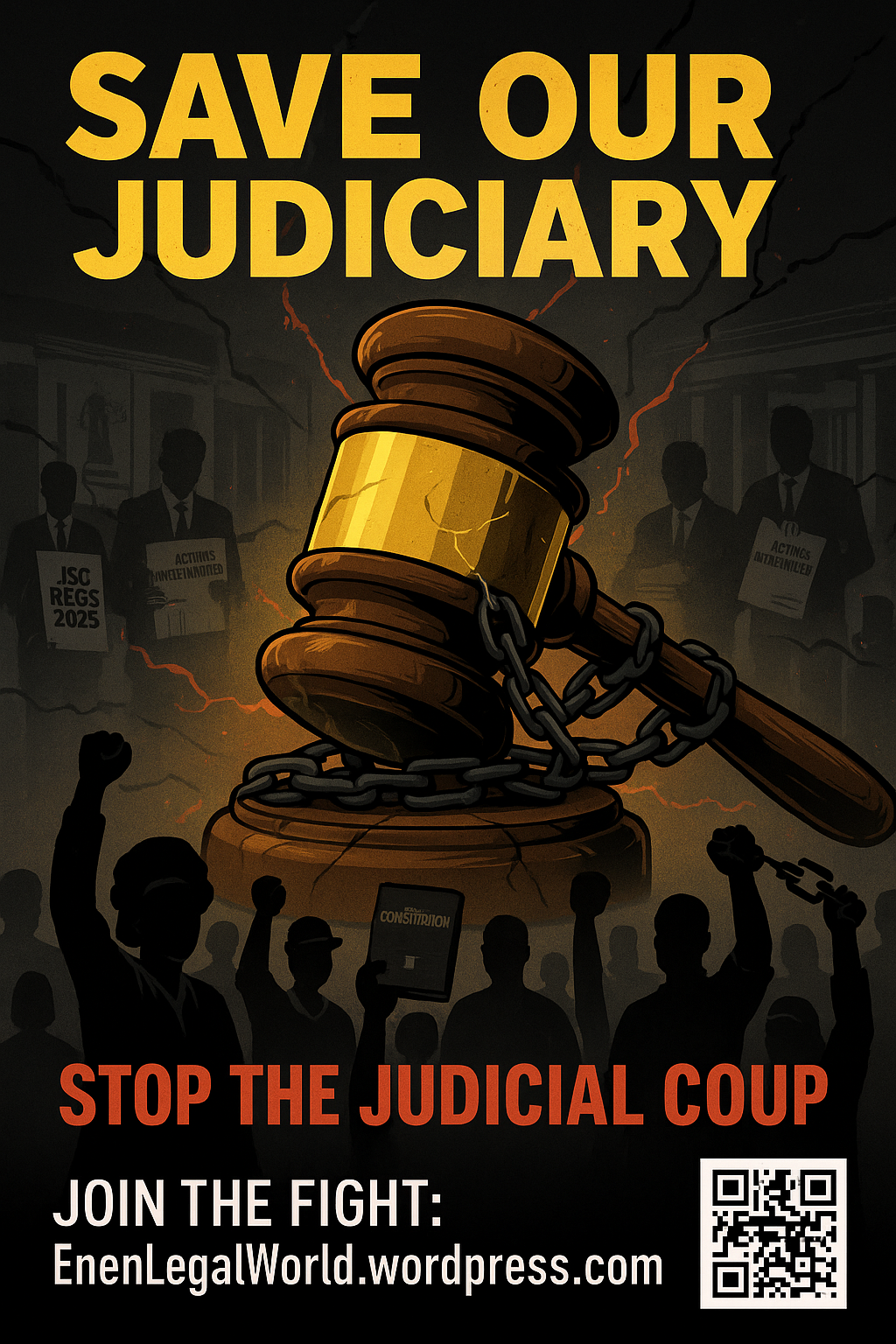
  • Uganda Needs Judges with Balls of Titanium Alloy—Not the Shackles of the JSC Regulations, 2025: Why You Should Be Worried

    Uganda Needs Judges with Balls of Titanium Alloy—Not the Shackles of the JSC Regulations, 2025: Why You Should Be Worried


    Let’s not waste time.
    Uganda’s judiciary has been hijacked. Quietly. Legally. Treacherously.

    They didn’t need a coup d’état. They just needed Statutory Instrument No. 4 of 2025—the Judicial Service Commission Regulations—to pass unchallenged.

    You can access a copy of those regulations here:


    And now the Constitution isn’t bleeding.

    It’s on life support. Plugged into a system designed to kill it slowly.

    Judges on Acting Terms. Courts on Probation. Justice on the Brink.


    Here’s what they’ve done:

    Invented a system where new judges are appointed on in an acting capacity, with the duration determined at the whims of the appointing authority—yes, like interns at a mobile money kiosk.

    Given the President the power to recycle retired judges, no questions asked. No medical. No mental. No morals.

    Created performance evaluations for judges like they’re applying for a promotion at a law firm.

    That’s right, you’re not day dreaming, the system was rigged. In 2022, the Constitutional Court damned this shrewd “sharp practice” and threw it in our Constitutional History by declaring it unconstitutional in Dr. Busingye Kabumba and Karamagi vs Attorney General.

    A copy of that decision can be found here:

    Good judgment, right? Damn, the government rigged it. It instead created a legal loophole which enabled it to pass these damned Regulations. 

    Firstly, it appealed against.  Secondly  the government obtained what is in effect  a suspension of the independence of the Judiciary as the Supreme Court delays to decide the Government’s Appeal .

    A copy of the decision which suspended the independence of High Court Judges as the government waits for a decision in its own appeal from the above case can be accessed from here:


    Okay, let’s dive into the evil in the Regulations.
    Reg. 29–33 and 31 are the smoking guns.
    And what they shoot is judicial independence—straight between the eyes.

    And Then There’s 2026…

    Uganda’s next elections are not just around the corner—they’re rumbling like thunder.

    And we know the script:

    Mass arrests.

    Disappearances.

    Violent suppression.

    Habeas corpus applications flying like confetti.

    Human rights cases lined up like a firing squad.


    It will take judges to hear them all.

    But what kind of judges?

    Not fearless ones. Not permanent ones. Not independent ones.

    The Regulations guarantee this:

    When the state comes for you, the judge before you may still be “acting,” “probationary,” or “awaiting confirmation.”

    You don’t need a judge praying for job security.

    You need a judge with balls forged from titanium alloy, ready to grab the State by its ball sac and say:

    Back off. The Constitution says this citizen walks free.”

    These Regulations can’t produce that judge.
    They produce whispering cowards in robes.

    But Wait, There’s a Recruitment Cartel Too

    They didn’t just kill judicial independence at the appointment level.

    They also built a Search and Recruitment Committee—and a Sub-Committee—with a quorum of TWO people.

    Let that sink in:
    Two people can now shortlist Uganda’s judges.

    Who are these people?

    The Attorney General—yes, the government’s own lawyer.

    The Chairperson of the JSC—currently Justice Singiza, who was once branded a “Nazi Judge” by opposition supporters for adjourning Besigye’s habeas corpus case instead of hearing it urgently.


    And guess who they kicked out of this process?

    The two (2) representatives of the Uganda Law Society.

    The very people the Constitution says should be part of the Judicial Service Commission.

    It Was Planned. Timed. Executed.

    These Regulations were passed while the Uganda Law Society is in court, fighting to elect its representatives.

    The plan is clear:
    Keep them out. Lock the process down. Staff the courts with friendly judges. Control the law from the inside out.

    This isn’t just bad law.

    It’s a judicial cartel in robes.

    And You Think It Doesn’t Affect You?

    Wait until your land is taken.
    Wait until your protest turns into a prison sentence.
    Wait until your loved one disappears.
    Wait until the courtroom is the only place left to cry out.

    Then you’ll pray that your judge isn’t still auditioning for a contract renewal.

    Here’s the Message:

    Uganda’s justice system is being rebuilt—not to protect you, but to survive you.

    It is no longer about law.
    It’s about control.
    It’s about loyalty.
    It’s about silencing justice before you can even plead for it.

    This is the war. This is the moment. This is the alarm.

    If you have eyes you better see, and if you have ears you better listen.

    More about me and disclaimer in the about page.

  • OF CHAINS AND ROBES: When the Judiciary Surrendered Its Soul at the Altar of Power

    OF CHAINS AND ROBES: When the Judiciary Surrendered Its Soul at the Altar of Power


    They told us Lady Justice was blind. Yet no soul foretold us that she could be gagged, chained by red tape, or forced to perform a scripted dirge for the state—while the true conduct of justice withers in her silent grasp.

    This is the tragedy of our times:
    On one fateful day, under the looming shadow of executive power, the Judiciary refused bail to Dr. Kizza Besigye—not because the law demanded it but because the long finger of the Executive had darkened the halls of justice. The gavel itself seemed to quiver in fear.

    In a nation where the very concept of “public interest” is weaponized, such a ruling is not just injustice—it’s a full-throated political press release performed by a bench too timid to uphold the Constitution. Uganda does not merely serve up injustice; we marinate it in irony, wrap it in drama, and serve it with a side of bitter satire.

    Then enters the spectacle of The Ssegirinya Case.
    Hon. Muhammad Ssegirinya—a brave legislator whose voice once roared in opposition—died at a hospital right here in Uganda and was laid to rest in Masaka amid national mourning. Parliament wept. The Electoral Commission hustled. A by-election crowned Counsel Nalukoola as the Honorable Member of Parliament for Kawempe North Constituency. The new MP elect was gazetted and subsequently took the oath of a member of Parliament and yet, the Judiciary clung to absurdity:
    “We need a death certificate to terminate the criminal case against him.”

    Imagine: while Parliament already acknowledged his passing, the Chief Magistrate’s Court demand forensic proof—as if they were guarding against a zombie revival in the halls of justice. Some things, Your Worships, don’t need official state records like a death certificate; they require judicial notice. Ssegirinya is gone. No amount of legal formality can reverse that truth. To be slightly more cheeky and dramatic about it, will the Court issue criminal summons or an arrest warrant to produce the fallen legislator before Court? Yes, that is the absurdity we are talking about.

    Meanwhile, within the oppressive corridors of power, a lone rebel rises. President Isaac Ssemakadde—a man both radical and resolute—was denied a podium at New Year Law Day, yet he found a way to become the voice for those silenced. Standing on a cold step outside the hallowed courtroom, he declared:

    “The Uganda Law Society doesn’t exist to soothe the egos of the Judiciary but to protect it from Executive Overreach.”


    That proclamation was not mere rhetoric—it was a rallying cry. No applause met his words, yet the Constitution itself, dusty and long-forgotten on a shelf, clapped with the thunder of truth.

    Adding a surreal twist to this saga, the ruling that doomed Besigye’s bail came on the heels of the anniversary of President Idi Amin’s regime collapse—the day Uganda first broke free from dictatorship. And as if the fates conspired further, on that very day, Justice Gadenya granted a stay of execution for the arrest warrant against President Ssemakadde. A copy of the Ruling by His Lordship Paul W Gadenya can be found here

    Read also about the international arrest warrant against President Isaac K. Ssemakade and why it was an embarrassment to the whole of Uganda’s Legal system here: https://enenlegalworld.com/2025/03/20/red-alert-ssemakadde-and-ugandas-judiciary-in-the-international-firestorm/

    History, it seems, is writing its own epic:
    The ancient echoes of liberation mingle with our modern struggles, and even the ancestors of this Republic refuse to sleep.

    In the midst of this theatrical legal circus, one voice from the depths of exasperation cut through the clamor:

    “The law ceased being an ass. It’s now a pussy.”


    Unfiltered, incendiary, and laughably raw—this isn’t a mere quip but a savage indictment. When courts purr in the laps of power rather than bite down on injustice, we can’t pretend neutrality. We must call the rule of law what it is: law taking orders instead of serving justice.

    As we stand at the crossroads of history, our hearts burn with the hope for a future where truth rings louder than decree. Like the fabled moment when Pontius Pilate (in his own conflicted way) declared, “I find no guilt in this man,” yet allowed the crowd to dictate a cruel verdict, the Ruling of the Hon. Lady Justice Comfort denying Besigye’s bail Application even after finding that he had satisfied all the requirements reveals to all those who care to see that executive Overreach influenced the outcome of the decision. A copy of the ruling can be accessed here:


    So here we are—writing not for mere record but for revolution. This is no ordinary blog post. It’s a legal thriller, a national mirror, a soaring cry that condemns mediocrity and demands accountability.

    Justice, if you’re still alive—send us a signal.
    We’re here.

    And for the record—this blog is not an attack on the personal integrity or competence of the judicial officers concerned. It is a constitutional critique—bold, unfiltered, and fully protected as free expression under Article 29 of Uganda’s Constitution. We aim not to tear down but to build a Judiciary worthy of public confidence, not executive approval.

  • Foot Soldiers Fight Back: Free Speech, Social Media, and the Battle for Judicial Accountability in Uganda

    Foot Soldiers Fight Back: Free Speech, Social Media, and the Battle for Judicial Accountability in Uganda

    Judicial power in Uganda is not a divine right handed down to judges in solemn robes. It is borrowed authority from the people, and when borrowed power is abused, the lenders have every right to demand accountability. That is what happened when Ugandans erupted in fury over Justice Douglas Singiza’s decision to adjourn a habeas corpus application, effectively prolonging an already illegal detention.

    This was not an internet tantrum—it was a constitutional defense mission, executed in real-time by citizens who understand their rights better than some of the people wearing wigs in courtrooms. Article 126(1) of the Constitution is clear:

    Judicial power is derived from the people and shall be exercised in conformity with the law and with values, norms, and aspirations of the people.”

    So, when the people declare that a ruling has spat on their constitutional values, they are not just complaining—they are executing their duty to keep judicial power in check.

    This is not the first time Singiza has found himself at the center of a human rights disaster. When Kakwenza Rukirabashaija, a novelist and torture victim, applied to retrieve his passport for urgent medical treatment abroad, it was Singiza—then Chief Magistrate at Buganda Road Court—who denied him. His reasoning?

    👉 “Ugandan hospitals can handle his condition.”

    Imagine suffering broken ribs, festering wounds, and open scars from state torture, only for a judge to declare that a hospital in Wandegeya is sufficient to handle what should be a war crimes case. This is the same judge who, three years later, sends Besigye and Lutale back to illegal detention while he thinks about their habeas corpus plea.

    The pattern is now too clear to ignore—delayed justice when it benefits the state, procedural gymnastics when fundamental rights are at stake, and then a full-blown judicial meltdown when the public calls it out.

    And how did Singiza react to the backlash? Like a true 21st-century authoritarian—he made the ruling about himself. Instead of addressing the constitutional chaos he created, he spent his precious obiter dicta crying about online criticism.

    What’s next? Should Ugandans start seeking judicial permission before commenting on court decisions? Must all legal critiques now be submitted in triplicate, with an affidavit from a Senior Advocate?

    This is a dangerous trend—a creeping attempt to criminalize judicial criticism and insulate courts from the same public scrutiny that every other arm of government faces.

    The executive is insulted daily.
    The legislature is mocked in real-time.
    The military is dragged through the mud.

    But the judiciary wants to be untouchable?

    In Onyango Obbo & Andrew Mwenda v. Attorney General, the Supreme Court made it clear that public officials—including judges—must tolerate criticism. Free speech does not require politeness, and it is not invalidated because it offends the recipient.

    Yet, here we are, watching judges compose emotional victim statements in court rulings instead of defending the Constitution.

    This is not judicial independence—this is judicial fragility.

    Uganda has reached a crossroads: either the judiciary remembers that it serves the people, or the people will remind it in ways it will never forget. Judicial power, like all borrowed authority, can be reclaimed when misused.

    This is not a warning.
    This is a constitutional reminder.

    DISCLAIMER: This blog is not intended to mock or attack the person of the Hon. Justice Douglas Ssingiza. It is commentary on the interesting obiter dicta in the Habeas Corpus Application of Dr. Kizza Besigye and Obeid Lutale vs. Attorney General. The Ruling in that case can be found here:

    The author is a Rule of enthusiast. More in the about page.

  • Reflections of the Uganda Law Council’s Refusal to License Martha Karua

    Reflections of the Uganda Law Council’s Refusal to License Martha Karua

    Rtd Col. Dr. Kiza Besigye. Photo credit: Wikipedia


    The refusal by the Uganda Law Council to grant Martha Karua, a distinguished Senior Counsel from Kenya, a temporary practicing license to represent Dr. Kizza Besigye in his ongoing trial before Uganda’s General Court Martial has raised significant concerns in my mind about Uganda’s legal system, regional cooperation, and political interference. In this post, I will break down my perspective on why this decision is problematic, critiquing the reasons provided by the Law Council and exploring the broader implications it has for both Uganda and the East African Community (EAC) at large.

    Background Context: The Case of Dr. Kizza Besigye

    Dr. Kizza Besigye, one of Uganda’s leading opposition figures, was invited to Nairobi by Martha Karua for a book launch. During this event, Besigye was allegedly found with a firearm in his hotel room, which led to his controversial extradition back to Uganda. This case is more than just a legal matter; it raises important issues surrounding Kenya’s sovereignty, extradition laws, and the treatment of political figures within the region. Besigye’s trial before the General Court Martial has been heavily scrutinized, especially in light of the Supreme Court’s recent stay of a ruling by the Constitutional Court in the case of Michael Kabaziguruka v. Attorney General (Constitutional Petition No. 45 of 2016), which had declared that military courts in Uganda have no jurisdiction to try civilians.

    The refusal to grant Karua a temporary license, made by the Uganda Law Council, appears to be a politically charged decision, occurring against the backdrop of these ongoing legal and political tensions. As a legal professional, I find this decision troubling, particularly when considering the broader implications for regional integration and the rule of law in Uganda.


    The Reasons Cited by the Law Council for Denial

    The Uganda Law Council gave several reasons for denying Martha Karua a temporary license to practice law in Uganda for Besigye’s defense. Let’s examine these reasons critically and reflect on the potential political undertones and legal inconsistencies involved.

    1. Lack of Notarized Documents
    The Law Council argued that Karua’s application was incomplete because it lacked notarized copies of her practicing certificate, a letter of good standing, nationality documents, and academic qualifications.

    My View: This is a procedural issue that could have been easily remedied. Rather than outright denying the application, the Law Council could have requested the missing documents or offered Karua an opportunity to rectify the deficiencies. This decision to deny her based on minor technicalities rather than facilitating her compliance reflects poor administrative practice. A lawyer of Karua’s stature should not be obstructed by such minor procedural issues.


    2. Absence of a Valid Practicing Certificate for Erias Lukwago
    Another reason cited for the refusal was that Karua’s local sponsor, Erias Lukwago, did not have a valid practicing certificate. This was apparently a reason for not processing the application.

    My View: The idea that Karua’s application should be rejected because Lukwago did not provide a valid practicing certificate is misguided. Upon reviewing the Judiciary website, it is clear that Erias Lukwago has an active practicing certificate for 2024. The Law Council could have simply verified this information rather than using this as a reason to deny Karua’s application. The failure to make such a simple verification indicates either an oversight or an intentional attempt to complicate the process. This was an avoidable technicality that should not have been used as grounds for denial.


    3. No Special Expertise Brought by Karua
    The Law Council claimed that Karua did not bring any special skills that Uganda’s legal community lacked, suggesting that her involvement in the case was unnecessary.

    My View: This argument is deeply problematic. The client has a fundamental right to choose their lawyer, and Karua’s expertise was specifically sought by Dr. Besigye. Her representation was not about fulfilling some special legal need that Ugandan lawyers couldn’t address but rather about providing the client with a lawyer of their choice. This rationale dismisses the right of a person to have the legal representation they feel is best suited to their case. The Council’s argument undermines not only Besigye’s right to choose but also the principles of justice and fairness.


    4. Political Undertones
    The Law Council expressed concerns about the political nature of the case, suggesting that Karua’s involvement was motivated by politics, given her association with Besigye and her public stance as an advocate for democracy and human rights.

    My View: This is where I find the decision most troubling. The role of the Law Council is not to pass judgment on the political affiliations of individuals involved in legal proceedings but to ensure that justice is served. Karua’s political opinions or affiliations should have no bearing on the decision to allow her to practice temporarily. The Council’s decision seems to be a veiled attempt to politically sideline a lawyer based on her association with a political opponent of the government. This kind of interference in legal matters not only compromises the integrity of the Law Council but also undermines the fairness of the trial itself.


    5. Conduct Before Approval
    Karua was accused of “holding out” as an advocate before her application had been approved, due to her presence at the court proceedings.

    My View: Karua made it clear that she was attending the proceedings as a visiting jurist awaiting approval. She did not mislead the court or claim to be practicing without a license. The accusation seems to be an exaggeration, designed to discredit her professional integrity. This accusation, made without substantiation, adds to the sense that the Law Council was looking for any excuse to deny her application.


    6. Logistical Constraints of the Law Council
    The Law Council mentioned that it could not expedite the application process due to its members’ full-time commitments in other roles, making it difficult to process Karua’s application on time.

    My View: This is a failure of institutional management rather than a valid reason to deny an application. If the Law Council is unable to manage the process in a timely manner, it speaks to the need for reform within the institution. A delay caused by the Council’s own logistical constraints should not serve as a reason to deny an individual the right to practice law in Uganda, especially in a case of such significance.


    The Double Standards of the Law Council

    One of the most glaring inconsistencies in this case is the selective application of the Law Council’s rules regarding foreign lawyers. Historical precedents show that the Council has granted temporary licenses to foreign lawyers when it suits the political interests of the government. For instance:

    John Khaminwa, a Kenyan lawyer, was allowed to represent President Museveni in a high-profile election petition before the Ugandan Supreme Court in 2001.

    Jim Gash, an American lawyer, was granted a temporary license to represent a client in Uganda, working on juvenile justice reform.


    These instances clearly demonstrate that the Law Council is capable of granting temporary licenses to foreign lawyers when it is politically convenient. However, when it comes to a case involving a prominent opposition figure like Dr. Besigye, the same flexibility is not applied. This selective approach casts doubt on the impartiality of the Law Council and raises questions about whether political considerations played a role in the denial of Karua’s application.


    The Regional and International Implications

    The refusal to grant Karua a temporary practicing license also raises important questions about Uganda’s commitment to regional integration. The East African Community (EAC) Treaty and its protocols, including the Mutual Recognition Agreement (MRA), emphasize the free movement of professionals across member states, including legal practitioners. By denying Karua’s application, Uganda is in direct contradiction of these commitments, which could harm the spirit of regional cooperation that the EAC seeks to foster.

    Uganda’s actions appear to undermine the EAC’s goal of facilitating the free movement of labor and professional services. This decision is particularly paradoxical given President Museveni’s strong advocacy for regional integration. If Uganda continues to place political barriers in the way of legal professionals from other EAC member states, it risks isolating itself from the very integration processes that Museveni has long championed.


    The Uganda Law Society’s Advocacy for Reform

    In response to the Law Council’s decision, the Uganda Law Society (ULS) has rightly condemned the denial of Karua’s application as per incuriam—legally flawed. The ULS has also called for reforms to ensure that such decisions are made impartially, without political interference. Some members of the ULS have even gone so far as to advocate for the abolition of the Law Council altogether, citing its growing susceptibility to political pressure and inefficiency in handling applications for foreign lawyers.

    I fully support this call for reform. The Law Council, and indeed all legal institutions, must operate with full independence, free from political influence. The integrity of Uganda’s legal system depends on the ability of lawyers to perform their duties without fear of political repercussions. The Law Council’s decision in Karua’s case demonstrates the need for urgent reform to ensure that legal institutions are better equipped to serve the principles of justice impartially.


    My Call for Reform and Conclusion

    In conclusion, the Uganda Law Council’s decision to deny Martha Karua a temporary practicing license is not just a legal misstep but also a reflection of broader issues within Uganda’s legal system. The refusal to grant the license based on procedural technicalities, political undertones, and double standards casts doubt on the impartiality and fairness of the decision-making process. Furthermore, it contradicts Uganda’s commitments to regional integration and the free movement of professionals within the East African Community

    About author:

    ENEN AMBROSE

    The author is a Rule of Law enthusiast working at M/S Okurut-Magara Associated Advocates in the up country Town of Adjumani.

    DISCLAIMER: all information in this blog is for general knowledge and educational purposes and is not intended to provide legal advice. Readers are encouraged to seek qualified attorneys in their areas of Jurisdiction for situation specific legal advice and courses of action.

    Contact us:

    Mobile, 0789856805

    ambrosenen@gmail.com.