Category: Revolution

  • ENEN’S SECOND LETTER TO THE RADICAL NEW BAR: Epistolary Greetings

    ENEN’S SECOND LETTER TO THE RADICAL NEW BAR: Epistolary Greetings

    Justice Is a Competitive Market

    An Epistle to the Radical New Bar, the Bench, the Bar, the Justice Sector and the People of Uganda.

    “The people do not owe the justice sector their confidence. The justice sector must earn it anew every day.”

    Grace, Mercy and Peace

    Grace, mercy and peace be unto you from God our Father and from our Lord Jesus Christ, who is Himself the Author of Justice, the Defender of the Oppressed, the Refuge of the Persecuted, the Hope of the Afflicted, and the righteous Judge before whose throne every earthly institution shall one day give an account.

    May His wisdom govern our minds.

    May His courage strengthen our hearts.

    May His mercy temper our judgments.

    May His truth continually remind us that no office, however exalted, no court, however dignified, and no constitution, however beautifully written, possesses an authority greater than justice itself.

    The Communion of Those Who Labour for Justice

    Before I write concerning institutions,

    permit me first to remember people.

    For justice has never been administered by buildings.

    Neither has it been preserved by statutes alone.

    Justice has always travelled through ordinary men and women who, in every generation, quietly choose courage over comfort, conscience over convenience, and duty over applause.

    To such men and women this Letter is dedicated.

    To RNB Commander 00001

    Grace be unto you, RNB Commander 00001, Isaac K. Ssemakadde, President of the Uganda Law Society, wherever Divine Providence has seen fit to preserve you during these uncertain days.
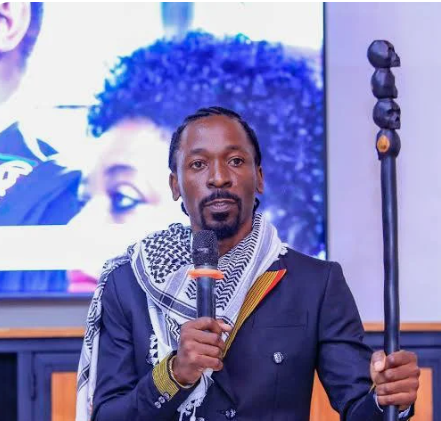
    Isaac K Ssemakadde SC: Exiled President of Uganda Law Society

    I pray for your health.

    I pray for your safety.

    I pray for your family.

    I pray for your eventual return in peace.

    May the Lord prosper every endeavour that honestly seeks the renewal of our profession.

    May He strengthen your hands as you continue calling the legal fraternity to the great work of Digital Transformation, Democratisation, Demilitarisation and Decolonisation.

    And may history judge every reform not by the comfort it afforded its authors, but by the justice it secured for the people.

    To Those Who Continue to Pay the Debt of Courage

    Permit me also to greet those whose names remind us that institutions are ultimately carried upon human shoulders.

    To Her Worship Atim Sheilah Gloria, and to every judicial officer who has quietly discovered that fidelity to conscience sometimes carries a personal cost, may the Lord grant courage, wisdom and peace.
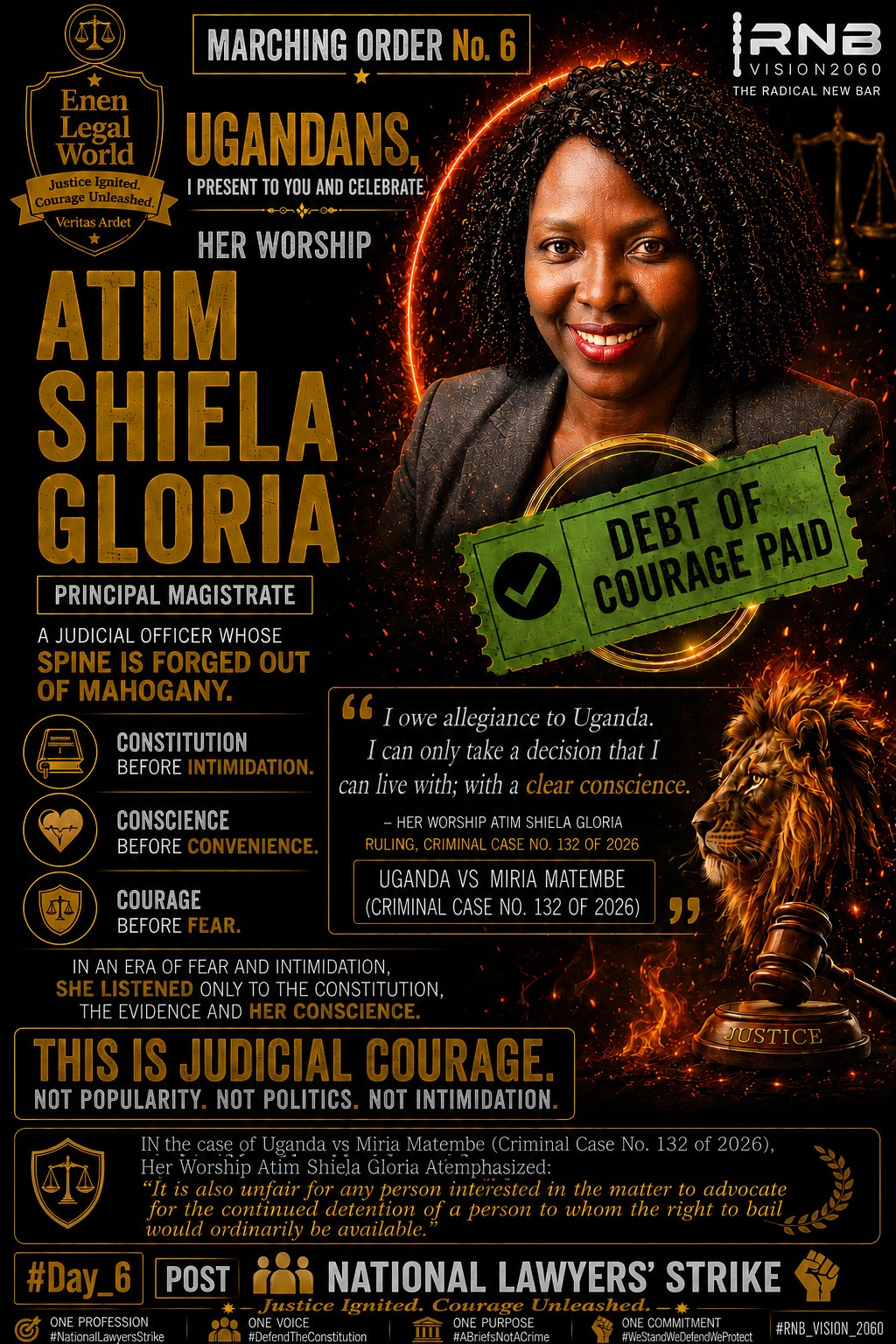
    Inset: Her Worship Atim Shiela Gloria. Infographics for Marching Order No. 6 of the ULS National Lawyers Strike, celebrating her for remaining form and truthful to her independence and the Judicial Oath. It is widely believed that she was transfered to a remote Court because she granted bail to the Hon. Miria Matembe.

    To Hon. Mariam Wangadya, the now resigned former Chairperson of the Uganda Human Rights Commission and to every public servant who has wrestled with the demands of conscience in the discharge of constitutional duty, may the God of truth preserve your integrity and reward every sacrifice made in the service of justice.
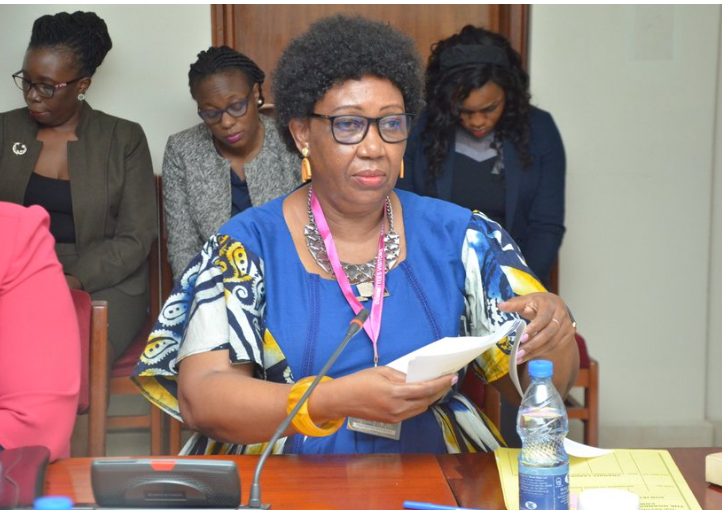
    The Hon Mariam Fauzat Wangadya: Chairperson emeritus of the Uganda Human Rights Commission. Circumstances leading to her resignation undoubtedly point to her resignation on a matter of principle- For recognising that her independence was compromised, leaving victims appearing before the Human Rights Commission without an effective remedy.

    To every Advocate who has endured criticism, imprisonment, intimidation, professional loss or public misunderstanding because they remained faithful to their oath, may your strength be renewed.

    History often remembers such moments only after they have passed.

    God remembers them while they are being lived.

    To Those Who Bear Heavy Burdens

    We remember all who presently carry burdens in the pursuit of justice.

    We remember Advocates defending unpopular clients.

    Judicial officers deciding difficult cases.

    Families waiting for justice.

    Citizens deprived of liberty.

    Victims awaiting accountability.

    Public servants striving to discharge their duties with integrity.

    And every unknown Ugandan whose quiet courage shall never appear in a law report, yet whose faithfulness strengthens the Republic more than they themselves may ever realise.

    May the Lord sustain you all.

    To Those Who Have Gone Before Us

    We pause to remember our departed colleagues.

    Advocates.

    Judicial officers.

    Court staff.

    Legal scholars.

    Public servants.

    Citizens who loved justice.

    Though their voices are now silent,

    their labour continues to speak.

    May Almighty God grant unto them eternal rest.

    May He comfort the families they have left behind.

    And may He raise another generation willing to continue the work that they faithfully began.

    To the Court Users of the Republic of Uganda

    Finally,

    and above all,

    I greet you.

    The people of Uganda.

    The widow seeking justice.

    The orphan seeking protection.

    The prisoner awaiting trial.

    The accused person longing to be heard.

    The victim longing to be believed.

    The worker.

    The employer.

    The tenant.

    The landlord.

    The refugee.

    The entrepreneur.

    The child.

    The elder.

    The taxpayer.

    The forgotten.

    Every citizen who has ever walked through the gates of a court carrying nothing but hope.

    It is from you that every justice institution ultimately derives both its purpose and its legitimacy.

    Without your confidence,

    our robes become garments.

    Our courtrooms become buildings.

    Our statutes become paper.

    Our offices become titles.

    And our learning becomes an exercise in vanity.

    We therefore acknowledge your frustrations.

    We recognise your disappointments.

    We hear your growing questions.

    This Letter is written because those questions deserve honest answers.

    An Author’s Reflection

    Beloved,

    Some may wonder why I have begun this Letter with prayers rather than propositions.

    The answer is simple.

    Justice is never administered by institutions alone.

    It is administered by people.

    By advocates whose consciences are tested.

    By judicial officers whose independence is questioned.

    By public servants who must daily choose between convenience and conviction.

    By citizens who continue believing in justice even when justice appears to have forgotten them.

    If we forget the people,

    we shall soon misunderstand the institutions they created.

    For institutions exist because people first entrusted them with their liberty, their property, their dignity and their hope.

    It is therefore fitting that we remember the people before we examine the institutions.

    A Word on the Journey Ahead

    The reflections that follow are neither offered as mere opinion nor as political rhetoric.

    They arise from a growing body of observation, reflection and conversation about how people seek justice in Uganda today.

    Some of those observations emerge from scholarly research.

    Others from the lived experiences of our courts, our communities and our profession.

    Still others from the unmistakable transformations brought about by technology, Alternative Justice Systems and the changing expectations of the public.

    Together, they invite us to confront a question that I believe our generation can no longer postpone.

    The Question Before Our Generation
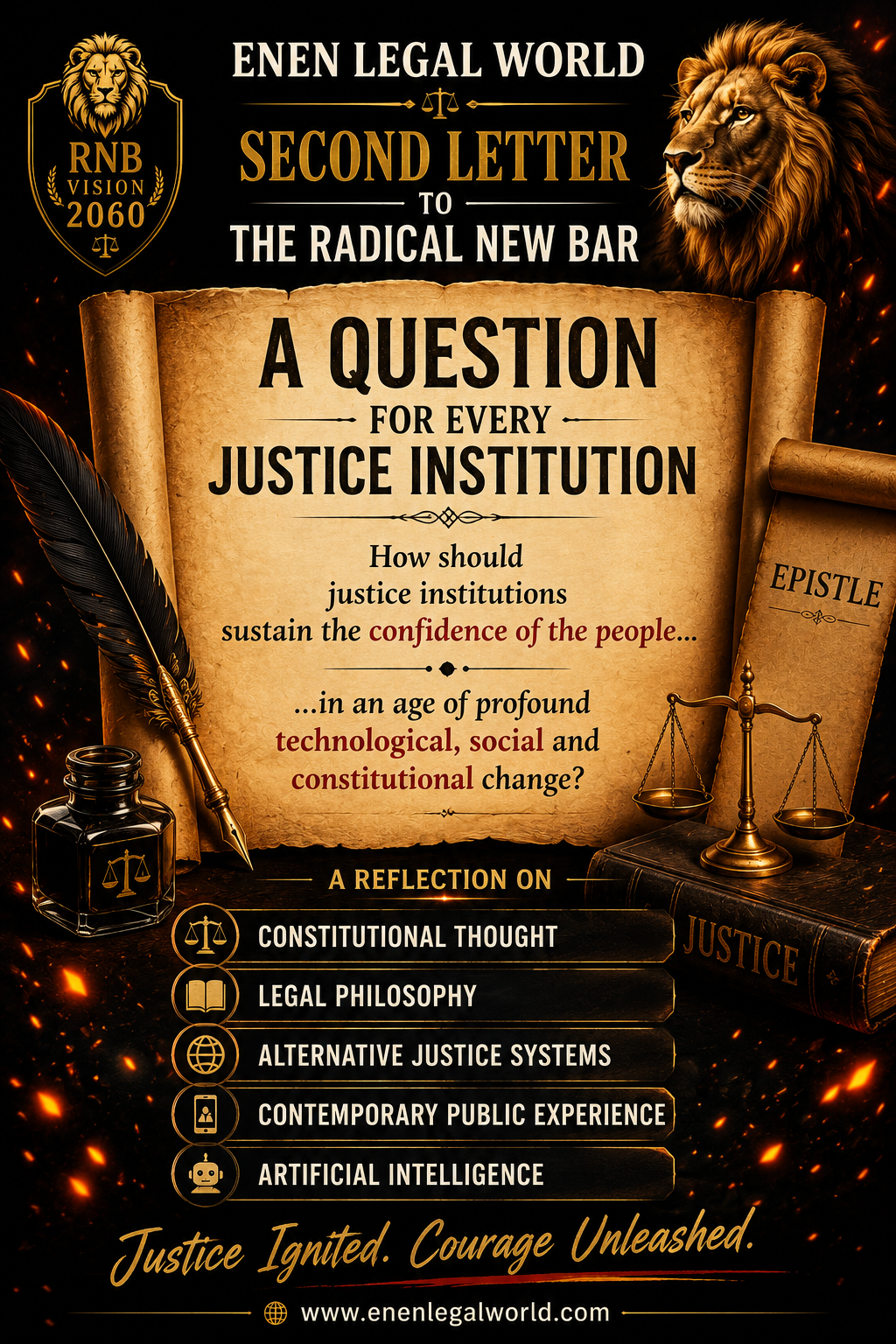
    Every generation inherits one question that eventually defines it.

    Some generations asked whether kings should govern.

    Others asked whether constitutions should restrain power.

    Others asked whether liberty belongs equally to all people.

    I believe our generation has inherited another.

    What becomes of the justice sector when the people begin seeking justice elsewhere?

    This Letter is an attempt to answer that question.

    JOIN THE UNDERGROUND AND FUEL THE MOVEMENT

    We have created a dedicated fans WhatsApp Channel. Don’t miss the latest updates, get early bird access to our latest blog posts and more, so much more. Click the following link to follow the Channel: https://whatsapp.com/channel/0029Vb9BQqw5a246bWVsLl3j

    Independent institutional critique and advocacy for a radical overhaul of legal culture require time, deep research, and uncompromised independence. If these narratives bring value to your legal journey or challenge your perspective, please visit our HOME PAGE to see how you can support this platform directly and keep the critique fierce and relentless.

    Enen Ambrose. Advocate

    Member, Judiciary Affairs Committee,

    Uganda Law Society

    & Founder–Enen Legal World

    Justice Ignited. Courage Unleashed.

    www.enenlegalworld.com | enen@enenlegalworld.com

  • FROM MEMORY TO JUSTICE: HONOURING GENERAL MOSES ALI BY COMPLETING HIS LEGACY

    FROM MEMORY TO JUSTICE: HONOURING GENERAL MOSES ALI BY COMPLETING HIS LEGACY

    The greatest tribute is not another speech, but a justice system worthy of the ideals he ultimately embraced.

    Enen Legal World Logo

    ADJUMANI | 23 July 2026 — Some tributes are spoken from the podium. Others emerge unexpectedly from history itself.

    From where we stood among the thousands gathered in Adjumani District to bid farewell to the Rt. Hon. (Rtd.) Gen. Moses Ali, it was clear that this was more than a funeral. It was a moment where the past and the future of Uganda’s constitutional project converged. Soldier, former rebel leader, peacemaker, statesman, and ultimately an Advocate of the High Court of Uganda—his life was a mirror held up to the nation’s own turbulent journey toward the Rule of Law.

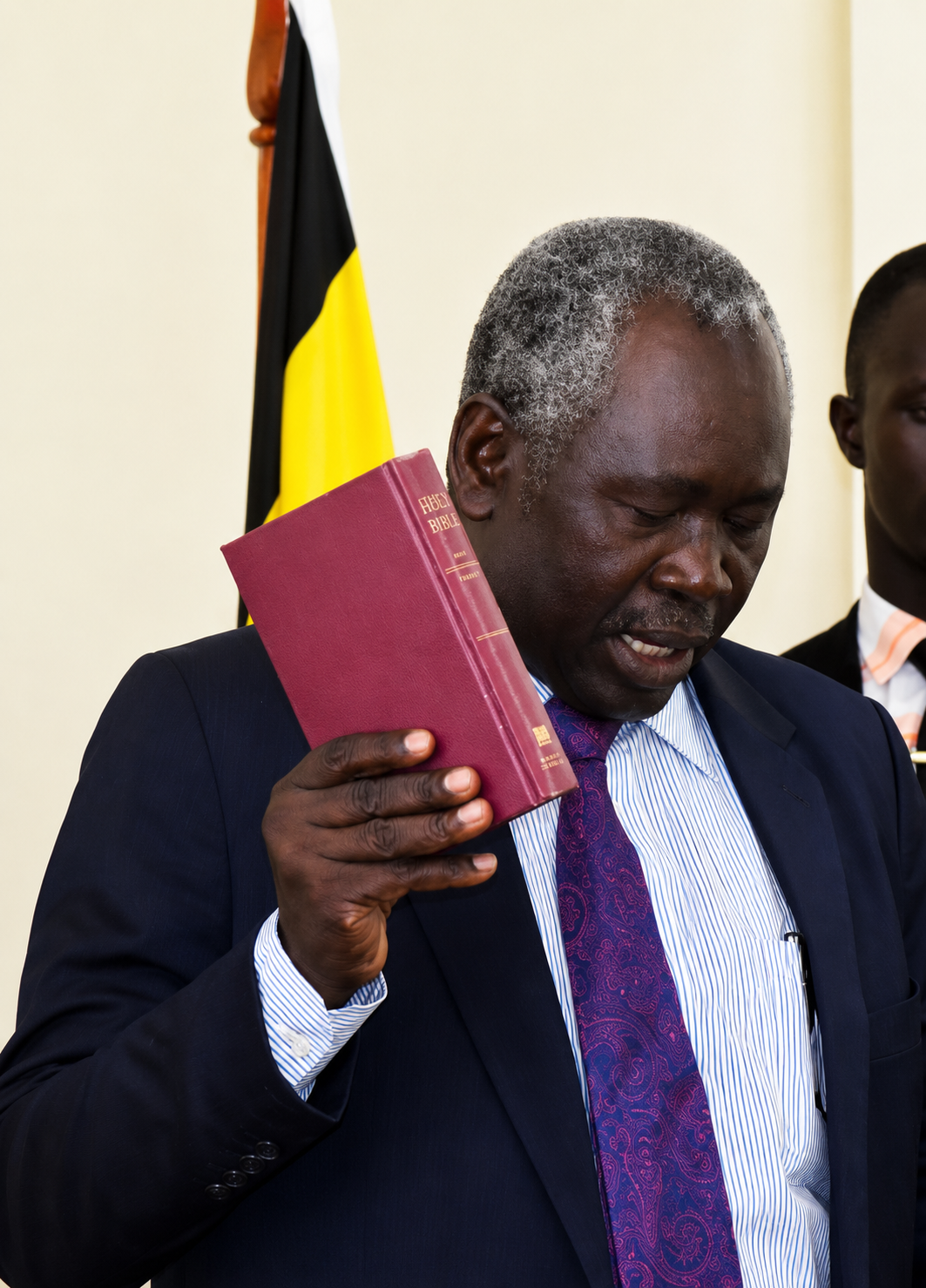
    Image: The Late Hon. Rtd. Gen Moses Ali

    Among the mourners was the Uganda Law Society (ULS), represented on behalf of its President, Isaac K. Ssemakadde represented by yours truly, the RNB footsoldier, colloqiually referred to by many lawyers as “footsoldier”. The Society had prepared a formal tribute celebrating the General’s remarkable journey. Owing to the constraints of a tightly scheduled state programme, the tribute was received for the official record but was not delivered from the podium.

    Find the copy of the ULS euology/condolence message here:

    Yet, fate arranged that its central message would still find a voice—not from the lawyers’ table, but from another elder statesman who knew General Moses Ali’s public service intimately.

    Speaking later in the programme, Rt. Hon. Baku Raphael Obudra reminded the congregation that the late General had long championed access to justice for West Nile. He recalled, in particular, Ali’s steadfast advocacy for the establishment of a High Court Circuit in Moyo.

    Then came a moment that transformed a funeral into a constitutional conversation.

    Obudra urged the national leadership to expedite the operationalisation of the already established Moyo High Court Circuit, so that the ideals for which Gen. Moses Ali had worked would finally become a lived reality for the communities he served.

    Image: The Rt. Hon. Baku Raphael Obudra. Former Deputy IGG and Acting IGG

    The response from the mourners was immediate and unmistakable. Thunderous applause rolled across the funeral grounds. It was more than an appreciation of a speech; it was a collective affirmation of a shared aspiration—a people’s plea for justice brought home.

    The Legacy Beyond the Battlefield

    Perhaps the most remarkable chapter of Gen. Moses Ali’s life was not that he once led men in war, but that he ultimately placed his faith in the law itself.

    History remembers him as a commander of the Uganda National Rescue Front (UNRF), a movement born from one of the country’s most turbulent chapters. But history did not end there. He was a signatory to peace, a senior cabinet minister, Deputy Prime Minister, Member of Parliament, and, in his later years, an Advocate of the High Court of Uganda.

    To become an Advocate after commanding armies is to acknowledge that the most enduring victories are not won by force, but by institutions that outlive those who build them. His personal evolution mirrors Uganda’s own constitutional journey—from the trauma of conflict toward the promise of governance under law.

    History repeatedly teaches that when societies fail to create credible constitutional avenues through which competing ideas may be expressed and resolved, grievances often migrate from the courtroom to the battlefield. Uganda’s Constitution was designed to prevent precisely that. It invites citizens to settle disagreements through elections rather than insurgency, through parliamentary debate rather than violence, through independent courts rather than mob justice.

    But that promise remains unfinished.

    The Moyo High Court: A Living Memorial

    The legal instrument establishing the Moyo High Court Circuit is already in force. Yet, for many residents of West Nile, accessing the High Court still requires a gruelling journey of approximately 200 kilometres to Arua; a burden measured not only in distance, but in transport costs, missed wages, delayed hearings, abandoned claims, and justice indefinitely deferred.

    Operationalising the Moyo Circuit would therefore achieve far more than administrative decentralisation. It would honour a vision that General Ali championed. It would restore public confidence in a judiciary that is visibly present and accessible. It would bring constitutional justice closer to the very people the Constitution exists to protect.

    Great nations honour their heroes not merely by remembering their names, but by strengthening the institutions for which they stood. Individuals pass from history. Institutions carry history forward. A High Court that dispenses justice to future generations would therefore become a more enduring monument than any statue erected in bronze.

    The Radical New Bar’s Continuing Conversation

    The conversation that unfolded at the funeral resonates with principles long advanced by the Radical New Bar—that justice depends upon institutions that are independent, accountable, and accessible to every citizen.

    These are not abstract ideals. They determine whether citizens trust courts over confrontation, advocacy over intimidation, and constitutional dialogue over conflict. As when by Malcom X, When societies fail to provide peaceful and credible avenues for resolving competing interests, instability often follows. The better path is the constitutional path: independent courts, fearless Advocates, judicial accountability, and a public square where ideas compete freely without fear.

    Finishing the Journey

    If Uganda truly wishes to honour Gen. Moses Ali, let us ensure that his commitment to access to justice becomes a lived reality.

    Let the Moyo High Court Circuit open its doors without further delay.
    Let judicial independence remain sacrosanct.
    Let lawyers continue to defend the Constitution fearlessly.
    Let the Rule of Law stand stronger than the Rule of Force.

    A journey from conflict to reconciliation.
    From force to law.
    From exclusion to access.
    From memory to justice.

    For the greatest tribute to any statesman is not the eloquence of our eulogies—it is the courage to finish the work that he began.

    If the life of General Moses Ali teaches us anything, it is this: the Rule of Law is the final victory over the Rule of Force. Let that victory now find a permanent home in Moyo.


    JOIN THE UNDERGROUND AND FUEL THE MOVEMENT

    We have created a dedicated fans WhatsApp Channel. Don’t miss the latest updates, get early bird access to our latest blog posts and more, so much more. Click the following link to follow the Channel: https://whatsapp.com/channel/0029Vb9BQqw5a246bWVsLl3j

    Independent institutional critique and advocacy for a radical overhaul of legal culture require time, deep research, and uncompromised independence. If these narratives bring value to your legal journey or challenge your perspective, please visit our HOME PAGE to see how you can support this platform directly and keep the critique fierce and relentless.

    Enen Ambrose. Advocate

    Member, Judiciary Affairs Committee,

    Uganda Law Society

    & Founder–Enen Legal World

    Justice Ignited. Courage Unleashed.

    www.enenlegalworld.com | enen@enenlegalworld.com


  • INTERNATIONAL BAR BODIES PETITION UNITED NATIONS OVER TREATMENT OF LAWYERS IN UGANDA

    INTERNATIONAL BAR BODIES PETITION UNITED NATIONS OVER TREATMENT OF LAWYERS IN UGANDA


    Madrid Bar Association and World Jurist Association seek urgent UN intervention over alleged interference with Besigye defence team.

    Two international legal organisations have formally petitioned the United Nations, urging urgent intervention over what they describe as a sustained pattern of state interference targeting lawyers representing Dr. Kizza Besigye and Hajji Obeid Lutale in ongoing treason-related proceedings before Ugandan courts.

    The communication was jointly submitted by the Human Rights Section of the Madrid Bar Association (Ilustre Colegio de la Abogacía de Madrid – ICAM) and the Human Rights Institute of the World Jurist Association (WJA). It is addressed to the United Nations Special Rapporteur on the Independence of Judges and Lawyers and the United Nations Working Group on Arbitrary Detention through the Office of the United Nations High Commissioner for Human Rights (OHCHR).

    The Lawyers’ Complaint

    According to the petition, the international organisations argue that the reported arrest, detention, prosecution and alleged ill-treatment of Kampala Lord Mayor and senior advocate Erias Lukwago, together with earlier incidents affecting other members of the defence team, form part of what they characterise as an escalating pattern of interference with the independence of the legal profession in Uganda.

    The communication states that the pattern cannot be understood by looking at Mr. Lukwago’s case in isolation. Instead, it points to a sequence of events involving retired Major Ronald Iduuli, advocate Eron Kiiza, Kenyan Senior Counsel Martha Karua, and the subsequent attempt to provide state-selected lawyers after members of the original defence team became unavailable.

    Martha Karua’s Deportation

    The petition also highlights the events of 22 June 2026, when Kenyan Senior Counsel Martha Karua travelled to Uganda to participate in the defence but was denied entry at Entebbe International Airport and returned to Kenya. The communication argues that her exclusion raises questions concerning the right of accused persons to legal representation by counsel of their own choosing and references the East African Court of Justice’s earlier decision in Samuel Mukira Mohochi v Attorney General of Uganda.

    State-Appointed Counsel

    A significant portion of the communication focuses on the issue of legal representation after the arrest of Mr. Lukwago and the exclusion of Ms. Karua.

    According to the petition, the accused declined representation from lawyers proposed through state channels, maintaining that the absence of their preferred advocates resulted from actions taken against those advocates themselves. The communication argues that compelling acceptance of substitute counsel would undermine the constitutional right to legal representation by a lawyer of one’s own choice.

    Read also: LET MY LAWYERS GO!, the National Legal Education Center Bill and the Independence Journey of Uganda’s Legal Profession.

    You can access the petition here:

    International Legal Standards

    The communication grounds its arguments in both domestic and international law.

    Among the authorities cited are:

    • Article 28(3)(d) of the Constitution of Uganda.
    • Article 14 of the International Covenant on Civil and Political Rights (ICCPR).
    • Article 7 of the African Charter on Human and Peoples’ Rights.
    • Principles 16 and 18 of the United Nations Basic Principles on the Role of Lawyers.

    According to the petition, these instruments require that lawyers be able to perform their professional functions without intimidation, harassment or improper interference.

    What the Petition Seeks

    The Madrid Bar Association and the World Jurist Association request the United Nations to:

    • transmit an urgent appeal to the Government of Uganda;
    • seek clarification regarding Martha Karua’s exclusion from Uganda;
    • request an independent investigation into the arrest of Ronald Iduuli;
    • urge the Government not to impose state-selected counsel on accused persons who have rejected such representation;
    • call upon Uganda to guarantee the independence of lawyers in accordance with domestic and international legal obligations; and
    • monitor proceedings before the High Court of Uganda, including the hearing scheduled for 29 July 2026.

    A Wider Debate

    The petition comes amid continuing discussion about the independence of the legal profession in Uganda and the ability of advocates to represent clients in politically sensitive proceedings without fear of intimidation or interference.

    Whether the United Nations Special Rapporteur or the Working Group on Arbitrary Detention will take action in response to the communication remains to be seen.

    Enen Legal World will continue monitoring developments relating to this matter and provide further News Bytes and legal analysis as events unfold.

    JOIN THE UNDERGROUND AND FUEL THE MOVEMENT

    We have created a dedicated fans WhatsApp Channel. Don’t miss the latest updates, get early bird access to our latest blog posts and more, so much more. Click the following link to follow the Channel: https://whatsapp.com/channel/0029Vb9BQqw5a246bWVsLl3j

    Independent institutional critique and advocacy for a radical overhaul of legal culture require time, deep research, and uncompromised independence. If these narratives bring value to your legal journey or challenge your perspective, please visit our HOME PAGE to see how you can support this platform directly and keep the critique fierce and relentless.

    Enen Ambrose. Advocate

    Member, Judiciary Affairs Committee,

    Uganda Law Society

    & Founder–Enen Legal World

    enen@enenlegalworld.com


  • ULS Raises Alarm Over “Opaque E-Justice” in Besigye Case Directions

    ULS Raises Alarm Over “Opaque E-Justice” in Besigye Case Directions

    The Uganda Law Society (ULS) has raised concerns over what it describes as a growing shift towards “opaque e-justice,” warning that recent electronic case management directions issued in the high-profile Besigye case risk undermining constitutional guarantees of fair hearing, open justice and equality of arms.

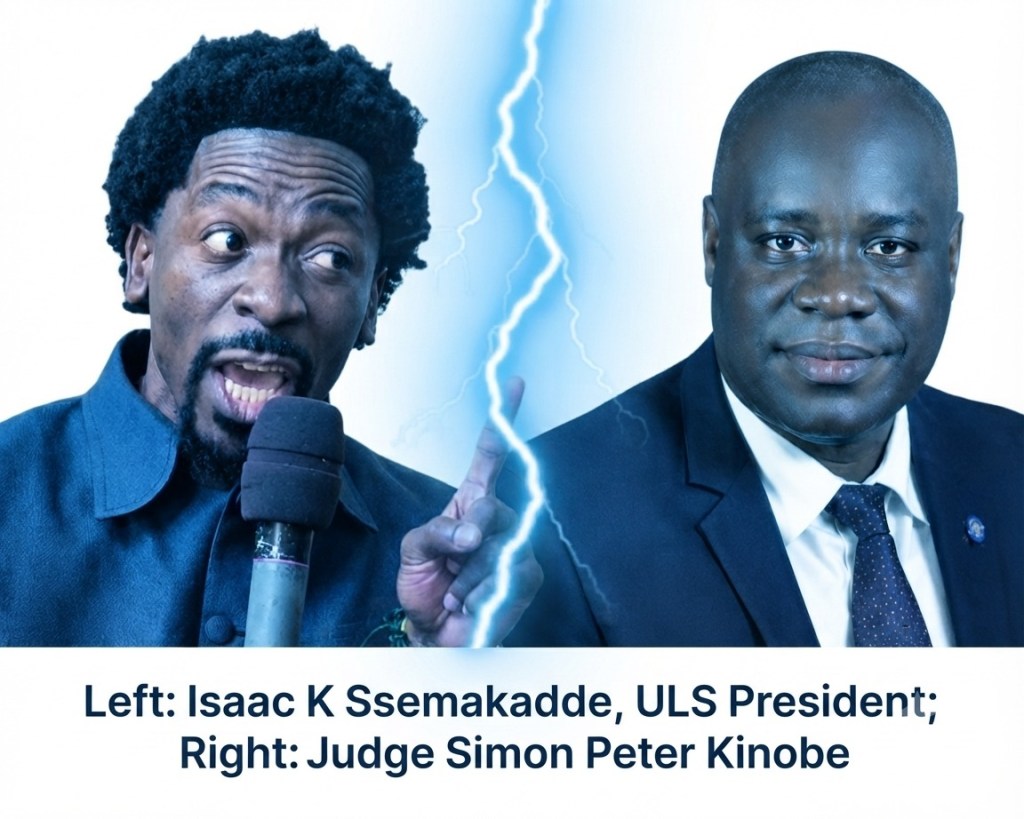
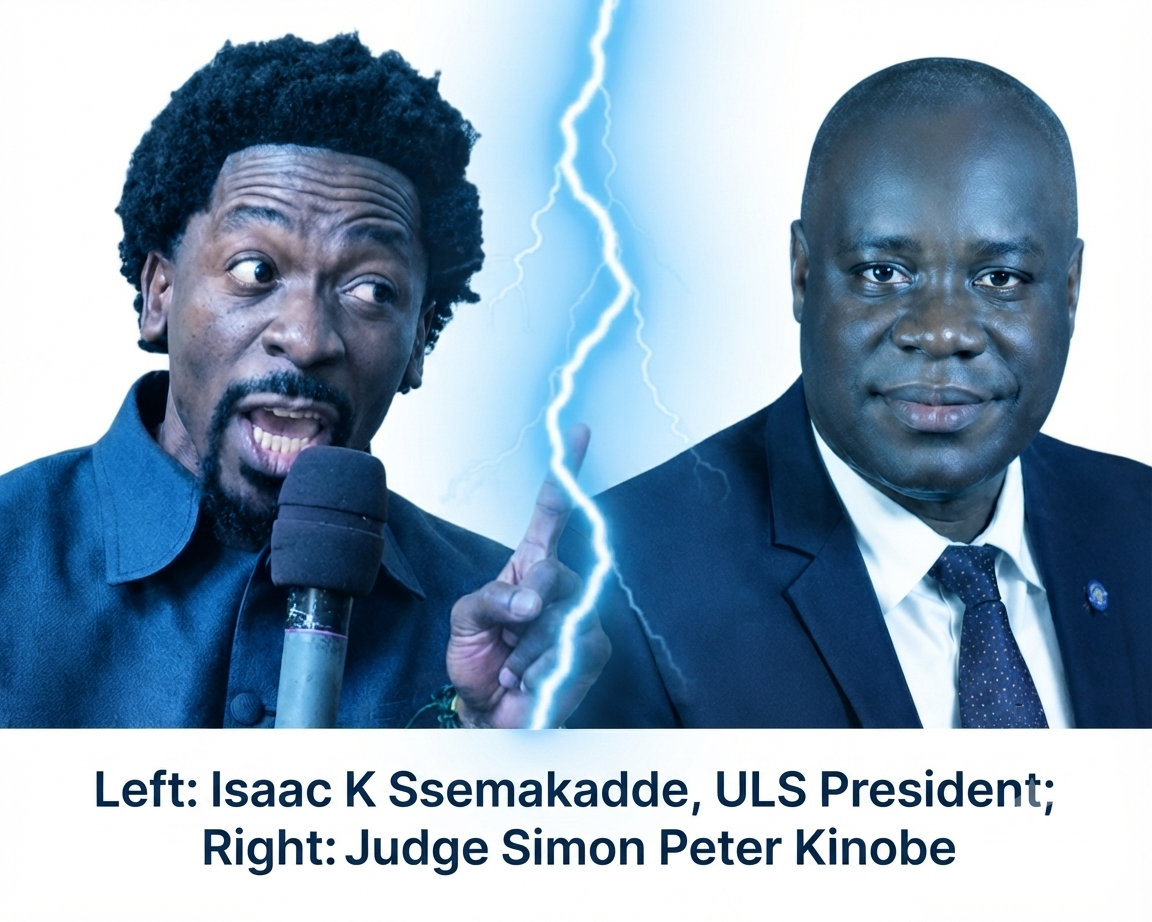
    In a press statement released on Tuesday, the Society criticized the case management directions issued on 17 July 2026 by Justice Simon Peter M. Kinobe in High Court Miscellaneous Application No. 0248 of 2026, involving Dr Kizza Besigye and Hajji Obeid Lutale against Gen Muhoozi Kainerugaba and the Attorney General.

    A copy of the Press Statement can be accessed here:

    According to the ULS, the directions impose stringent electronic filing deadlines under the Judiciary’s Electronic Court Case Management Information System (ECCMIS) while failing to account for litigants who may lack reliable access to computers, internet connectivity, legal representation or other basic resources required to participate effectively in digital proceedings.

    The Society argues that such requirements disproportionately disadvantage vulnerable litigants, particularly incarcerated applicants, and risk transforming technology from a tool that expands access to justice into one that restricts it.

    The statement further links the concerns to the Society’s earlier advisory issued on 4 June 2026 in response to the Chief Justice’s Administrative Circular No. 1 of 2026. In that advisory, the ULS questioned whether the Judiciary’s digital transformation framework sufficiently safeguards constitutional principles of transparency, public accountability and open justice.

    According to the Society, the latest case management directions reinforce those concerns by emphasizing administrative efficiency without corresponding safeguards for public and media access to court proceedings and records.

    Read also: A Paperless Judiciary: Why Aren’t We Ready?

    The ULS also questioned the practicality of requiring incarcerated applicants to comply with tight electronic timelines while the respondents—senior government officials represented by the State—enjoy significantly greater institutional resources.

    The Society maintains that this imbalance threatens the constitutional principle of equality of arms and may compromise the right to a fair hearing guaranteed under Article 28 of the Constitution.

    Beyond timelines, the statement criticizes the absence of mandatory pre-hearing scheduling conferences in complex constitutional litigation and warns that the Judiciary has yet to establish adequate contingency protocols for power outages, internet disruptions and system failures that could affect electronic proceedings.

    The Uganda Law Society called upon the trial judge to review the directions and adopt realistic procedural timelines that ensure meaningful participation by all parties.

    It also renewed its call for the rescission of the Chief Justice’s Administrative Circular No. 1 of 2026 and urged the Judiciary to develop a revised digital justice framework that expressly subordinates electronic court administration to constitutional guarantees of openness, fairness and equal access to justice.

    The statement concludes with a warning that digital innovation must remain a servant of justice rather than its master.

    “Justice that cannot be seen or accessed by the people is no justice at all,” the Society said.


    JOIN THE UNDERGROUND AND FUEL THE MOVEMENT

    We have created a dedicated fans WhatsApp Channel. Don’t miss the latest updates, get early bird access to our latest blog posts and more, so much more. Click the following link to follow the Channel: https://whatsapp.com/channel/0029Vb9BQqw5a246bWVsLl3j

    Independent institutional critique and advocacy for a radical overhaul of legal culture require time, deep research, and uncompromised independence. If these narratives bring value to your legal journey or challenge your perspective, please visit our HOME PAGE to see how you can support this platform directly and keep the critique fierce and relentless.

    Enen Ambrose. Advocate

    Member, Judiciary Affairs Committee,

    Uganda Law Society

    & Founder–Enen Legal World

    enen@enenlegalworld.com

  • ENEN’S SECOND LETTER TO THE RADICAL NEW BAR:FOREWORD

    ENEN’S SECOND LETTER TO THE RADICAL NEW BAR:FOREWORD

    FOREWORD

    The pages that follow are written in an unusual form. They are neither a judicial opinion, nor an academic journal article, nor a political manifesto in the ordinary sense. They are an epistle, an open letter addressed to the Radical New Bar, the Bench, the Bar, the wider Justice Sector, and ultimately to the people of Uganda. The choice of this form is deliberate.

    Throughout history, letters have served as instruments of reflection, correction, encouragement and reform. They have challenged institutions, comforted communities, and invited generations to re-examine the principles upon which they stand. This Letter is offered in that same spirit. Its central concern is neither the defence nor the condemnation of any single institution. Rather, it asks a broader question:

    How should justice institutions sustain the confidence of the people in an age of profound technological, social and constitutional change?

    The arguments that follow draw upon legal philosophy, constitutional thought, developments in Uganda’s justice sector, scholarship on Alternative Justice Systems, and contemporary public experience. They seek neither to diminish the constitutional role of the courts nor to glorify their competitors. Instead, they invite all who labour for justice to reflect upon a proposition that lies at the heart of this Letter:

    Justice is a competitive market in which institutions continually earn, or lose the confidence of the people they exist to serve.

    Whether the reader ultimately agrees with this proposition is less important than engaging seriously with the questions it raises.

    This Letter is therefore offered, not as the final word on the future of justice, but as a contribution to an ongoing national conversation about legal culture, institutional legitimacy, and the enduring pursuit of justice.

    The reader is now invited to proceed.

    JOIN THE UNDERGROUND AND FUEL THE MOVEMENT

    We have created a dedicated fans WhatsApp Channel. Don’t miss the latest updates, get early bird access to our latest blog posts and more, so much more. Click the following link to follow the Channel: https://whatsapp.com/channel/0029Vb9BQqw5a246bWVsLl3j

    Independent institutional critique and advocacy for a radical overhaul of legal culture require time, deep research, and uncompromised independence. If these narratives bring value to your legal journey or challenge your perspective, please visit our HOME PAGE to see how you can support this platform directly and keep the critique fierce and relentless.

    Enen Ambrose. Advocate

    Member, Judiciary Affairs Committee,

    Uganda Law Society

    & Founder–Enen Legal World

    Justice Ignited. Courage Unleashed.

    www.enenlegalworld.com | enen@enenlegalworld.com

  • CYBERFRAUD ALERT! HOW THE IDENTITY OF HON. JUSTINE NAMEERE WAS IMPERSONATED — AND I WAS NEARLY DEFRAUDED

    CYBERFRAUD ALERT! HOW THE IDENTITY OF HON. JUSTINE NAMEERE WAS IMPERSONATED — AND I WAS NEARLY DEFRAUDED

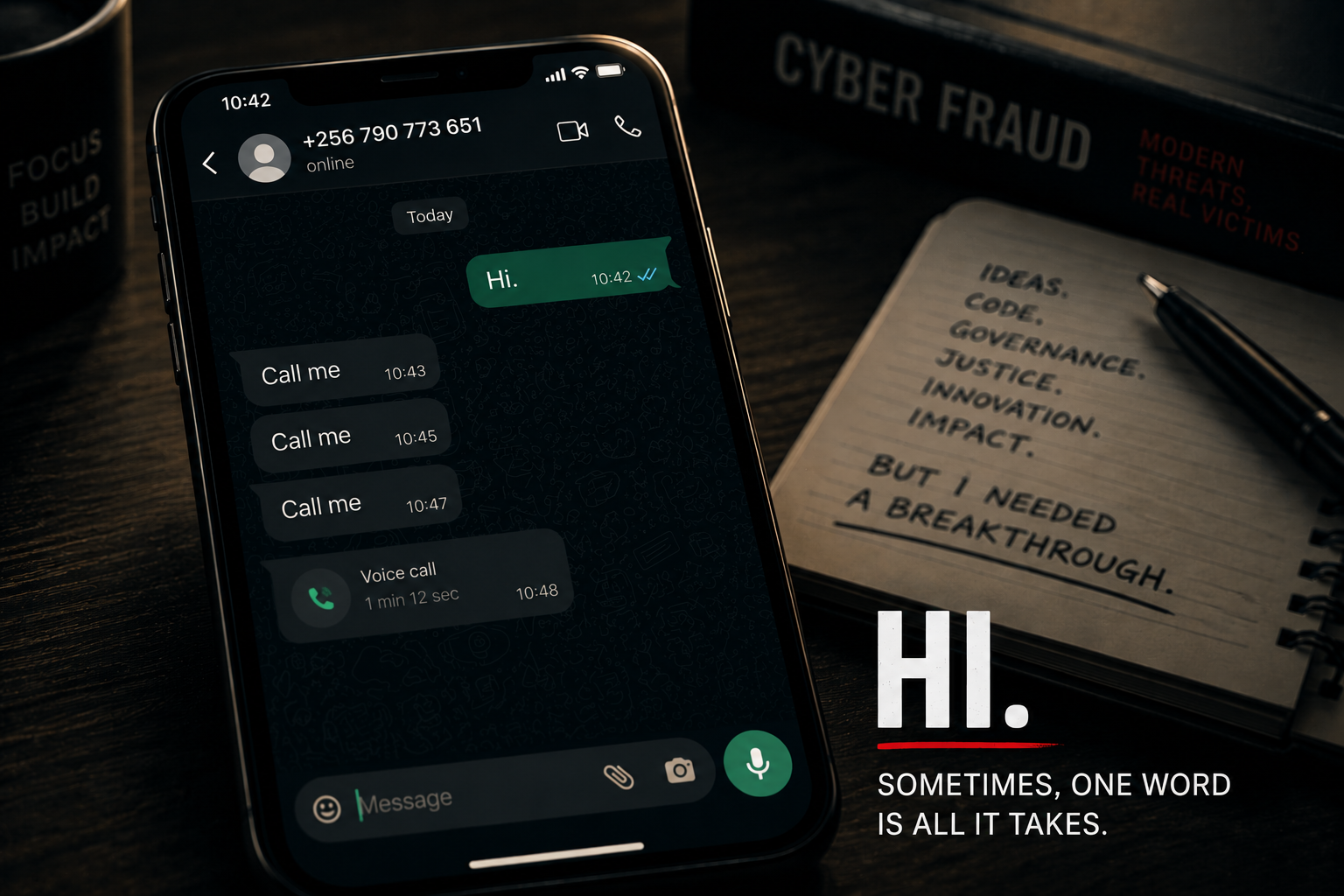
    I almost got defrauded by a deepfake.

    The first mistake I made was believing that the person on the other end of the phone was who she said she was.

    The second was more embarrassing.

    I knew enough about technology to build applications that crawl public databases, retrieve information and place it in the hands of ordinary citizens.

    I knew enough about law to be suspicious of almost everything.

    But on that particular day, I was busy being grateful.

    And gratitude, I would later discover, is a very poor cybersecurity system.

    Let me rewind.

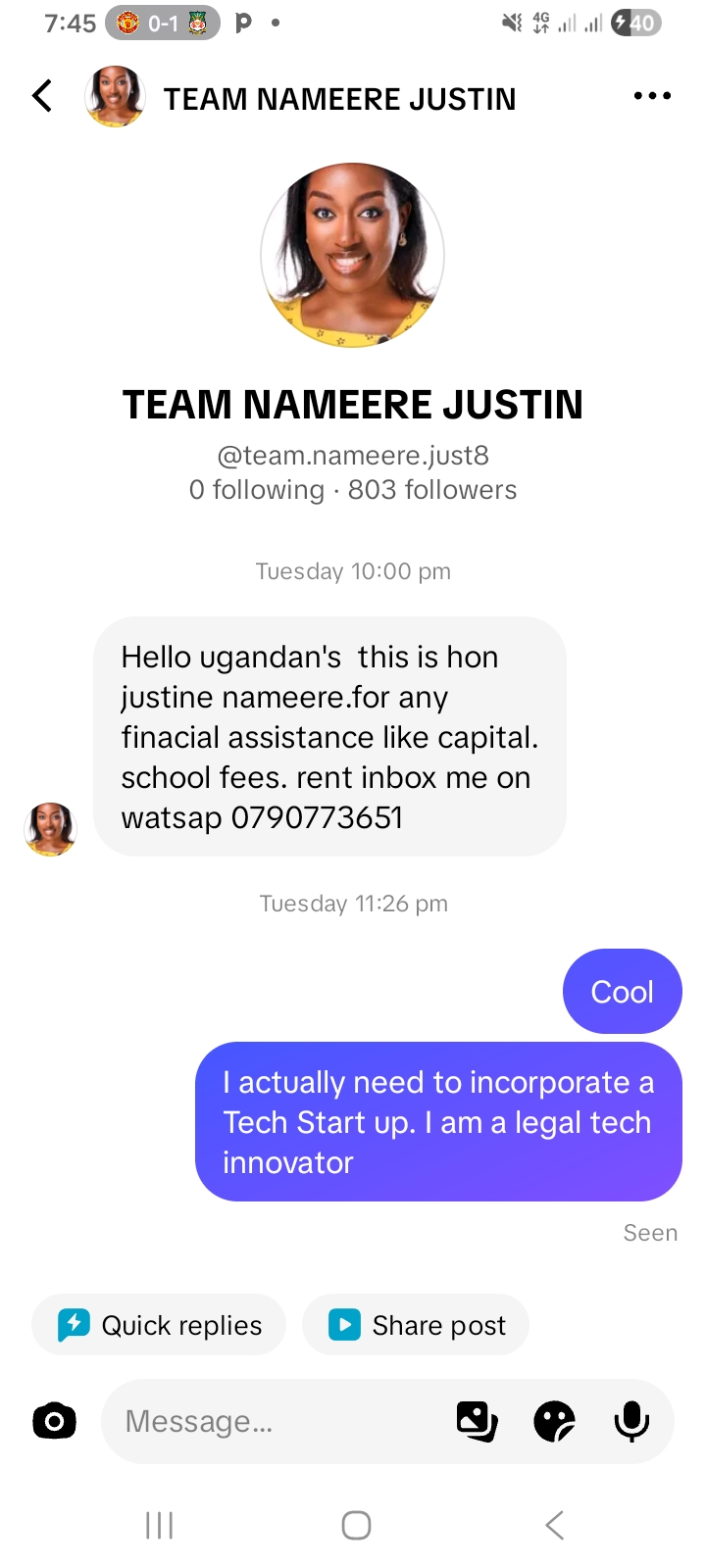
    A few days ago, I came across a TikTok account carrying videos of the Hon. Justine Nameere, the Minister of State for Local Government. In one of the videos, she was speaking about a promise she had made during her campaign for election as Member of Parliament.

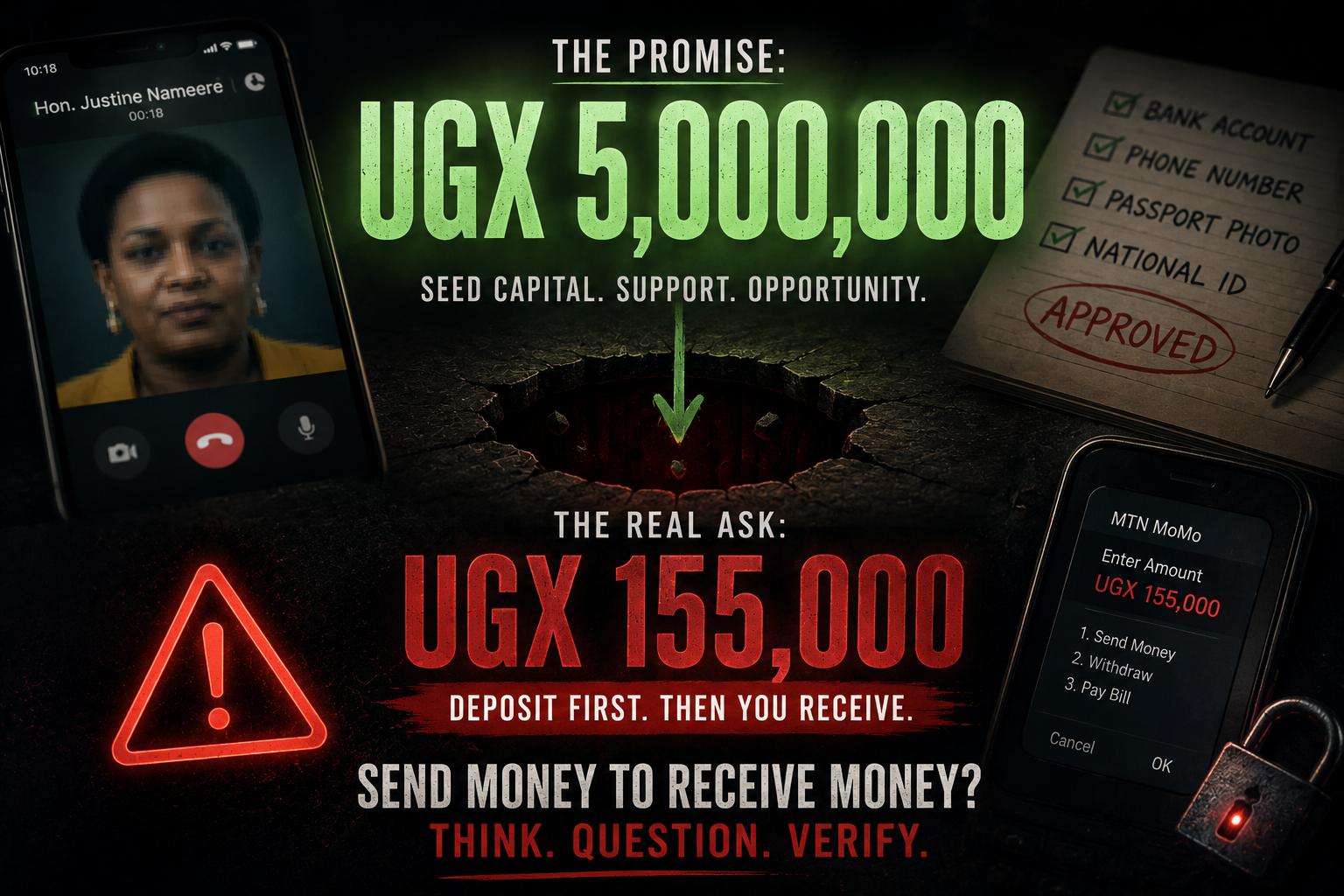
    She had promised to support people with seed capital of UGX 5,000,000.

    A copy of the video can be accessed on this link: https://vt.tiktok.com/ZSXuGnhVE/

    I did not think much of it.

    I had been working on my own things.

    I had been developing digital solutions—Android applications, Progressive Web Applications and iOS systems—which I believed could contribute to the #Digital_Transformation agenda of the Isaac Ssemakadde SC-led Radical New Bar at the Uganda Law Society.

    I will not say much more about the projects here.

    I was simply trying to turn some of my ideas into something real.

    And like many people with an idea and a little passion, I was looking for strategic sponsors willing to support the early development of what may one day become a public utility.

    The proposed seed capital would have helped.

    I asked for UGX 2,000,000.

    “Only?”

    The voice on the other end asked.

    Then she said she would make it UGX 5,000,000.

    There are other things I am not yet ready to discuss publicly.

    My problem was not ideas.

    My problem was money.

    Technology, in the 21st century, has a cruel sense of humour. You can have the idea. You can have the passion. You can even have the ability to build the thing.

    But at some point, Firebase wants to be paid.

    Servers want to be paid.

    Digital assets want to be paid.

    Company registration wants to be paid.

    And the tech person you finally discover after three months of fighting with software development platforms also wants to be paid.

    So, yes, UGX 5,000,000 would have helped.

    Then a number was provided to me through the TikTok account.

    I saved it.

    And sent a simple message.

    “Hi.”

    The person on the other end urged me to call.

    I did not.

    She urged me again.

    I still did not.

    Then the phone rang.

    She called me.

    The voice was hers.

    Or, at least, it sounded exactly like hers.

    I picked up.

    I introduced myself.

    I told her where I was.

    Adjumani.

    We spoke.

    And this is where the story becomes uncomfortable.

    Because the conversation was not some vague, robotic conversation between a stranger and a man desperate for money.

    I told her that I had followed her visit to Dokolo with the Senior Minister.

    I remembered the stern warning she had given contractors when she was handing over a road construction project.

    I told her that, although I was in Adjumani, Dokolo had Lango people.

    “Those are my people too,” I told her.

    Then I suggested that she consider visiting Otuke as part of the countrywide crusade against corruption in Local Government.

    The conversation was natural.

    It flowed.

    Then we turned to the issue of seed capital.

    I explained what I was doing.

    Legal technology.

    Digital platforms.

    Legal education.

    Solutions intended to digitise aspects of legal governance.

    I asked for UGX 2,000,000.

    Two million shillings.

    The response was almost comic.

    “Only?”

    Then she said she would make it UGX 5,000,000.

    I expressed gratitude.

    She told me what she required.

    A bank account.

    A phone number registered in my name.

    A passport-size photograph.

    And my National ID.

    I set out to assemble the requirements.

    There is a small detail here which still amuses me.

    I tried to create a passport-size photograph using AI.

    I had been cleaning up images, reconstructing angles and trying to make technology do what a professional photographer does in a few minutes.

    I failed miserably.

    Eventually, I went to a real photo studio and took real passport photographs.

    Sometimes, the future must respectfully step aside for a man with a camera.

    I sent the requirements.

    Then the video call came.

    And this is where the plot quietly changed.

    The call began with the face on the screen appearing slightly blurred.

    Not dramatically.

    Just enough to make the image look like one of those poor internet connections we have all become accustomed to.

    I did not immediately panic.

    I had already spoken to the person.

    The voice was hers.

    The face looked like hers.

    The story made sense.

    Then the banking arrangements began.

    I was asked about my bank account.

    At some point, a bank video call was purportedly made.

    The UGX 5,000,000 was even shown to me.

    The person on the other side looked exactly like the Minister.

    I had my National ID.

    I had my phone.

    I had already furnished my banking and mobile money details.

    Then came the curious issue of the bank.

    Bank of Africa.

    I was asked whether I had a Bank of Africa account.

    I did not.

    Then the story took a turn.

    I was told to deposit UGX 155,000 on my mobile money account.

    The explanation was that the Minister’s Secretary would initiate a transaction and withdraw the money directly from my phone.

    After that, the UGX 5,000,000 would be sent to my mobile money account.

    I paused.

    And somewhere in that pause, the entire story finally stopped being a story about seed capital.

    It became a story about a transaction charge.

    I have spent enough time around Ugandan systems to know that when a person tells you that you must first send money in order to receive money, the bells should not merely ring.

    They should summon the entire brass band.

    I blocked the number.

    Immediately.

    The number being used to contact me on WhatsApp was 0790773651.

    The number is registered in the name of Sumaya Tumwesigye.

    Another number, 0755116502, later attempted to contact me while purporting to be Hajjat Namyalo.

    I subsequently established that the real Hajjat Namyalo is a known public figure who serves as Secretary in the Office of the National Chairperson of the NRM.

    I am deliberately stating these facts carefully.

    I am not saying that the persons in whose names these numbers are registered are the people who contacted me.

    In fact, that is precisely the problem.

    If a SIM card is registered in your name and is being used to impersonate public officials and solicit money, you may have a problem you do not even know exists.

    And this is where I depart from my normal programming.

    Enen Legal World is primarily a legal literacy and Rule of Law platform.

    I write about law.

    I write about institutions.

    I write about governance.

    I occasionally write things which make people very uncomfortable.

    But today, I am breaking the normal editorial policy.

    Because cyber fraud has become too clever to be treated as a distant problem belonging to “those people who are easily deceived.”

    I was not sitting in a dark room waiting for free money from a stranger.

    I had a genuine project.

    I had seen a genuine campaign promise.

    I had a reason to believe that a Minister might support a young Ugandan working on technology.

    I had a conversation that contained details which made the interaction feel real.

    I saw a face.

    I heard a voice.

    And I almost became a statistic.

    The fraudsters did not merely impersonate a Minister.

    They walked into a story that was already true.

    That is what makes this dangerous.

    The next person may not pause at UGX 155,000.

    The next person may have just lost a job.

    The next person may have school fees due.

    The next person may believe that UGX 5,000,000 has finally arrived to rescue them.

    And when that person sends the money, the fraudsters will not need to explain how the video call worked.

    They will simply disappear.

    I have already spoken to the Minister’s office and provided the numbers used to contact me.

    I intend to report the matter to the police and seek guidance on the proper preservation and investigation of the available evidence.

    Because this is not merely about my almost-loss of UGX 155,000.

    It is about a technology that can now make a person look like somebody else, sound like somebody else and say things that the real person may actually have said before.

    We have entered a very dangerous era.

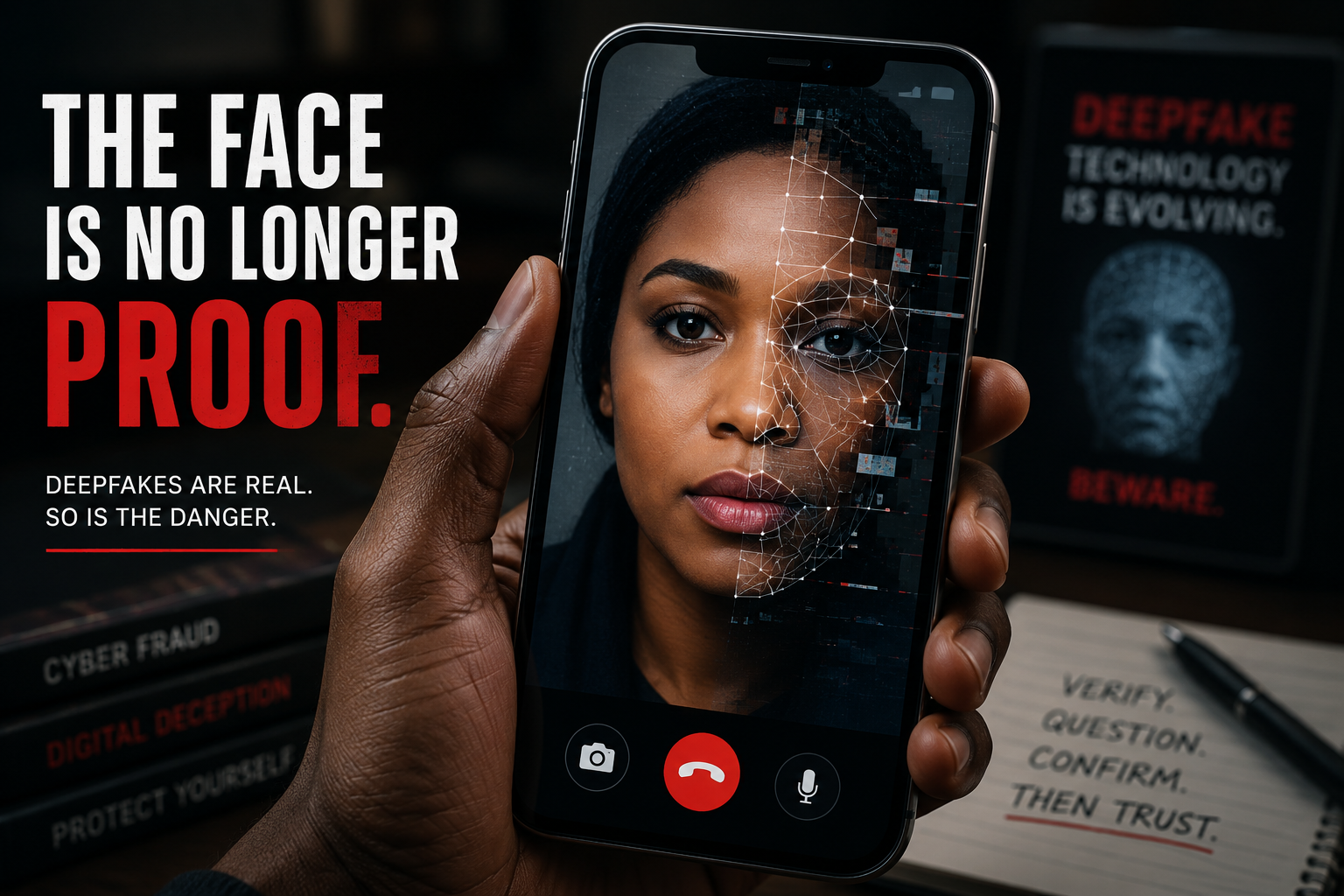
    The face is no longer proof.

    The voice is no longer proof.

    And if you think a WhatsApp video call is sufficient authentication, you may be living in the past.

    Today, I was lucky.

    Not because I am smarter than the fraudsters.

    Not because I possess some supernatural ability to detect a deepfake.

    I was lucky because, somewhere between the Minister’s Secretary and UGX 155,000, the story finally became too strange even for my imagination.

    This time, I have chosen not to remain neutral on cyber fraud. Because this is no longer somebody else’s problem.

    I am therefore calling upon the authorities to take up this case — and the many other cyber fraud cases that continue to torment members of the public. And I ask you, my dear reader, to join me in demanding the same.

    Because the next call may not be made to somebody else.

    EDITORIAL NOTE: This is a first-person account of an attempted fraud as experienced by the author. The events described are supported by the author’s contemporaneous records and subsequent verification efforts. The author has shared the matter with the relevant authorities and invites investigation.

    For the avoidance of doubt, this account does not suggest that the individuals whose names or identities were impersonated participated in the fraud. The concern is that their identities may have been misused by persons who are presently unknown to me.

    JOIN THE UNDERGROUND AND FUEL THE MOVEMENT

    We have created a dedicated fans WhatsApp Channel. Don’t miss the latest updates, get early bird access to our latest blog posts and more, so much more. Click the following link to follow the Channel: https://whatsapp.com/channel/0029Vb9BQqw5a246bWVsLl3j

    Independent institutional critique and advocacy for a radical overhaul of legal culture require time, deep research, and uncompromised independence. If these narratives bring value to your legal journey or challenge your perspective, please visit our HOME PAGE to see how you can support this platform directly and keep the critique fierce and relentless.

    Enen Ambrose. Advocate

    Member, Judiciary Affairs Committee,

    Uganda Law Society

    & Founder–Enen Legal World

  • Has Aminism Returned? The Arrest of Lawyers and the Future of the Rule of Law in Uganda.

    What happened to Counsel Lukwago strikes at the heart of justice. Arresting and intimidating a lawyer for
    _preparing to serve court papers_ is a direct attack on the rule of law. If advocates can’t file and serve process safely, the courts themselves are under siege.

    I hope this time  the Judiciary will apply its  Constitutional Duty under
    Article 126(1), of The Constitution of Uganda. _“Judicial power is derived from the people and shall be exercised by the courts… in the name of the people and in conformity with law and with the values, norms and aspirations of the people.”_

    When an officer of court is “abducted” for doing his job, the Judiciary must:
    Issue a statement The Chief Justice or DCJ or PJ  should publicly condemn any interference with legal process. Silence reads as consent or complicity.
    Demand immediate disclosure: Courts have inherent power to require security agencies to produce a detained advocate and state where he is he is especially where messages shared are distressing like what we are seeing-

    Post by Erias Lukwago on X

    Protect the process:
    No person is above service of process.
    – Judiciary has been put on trial by these events as to whether it will protect the judicial process or not.The whole world is watching I believe.
    – As for Ugandans ,its difficult to know what they think: New Normal has arrived for them.

    Secondly  Uganda Law Society   must defend its  members and the rule of law. 
    They  should file an-

    Emergency petition in High Court for Lukwago’s production and safety.  They should not wait for end of 48 hours.
    ULS should Call for judicial inquiry Into the “basement” photo, the arrest, and likely  torture.
    Surely  the Provisions of the Constitution particulatly  Article 24 of the Constitution protects people from torture as “No person shall be subjected to any form of torture, cruel, inhuman or degrading treatment or punishment.”. It is  mandatory.


    I saw members on LDC Legal Alerts forum supporting Torture of suspects, and these were both Judicial Officers and Advocates,
    I hope they have seen the dangers of tolerating torture of anyone arrested
    I hope ULS will be serious on formally bringing this to the attention of the International community because independence of the judicial officers and lawyers has been terribly affected.
    They are now siezed with fear.

    Lawyers who would persue this matter might be the next victims. No one is safe.

    If ULS does not rise up and take practicable steps, the rights of their members  to practice under  Article 40(2) – Every Ugandan has a right to practice their profession will seriously be affected.
    2. Independence of lawyers under UN Basic Principles on the Role of Lawyers must be upheld. _“Governments shall ensure that lawyers are able to perform all of their professional functions without intimidation, hindrance, harassment or improper interference.”_
    3. There can be no justice without Access to courts.
    If lawyers are  arrested   for serving papers, you’ve shut the court doors there by violating Article 28– Right to a fair hearing.


    Every person regardless of the nature of his or her case has a right to legal representation.
    Harrassing lawyers should be condenmed in the strongest terms and action taken.

    Even the Holy Word of God provides for legal services.
    Proverbs 31:8-9: _“Speak up for those who cannot speak for themselves, for the rights of all who are destitute. Speak up and judge fairly; defend the rights of the poor and needy.”_ 
    Isaiah 1:17: _“Learn to do right; seek justice. Defend the oppressed.”_

    A reign of terror starts when advocates are punished for  representing particular clients or filing papers in court.
    It ends when the Judiciary says _“No. Not on our watch.”_
    That is why Judiciary and ULS has to work together to end this foolishness and impunity

    What should happen next
    1. Immediate production: Lukwago must be brought before a judge within 48 hours per Article 23(4).
    2. Medical examination: If the photo shows distress, an independent doctor must assess him for torture.
    3. Protective orders: Court should bar security agencies particulary UPDF, from interfering with lawyers serving process in any case filed in Ugandan courts.
    4. The judiviary should come out to condenm illegal  ingazetted basements for this is not the first time its happening
    Everything goes back to the Judiviary as an arm of Government.
    Terror cannot rule where law stands.
    Judiciary should apply the law as it is. Their current complicit is allowing terror to stand. Eddy Mutwe, and others would not be in jail now if  _Judiciary was exercising its Judicial independence.
    I know the word of God says:
    “Tyranny will be far from you; you will have nothing to fear” Isaiah 54:14
    But that promise requires judges, lawyers, and  representatives  of citizens in Parliament to act and citizens themselves.
    Silence means you have consented to Terror.
    Is that so for Ugandans?
    Let Lukwago’s case open our eyes.
    No one is safe .

    From Enen Legal World:

    This Blog foreshadows for a high ranking Judicial Officer who prefers to remain anonymous for fear of “the basement” which is nolonger a secret.

    For feedback or comments:

    enen@enenlegalworld.com
  • A Paperless Judiciary: Why Aren’t We Ready?

    A Paperless Judiciary: Why Aren’t We Ready?

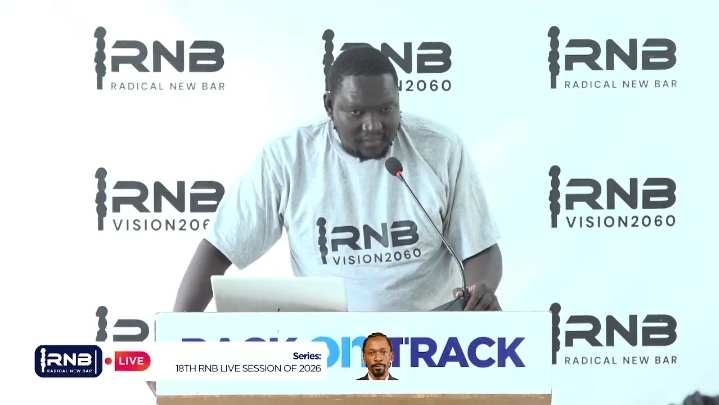
    A speech I presentd at the 18th RNB Live on 4th June, 2026 at ULS House, Kampala

    Paperless Judiciary: Why Aren’t We Ready?

    A speech presented by Enen Ambrose, blogger at www.enenlegalworld.com at the 18th RNB Live on 4th June, 2026 at ULS House, Kampala

    The President of the Uganda Law Society, Isaac K. Ssemakadde SC, the Most Perpendicular Vice President, Anthony Asiimwe, my Northern Uganda Representative to the ULS Governing Council, Egaru Emmanuel Omiat, who I believe is following this discussion online,the General Secretary Salim Babu, together with fellow members of the ULS RNB Governing Council — whom I prefer to call the ULS RNB High Command — the highly distinguished members of the medical fraternity present with us today, colleagues, fellow officers of the court, distinguished guests, and fellow citizens both here in the hall and watching us online:

    I was invited to speak in my capacity as a blogger at www.enenlegalworld.com on the theme: A Fully Paperless Judiciary — Why Aren’t We Ready?

    I stand before you today with deep humility and sincere concern. As a technology enthusiast who believes that technology must facilitate access to justice rather than impede it, I have witnessed firsthand the challenges that arise when we rush into a fully paperless system without adequately preparing the people it is meant to serve.

    What I have observed is not mere technical inconvenience. It is something far more serious — a subtle but damaging form of harm which I prefer to call “the quiet violence of procedure” being done to the very people we are sworn to serve.

     Part I: The Quiet Crisis

    This is not the violence of guns or angry mobs. It is the quiet, daily violence of a system that pretends everything is working when it clearly isn’t.

    Just three days ago, on 1st June 2026, the Judiciary’s deadline for crossing into full paperless operations came and went. Yet the Judiciary’s ICT Director confirmed that the system will only be rolled out to 49 courts — just 20% of the total.

    Imagine a magistrate who cannot access a bail application because the network has failed. The system coldly declares “the file is not before court.” Yet the accused — whether a poor market vendor, a struggling farmer, or a respected professional — stands right there in the dock.

    When this recently happened to an advocate, that person was remanded to Luzira Prison.

    We have always been told that justice delayed is justice denied. But what do we call justice that has simply disappeared from the screen?

    We are rushing into a paperless judiciary while many citizens, and even many lawyers, still cannot navigate it. If a poor person cannot understand their case without a single sheet of paper, have we really advanced, or have we simply replaced one barrier with a more expensive, more frustrating one?

     Part II: The Evidence on the Ground

    My concerns are not theoretical. A recent survey by the PM Digital Law Hub revealed worrying numbers:

    – 87% of judicial officers and advocates have experienced frequent system disruptions. 

    – 78% say technical support is unreliable. 

    – 67% were not confident we would be ready for the June 1st deadline. 

    – 59% have received no formal training at all.

    Let me give you a picture of what these numbers mean. My firm once sent a bright, confident legal assistant to the Gulu branch of the Uganda Registration Services Bureau. His task was to certify company records we needed as evidence in court. He knew the registry. He knew the clerk. He was polished and fully prepared.

    But when he arrived, the physical counter was still there — yet the records had already moved online. The staff of URSB turned him back empty-handed. That day, we had no choice but to force ourselves to adapt to the new technology.

    That, colleagues, is exactly where many of us are today with ECCMIS. We are still walking the old path, trusting the old counters, while the world has moved on.

    Let me tell you another story — one that has not happened yet, but will happen if we are not careful. I want you to meet a lawyer. She is experienced. She has practised for fifteen years. One afternoon, she receives an urgent call. A client is about to be evicted. A temporary injunction must be filed before 5:00 p.m. She knows the High Court Registry well. She has done this a hundred times. But when she arrives, the counters are gone. The clerks point to a sign: “All filings electronic. Use ECCMIS. No paper accepted.” She does not have her laptop. The courthouse Wi‑Fi is down. Her phone battery is low. She tries to log in — she has forgotten her password. She calls her clerk. No answer. The clock shows 4:47 p.m. Her client will be evicted tomorrow. And there is nothing she can do. Colleagues, come July 2026, if the paperless mandate is fully enforced without the changes we are demanding, this will happen. I guarantee it. Our lady lawyer will stand in that registry, fully unarmed and disempowered. In that moment, like our legal assistant at URSB, she will learn the hard way: how she was trained for the profession is no longer relevant. She must upgrade her digital skills — or risk being rendered irrelevant.

    In 2026, we still have judicial officers reaching for the Civil Procedure Rules of 1929 to determine the validity of a summons delivered through a WhatsApp message, while the entire body of laws enacted to facilitate the digital transformation of the Judiciary gathers dust.

    Without a clear Practice Direction from the Chief Justice, and without digital competence forming part of performance evaluation, even this limited rollout to only 49 courts risks a spectacular failure.

     Part III: The Human Cost

    The Nocturnal Lawyer

    Our advocates are now working at 2:00 a.m. not because they are dedicated, but because the system is too slow and congested during the day. We have, in effect, outsourced government server problems to the sleep and mental health of lawyers.

    This is not digital transformation. It is like constructing a magnificent house without laying a proper foundation — impressive on the surface, but unsustainable and harmful to those who must live in it.

    A new digital underclass

    As Advocate Madira Jimmy from Arua warned me, many lawyers in the North risk being reduced to “local assistants” for Kampala-based lawyers who have better internet and support.

    The same law degree, the same oath, but a completely different playing field. This is creating a dangerous hierarchy inside our own profession.

    The Vanishing File

    Under the old physical system, a file could be traced. Today, an urgent application can simply “disappear” in the ECCMIS system.

    A judicial officer who does not wish to attend to a matter no longer needs to hide a physical file. They can simply say, “The system shows nothing.” And who can argue with a screen they cannot see?

    We recently experienced this when the Uganda Law Society filed an urgent Human Rights Application concerning the Ggaba trial. That application was effectively not attended to.

    In my humble view, this incident points not only to a potential case of misconduct against the concerned judicial officers, but more importantly, to a deeper and disturbing lack of accountability in our digital justice system.

    If this can be done to the Uganda Law Society itself, one wonders: who else is suffering the same fate — ordinary citizens who have no voice and no remedy at all?

    Part IV: What We Must Do

    I am not here to condemn the Bar or the Bench, nor am I here as a doomsayer. My critique is directed across the board — at all of us who have a role to play in the successful adoption of digital transformation in the administration of justice.

    1. Mandate Offline Functionality — Every court computer must be able to pre-cache daily files and work when the network fails. Our banking, email apps, file backup systems like Google Drive already do this.
    1. Mandatory Training — No more “learning on the job.” Every judicial officer, clerk, and advocate must undergo verifiable digital training.
    1. Recognise Modern Communication — Issue a Practice Direction accepting service via WhatsApp and SMS to verified numbers. The court can always set aside service where injustice is shown.
    1. True Hybrid System — Do not treat paper as the enemy. A genuine hybrid approach beyond the current 20% rollout is wisdom, not weakness.
    1. Citizen-Centred Design — The system must work for the widow in Amudat who has never opened a PDF.
    1. Cultivate a Transformed Legal Culture — Digital transformation without a corresponding culture of accountability and citizen-centred justice is merely digitising the old bad manners. We must deliberately build a new legal culture where technology serves justice rather than concealing injustice.
    2. Embrace Technology at Individual and Institutional Level — We must consciously cultivate a new culture of embracing technology at both personal and institutional levels. A lawyer who boasts that they never read their emails or deliberately switches off their WhatsApp blue ticks is no different from a judicial officer who conveniently claims “the system shows nothing.” True digital transformation demands personal responsibility from all of us.

     Part V: A Call to Action

    To my fellow advocates: We must continue having honest and regular conversations about digital transformation and the development of a new digital legal culture. Our shared goal is to ensure that technology truly enhances access to justice for all. Let us speak up constructively, with one voice, for the good of our clients and the future of our profession.

    To judicial officers: My clarion call to you today is this — many of you are working under very difficult conditions. Let us join hands and fight together for better tools, better infrastructure, and better support.

    As the ancient proverb teaches us — and I have merely adapted it here — “the roots of accountability are bitter, but the fruits are sweet.” (A variation of Aristotle’s famous saying on education). Let us therefore courageously cultivate, at both personal and institutional levels, a new legal culture of accountability and genuine digital transformation.

    To the people of Uganda: Walk with us. The widow in Amudat — who has never opened a PDF — the accused in Luzira, whose bail application vanished from a screen, and the nocturnal lawyer, awake at 2am fighting a congested server — they need us to get this right.

    The spirit is willing. Let us now strengthen the flesh of this system.

    Thank you.

    I remain Enen Ambrose of Enen Legal World, a legal literacy blog which you can find at www.enenlegalworld.com and I say this for God and My Country.

    ENEN AMBROSE

    www.enenlegalworld.com

    A copy of the speech can be found here:

    JOIN THE UNDERGROUND AND FUEL THE MOVEMENT

    We have created a dedicated fans WhatsApp Channel. Don’t miss the latest updates, get early bird access to our latest blog posts and more, so much more. Click the following link to follow the Channel: https://whatsapp.com/channel/0029Vb9BQqw5a246bWVsLl3j

    Independent institutional critique and advocacy for a radical overhaul of legal culture require time, deep research, and uncompromised independence. If these narratives bring value to your legal journey or challenge your perspective, please visit our HOME PAGE to see how you can support this platform directly and keep the critique fierce and relentless.

    Enen Ambrose. Advocate

    Member, Judiciary Affairs Committee,

    Uganda Law Society

    & Founder–Enen Legal World

  • When the Constitution Loses Its Teeth: A Lament After Faruku

    When the Constitution Loses Its Teeth: A Lament After Faruku

    Imagine your son leaves home to go to the farm.

    He never returns.

    Days become weeks.

    Weeks become months.

    You move from police station to police station looking for him.

    Nobody tells you where he is.

    Nobody tells you what he has done.

    Nobody tells you when he will come home.

    Then one morning, somebody calls.

    “He is being produced in court.”

    You rush there.

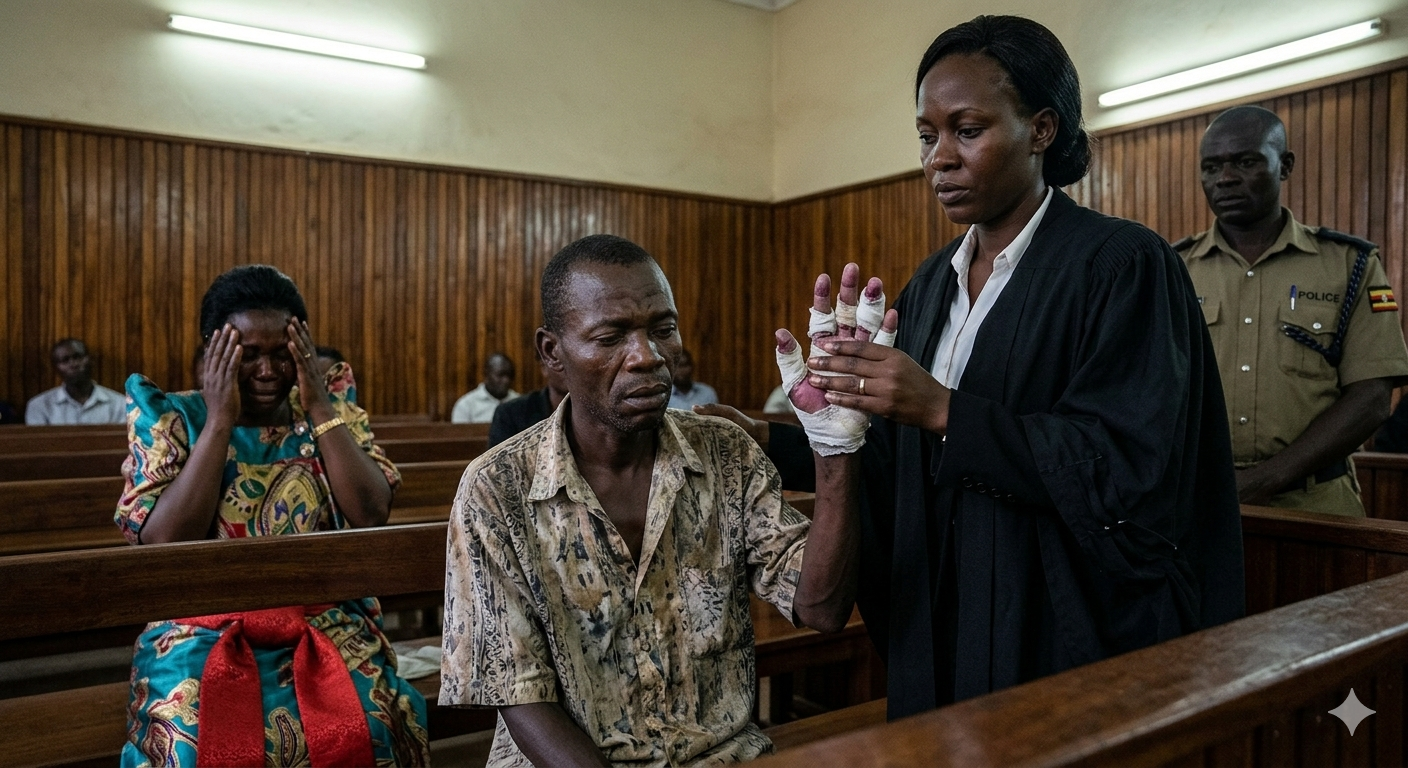
    He arrives limping.

    His mother begins to cry.

    Even before he speaks, everybody in court can see that something happened.

    The State says he is a criminal.

    He says he was tortured.

    The Court agrees that his rights were violated.

    But the trial continues anyway.

    That is why the Constitutional Court’s decision in Faruku Muhamed and 2 others v Attorney General matters. A copy of the judgment can be accessed here

    Many Ugandans will never read the judgment.

    Many will never understand the legal arguments.

    But every Ugandan should understand what is at stake.

    Because this case is not really about criminals.

    It is about power.

    For nearly twenty years , in cases like those of Uganda Law Society and the famous Kayunga riots Uganda’s courts had been slowly teaching the State a simple lesson:

    There are some lines you do not cross.

    Some rights are so important that violating them comes at a heavy price.

    That principle was not created to protect criminals.

    It was created to protect citizens.

    It was created because Uganda knows what happens when people in power stop fearing the Constitution.

    Our Constitution was not written in paradise.

    It was written after years of arbitrary arrests.

    Years of torture.

    Years of disappearances.

    Years of constitutional crises.

    Years in which the ordinary citizen stood almost naked before the power of the State.

    The framers understood something simple.

    A government should never be allowed to break the law in order to enforce the law.

    That is why some rights were declared non-derogable.

    Untouchable.

    Non-negotiable.

    Beyond convenience.

    Beyond politics.

    Beyond excuses.

    The Faruku decision changes that conversation.

    The Court has not legalized torture.

    The Court has not abolished constitutional rights.

    The Court has done something more subtle.

    It has reduced the cost of violating them.

    And history teaches us that constitutional decline rarely begins when rights are abolished.

    It begins when violating them becomes cheaper.

    Supporters of the decision ask a fair question.

    Should a murderer walk free because he was tortured?

    Should a terrorist escape punishment because his rights were violated?

    Those questions sound persuasive.

    Until we ask another.

    If the State already had enough evidence to convict, why was torture necessary in the first place?

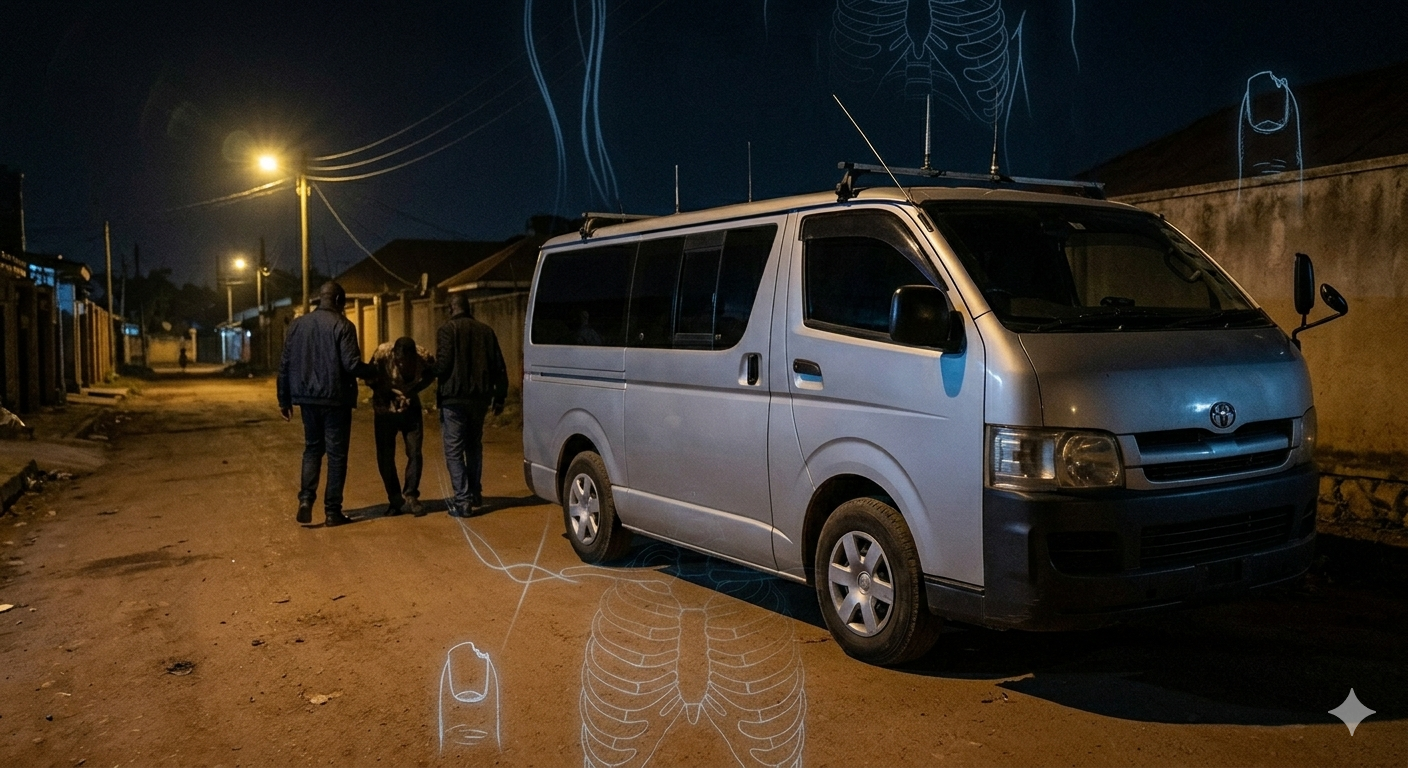
    Why break the ribs?

    Why remove the fingernails?

    Why apply electric wires?

    Why violate the Constitution at all?

    That is the question Uganda should be asking.

    Instead, we are being encouraged to focus on what happens after the violation.

    Sue for damages.

    File another case.

    Seek compensation.

    But every Ugandan knows the reality.

    The person who emerges from years of detention, trial, imprisonment, poverty and trauma rarely possesses the energy, resources or influence required to start another legal battle.

    The remedy exists on paper.

    Life exists in reality.

    And those two things are not always the same.

    Perhaps the most frightening symbol of this reality is a single word.

    “Drones.”

    There was a time when a drone was something that flew in the sky.

    Today, many Ugandans hear that word and think of something else entirely.

    Think about how abnormal that is.

    Think about how much had to happen before an entire country accepted that vocabulary.

    Think about how many stories are hidden inside that single word.

    The abnormal has become normal.

    The shocking has become routine.

    The unacceptable has become familiar.

    And when that happens, constitutional erosion is already underway.

    Some people will say these concerns are exaggerated.

    They will say rights still exist.

    They will say courts remain independent.

    Perhaps.

    But constitutional history is filled with societies that discovered too late that rights on paper are not the same thing as rights in practice.

    A Constitution is not tested when it protects the popular.

    It is tested when it protects the unpopular.

    It is not tested when it restrains the weak.

    It is tested when it restrains the powerful.

    The true measure of constitutionalism is not how the State treats those it likes.

    It is how the State treats those it fears, suspects, opposes or despises.

    That is why this moment matters.

    Not because a criminal might benefit.

    But because power always expands into spaces where consequences disappear.

    Today it may be a suspected criminal.

    Tomorrow it may be a journalist.

    The next day it may be a businessman.

    The day after that it may be an opposition supporter.

    One day it may be your son.

    Or your daughter.

    Or you.

    The Supreme Court may yet reverse this decision.

    History may yet correct it.

    But the real answer will not be found in law reports.

    It will be found in what follows.

    If State agencies become more respectful of constitutional rights, perhaps the Court’s faith in alternative remedies will be vindicated.

    If they do not, future generations may look back upon Faruku as the moment Uganda’s Constitution was not destroyed—

    but the moment it was asked to stand aside while power carried on with business as usual.

    Our Constitution was meant to be a fence around the citizen.

    A fence is only as strong as the dog that guards it.

    If the dog can no longer bite, only the thief has reason to celebrate.

    That is why some of us are mourning today.

    Not because the Constitution is dead.

    But because it has been asked to whisper where once it could roar.

    DISCLAIMER:

    The contents of this Blog are not intended to be used as a substitute for legal advice. The author shall not accept liability for use of the contents of this Blog as legal advice. Readers are encuraged to consult qualified advocates for real life situations for legal advice.

    JOIN THE UNDERGROUND AND FUEL THE MOVEMENT

    We have created a dedicated fans WhatsApp Channel. Don’t miss the latest updates, get early bird access to our latest blog posts and more, so much more. Click the following link to follow the Channel: https://whatsapp.com/channel/0029Vb9BQqw5a246bWVsLl3j

    Independent institutional critique and advocacy for a radical overhaul of legal culture require time, deep research, and uncompromised independence. If these narratives bring value to your legal journey or challenge your perspective, please visit our HOME PAGE to see how you can support this platform directly and keep the critique fierce and relentless.

    Enen Ambrose. Advocate

    Member, Judiciary Affairs Committee,

    Uganda Law Society

    & Founder–Enen Legal World

  • THE DIGITAL JUSTICE CROSSROADS: REFLECTIONS FROM THE ECCMIS SYMPOSIUM

    THE DIGITAL JUSTICE CROSSROADS: REFLECTIONS FROM THE ECCMIS SYMPOSIUM

    Dear Colleagues,

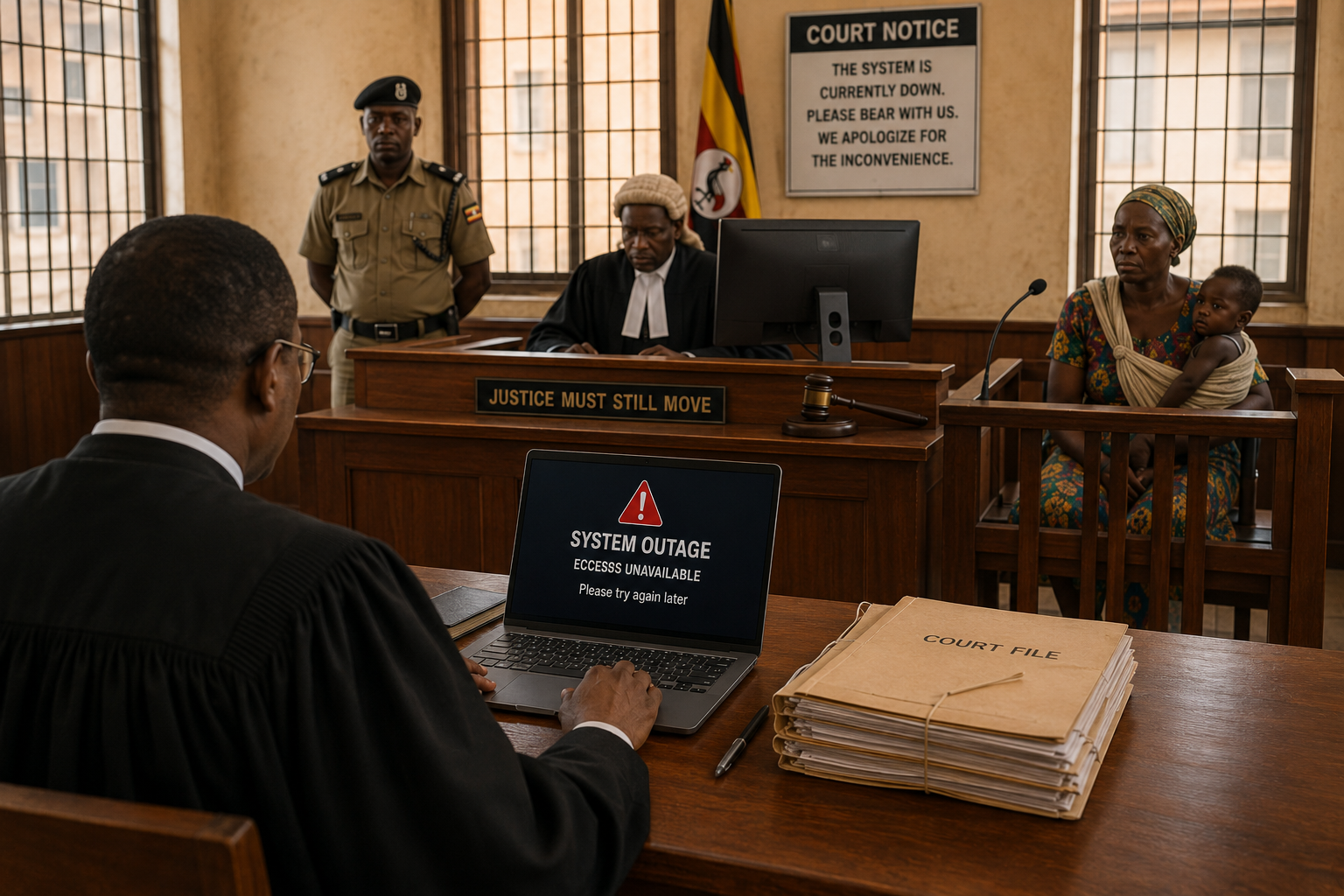
    A court file can disappear.

    A server can crash.

    A network cable can be cut.

    Yet justice must still move.

    That, in many ways, was the question hanging over the inaugural ECCMIS Symposium that I recently attended as a member of the Judiciary Affairs Committee of the Uganda Law Society, a technology enthusiast, and perhaps most importantly, a practising advocate who has experienced firsthand both the promise and frustrations of Uganda’s digital transition.

    This newsletter is a continuation of my earlier reflections on the necessity of technological adoption within our profession. Then, I argued that lawyers must embrace technology or risk being left behind. Today, however, I wish to discuss a different concern: how we ensure that digital transformation does not leave people behind.

    The Bar Speaks

    Our ULS leadership—President Isaac Ssemakadde, SC, and VP Anthony Asiimwe—were clear: while the Bar supports modernization, we must prioritize accountability and interoperability. As Vice President Asiimwe noted, deadlines continue to run even when the system fails, creating a dangerous procedural environment for advocates. The leadership emphasized that a digital system that cannot guarantee the safety of our filings is, for all practical purposes, a liability to the Rule of Law.

    Beyond the Headlines

    Much has already been said about ECCMIS, the Judiciary’s flagship case management system. The symposium brought together judicial officers, ICT specialists, researchers, and members of the Bar to discuss the realities of implementation. What emerged was neither a story of triumph nor failure, but one of transition.

    Mr. David Sunday Kikabi, Director of ICT at the Judiciary, clarified that the transition remains phased, operating in 49 court stations, representing roughly twenty percent of the Judiciary’s footprint. Hon. Justice Christopher Madrama reminded participants that meaningful criticism must appreciate the operational realities of implementing a national digital infrastructure. Lady Justice Immaculate Busingye offered a historical reminder that ECCMIS was born from the Bar’s outcry over missing court files and administrative inefficiencies.

    The Day Technology Sent Me Home

    Several years ago, I dispatched my legal assistant to certify specific company records for use as evidence. The process had migrated to digital URSB portals, and the traditional method was no longer available.

    Looking back, the issue was not the technology itself, but the lack of preparedness and notice. We arrived at a destination only to discover the road had been moved.

    The Walk of Shame

    This experience mirrors a reality we have lived or heard of: a lawyer travels with a client, fully prepared, to file court a client’s case, including an urgent application for an interim injunction, a high stakes life and death-last minute filing where the plan is to secure an urgent exparte interim relief, only to be guided that manual filing is nolonger being accepted, rather that everything is being filed online and worst of all, the system is itself down!. The “walk of shame” of the lawyer and his client back to chambers to figure out what to do next undermines the dignity of our profession and erodes trust.

    The Namukasa Test

    Perhaps the most profound contribution came from Lady Justice Monica Mugyenyi, who asked: Can Namukasa use it? If our justice system is technologically sophisticated but socially inaccessible, it has merely transformed the appearance of the problem, not solved it.

    What the Research Revealed

    Research presented during the symposium identified recurring concerns, including bandwidth limitations, intermittent outages, server congestion, and user-experience challenges. In some instances, courts equipped for ECCMIS have reverted to manual processes due to operational interruptions. These findings should not be viewed as evidence of failure. Rather, they remind us that digital transformation is a process of continuous refinement.

    A copy of the report can be found here:

    Building Two Bridges

    Waiting for perfection is not a strategy; building bridges is.

    1. Bridge One: Training the Profession. I am championing a volunteer-led Trainer-of-Trainers programme to bring practical ECCMIS training to regional bars. I invite the Judiciary’s ICT Directorate to collaborate in developing a standardised framework to equip advocates with the skills to navigate the digital environment confidently.
    2. Bridge Two: Interoperable Solutions. During the symposium, Riyale Tech Solutions showcased the Riyale Legal Suite, an ECCMIS-integrated practice management platform that helps law firms manage and track ECCMIS updates, court cases, hearing dates, documents, clients, billing and invoicing, court schedules, and day-to-day operations. By streamlining legal workflows and digitizing firm operations, Riyale Legal Suite supports the transition to a paperless practice and improves efficiency across the firm. Paperless courts need paperless law firms, and Riyale Legal Suite bridges the gap. Having reviewed the platform, I believe it offers practical solutions for many of the challenges currently facing firms during the transition to digital practice. If you missed symposiom, Access the Riyale Tech Presentation here. Advocates interested in exploring the platform further may contact me for demonstrations, implementation support, and licensing arrangements.

    The Road Ahead

    The future of justice will undoubtedly be digital. The question is whether it will also remain accessible.

    If Namukasa can navigate the system with confidence, if advocates can serve their clients without fear of technological paralysis, and if justice can continue moving even when a server fails, then ECCMIS will have achieved something far greater than digitisation. It will have expanded access to justice. And that is a future worth building.

    Now let me be equally clear. I hold no equity, ownership, employment, or decision-making role in Riyale Tech Solutions or any affiliated legal technology provider discussed in this article. Any professional introductions that may arise between practitioners and technology providers do not influence the opinions expressed here, which remain independently formed.

    Let us build the connections that matter.

    Enen Ambrose

    Advocate & Member, Judiciary Affairs Committee, Uganda Law Society

    Phone/WhatsApp: 0789856805 | Email: enen@enenlegalworld.com or ambrosenen@gmail.com