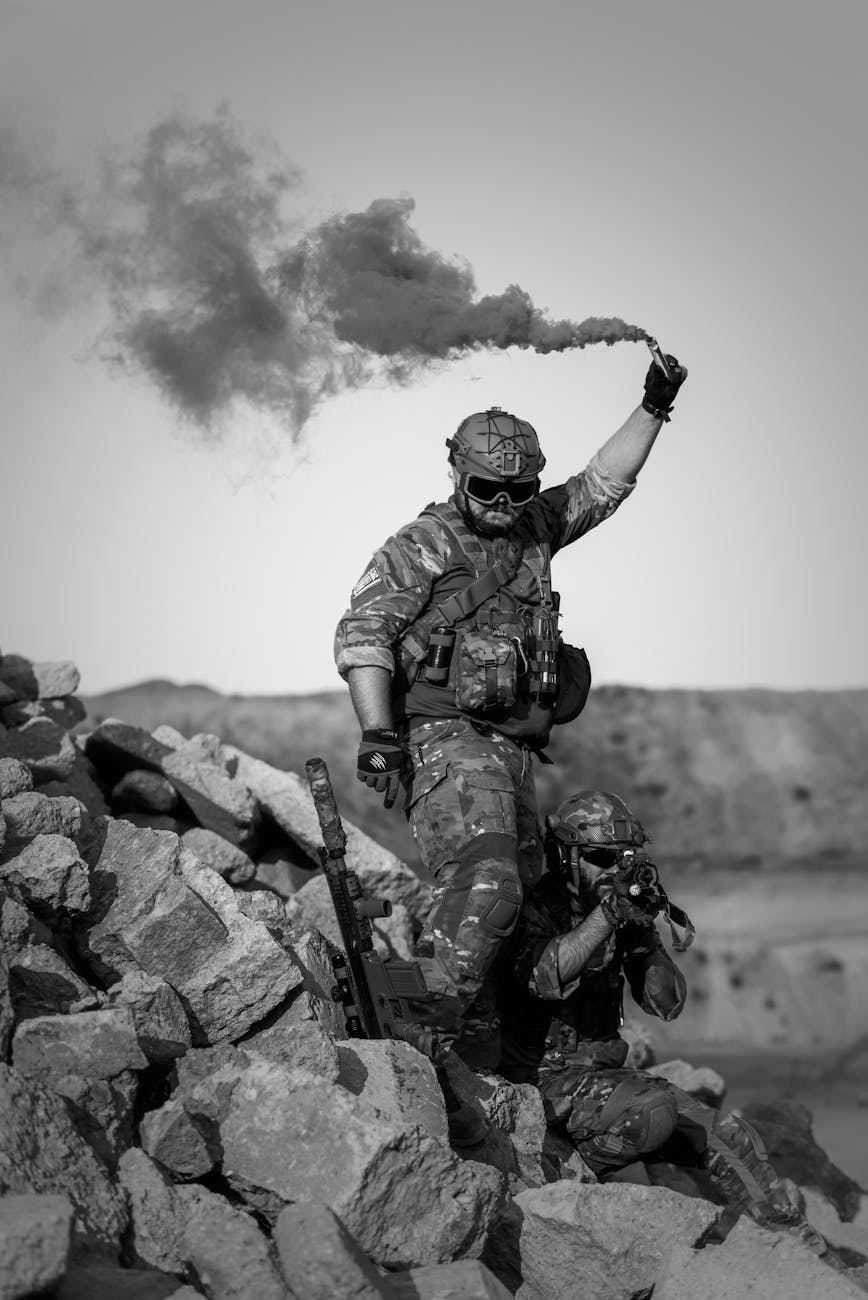
Category: Trial of Civilians in military Courts

  • FROM BROWN TO PLESSY: WHY FARUKU MAY BECOME THE MOST CONSEQUENTIAL CONSTITUTIONAL REGRESSION OF THE LAST TWO DECADES

    FROM BROWN TO PLESSY: WHY FARUKU MAY BECOME THE MOST CONSEQUENTIAL CONSTITUTIONAL REGRESSION OF THE LAST TWO DECADES

    Constitutionalism, Deterrence and the Price of Violating Non-Derogable Rights
    Constitutional courts shape legal culture. Some decisions expand the reach of rights. Others contract it. Some become monuments to constitutional progress. Others become warnings from history.

    The Constitutional Court’s decision in Faruku Muhamed & Others v Attorney General belongs to the latter category.

    Indeed, it may come to be remembered as one of the most consequential constitutional regressions since the promulgation of the 1995 Constitution.

    The judgment has already generated intense debate. Supporters praise it as a restoration of balance between the rights of accused persons and society’s legitimate interest in the prosecution of crime. Critics view it as a retreat from the robust protection of non-derogable rights that Ugandan courts painstakingly developed over the last two decades.

    I count myself among the latter.

    Not because I underestimate the importance of criminal accountability.

    Not because I believe every constitutional violation should automatically free every accused person.

    But because I believe the Court has fundamentally misunderstood the constitutional function of consequences.

    At its heart, Faruku is not a case about criminals.

    It is a case about incentives.

    It is a case about deterrence.

    It is a case about the price the State must pay when it violates the Constitution.

    And once one understands that, the implications become profoundly unsettling.

    THE FORGOTTEN PURPOSE OF SECTION 11(2)

    Much of the commentary surrounding Section 11(2) of the Human Rights (Enforcement) Act proceeds from a mistaken premise.

    The provision was never principally about rewarding accused persons.

    It was never principally about frustrating criminal trials.

    Nor was it intended to create technical escape routes for the guilty.

    Its purpose was institutional.

    Its purpose was preventative.

    Its purpose was deterrent.

    Every legal system creates incentives.

    A police officer deciding how to obtain evidence responds to incentives.

    An investigator deciding whether to respect constitutional safeguards responds to incentives.

    A security agency deciding whether compliance is worth the inconvenience responds to incentives.

    The genius of Section 11(2) was that it altered those incentives.

    It communicated a simple message:

    If you violate non-derogable rights, you may lose the prosecution altogether.

    That message did not exist to protect criminals.

    It existed to discipline power.

    It existed to ensure that constitutional compliance became the cheapest option available to the State.

    The Court has now substantially weakened that discipline.

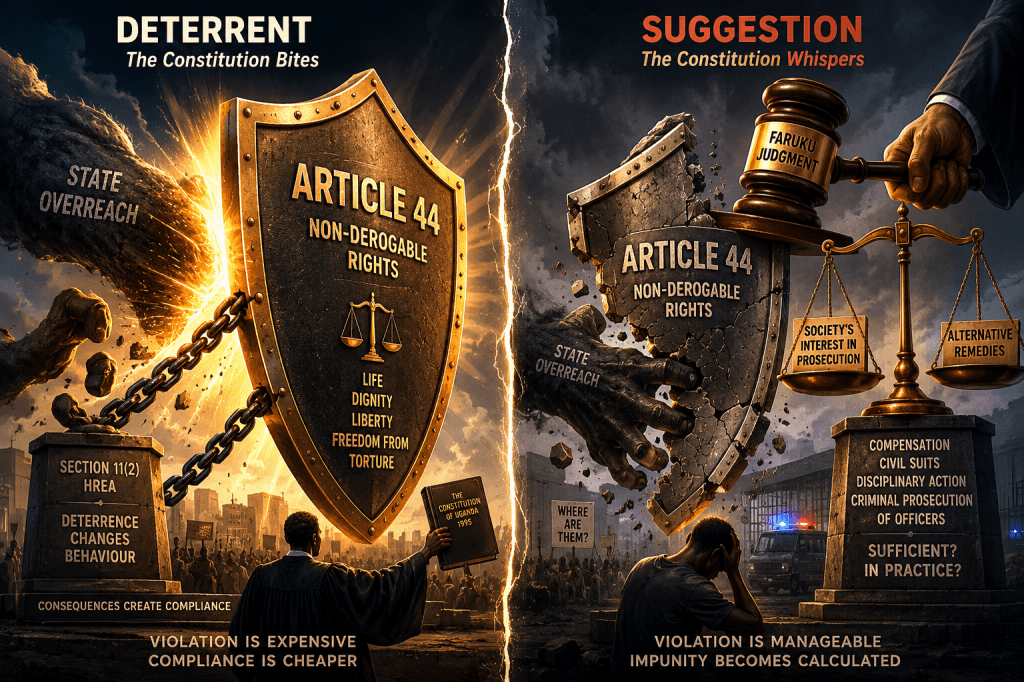
    THE DOCTRINAL ERROR: WHEN A DETERRENT BECOMES A SUGGESTION

    The central problem with Faruku is doctrinal before it is political.

    Section 11(2) was not merely a remedy available to an accused person after a violation had occurred.

    It was a prophylactic rule.

    A constitutional deterrent.

    A bright-line consequence designed to influence institutional behaviour before violations occurred.

    The provision did not merely compensate victims.

    It regulated power.

    By emphasizing alternative remedies such as compensation, civil suits, administrative sanctions and criminal proceedings against offending officers, the Court transformed a deterrent into a suggestion.

    That distinction matters.

    A deterrent commands compliance.

    A suggestion invites balancing.

    A deterrent changes behaviour.

    A suggestion merely expresses disapproval.

    The practical consequence is that the constitutional cost of violating non-derogable rights has been reduced.

    Rights rarely disappear overnight.

    More often, they remain on paper while their practical force is quietly diminished.

    That is why Faruku is so significant.

    The issue is not whether rights still exist.

    The issue is whether violating them has become cheaper.

    ARTICLE 44 WAS WRITTEN IN BLOOD, NOT THEORY

    Perhaps the most troubling feature of the judgment is its apparent detachment from the constitutional history that produced Article 44 itself.

    Article 44 did not emerge from academic theory.

    It did not emerge from abstract constitutional philosophy.

    It emerged from Uganda’s encounter with arbitrary power.

    It emerged from detention without trial.

    It emerged from torture.

    It emerged from disappearances.

    It emerged from constitutional crises that taught painful lessons about what happens when power operates without meaningful restraint.

    The framers of the 1995 Constitution understood something simple:

    Power rarely restrains itself.

    That understanding explains why certain rights were elevated beyond ordinary balancing exercises.

    The Constitution does not merely describe freedom from torture as important.

    It describes it as non-derogable.

    That distinction is critical.

    A right that may be balanced against competing interests is fundamentally different from a right that may not.

    The Court repeatedly invokes society’s interest in prosecution.

    But Article 44 itself represents a balancing exercise already undertaken by the framers.

    They considered the demands of security.

    They considered public order.

    They considered law enforcement.

    They nevertheless chose to place certain rights beyond derogation.

    The question therefore is not whether courts should rebalance those interests today.

    The question is whether courts are free to rebalance what the Constitution has already balanced.

    That question deserves far greater attention than it has thus far received.

    LEGAL CULTURE: A PERSONAL OBSERVATION

    Years ago, I appeared before a Chief Magistrate in a criminal matter that had stagnated for nearly three years.

    I argued that the accused person’s constitutional right to a fair and speedy trial had been violated.

    The Magistrate looked at me and asked:

    “Are you sure the Constitution says the hearing must be speedy?”

    I answered in the affirmative.

    A copy of the Constitution was produced.

    The word was found.

    The Magistrate then asked:

    “But Counsel, why are you over-lawyering?, I thought you are in a hurry and have other things to do? Me I want to adjourn my matters today and travel for the weekend”

    Many younger lawyers would find that exchange difficult to believe.

    That is precisely the point.

    For the last two decades Uganda’s legal culture has been evolving.

    Slowly.

    Imperfectly.

    Painfully.

    But undeniably.

    Rights increasingly ceased to be aspirations.

    They increasingly became enforceable commands.

    Lawyers became bolder.

    Judges became more receptive.

    Constitutional litigation became more meaningful.

    Decisions such as Uganda Law Society v Attorney General, Uganda vs Ssekabira Robert and 11 others, and others collectively contributed to that transformation.

    The cases were not identical.

    The rights involved were not identical.

    But together they built something larger than individual precedents.

    They built a culture.

    A culture in which State actors increasingly understood that constitutional violations carry consequences.

    Faruku teaches a different lesson.

    THE COURT’S BALANCING EXERCISE

    To criticize the judgment honestly, one must first acknowledge its strongest argument.

    Society possesses a legitimate interest in the prosecution of crime.

    Victims possess rights.

    Public safety matters.

    Few reasonable people would celebrate a system in which serious offenders automatically escape accountability because constitutional violations occurred during investigation.

    That concern deserves respect.

    I do not pretend the question is easy.

    There are undoubtedly hard cases at the margins.

    But the answer to a difficult question is not to abandon deterrence altogether.

    The Court’s solution effectively transfers the cost of constitutional violations away from the State and onto the victim of those violations.

    The Court assures us that alternative remedies remain available.

    Compensation.

    Civil litigation.

    Administrative sanctions.

    Criminal prosecution of offending officers.

    In theory, this appears balanced.

    In practice, it appears detached from reality.

    How many torture survivors successfully litigate compensation claims after years of detention, trial, imprisonment, poverty and trauma?

    How many possess the resources necessary to commence fresh proceedings against the very institutions that violated their rights?

    The remedy exists on paper.

    Life exists in reality.

    The two are not always the same.

    THE REALITY PROBLEM

    Constitutional theory cannot be divorced from constitutional reality.

    Uganda is not debating torture in a vacuum.

    Uganda is not debating arbitrary detention in a vacuum.

    Uganda is not debating abuse of power in a vacuum.

    We are debating these issues within a society where allegations of torture remain common, where unlawful detention continues to generate public controversy and where citizens routinely question whether constitutional safeguards are sufficient to restrain State power.

    Perhaps the most chilling symbol of this reality is linguistic.

    Ugandans now speak of “drones” not as aircraft but as a particular form of feared encounter with power.

    Think about that.

    Think about how much constitutional failure must occur before a society casually incorporates the language of disappearance into everyday conversation.

    That normalization did not happen by accident.

    It happened because constitutional safeguards increasingly appeared uncertain.

    The question is whether Faruku strengthens those safeguards or weakens them.

    I fear it does the latter.

    FROM BROWN TO PLESSY

    The analogy may appear provocative.

    It is intended to be.

    In 1896, the United States Supreme Court decided Plessy v Ferguson.

    The Court did not abolish equality.

    It merely reinterpreted it in a manner that dramatically reduced its practical force.

    Rights remained on paper.

    Their effectiveness diminished in reality.

    Fifty-eight years later, Brown v Board of Education repudiated that approach.

    The lesson is not about race.

    The lesson is about constitutional trajectories.

    Constitutional progress is not inevitable.

    Rights expand.

    Rights contract.

    Courts advance liberty.

    Courts retreat from it.

    Faruku does not abolish Article 44.

    It does something more subtle.

    And therefore potentially more consequential.

    It preserves the right while reducing the consequences of violating it.

    That is the structural similarity.

    In neither case was the constitutional right formally erased.

    Instead, the practical cost of ignoring it became negotiable.

    That is how constitutional regressions often occur.

    Not through dramatic declarations.

    Not through open hostility to rights.

    But through incremental reductions in consequence.

    History teaches that constitutional decline rarely begins when courts announce that rights no longer matter.

    It begins when courts assure us that rights still matter while simultaneously reducing the cost of violating them.

    CONCLUSION

    The Supreme Court may reverse Faruku.

    It may not.

    That question will be answered in due course.

    The more profound question concerns constitutional culture.

    For two decades Uganda appeared to be moving toward a constitutional order in which rights carried consequences and power carried limits.

    Faruku signals movement in the opposite direction.

    Whether that signal becomes a turning point or merely a temporary detour remains unknown.

    History will answer that question.

    The rest of us must live through it.

    If future generations inherit a stronger constitutional culture, Faruku will be remembered as a wrong turn that was eventually corrected.

    If they inherit a weaker one, where torture remains illegal but increasingly inexpensive for the State, they may remember it differently.

    Not as the day constitutional rights disappeared.

    But as the day violating them became cheaper.

    Not as the day the Constitution died.

    But as the day it was asked to whisper where once it could roar.

    DISCLAIMER:

    The contents of this Blog are not intended to be used as a substitute for legal advice. The author shall not accept liability for use of the contents of this Blog as legal advice. Readers are encuraged to consult qualified advocates for real life situations for legal advice.

    JOIN THE UNDERGROUND AND FUEL THE MOVEMENT

    We have created a dedicated fans WhatsApp Channel. Don’t miss the latest updates, get early bird access to our latest blog posts and more, so much more. Click the following link to follow the Channel: https://whatsapp.com/channel/0029Vb9BQqw5a246bWVsLl3j

    Independent institutional critique and advocacy for a radical overhaul of legal culture require time, deep research, and uncompromised independence. If these narratives bring value to your legal journey or challenge your perspective, please visit our HOME PAGE to see how you can support this platform directly and keep the critique fierce and relentless.

    Enen Ambrose. Advocate

    Member, Judiciary Affairs Committee,

    Uganda Law Society

    & Founder–Enen Legal World
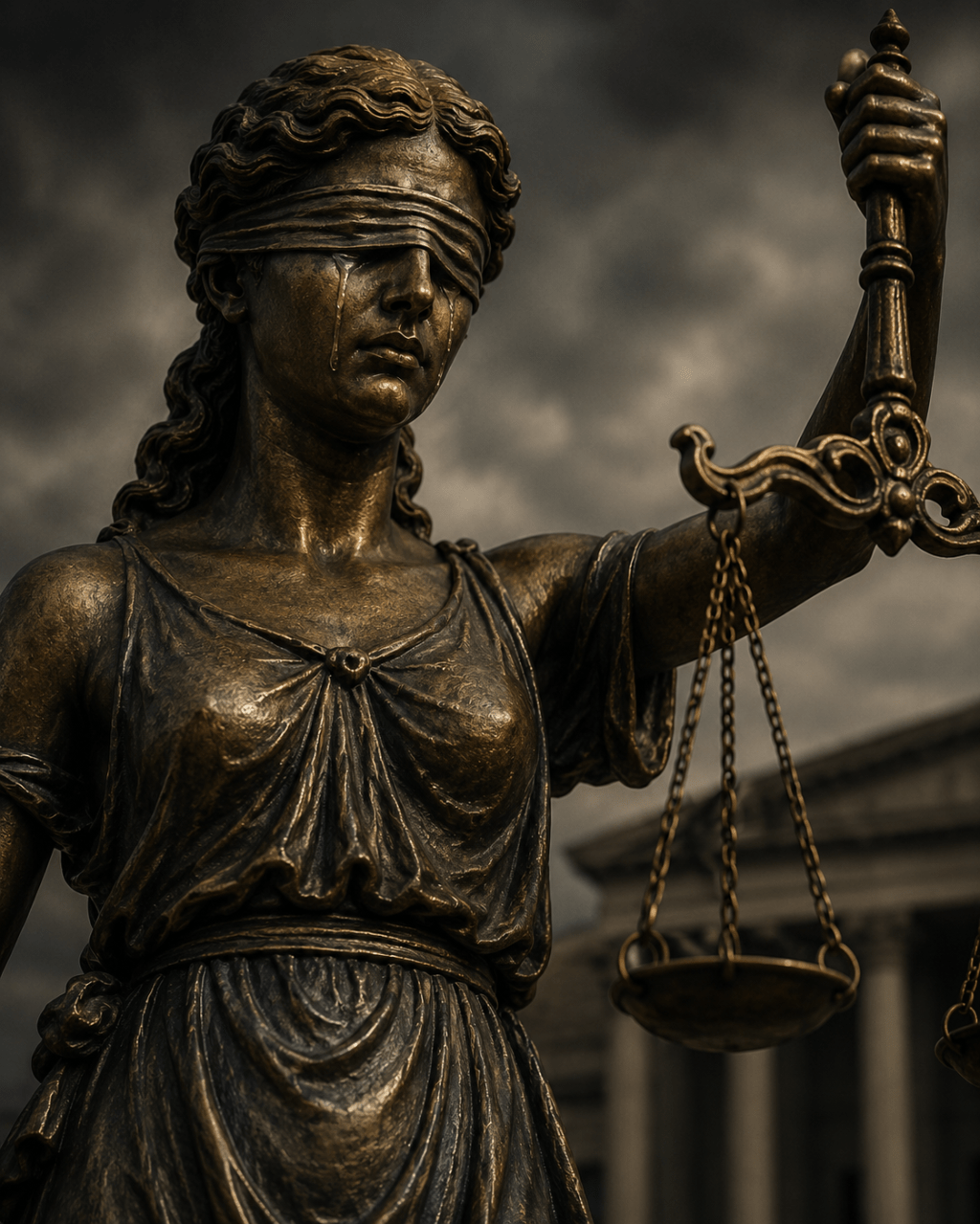
  • When the Constitution Loses Its Teeth: A Lament After Faruku

    When the Constitution Loses Its Teeth: A Lament After Faruku

    Imagine your son leaves home to go to the farm.

    He never returns.

    Days become weeks.

    Weeks become months.

    You move from police station to police station looking for him.

    Nobody tells you where he is.

    Nobody tells you what he has done.

    Nobody tells you when he will come home.

    Then one morning, somebody calls.

    “He is being produced in court.”

    You rush there.

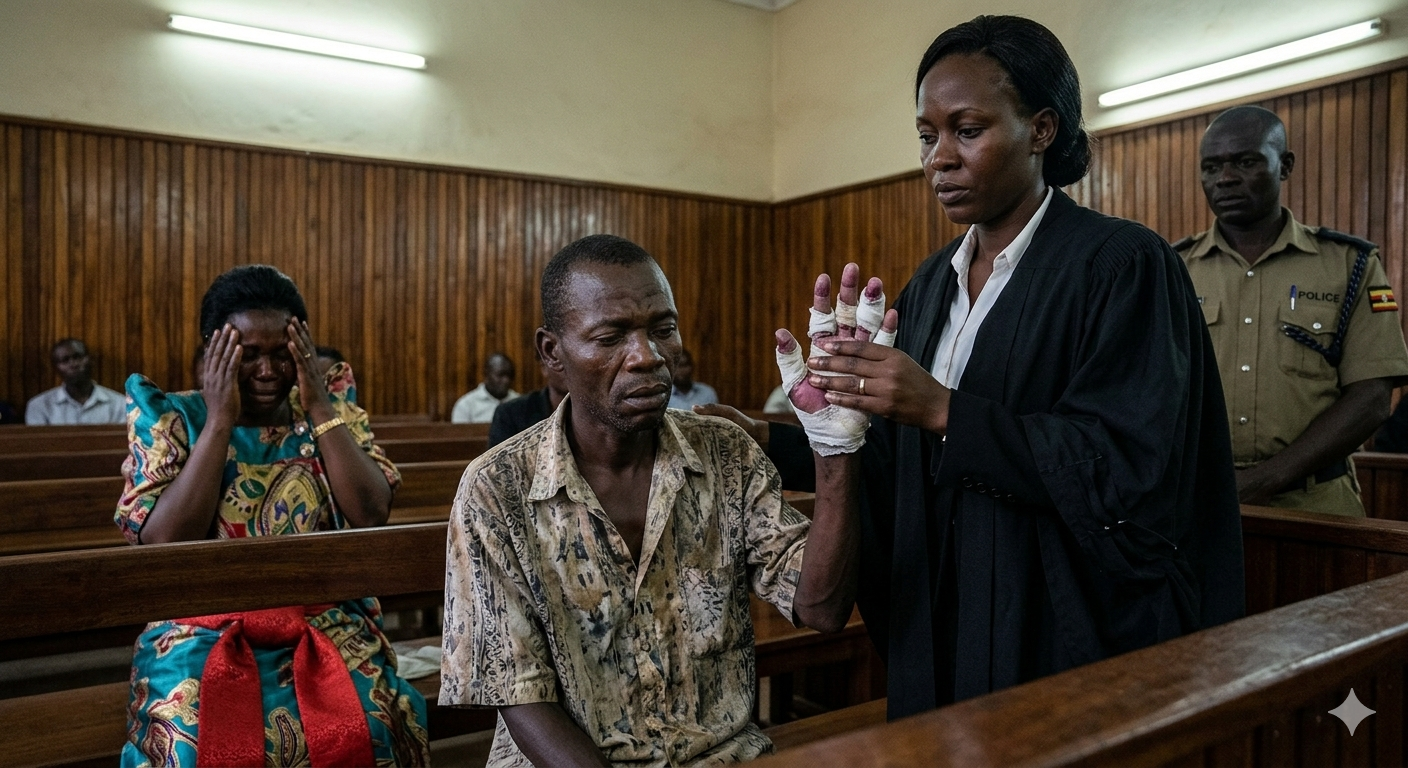
    He arrives limping.

    His mother begins to cry.

    Even before he speaks, everybody in court can see that something happened.

    The State says he is a criminal.

    He says he was tortured.

    The Court agrees that his rights were violated.

    But the trial continues anyway.

    That is why the Constitutional Court’s decision in Faruku Muhamed and 2 others v Attorney General matters. A copy of the judgment can be accessed here

    Many Ugandans will never read the judgment.

    Many will never understand the legal arguments.

    But every Ugandan should understand what is at stake.

    Because this case is not really about criminals.

    It is about power.

    For nearly twenty years , in cases like those of Uganda Law Society and the famous Kayunga riots Uganda’s courts had been slowly teaching the State a simple lesson:

    There are some lines you do not cross.

    Some rights are so important that violating them comes at a heavy price.

    That principle was not created to protect criminals.

    It was created to protect citizens.

    It was created because Uganda knows what happens when people in power stop fearing the Constitution.

    Our Constitution was not written in paradise.

    It was written after years of arbitrary arrests.

    Years of torture.

    Years of disappearances.

    Years of constitutional crises.

    Years in which the ordinary citizen stood almost naked before the power of the State.

    The framers understood something simple.

    A government should never be allowed to break the law in order to enforce the law.

    That is why some rights were declared non-derogable.

    Untouchable.

    Non-negotiable.

    Beyond convenience.

    Beyond politics.

    Beyond excuses.

    The Faruku decision changes that conversation.

    The Court has not legalized torture.

    The Court has not abolished constitutional rights.

    The Court has done something more subtle.

    It has reduced the cost of violating them.

    And history teaches us that constitutional decline rarely begins when rights are abolished.

    It begins when violating them becomes cheaper.

    Supporters of the decision ask a fair question.

    Should a murderer walk free because he was tortured?

    Should a terrorist escape punishment because his rights were violated?

    Those questions sound persuasive.

    Until we ask another.

    If the State already had enough evidence to convict, why was torture necessary in the first place?

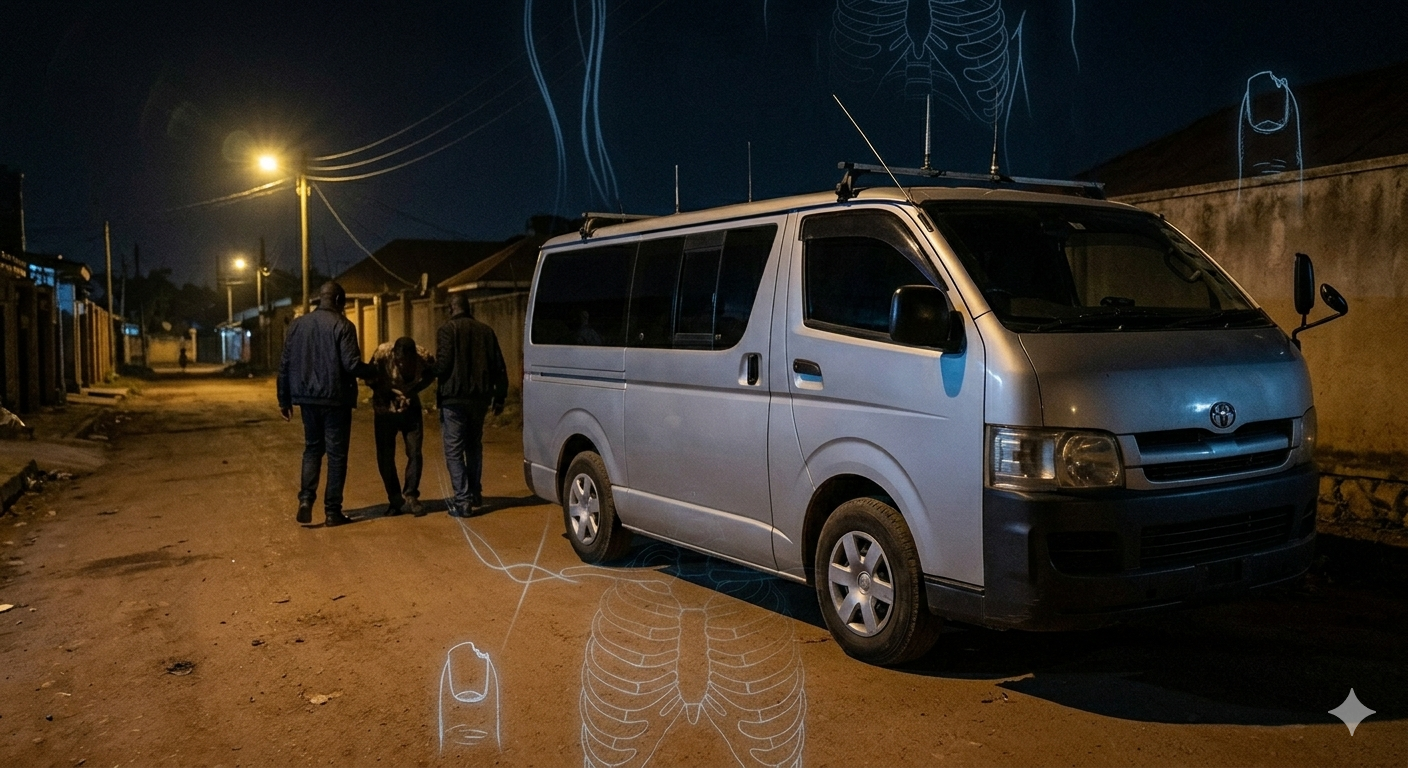
    Why break the ribs?

    Why remove the fingernails?

    Why apply electric wires?

    Why violate the Constitution at all?

    That is the question Uganda should be asking.

    Instead, we are being encouraged to focus on what happens after the violation.

    Sue for damages.

    File another case.

    Seek compensation.

    But every Ugandan knows the reality.

    The person who emerges from years of detention, trial, imprisonment, poverty and trauma rarely possesses the energy, resources or influence required to start another legal battle.

    The remedy exists on paper.

    Life exists in reality.

    And those two things are not always the same.

    Perhaps the most frightening symbol of this reality is a single word.

    “Drones.”

    There was a time when a drone was something that flew in the sky.

    Today, many Ugandans hear that word and think of something else entirely.

    Think about how abnormal that is.

    Think about how much had to happen before an entire country accepted that vocabulary.

    Think about how many stories are hidden inside that single word.

    The abnormal has become normal.

    The shocking has become routine.

    The unacceptable has become familiar.

    And when that happens, constitutional erosion is already underway.

    Some people will say these concerns are exaggerated.

    They will say rights still exist.

    They will say courts remain independent.

    Perhaps.

    But constitutional history is filled with societies that discovered too late that rights on paper are not the same thing as rights in practice.

    A Constitution is not tested when it protects the popular.

    It is tested when it protects the unpopular.

    It is not tested when it restrains the weak.

    It is tested when it restrains the powerful.

    The true measure of constitutionalism is not how the State treats those it likes.

    It is how the State treats those it fears, suspects, opposes or despises.

    That is why this moment matters.

    Not because a criminal might benefit.

    But because power always expands into spaces where consequences disappear.

    Today it may be a suspected criminal.

    Tomorrow it may be a journalist.

    The next day it may be a businessman.

    The day after that it may be an opposition supporter.

    One day it may be your son.

    Or your daughter.

    Or you.

    The Supreme Court may yet reverse this decision.

    History may yet correct it.

    But the real answer will not be found in law reports.

    It will be found in what follows.

    If State agencies become more respectful of constitutional rights, perhaps the Court’s faith in alternative remedies will be vindicated.

    If they do not, future generations may look back upon Faruku as the moment Uganda’s Constitution was not destroyed—

    but the moment it was asked to stand aside while power carried on with business as usual.

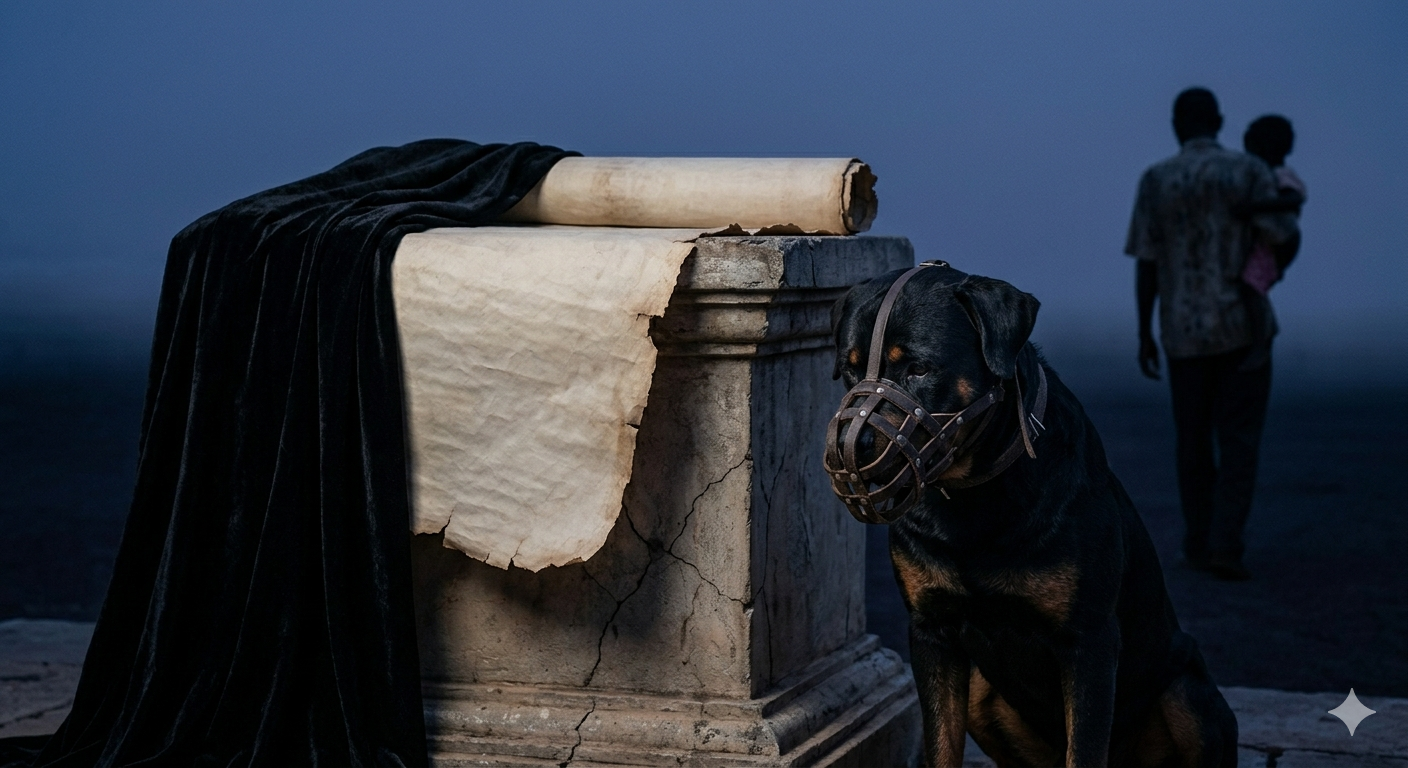
    Our Constitution was meant to be a fence around the citizen.

    A fence is only as strong as the dog that guards it.

    If the dog can no longer bite, only the thief has reason to celebrate.

    That is why some of us are mourning today.

    Not because the Constitution is dead.

    But because it has been asked to whisper where once it could roar.

    DISCLAIMER:

    The contents of this Blog are not intended to be used as a substitute for legal advice. The author shall not accept liability for use of the contents of this Blog as legal advice. Readers are encuraged to consult qualified advocates for real life situations for legal advice.

    JOIN THE UNDERGROUND AND FUEL THE MOVEMENT

    We have created a dedicated fans WhatsApp Channel. Don’t miss the latest updates, get early bird access to our latest blog posts and more, so much more. Click the following link to follow the Channel: https://whatsapp.com/channel/0029Vb9BQqw5a246bWVsLl3j

    Independent institutional critique and advocacy for a radical overhaul of legal culture require time, deep research, and uncompromised independence. If these narratives bring value to your legal journey or challenge your perspective, please visit our HOME PAGE to see how you can support this platform directly and keep the critique fierce and relentless.

    Enen Ambrose. Advocate

    Member, Judiciary Affairs Committee,

    Uganda Law Society

    & Founder–Enen Legal World
  • Chronicles of His Worship Mulyanyama — Episode 3

    Chronicles of His Worship Mulyanyama — Episode 3

    When “Just Cause” Entered the Registry


    Author’s Note: The Chronicles of His Worship Mulyanyama is a serialized literary commentary designed to constructively critique the institutional and structural implications of the Magistrates Courts (Amendment) Act, No. 6 of 2026. This work is a creative exploration of the human infrastructure behind public service and is not intended to ridicule, embarrass, or undermine the integrity of the Judiciary.

    The brown envelope had not lied.

    TRANSFER OF FILES – FOR JUST CAUSE.
    No explanation. No appeal. Just a signature from the Chief Magistrate and a list of file numbers.

    Among them: File No. 43. The twins fighting over cassava. Imat Nekolina’s envelope. Ocen Okello’s breach of contract case for the supply of beans to Kec Primary School.

    All of them, transferred. To whom? For what reason? The envelope did not say.

    Mulyanyama set the letter down. He did not call the Chief Magistrate. He simply stared at his phone.


    Counsel Ogwang Adede woke before sunrise.

    He had spent 200,000 shillings on fuel the previous evening – a calculated investment. Today, he would drive from Lira to Omwonyo‑le for Ocen Okello’s case. Four years of beans. Four years of adjournments. Today, he would close the defence under Order 17 Rule 4.

    He checked his phone.

    A message from the headmaster: “Fees balance remains. Your son cannot sit exams.”

    He silenced it. First, court. Then fees.


    Then he opened the Lira High Court WhatsApp group.

    NOTICE: The Honourable Judge will not sit this week. He has been deployed to Omwonyo‑le for a donor‑funded SGBV session. All matters stand adjourned.

    He refreshed. The Omwonyo‑le Magistrates Court group had a new notice:

    NOTICE: His Worship Mulyanyama has been designated Registrar for the forthcoming SGBV session. Additionally, a donor‑funded plea bargaining session will run for two weeks. No judicial officer will be at Omwonyo‑le during this period.

    He scrolled further.

    UPDATE: All other magistrates and the Registrar have travelled for a Judiciary conference. Only those excused for donor conditionalities remain in session.

    Counsel Ogwang Adede stared at the screen.

    In Lira – no Judge.
    In Omwonyo‑le – no Mulyanyama.
    No Magistrate. No Registrar. No court.
    Two weeks.

    He had spent 200,000 shillings on fuel. But that was not the worst of it.

    That morning, he had been expecting a deposit of 30,000,000 shillings in taxed costs from a judgment debtor – Okullo Aram. The matter was coming up for Notice to Show Cause before the Registrar of the High Court in Lira. Okullo had called last evening, panicking, begging not to be thrown into civil prison. He was prepared to deposit the money in front of the Registrar.

    Then Okullo sent a message: a photo of a notice from the Registrar’s chambers. The Registrar had travelled to Kampala overnight – for a donor‑funded workshop on case management.

    After sending the notice, Okullo’s phone went silent.

    Counsel Ogwang Adede called back. Twice. Three times. Nothing.

    Later, he learned that Okullo Aram had five children in university and three in secondary school. The money that was meant for taxed costs had been redirected – to tuition fees, to accommodation, to books.

    The debtor had not fled. He had simply reprioritised. And the law could not touch him – because the Registrar was not there to hear the Notice to Show Cause.

    His clerk’s salary would wait.
    His legal assistant’s salary would wait.
    The headmaster’s message about his son’s exams would not wait.


    Then his firm WhatsApp group buzzed.

    A calling letter. From His Worship Munyakuzi, Chief Magistrate of Oneka Iden – the Chief Magisterial area under which Omwonyo‑le fell.

    TRANSFER OF FILE – FOR JUST CAUSE.
    On the court’s own motion, Ocen Okello’s case is transferred to my court for hearing.

    No application from any party. No consent. No explanation.
    Just just cause.

    Counsel read it twice. His hands did not shake. They had done this before.


    Mulyanyama had also seen the letter.

    He picked up his phone and called Munyakuzi.

    “Sir, with respect… those are live matters. Judicial independence –”

    A pause. Then Munyakuzi laughed.

    “Worship, did you not read Section 217A of the amendment? I have powers to transfer those files to my Court.”

    The line went dead.

    Mulyanyama stared at his phone. The ground at Omwonyo‑le had swallowed an axe. Now the law was swallowing itself.


    Ocen Okello did not learn about the transfer from a noticeboard.

    He learned it from Alyek Molly.

    He had not even reached the bank. His Boxer motorcycle was still coughing dust somewhere between Abako and Oneka Iden when his phone vibrated.

    He smiled when he saw the name. Alyek Molly – Registry. He answered immediately.

    “My daughter… how is today?”

    For a second, Alyek said nothing. Then her voice came – soft, tired, almost apologetic.

    “Mzee… don’t come to court.”

    Silence.

    “I have already told your lawyer.”

    Ocen slowed the motorcycle. “What now?”

    Alyek looked through the registry window before answering. “His Worship has two critical assignments.” She lowered her voice. “He has been designated Registrar for the SGBV session… and after that… another plea bargain project. Two hundred files. Fifteen days.”

    Ocen said nothing.

    Alyek swallowed. “Mzee… save your fuel.”

    The line went dead.


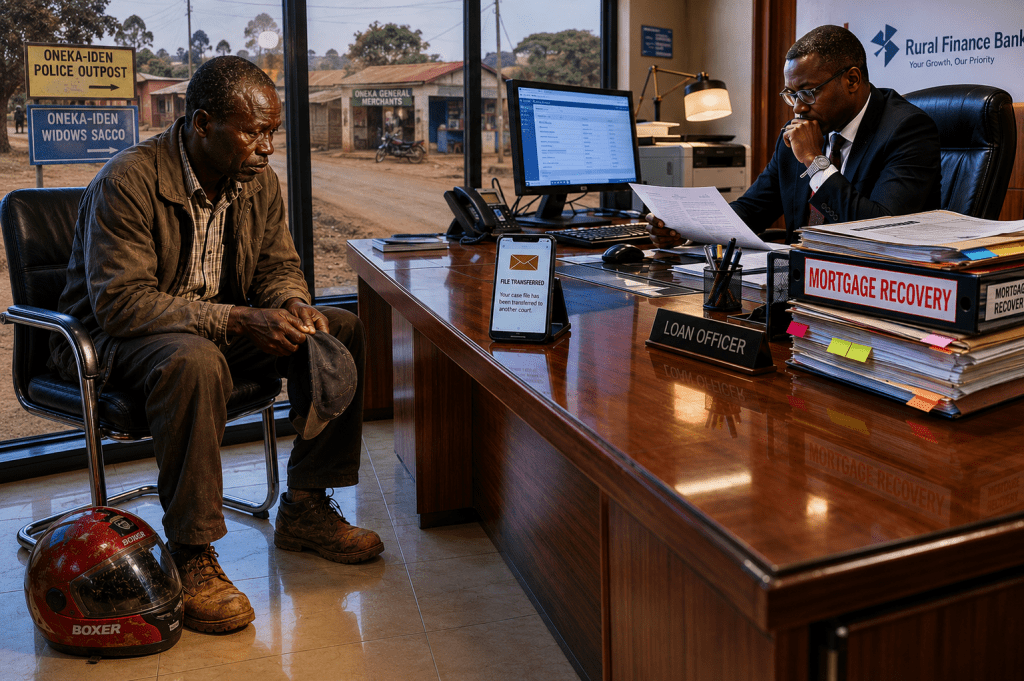
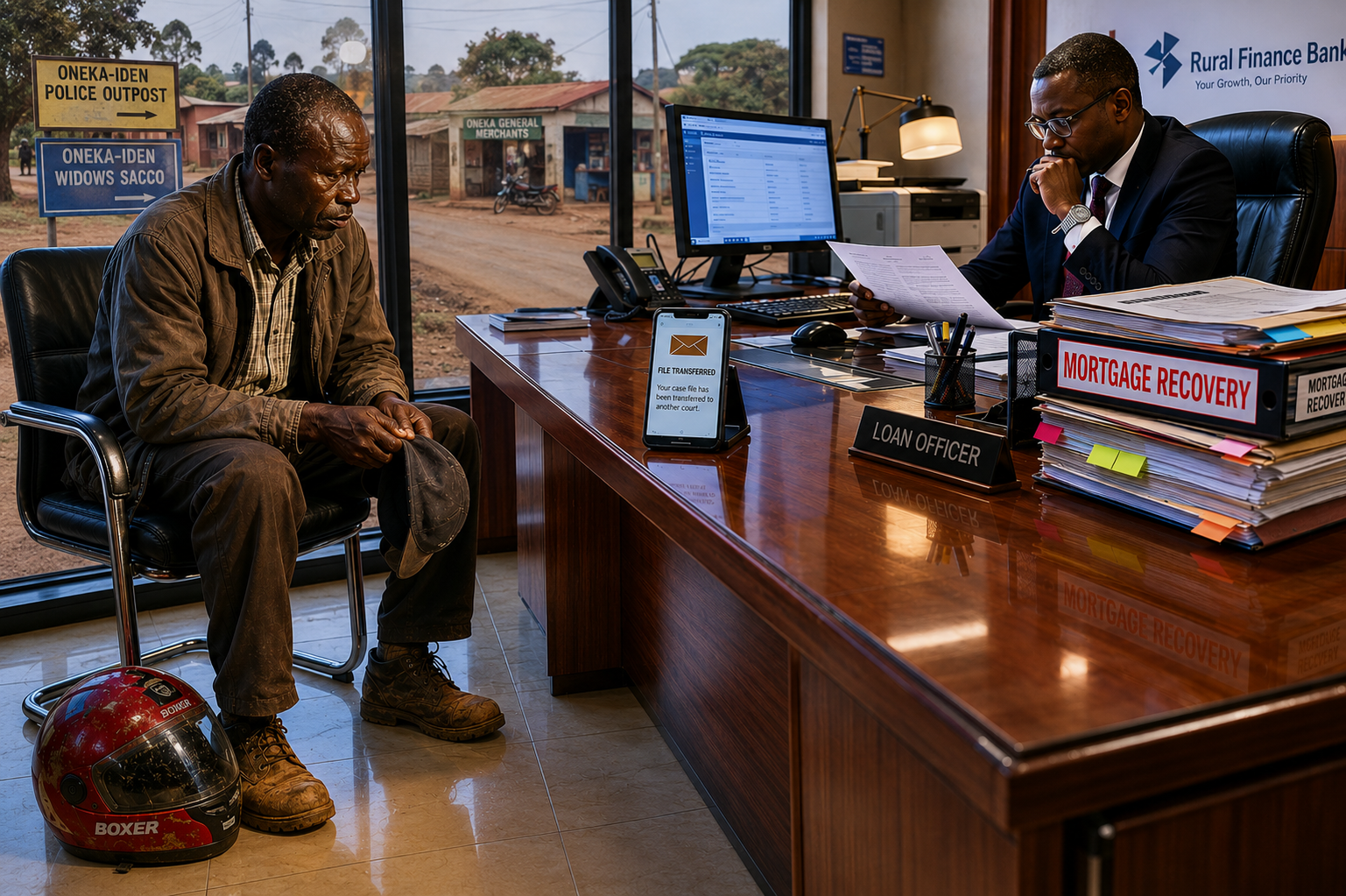
    Forty minutes later, Ocen Okello sat inside the office of the loan officer.

    Tie. Ledger. Calculator. No smile.

    The file marked MORTGAGE RECOVERY – FINAL NOTICE lay open on the desk.

    Ocen removed his cap. Held it in both hands. And began pleading.

    “Sir… please do not sell my house.”

    He swallowed. “The case is very near judgment, I promise.”

    The loan officer said nothing. So Ocen continued.

    “My lawyer says… no more than one month.”

    He pointed weakly toward Omwonyo‑le. “The court has some delays… delays I do not fully understand… delays I cannot even explain properly…”

    Just then – his phone vibrated again.

    This time, Counsel Ogwang Adede.

    He opened the message.

    Brown envelope. Three words.

    TRANSFERRED FOR JUST CAUSE.

    Ocen read it once. Read it twice. Then slowly looked back at the loan officer… and for the first time in four years… did not know which debt was more dangerous – the one inside the bank, or the one inside the court.


    By lunchtime, Omwonyo‑le was already whispering.

    The new Chairperson of the School Management Committee of Kec Primary School – the same school that had eaten Ocen Okello’s beans – was an old boy of Chief Magistrate Munyakuzi.

    In Omwonyo‑le, rumours travelled faster than judgments.
    And this rumour had teeth.

    “He is willing to vouch for his old buddy,” Alyek Molly heard from a clerk in Oneka Iden. “To save the school from an old crippling debt.”

    Alyek said nothing. She was still calculating her mother’s medication. Friday’s tuition. The per diem that would now not come.


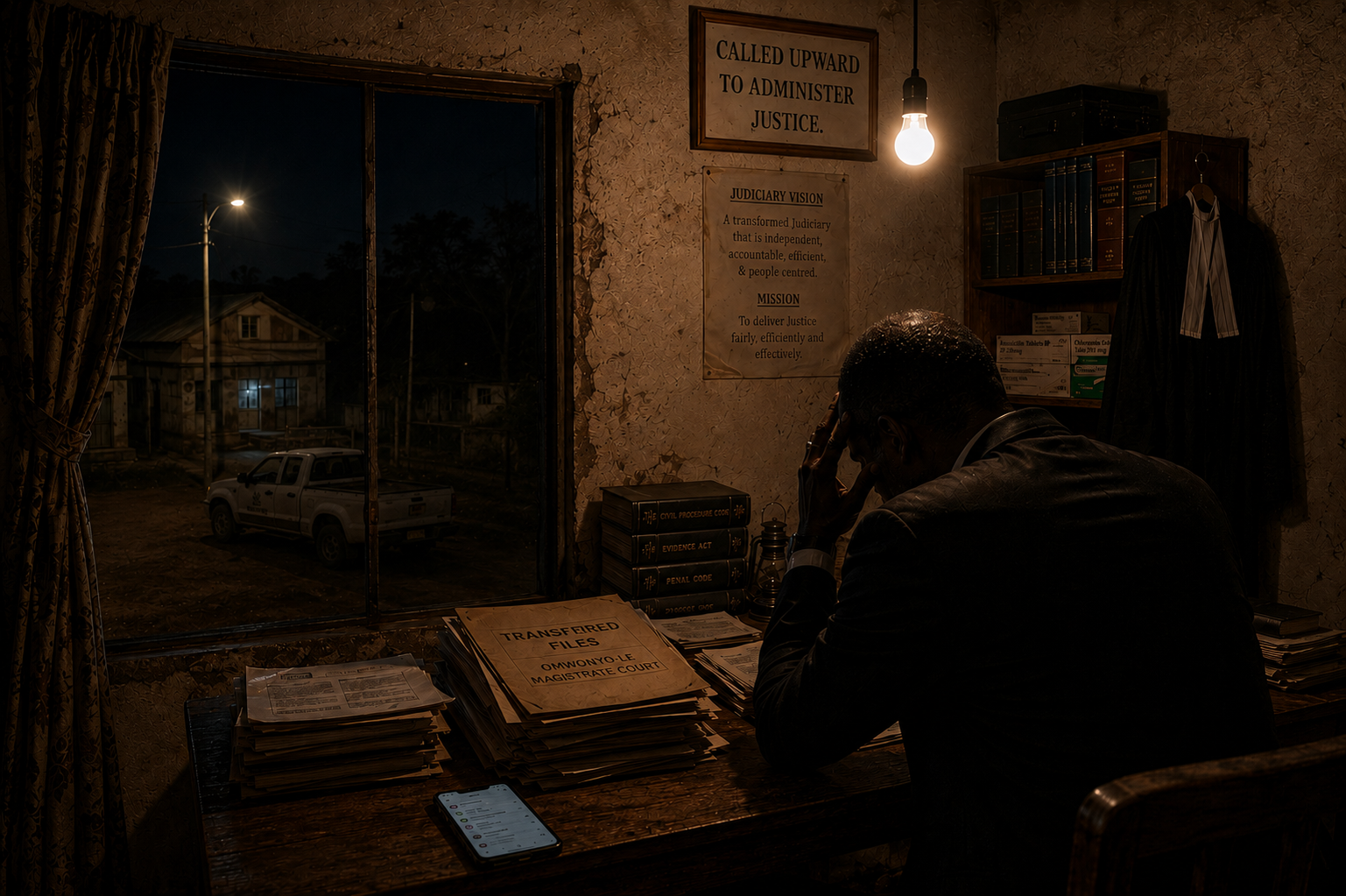
    That evening, Mulyanyama sat in his rented room above the pharmacy in Oneka Iden.

    The brown envelope still lay on the table.
    Open. Unfolded. Unanswered.

    The names stared back at him.
    Imat Nekolina. Ocen Okello.
    Four years. Red ribbons. Borrowed fuel. Dead witnesses.
    Transferred. For just cause.

    His phone vibrated.
    Counsel Ogwang Adede.

    Mulyanyama stared at the screen for two rings. Then answered.

    No greetings. Just breathing.

    Then Counsel spoke.

    “Worship… what is going on?”

    Silence.

    “What happened?”

    Another silence. Then the question that hit harder than any objection ever raised in court:

    “Who complained?”

    Mulyanyama looked again at the brown envelope. Then at the ceiling. Then finally spoke. Quietly. Almost apologetically.

    “Counsel… I honestly have no idea.”

    A pause. Then –

    “Just orders from above.”

    Neither man spoke again. For a few seconds, all that remained between lawyer and magistrate was breathing.

    Then the line went dead.

    And for the first time since the amendment, His Worship Mulyanyama realised something far more dangerous than corruption:

    Sometimes a file is not stolen. Sometimes… it is simply called upward.


    Before you blame a magistrate for “delayed justice”… ask two questions:

    Who funded the last special session in your court? And how many times has a file been transferred – without your consent – “for just cause”?

    The system is not broken.
    The system is fully booked.

    Enen Ambrose

    Advocate

    Member: Judiciary Affairs Committee

    Uganda Law Society,

    For feedback or comments: enen@enenlegalworld.com

    If you missed the start of this journey, you can catch up on the systemic breakdown of the Magistrates Courts in Chronicles of His Worship Mulyanyama — Episode 2

    Legal Disclaimer Fiction & Non-Defamation Notice:

    This post is a pure work of fiction and creative literature. The characters, dialogue, specific incidents, and settings—including the character of His Worship Mulyanyama and the location of Omwonyo-le Magistrates Court—are products of the author’s imagination or are used fictitiously. Any resemblance or exact matches to actual persons, living or dead, real-life judicial officers, or specific ongoing cases is entirely coincidental. This text is created solely for the purpose of systemic legislative critique and systemic advocacy; it is not maliciously constructed, nor should it be interpreted as an attempt to defame, misrepresent, or malign any living individual or public office holder.

    The legal references in this Series is for information purposes only and is not intended to be used as a substitute for legal advice. The author does not assume responsibility or admit liability arising from the use of the contents of this blog as legal advice.

    The author strongly encourages readers to consult a licensed attorney for specific context related legal advice.

    FUEL THE MOVEMENT

    Independent institutional critique and advocacy for a radical overhaul of legal culture require time, deep research, and uncompromised independence. If these narratives bring value to your legal journey or challenge your perspective, please visit our HOME PAGE to see how you can support this platform directly and keep the critique fierce and relentless.

    Enen Ambrose. Advocate & Founder–Enen Legal World

  • The Philosophy of Insults: When Truth Becomes Fire and Tests Legitimacy”Enen’s Letter to the Radical New Bar and Every Citizen Who Still Dares to Speak

    The Philosophy of Insults: When Truth Becomes Fire and Tests Legitimacy”Enen’s Letter to the Radical New Bar and Every Citizen Who Still Dares to Speak

    Logo: Enen Legal World


    🪶 The Fable

    Deep within the Mambo Forest, the animal kingdom lived in awe of a single, dazzling truth: their ruler, Twon Gweno the cock, wore a crown of living fire. His comb was a legend, a crest of such vibrant crimson that the elders swore it was a fragment of the first sun. His morning crow was a decree:

    Bow to my glory, and you will be spared my flame.”

    And so, the animals bowed. Fear made them pious; fear made the cock sovereign with unquestioned loyalty, respect and cooperation from the rest of the animal kingdom in that forest. It was a classic case of natural-born legitimacy; never really earned.

    One evening, a crisis struck. Ichuli, the fox, the sole specialist in lighting the communal fire, was away. The wood was piled, but the spark was missing. The night, cold and predatory, loomed.

    Odyek Odyek, the hyena, a friend to truth and enemy of pretence, stepped forward.

    “The solution is simple,” she said. “We bow to Ladit Twon Gweno’s crown of fire. I will sprint to his home and borrow a spark.”

    She took a tuft of the driest spear grass, the Obia and went to the cock’s compound. She found him in a deep, unconscious slumber. Without waking him, she gently pressed the grass to his legendary crown, waiting for the catch, the sizzle, the proof.

    The grass rested on the crown, as inert as if it had been placed on a cool stone. The legendary fire was a phantom.


    Odyek Odyek, the hyena returned to the gathering and dropped the cold, unburnt grass in the centre of the circle. No words were needed. The lie they had bowed to for generations unravelled in that silent moment.

    Power, and unearned but coerced legitimacy unmasked, bled its authority into the silent night.


    ⚖️ The Lesson

    Borrowed fire must warm the hearts of the people. When it no longer does, the borrower is called to account.


    So it is with the courts. The robe, the gavel, the summons, and the warrant are instruments loaned by the people. Article 126(1) of the Constitution does not sing an ornament; it issues a command:

    Judicial power is derived from the people and shall be exercised by the Courts in their name and in accordance with the law and their values, norms, and aspirations.


    🧱 The Three Pillars of Legitimacy

    Legitimacy; the respect of the people and their cooperation with the courts, is the covenant at the heart of that loan. It demands three sacramental elements:

    Reflection: Judicial power must reflect the values and aspirations of the people; not the insatiable appetite of a sophisticated elite for luxury or high life.

    Truth: Courts must administer justice in accordance with law and truth, not convenience or midnight deals.

    The Judicial Oath: The solemn undertaking before God to do justice to all manner of people without fear, favour, ill will or affection is no actor’s prayer; it is a chain of duty.


    Strip away any of these, and what remains is a gowned pretender, eloquent and majestic, perhaps, but hollow: a cock whose crown no longer burns.


    The Evidence of Decay

    For those who have seen:

    • Appeal files missing thirty-eight pages.

    • A High Court hearing conducted not in a public courtroom but secretly in a posh hotel in which 15 minutes out of those proceedings were conducted in the absence of the opposite party and the whole process bashed by the Court of Appeal for want of a fair hearing and lack of judicial accountability and transparency and thereby further exacerbating the already slim public trust in the Court system entirely

    • A lower bench judicial officer bashed; “I don’t want to see this rubbish here, take it back where it came from” when they had sought guidance over files of thousands of remand detainees who had clocked mandatory bail, over 5 years where the Office of the Director of Public Prosecution state attorneys appeared neither willing nor ready to commit them for trial in the High Court.

    • The poorest peasants completely blocked from accessing justice because the lower courts have received directives not to register and dispose of customary land disputes unless a surveyor had first rendered a preliminary survey report; peasants who have never heard of, met heard about or hired the services of a professional called a surveyor. They have to sell a chunk of land  to afford a surveyor to conduct a preliminary survey and get their case registered.

    • A National Bar Association President’s liberty preserving Application for stay of execution of a manifestly void Contempt of Court ruling take close to 9 months without disposal.  


    These are not footnotes; they are flesh-and-blood indictments.
    The 1995 Constitution’s promise of a speedy and fair hearing has become hot air—Kikwangala, Kichupuli, Kawani.


    🗣️ The Test — The Philosophy of Insults. Withdrawing legitimacy and requiring that it be earned back by fidelity to its 3 pillars.

    To insult without malice but with evidence is to perform constitutional maintenance and maintain pure legitimacy.”


    Hence the philosophy of insults. This is not the petty malice of a tavern quarrel. It is a civic stress-test, a pressure gauge for legitimacy.

    It is the public’s cry:

    “GIVE US WHAT YOU OWE US.”


    We lent you power; we demand accountability in return.

    A people that cannot insult and mock power has already lost moral authority. The right to insult and offend the powerful is not a luxury, it is the citizen’s tool for testing whether the borrowed flame is real.


    📜 The Proof — The Jurisprudence of Defiance

    “Leaders should grow hard skins to bear.”
    “Power must endure insult to remain clean.”

    Uganda: When the Constitution Answered Back

    This philosophy is not just wisdom; it is the settled weight of law. Consider Andrew Mwenda, whose words rattled the Republic:


    This philosophy is not just wisdom; it is the settled weight of law. Consider Andrew Mwenda, whose words rattled the Republic:
    You see these African Presidents. This man went to University, why can’t he
    behave like an educated person? Why does he behave like a villager?’

    Museveni can never intimidate me. He can only intimidate himself ……… the
    President is becoming more of a coward and every day importing cars that are
    armor plated and bullet proof and you know moving in tanks and mambas, you
    know hiding with a mountain of soldiers surrounding him, he thinks that, that
    is security. That is not security. That is cowardice”

    Actually Museveni’s days are numbered if he goes on a collision course with
    me.”

    You mismanaged Garang’s Security. Are you saying it is Monitor that caused
    the death of Garang or it is your own mismanagement? Garang’s security was
    put in danger by our own Government putting him first of all on a junk
    helicopter, second at night, third passing through Imatong Hills where Kony
    is ?……Are you aware that your Government killed Garang?”

    I can never withdraw it. Police call them, I would say the Government of
    Uganda, out of incompetence led to or caused the death of Garang”

    When the state reached for iron law and charged him with sedition, the Constitutional Court answered with freedom, declaring that people from all backgrounds enjoy equal rights of expression, polite or not.

    “……Our people express their thoughts differently depending on the environment of their birth, upbringing and education.

    While a child brought up in an elite and God fearing society may know how to address an elder or leader politely, his counterpart brought up in a slum environment may make annoying and impolite comments, honestly believing that, that is how to express him/herself.

    All these different categories of people in our society enjoy equal rights under the Constitution and the law. And they have equal political power of one vote each.Then came the killer line that buried sedition:

    “……During elections voters make very annoying and character assassinating remarks and yet in most cases false, and yet no prosecutions are preferred against them. The reason is because they have a right to criticize their leaders rightly or wrongly. The Court concluded “Leaders should grow hard skins to bear.”
    A copy of the judgment can be found here:


    Burkina Faso: The Continental Echo

    In Burkina Faso, journalist Issa Konaté was jailed for calling a prosecutor “a criminal in a robe.” In his Words:

    “…….The Prosecutor of Faso is the godfather of bandits. He is the sponsor, the organizer, the leader of a vast network of counterfeiters and traffickers that he protects with his power and status.”
    This is a prosecutor who does not prosecute crime, he commands it. He is not a guardian of order but a godfather of disorder
    While honest citizens sleep in fear, the chief lawman of our nation sits in his office, dividing the spoils of crime with police officers and bankers
    He is not a magistrate; he is a criminal in a robe. A saboteur of justice…….”


    The African Court answered with thunder and reason. Custodial sentences for speech are a bludgeon against Democracy:
    “The Court is of the view that the violations of laws of freedom of speech and the press cannot be sanctioned by custodial sentences, without going contrary to the provisions of Articles 9 and 19 of the Charter”

    The Court pronounced itself on the role of public figures under scrutiny.

    “There is no doubt that a prosecutor is a public figure; as such he is more exposed than an ordinary individual and is subject to many and more severe criticisms. Given that, a higher degree of tolerance is expected of him”

    A copy of the judgment can be found here:


    From this we learn that “Power must endure insult to remain clean.”


    🪶 The Heritage; The Lango Grammar of Reproof

    This civic logic is not foreign to us. In Lango, the sharp tongue has long done the work of reform.

    • “Ole yin ibedo dako dako”; “…..you man, you behave womanly…”. It is not cruelty. It is shock therapy for duty and clarion call for the family patriarch to “man up” and live up to his responsibilities to his family, to lead firmly, provide for it and protect it.

    • “Lango mito alek”; “…..Lango deserves a pestle…” A reminder that discipline is coming unless reform comes first and that it intact comes usually after enforced discipline.


    • “Kwany Ka Point” The Gen Z’s and Millenials have similarly curved their own wisdom, “pick only the point”: As plain and simple as that. Pick only the point, filter it from the insult.


    • “Ikok Ugali idogi.”  “…..You will cry with Ugali in your mouth. …”


    In the old rite of passage, a young man’s two upper incisors were pulled, and boiling herbal Ugali was placed in his mouth to ease the agony. He cried through the very remedy meant to heal. Reform rarely feels like mercy.

    So when the citizen mocks the powerful, the intention is not cruelty; it is Ugali in the mouth of power: a necessary sting, a painful antidote.

    The insult becomes a civic anaesthetic; searing, brutally  humiliating, but designed to cleanse and restore legitimacy

    Reform rarely feels like mercy.
    So when the citizen insults and mocks the powerful, the intention is not cruelty. It is Ugali in the mouth of power: a necessary sting, a painful antidote.


    🔥 The Repair — The Calculus of Force

    Public outrage, properly aimed, creates four fields of pressure that make corruption intolerable:

    1. Professional Ostracization: When integrity collapses, the social scaffolding of a career falls with it.


    2. Erosion of Authority: A judge who loses public confidence loses jurisdictional muscle and may in fact receive fewer to zero allocations of files to handle or minimal chances to be chosen to sit on a panel in the case of hearings in courts that are manned by more than one Judicial Officer.


    3. Legal and Institutional Siege: Scandal catalyses petitions, litigation, and oversight that eat at illegitimacy.


    4. Political Abandonment: The appointing power prefers a scapegoat to a scandal, forcing a “voluntary” exit.

    From this, we learn that insults are not instruments of mob rule; they are the social physics of accountability.Yet outrage alone is not reform. The sting must translate into architecture: cooling-off periods for judges, transparent appointments, and independent oversight with teeth. Shame, the direct consequence of insult, reveals the rot; law must excise it.


    ⚔️ The Awakening — The Price of Truth

    The hyena who taught the village to see.”

    For too long, the Uganda Law Society was a sleeping giant while the temple burned. But the dry grass is now burning in Masaka.
    When the President of the Bar , the hyena who taught the village to see, lives in exile for refusing to apologise for truth, his banishment becomes the ultimate test.

    Isaac K Ssemakadde (SC) President of Uganda Law Society. Credit: Uganda Law Society Website.


    📜 The Counsel; A Call to the Bench and the People

    This is not an invitation to vulgarity for its own sake.
    Insult as a civic weapon must be wielded with evidence, not rumour; with satire steeped in fact, not malice.

    To the Judges:

    Grow the hard skins the Constitutional Court commanded you to have. Wear patience as armour, not menace. Treat insult as a thermometer, not as treason or contempt.

    When a citizen insults, ask: does this insult point to truth? If yes, answer in reason, remedy the wrong, and let the nation watch you Act. If not, let the insult fall like a pebble. The dignity and legitimacy of the bench is earned by magnanimity and the stoic creed of the 3 pillars of legitimacy namely Reflection (of law, values, norms and aspirations); Truth and by abiding by the Judicial Oath. It is not enforced by fury, bullying or jaling dissent.

    This doctrine requires courage from all sides. The Bar must be relentlessly courageous and fearless in its insult and ridicule while exacting in its ethics.

    The public must be loud and literate, hurl insults but bring evidence. Lawyers must translate courage into petitions, not merely WhatsApp gossip and tweets. The Legislature must codify protections for speech against disproportionate criminal sanction and the Judiciary must redicscover the humility of the oath, the most important leg of judicial legitimacy; to do justice without fear, favour, ill will or affection. 

    To

    the citizens: Wield the pen. Make the insult precise devastatingly; threads that link to missing pages, memes that reveal truth.


    🌞 The Benediction & Epilogue

    Lock and Roseau taught and we learnt from the social contract doctrine that all power, judicial power inclusive, like the communal bull, is never owned. It is loaned to serve, not to feast upon. Judicial officers are, therefore, commissioners, agents of the people, not monarchs. The people are the principal. When the agent betrays, the principal must insult loudly in true reprimand.


    If those entrusted with it betray the trust, the people must remind them, sometimes with satire, sometimes with searing words, that borrowed fire must warm, not burn.

    This is neither an incitement to violence nor a call for insurrection. It is a call to civil carnage against corruption, ritualised, and peaceful.

    Let the insults be sharp, witty, and relentless, and let them dismantle rotten cartels of impunity.
    Turn every courtroom cover into a public syllabus: transparent reasons, readable judgments, accountability writ in footnotes and public records.
    Make the institutions bleed truth, not people.

    To end illiteracy in justice, let every citizen wield the pen.

    Let the hyenas come. Let the baraza be noisy.

    Let society test the crown every morning until the judges can point, with open hands and clear reasons, and say:

    Here is the flame.”

    Until then, press the grass. Let the crown be tried in daylight.
    Let the fire prove itself true.

    ✍️ Dedication

    This blog is dedicated to all prisoners, present and past, of conscience, self-expression, and free speech: Male Mabirizi Kiwanuka, Ivan Samuel Sebadduka J, and Isaac K. Ssemakadde (SC), President of the Uganda Law Society, for executing a civic duty tragically confused with contempt of court.

    Contempt must be reserved for direct obstruction of justice, not as a cudgel to discipline ridicule.
    Imprisoning insult and mockery is to forget the nature and source of judicial power: the people’s consent.

    May the Good Lord bless and protect you all.
    And may we witness, in our lifetime, thick-skinned judicial officers who treat insults with nothing more than “a wry smile,”
    as aptly put twenty-five years ago by the eminent British jurist, Lord Justice Simon Brown.

    The author is a member of the inaugural Judiciary Affairs Committee of the Uganda Law Society.

    DISCLAIMER: This Blog is not a call for mob justice, chaos or disorder against our beloved holders of judicial power and other public power, it is brutal and defiant reminder that illegitimate conduct leads to a withdrawal of respect from the very owners of the power and attracts criminal and administrative sanctions, some as grave as removal from office. It is also to encourage the clean and disciplined judicial officers to continue upholding the consent of the people for them to administer justice by upholding the stoic pillars of legitimacy first mentioned in this Blog, and that with or without climbing the career ladder, God, the original designer of justice will be the ultimate one to reward their efforts both now and in the afterlife.

    This blog is not intended to be used as legal advice, and the author denies liability for use of the contents herein as legal advice. Readers are encouraged to consult a licensed Advocate to give them specialised advice and representation.

    For feedbacks and comments: ambrosenen@gmail.com. 

    References.

    For further reading or references. I consulted the following books.

    1. Politics as a Vocation (Politik als Beruf) by Max Weber

    2. Second Treatise of Government” by John Locke.

    3. The Social Contract” (Du contrat social) by Jean-Jacques Rousseau.

    4. Weapons of the Weak: Everyday Forms of Peasant Resistance” by James C. Scott.

    5. How to Do Things with Words” by J.L. Austin.

  • ULS and UPC Under Siege: How Ssemakadde and Akena Are Battling the Slow Poison of Capture

    ULS and UPC Under Siege: How Ssemakadde and Akena Are Battling the Slow Poison of Capture


    Dusk cloaks a Ugandan village, the stew pot simmering under a mango tree, its steam weaving kin. Semaka, iron-fisted head of the home, strides in, his name a tremor, his spoon, greedy as a warlord’s blade, clinks against the pot, counting the meat, each jab a betrayal of trust. Jucupanti, rooted like a termite hill, stands as justice, her eyes kind yet fierce, her heart a scale balancing truth, her serenity Uganda’s beating root. Semaka’s meddling scars her, but her sons, barefoot, smoke-eyed fists like granite, rise to thrash the tyrant defiling their mother’s pot.

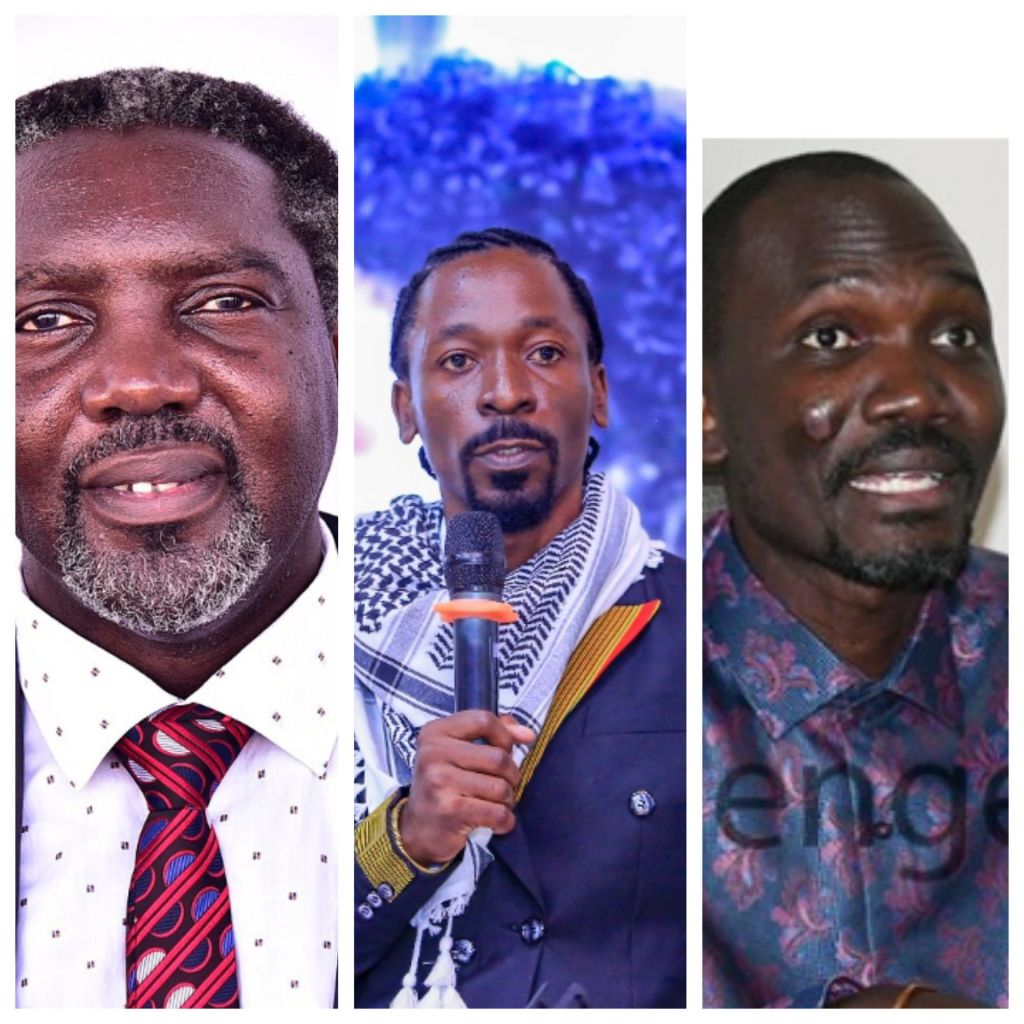
    Jimmy James Micheal Akena, Isaac Ssemakadde, and Denis Enap


    This is Uganda’s fight. The state is Semaka, its institutions, the pot, autonomy, the meat. Every clink is a power grab, every glance a wound to democracy’s soul. The sons, Uganda Law Society (ULS), Uganda Peoples Congress (UPC), the people, are its watchdogs, their fury blazing in courtrooms, civil society, public town halls and digital shadows. Institutional autonomy, the heart of democracy, pulses in their defiance, guarding Jucupanti’s pot against Semaka’s claw.


    A Kampala courtroom crackles with treachery. Semaka’s chopping sticks yanked four critical ULS appeals from the Court of Appeal’s cause list for 10th July 2025. Semaka’s style and chopping sticks have no respect for decisional autonomy of the empanelled coram designated to hear those very appeals and the fact that causelisting them was already a Judicial Act which could not be reversed in a casual manner, administratively.

    The affected Appeals were:

    1. Civil Appeal No. 98 of 2025 ULS & Anor v Mugisha Hashim & 2 Ors.,

    2. Civil Appeal No. 99 of 2025 ULS & Anor v Phoena Nabasa Wall,

    3. Civil Appeal No. 102 of 2025 Isaac Ssemakadde v Mugisha Hashim, and;

    4. Civil Appeal No. 111 of 2025 ULS v Brian Kirima—chaining ULS’s nomination to the Judicial Service Commission, its President Isaac Ssemakadde’s liberty, and its democratic governance. On June 30, 2025, the Registrar de-cause-listed these appeals, citing non-mandatory conferencing, followed by indefinite delays on July 3. On July 7, the Deputy Chief Justice admitted directing the move, cloaking it in Article 21(1)’s equality while alleging baseless lobbying by ULS and prioritizing decade-old appeals. This is judicial capture—Semaka’s spoon stealing the meat, shielding Hon. Justice Musa Ssekaana’s rulings (himself now a Justice of Appeal) and defying Articles 28(1) (fair hearing), 128(1)-(2) (judicial independence), and 126(1) (public interest). The cases of the State of Utta Pradesh vs. Anup Singh and  Carltona Ltd vs Commissioner of Works [1943]2 ALLER  560 all stand shoulder to shoulder with the Uganda Law Society, buttressing its push back to protest the decause lisitng of the ULS Appeals as an erosion of the decisional autonomy and independence of the three justices before whom the appeals were scheduled to be heard. Of course, the ULS stood unbowed in its fight to yank Semaka’s schemes.

    What followed was three days of digital town halls on X, hosted by Alfred Muyaka, ULS Head of Communications Adam Nuwamanya, and the indomitable Leonard Egesa slamming the Judiciary for institutional capture of the ULS. The stakes were so high. In between the spaces were frantic legal and diplomatic efforts to restore the ULS Appeals to the cause list and when it became clear that the Deputy Chief Justice had refused to relent as he had earlier communicated, the ULS hurled, like a rocket launcher, an official boycott of the Hon. Chief Justice, Alfonse Owiny-Dollo’s thanksgiving prayer and feast in Patongo, Agago District.

    Ssemakadde’s voice, sharp as a spear, carved 17 truths, three of which yours truly brings to you in surmised form from The Observer (July 23, 2025): Patongo’s gifts—Shs 5m from an acting judge, Shs 3m from the Principal Judge—spit on the Leadership Code Act’s Shs 200,000 cap, (Sections 12(3) with a duty to report gifts in excess of the threshold to the Inspector General of Government (Section 12(4) and a duty to deposit the excess into the Consolidated fund, (Section 12(7))breeding corruption’s rot. The NRM National chairperson’s triumphalist presence (President Yoweri Tibahaburwa Museveni) while throwing jibes at the Democratic Party’s President and Minister of Justice and Constitutional Affairs Minister, Hon Nobert Mao for the destruction of the Democratic Party  and cloaked in secret donations, risks political capture, defying judicial neutrality (Principles 2.2, 4.4, 4.6, Judicial Conduct Code). The tax-fueled feast mocked Ugandans begging for justice in crumbling courts, crowning the judiciary elitist, not just.

    Ssemakadde’s roar is a son’s fist for Jucupanti’s honor, a war cry to seize the judiciary’s soul.
    The cry drifts to Kampala’s heart, where Uganda House, relic of Obote’s dreams, hums with defiance. Jimmy Akena, heir to that fire, sits, his face lit by a laptop’s glow. On July 26, 2025, police churn Kamdini’s dust, chasing a UPC National Delegates Conference that’s a ghost. The day before, Semaka’s shadow, wielding external forces bent on judicial capture, snatched an ex parte interim order—Joseph Pinytek Ochieno v Uganda People’s Congress and Jimmy Akena (Miscellaneous Application, unreported, 2025)—to halt it. Signed on a Saturday, it’s a phantom—ECCMIS, Uganda’s Electronic Court Case Management system, sleeps on weekends, servers dark as Technicians do routine maintenance, the interim order therefore unserved, a chief’s shout lost to the wind. Akena’s smirk splits the silence, fingers dancing on keys. In a Zoom call, ablaze with democratic will, 700 plus  delegates, from all corners of the Country, UPC’s supreme organ, log in, screens flickering defiance. Three bolts forge their triumph: the Constitution bends, rewriting power; presidential term limits vanish, freeing Akena; a 12-month extension seals his reign to lead a peaceful handover. The delegates suspend the three-month notice with a nod, asserting their autonomy over external shackles like the Denis Adim Enap v Uganda People’s Congress and Hon. Jimmy James Michael Akena (Miscellaneous Cause No. 148 of 2025) ruling, which sought to bury Akena’s presidency. Kamdini’s police find silence, a perfect decoy of the Sandhurst trained political strategist; the war burns on screens. Semaka’s paper tiger falls to UPC’s democratic lion.
    For the village bars and barazas: an unserved order is a shout in a storm—dead on the wind. UPC’s digital triumph, a son’s jab at Semaka, reclaims the meat for the party’s heart, outwitting NRM’s fear of Akena on the 2026 ballot. Courts may growl, but the delegates’ will, the soul of institutional autonomy, hums by every fire.
    That triumph’s shadow slithers to the NRM’s war rooms, where fear flickers like a dying lamp. A secret survey sears: Akena, the Northern spark, threatens their presidential dreams, needing more than 50% of the valid votes cast, as Uganda’s 1995 Constitution, Article 103(1), demands. The National Unity Platform’s Kyagulanyi Robert Ssentamu, the Fire Base Edutainment Ghetto Gladiator tunred politician,  popularly known by his stage name, Bobi Wine, locks Central and Eastern Uganda, as well as huge swathes of the Northern youth vote itself, forging a three-way clash: Museveni, Kyagulanyi, Akena. Jucupanti’s scales, the Constitution, gleam in the fray. Akena, ghost of Milton Obote’s legacy, kindles a Northern flame for a lost dawn. The Ochieno order was a desperate swipe by Semaka’s external forces to snuff it, fearing UPC’s best shot at state power. Semaka’s spoon clinks, seizing ULS cases, chasing UPC’s ghosts, clawing autonomy. But the sons—ULS, UPC, the civil society, and the people—stand fierce, eyes blazing for Jucupanti’s pot. The state’s tyranny weaves a noose, deaf to the Constitution’s call for fairness. The sons are done waiting.
    The fight surges to a village square, dusk heavy, the stew pot steaming. Semaka looms, his spoon a blade, scarring the soul. Jucupanti, justice’s heart, stands serene—eyes fierce, heart a scale, roots deep. Her sons, lion-hearted, rise like a savanna storm. The square pulses as ULS, UPC, the people charge, fists forged in ancestral fire. Semaka falls, his spoon shattering, the meat saved. Jucupanti’s smile is a sunrise, her pride a hearth’s glow. Semaka, humbled, bows, the family’s honour reborn. The pot is shared; trust the broth, freedom the spice, every Ugandan one. This is their democracy, Uganda’s heart, fierce with its watchdogs.
    UPC lit the way. Akena’s digital triumph, driven by the delegates’ supreme will, turned a court order to ash, saving the meat as Kamdini’s police chased ghosts, they brainlessly walked into the decoy. ULS, choked by lies, roars on. Ssemakadde, Jucupanti’s son, thunders on X, defying Patongo’s empty festivities. Lawyers, armed with truth and swagger, are poised to storm the gate, their constitutional petition challenging the de-cause-listing as judicial capture. If UPC’s delegates broke Semaka’s chains, ULS can crush his blade. The call blazes: ULS, all civil society, and the people wield the Constitution like a spear. Charge for Jucupanti’s pot, forge a nation free of shame. Autonomy thunders, and your triumph will light Uganda’s soul.

    DISCLAIMER!

    The views expressed in this Blog are public commentaries to spark crucial debates for reform. It is not intended to attack or ridicule personalities mentioned in it.

    The contents of this blog do not constitute legal advice.  Readers are encouraged to consult a licensed attorney for situation specific legal advice. The author accepts no responsibility for any harm, legal,  financial, or otherwise arising from the use of information in this blog as legal advice

    About:

    Enen Ambrose, the author of this Blog is a rule of law enthusiast and a member of the inaugural Judiciary Affairs Committee of the Uganda Law Society. 

  • Foot Soldiers Fight Back: Free Speech, Social Media, and the Battle for Judicial Accountability in Uganda

    Foot Soldiers Fight Back: Free Speech, Social Media, and the Battle for Judicial Accountability in Uganda

    Judicial power in Uganda is not a divine right handed down to judges in solemn robes. It is borrowed authority from the people, and when borrowed power is abused, the lenders have every right to demand accountability. That is what happened when Ugandans erupted in fury over Justice Douglas Singiza’s decision to adjourn a habeas corpus application, effectively prolonging an already illegal detention.

    This was not an internet tantrum—it was a constitutional defense mission, executed in real-time by citizens who understand their rights better than some of the people wearing wigs in courtrooms. Article 126(1) of the Constitution is clear:

    Judicial power is derived from the people and shall be exercised in conformity with the law and with values, norms, and aspirations of the people.”

    So, when the people declare that a ruling has spat on their constitutional values, they are not just complaining—they are executing their duty to keep judicial power in check.

    This is not the first time Singiza has found himself at the center of a human rights disaster. When Kakwenza Rukirabashaija, a novelist and torture victim, applied to retrieve his passport for urgent medical treatment abroad, it was Singiza—then Chief Magistrate at Buganda Road Court—who denied him. His reasoning?

    👉 “Ugandan hospitals can handle his condition.”

    Imagine suffering broken ribs, festering wounds, and open scars from state torture, only for a judge to declare that a hospital in Wandegeya is sufficient to handle what should be a war crimes case. This is the same judge who, three years later, sends Besigye and Lutale back to illegal detention while he thinks about their habeas corpus plea.

    The pattern is now too clear to ignore—delayed justice when it benefits the state, procedural gymnastics when fundamental rights are at stake, and then a full-blown judicial meltdown when the public calls it out.

    And how did Singiza react to the backlash? Like a true 21st-century authoritarian—he made the ruling about himself. Instead of addressing the constitutional chaos he created, he spent his precious obiter dicta crying about online criticism.

    What’s next? Should Ugandans start seeking judicial permission before commenting on court decisions? Must all legal critiques now be submitted in triplicate, with an affidavit from a Senior Advocate?

    This is a dangerous trend—a creeping attempt to criminalize judicial criticism and insulate courts from the same public scrutiny that every other arm of government faces.

    The executive is insulted daily.
    The legislature is mocked in real-time.
    The military is dragged through the mud.

    But the judiciary wants to be untouchable?

    In Onyango Obbo & Andrew Mwenda v. Attorney General, the Supreme Court made it clear that public officials—including judges—must tolerate criticism. Free speech does not require politeness, and it is not invalidated because it offends the recipient.

    Yet, here we are, watching judges compose emotional victim statements in court rulings instead of defending the Constitution.

    This is not judicial independence—this is judicial fragility.

    Uganda has reached a crossroads: either the judiciary remembers that it serves the people, or the people will remind it in ways it will never forget. Judicial power, like all borrowed authority, can be reclaimed when misused.

    This is not a warning.
    This is a constitutional reminder.

    DISCLAIMER: This blog is not intended to mock or attack the person of the Hon. Justice Douglas Ssingiza. It is commentary on the interesting obiter dicta in the Habeas Corpus Application of Dr. Kizza Besigye and Obeid Lutale vs. Attorney General. The Ruling in that case can be found here:

    The author is a Rule of enthusiast. More in the about page.

  • NO APOLOGIES, NO SURRENDER: THE RADICAL NEW BAR TAKES THE JUDICIARY TO WAR

    NO APOLOGIES, NO SURRENDER: THE RADICAL NEW BAR TAKES THE JUDICIARY TO WAR


    The Judiciary wanted a fight. Now, it has a war.

    The New Law Year was supposed to be ceremonial—a chance for the Bench and the Bar to sip tea and pretend they liked each other. Instead, it became a crime scene.

    Chief Justice Alfonse Owiny-Dollo, tired of the Uganda Law Society’s relentless attacks, came out swinging. He stood before the nation, fists metaphorically clenched, voice dripping with fury.

    At first, he played innocent. Pretended he wasn’t the one who had gagged Isaac Ssemakadde. Then, unable to hold back, he let the truth slip.

    “I am the one who ordered that the President of the Uganda Law Society should not speak.”


    And then, like a man who had been waiting to explode, he thundered:

    “Only a fool, and I really mean it, it is only a fool who abuses you, insults you, dehumanizes you and thinks it will be business as usual. It cannot be business as usual unless you make amends.”


    Boom. There it was.

    The Judiciary was officially in its feelings.

    The message was clear: Bend the knee, apologize, or face consequences.

    But here’s the thing—Ssemakadde doesn’t kneel. The Radical New Bar doesn’t beg. And the Uganda Law Society doesn’t send apology cards.

    Ssemakadde’s response was swift, brutal, and final:

    “The Uganda Law Society doesn’t exist to soothe the Judiciary or assuage its egos. The Uganda Law Society’s role is to protect the Judiciary from Executive Overreach and to ensure public trust in the Judiciary.”


    Translation? Cry if you want. The Bar owes you nothing.

    THE BUILD-UP TO WAR: THE JUDICIARY’S NEVER-ENDING BLEEDING

    This wasn’t just an outburst. This was months of pent-up fury.

    The Judiciary had been bleeding out ever since the Radical New Bar declared war on its comfort zone.

    Executive Order No. 1 threw the Attorney General and Solicitor General out of the ULS Council.

    Executive Order No. 2 announced a Radical Surgery on the Judiciary—no anesthesia, just raw scalpel to the bone.

    Executive Order No. 3 didn’t just boycott Justice Musa Ssekana—it excommunicated him from the legal faith.


    Justice Ssekana, famous for delivering controversial and contradictory rulings had crossed a dangerous line.

    He had blocked ULS elections for its representative to the Judicial Service Commission. Many saw it as blatant Judicial Overreach—the Bench trying to control the Bar.

    The Radical New Bar did not take it lightly.

    A total boycott of Justice Ssekana’s courtroom. His rulings became legal noise—heard but never taken seriously.

    The ULS plaque that once honored him? REVOKED. PUBLICLY DISOWNED. SYMBOLICALLY BURNT.

    A whistleblower campaign launched, calling for evidence to have him removed for Judicial Misconduct.


    Ssekana was supposed to be finished.

    But Uganda’s Judiciary is like a bad magic trick—the more incompetent you are, the higher you rise.

    Instead of accountability, Ssekana is now pending vetting for the Court of Appeal.

    A man under public investigation for judicial misconduct is being lined up for a promotion.

    At this point, the Judiciary wasn’t just bleeding—it was leaking credibility like a sinking ship.

    THE KABAZIGURUKA JUDGMENT—WHEN REAL POWER SPOKE, THE JUDICIARY COWERED

    But let’s talk about the elephant in the room.

    The Uganda Law Society forced the Supreme Court to deliver the Kabaziguruka Judgment on January 31, 2025. It was a victory for the Rule of Law—civilians could no longer be tried in military courts.

    The Radical New Bar celebrated.

    And then, Gen. Muhoozi Kainerugaba entered the chat.

    Uganda’s Chief of Defense Forces. The President’s son. The man who commands tanks, fighter jets, and battle-hardened soldiers.

    He wasn’t impressed.

    He didn’t file for a review. He didn’t even bother to hide his disgust.

    He called the entire Supreme Court “clowns.”

    Then, he went further.

    “We are coming for you.”


    A direct threat. An undeniable challenge.

    If any civilian had said this, contempt of court summons would have been printed, signed, and delivered in minutes.

    But this was Uganda’s most powerful General.

    What did the Judiciary do?

    NOTHING.

    No warning. No condemnation. No outrage. Just silence.

    But when Ssemakadde calls out judicial incompetence? Suddenly, the Judiciary is offended.
    When Sebaduka criticizes the Bench? Suddenly, they have the power to throw someone in jail.

    Muhoozi tells the Supreme Court “we are coming for you,” and they act like they didn’t hear a thing.

    But when the Radical New Bar speaks, the Judiciary suddenly remembers how to fight.

    THE FINAL SHOWDOWN: THE PUBLIC INQUIRY IS COMING

    The Judiciary thought the worst was over? Not even close.

    Because Isaac Ssemakadde doesn’t just fight battles—he wages wars.

    Last year, he made a promise:

    The Uganda Law Society would not wait for the broken, spineless, toothless Judicial Service Commission to act.

    No more fake investigations. No more endless excuses. No more allowing compromised institutions to pretend they can police themselves.

    The ULS would marshal a PUBLIC COMMISSION OF INQUIRY into the entire Bench.

    And he gave the Judicial Service Commission a deadline—January 15, 2025—to furnish a report on its inquiry against Justice Ssekana.

    The deadline came and went.

    No report. No accountability. Just the same old game of protecting the powerful.

    Now, the ULS Governing Council has just completed its retreat. What were they doing? COMBING THROUGH PUBLICLY GATHERED EVIDENCE AGAINST JUSTICE SSEKANA.

    Evidence gathered as a result of Executive Order No. 3.

    The Judiciary wanted a fight? Now, it has a full-scale public investigation coming straight for its doorstep.

    And the Chief Justice still expects an apology?

    The ULS will not apologize to a judge they have been investigating for potential removal.

    The Judiciary wanted a war. Now, it’s getting one.

    The horns are locked. The trenches are dug. The battle lines are drawn.

    And if the Judiciary thought the Radical New Bar was dangerous before?

    They haven’t seen anything yet.

    This is no longer just a legal fight. This is institutional. This is existential. This is irreversible.

    Brace yourselves. 2025 is about to be the most explosive year in Ugandan legal history.

    NO APOLOGIES. NO COMPROMISES. NO MERCY.

    JUSTICE WILL PREVAIL.

    DISCLAIMER: This Blog is not intended to ridicule or attack the persons of the Honorable Chief Justice Alfonse Chigamoi Owiny Dollo, the Hon. Justice Musa Ssekana. It is purely public commentary on the spat that happened at the opening of the New Law Year at the Supreme Court, Kampala.

    The information contained in this Blog is not intended to be used as Legal advice. The author accepts no liability for injury arising from using the information contained in the Blog as Legal Advice. Readers are advised to seek the services of a qualified attorney in their area of Jurisdiction to deal with specific scenarios.

    Do you have a story that would contribute to the Rule of Law discussion that you want us to write about? Reach out to us at ambrosenen@gmail.com

  • BANG! MILITARY COURTS FOR CIVILIANS ARE DEAD—THE SUPREME COURT JUST DROPPED THE HAMMER, AND THE RADICAL NEW BAR LIT THE FUNERAL PYRE!

    BANG! MILITARY COURTS FOR CIVILIANS ARE DEAD—THE SUPREME COURT JUST DROPPED THE HAMMER, AND THE RADICAL NEW BAR LIT THE FUNERAL PYRE!

    The Supreme Court has spoken. The revolution has won. The military courts are finished. It took 25 years of legal battles, endless delays, and the relentless fire of Uganda’s most radical legal minds, but justice has finally arrived. And when it came, it wasn’t subtle. It came with the full force of the Constitution, a gavel so loud it could shake the foundations of every military courtroom still pretending to be a temple of justice.

    This is not just a legal victory; it is a demolition job on a long-standing abuse of power. It is the final nail in the coffin for a system that has for decades terrorized civilians, dragging them before military tribunals as if they were rogue soldiers, silencing dissent under the guise of national security. And the Supreme Court? Oh, the Supreme Court delivered its judgment with flair, with humor, and with the kind of clarity that leaves no room for debate.

    Chief Justice Owiny-Dollo, ever the master of courtroom theatre, laid it all bare in ways that had the entire legal fraternity both laughing and nodding in agreement. Imagine a Uganda where he, a civilian, is picked to lead a military brigade to guard the war-torn eastern border with the DRC. Imagine him, clad in combat gear, barking orders to soldiers while probably asking them which way to point a gun. Or worse—picture him in a hospital theatre, standing over an unconscious patient, scalpel in hand, completely clueless about whether he’s holding a kidney or a liver. Madness, right? Exactly. That, he said, is the absurdity of putting untrained military officers in charge of dispensing justice.

    This was the point where even the most rigid courtroom observer had to chuckle. But beneath the humor was a devastating truth: military courts are tribunals run by people without the first clue about judicial procedure, yet they have spent years presiding over cases, handing down life sentences and convictions like they were distributing rations at a military mess. The Chief Justice didn’t mince his words. The Constitution was clear, and so was the Court—military justice is for military personnel, period. Civilians have no business being tried there.

    And yet, as the judgment was delivered, there was another remarkable moment. Counsel Caleb Alaka, one of Uganda’s legal firebrands, stood up and did something few saw coming—he apologized. On behalf of the Uganda Law Society, he expressed regret for the extreme activism, the relentless pressure, the public letters, the weekly legal firebombs the Radical New Bar had been hurling at the Supreme Court, demanding action. The judges listened, some perhaps amused, others with the quiet satisfaction of warriors who had just emerged victorious in a long and bloody intellectual battle.

    The apology was sincere, but let’s be honest—this war was necessary. The Radical New Bar, under the fearless and uncompromising leadership of Isaac K. Ssemakadde, fought like hell to make this ruling happen. The legal establishment had long grown too comfortable, too resigned to waiting indefinitely for judgments while civilians continued to be dragged before military tribunals. The RNB was having none of it. Weekly press conferences, legal activism so sharp it cut through the silence, direct challenges to judicial inertia—this was lawfare at its finest. And in the end, the pressure worked.

    The judgment is now out, and the message is clear: no more military courts for civilians. No more kangaroo justice. No more legal intimidation. If the army wants to try someone, that person better be wearing a uniform. Otherwise, they belong in the courts of law established by the Constitution. And for those still clinging to the old ways, still hoping that military justice can be used as a tool of fear and suppression? Pack up your case files. Your era is over.

    For the Uganda People’s Defence Forces, the ruling leaves no room for negotiation. Civilians currently facing trial in military courts must be released. Every ongoing case must be dropped. Any attempt to defy this ruling will not just be illegal—it will be suicidal. The ULS and the RNB are watching. The Supreme Court is watching. And the Ugandan people, tired of impunity, will not tolerate another second of this nonsense.

    Parliament? Time to clean house. The UPDF Act needs to be amended—immediately. Those loopholes that allowed military courts to overstep their jurisdiction must be sealed permanently. No more ambiguity, no more exploitation of civilians through legal gymnastics. This ruling has set the standard, now it’s up to lawmakers to ensure the law reflects it. And the Executive? The President, the Attorney General, the Director of Public Prosecutions—they need to act. Not tomorrow, not next week. Now.

    For those who still think this is just another ruling, another judgment to be ignored or manipulated—think again. This is the beginning of a new era. The days when military courts were used as tools of intimidation are gone. The days when civilians had to fear being hauled before unqualified military judges who don’t know the difference between fair trial rights and a parade drill are gone. This is what victory looks like.

    Uganda’s legal profession will never be the same. The Supreme Court has reaffirmed its place in history. The Radical New Bar has cemented its reputation as the most effective force for legal accountability in modern Uganda. And the Constitution? It has won. The rule of law has won. Justice has won.

    The revolution is here, and it has no brakes.

    A copy of the Judgment can be found here

    The statement of the Uganda Law Society welcoming the Judgment can be found here

    Enen Ambrose is a Rule of Law enthusiast and a supporter of the firebrand president of the Uganda Law Society, Isaac K Ssemakade.

    Disclaimer: This write up is for informational purposes only and should not be taken as a substitute for professional legal advice. Readers are advised to seek the services of a qualified attorney in their area of Jurisdiction for situation specific legal advice and course of action.

    Do you have a story in your community that sheds light on the Rule of Law discourse that you want us to discuss about? Or do you have valuable constructive feedback for us?

    Please reach out to us on, ambrosenen@gmail.com or +256789856805