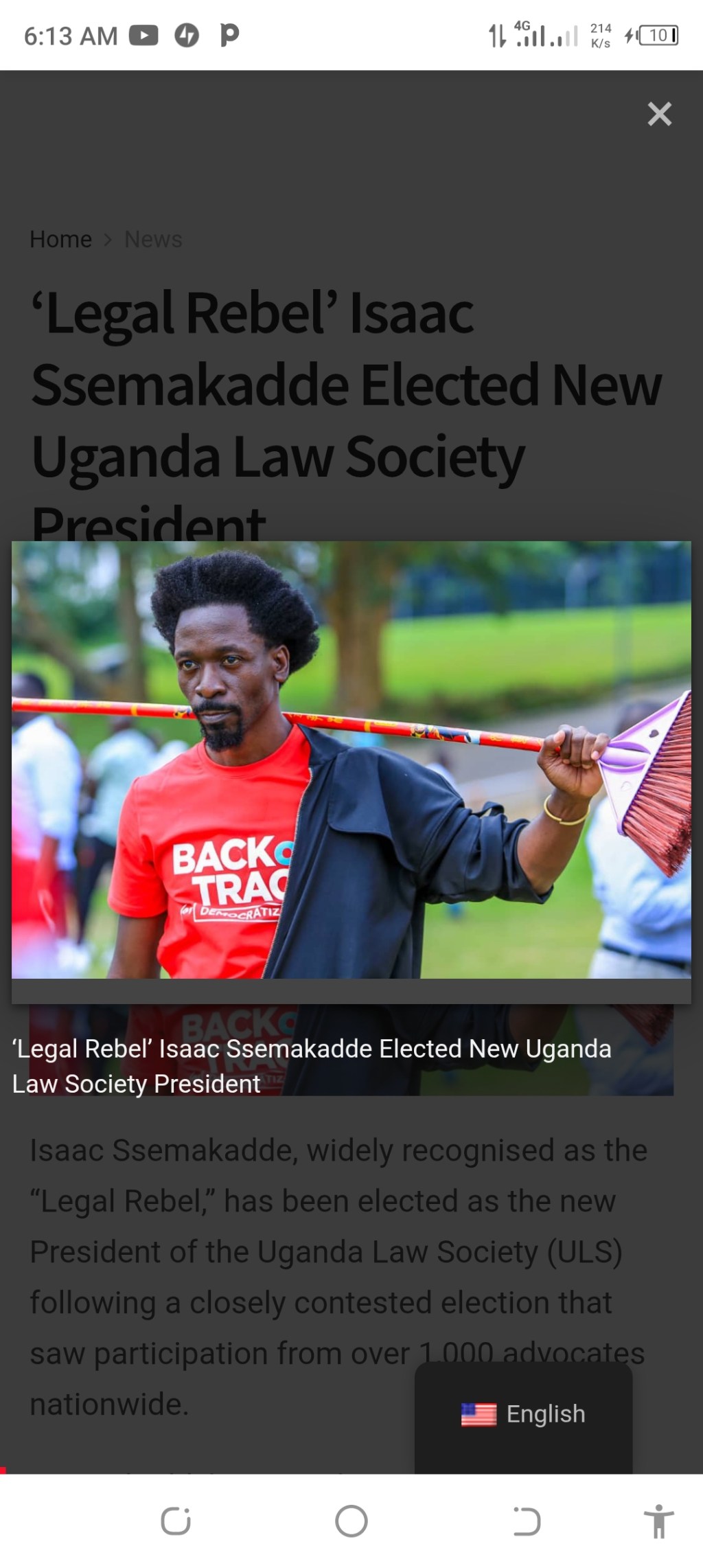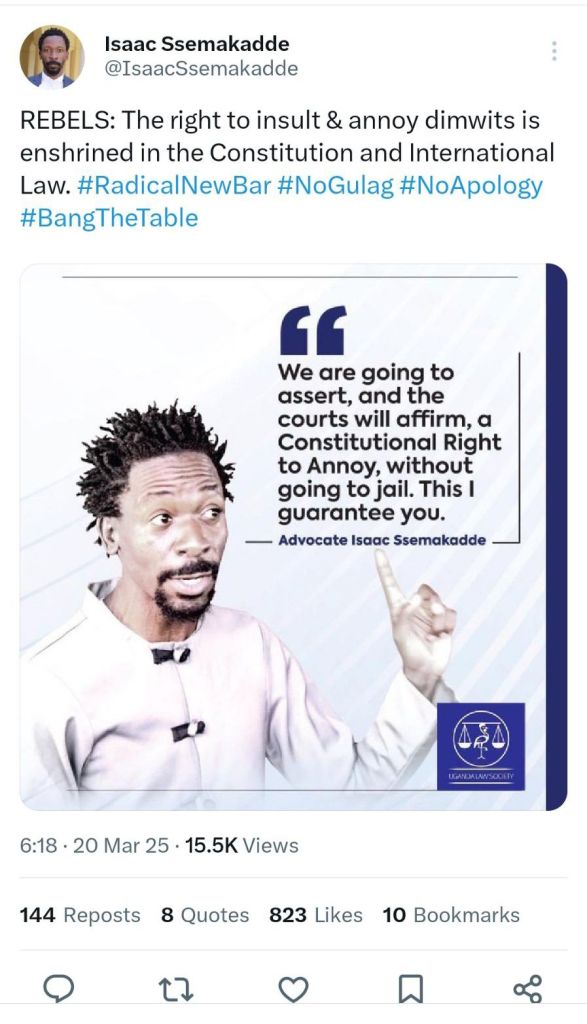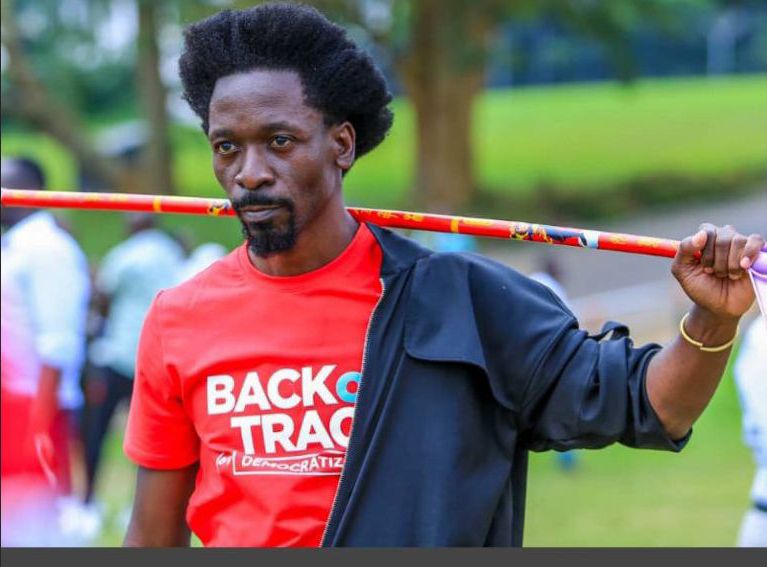
Tag: Constitutionalism

  • NO APOLOGIES, NO SURRENDER: THE RADICAL NEW BAR TAKES THE JUDICIARY TO WAR

    NO APOLOGIES, NO SURRENDER: THE RADICAL NEW BAR TAKES THE JUDICIARY TO WAR


    The Judiciary wanted a fight. Now, it has a war.

    The New Law Year was supposed to be ceremonial—a chance for the Bench and the Bar to sip tea and pretend they liked each other. Instead, it became a crime scene.

    Chief Justice Alfonse Owiny-Dollo, tired of the Uganda Law Society’s relentless attacks, came out swinging. He stood before the nation, fists metaphorically clenched, voice dripping with fury.

    At first, he played innocent. Pretended he wasn’t the one who had gagged Isaac Ssemakadde. Then, unable to hold back, he let the truth slip.

    “I am the one who ordered that the President of the Uganda Law Society should not speak.”


    And then, like a man who had been waiting to explode, he thundered:

    “Only a fool, and I really mean it, it is only a fool who abuses you, insults you, dehumanizes you and thinks it will be business as usual. It cannot be business as usual unless you make amends.”


    Boom. There it was.

    The Judiciary was officially in its feelings.

    The message was clear: Bend the knee, apologize, or face consequences.

    But here’s the thing—Ssemakadde doesn’t kneel. The Radical New Bar doesn’t beg. And the Uganda Law Society doesn’t send apology cards.

    Ssemakadde’s response was swift, brutal, and final:

    “The Uganda Law Society doesn’t exist to soothe the Judiciary or assuage its egos. The Uganda Law Society’s role is to protect the Judiciary from Executive Overreach and to ensure public trust in the Judiciary.”


    Translation? Cry if you want. The Bar owes you nothing.

    THE BUILD-UP TO WAR: THE JUDICIARY’S NEVER-ENDING BLEEDING

    This wasn’t just an outburst. This was months of pent-up fury.

    The Judiciary had been bleeding out ever since the Radical New Bar declared war on its comfort zone.

    Executive Order No. 1 threw the Attorney General and Solicitor General out of the ULS Council.

    Executive Order No. 2 announced a Radical Surgery on the Judiciary—no anesthesia, just raw scalpel to the bone.

    Executive Order No. 3 didn’t just boycott Justice Musa Ssekana—it excommunicated him from the legal faith.


    Justice Ssekana, famous for delivering controversial and contradictory rulings had crossed a dangerous line.

    He had blocked ULS elections for its representative to the Judicial Service Commission. Many saw it as blatant Judicial Overreach—the Bench trying to control the Bar.

    The Radical New Bar did not take it lightly.

    A total boycott of Justice Ssekana’s courtroom. His rulings became legal noise—heard but never taken seriously.

    The ULS plaque that once honored him? REVOKED. PUBLICLY DISOWNED. SYMBOLICALLY BURNT.

    A whistleblower campaign launched, calling for evidence to have him removed for Judicial Misconduct.


    Ssekana was supposed to be finished.

    But Uganda’s Judiciary is like a bad magic trick—the more incompetent you are, the higher you rise.

    Instead of accountability, Ssekana is now pending vetting for the Court of Appeal.

    A man under public investigation for judicial misconduct is being lined up for a promotion.

    At this point, the Judiciary wasn’t just bleeding—it was leaking credibility like a sinking ship.

    THE KABAZIGURUKA JUDGMENT—WHEN REAL POWER SPOKE, THE JUDICIARY COWERED

    But let’s talk about the elephant in the room.

    The Uganda Law Society forced the Supreme Court to deliver the Kabaziguruka Judgment on January 31, 2025. It was a victory for the Rule of Law—civilians could no longer be tried in military courts.

    The Radical New Bar celebrated.

    And then, Gen. Muhoozi Kainerugaba entered the chat.

    Uganda’s Chief of Defense Forces. The President’s son. The man who commands tanks, fighter jets, and battle-hardened soldiers.

    He wasn’t impressed.

    He didn’t file for a review. He didn’t even bother to hide his disgust.

    He called the entire Supreme Court “clowns.”

    Then, he went further.

    “We are coming for you.”


    A direct threat. An undeniable challenge.

    If any civilian had said this, contempt of court summons would have been printed, signed, and delivered in minutes.

    But this was Uganda’s most powerful General.

    What did the Judiciary do?

    NOTHING.

    No warning. No condemnation. No outrage. Just silence.

    But when Ssemakadde calls out judicial incompetence? Suddenly, the Judiciary is offended.
    When Sebaduka criticizes the Bench? Suddenly, they have the power to throw someone in jail.

    Muhoozi tells the Supreme Court “we are coming for you,” and they act like they didn’t hear a thing.

    But when the Radical New Bar speaks, the Judiciary suddenly remembers how to fight.

    THE FINAL SHOWDOWN: THE PUBLIC INQUIRY IS COMING

    The Judiciary thought the worst was over? Not even close.

    Because Isaac Ssemakadde doesn’t just fight battles—he wages wars.

    Last year, he made a promise:

    The Uganda Law Society would not wait for the broken, spineless, toothless Judicial Service Commission to act.

    No more fake investigations. No more endless excuses. No more allowing compromised institutions to pretend they can police themselves.

    The ULS would marshal a PUBLIC COMMISSION OF INQUIRY into the entire Bench.

    And he gave the Judicial Service Commission a deadline—January 15, 2025—to furnish a report on its inquiry against Justice Ssekana.

    The deadline came and went.

    No report. No accountability. Just the same old game of protecting the powerful.

    Now, the ULS Governing Council has just completed its retreat. What were they doing? COMBING THROUGH PUBLICLY GATHERED EVIDENCE AGAINST JUSTICE SSEKANA.

    Evidence gathered as a result of Executive Order No. 3.

    The Judiciary wanted a fight? Now, it has a full-scale public investigation coming straight for its doorstep.

    And the Chief Justice still expects an apology?

    The ULS will not apologize to a judge they have been investigating for potential removal.

    The Judiciary wanted a war. Now, it’s getting one.

    The horns are locked. The trenches are dug. The battle lines are drawn.

    And if the Judiciary thought the Radical New Bar was dangerous before?

    They haven’t seen anything yet.

    This is no longer just a legal fight. This is institutional. This is existential. This is irreversible.

    Brace yourselves. 2025 is about to be the most explosive year in Ugandan legal history.

    NO APOLOGIES. NO COMPROMISES. NO MERCY.

    JUSTICE WILL PREVAIL.

    DISCLAIMER: This Blog is not intended to ridicule or attack the persons of the Honorable Chief Justice Alfonse Chigamoi Owiny Dollo, the Hon. Justice Musa Ssekana. It is purely public commentary on the spat that happened at the opening of the New Law Year at the Supreme Court, Kampala.

    The information contained in this Blog is not intended to be used as Legal advice. The author accepts no liability for injury arising from using the information contained in the Blog as Legal Advice. Readers are advised to seek the services of a qualified attorney in their area of Jurisdiction to deal with specific scenarios.

    Do you have a story that would contribute to the Rule of Law discussion that you want us to write about? Reach out to us at ambrosenen@gmail.com

  • BANG! MILITARY COURTS FOR CIVILIANS ARE DEAD—THE SUPREME COURT JUST DROPPED THE HAMMER, AND THE RADICAL NEW BAR LIT THE FUNERAL PYRE!

    BANG! MILITARY COURTS FOR CIVILIANS ARE DEAD—THE SUPREME COURT JUST DROPPED THE HAMMER, AND THE RADICAL NEW BAR LIT THE FUNERAL PYRE!

    The Supreme Court has spoken. The revolution has won. The military courts are finished. It took 25 years of legal battles, endless delays, and the relentless fire of Uganda’s most radical legal minds, but justice has finally arrived. And when it came, it wasn’t subtle. It came with the full force of the Constitution, a gavel so loud it could shake the foundations of every military courtroom still pretending to be a temple of justice.

    This is not just a legal victory; it is a demolition job on a long-standing abuse of power. It is the final nail in the coffin for a system that has for decades terrorized civilians, dragging them before military tribunals as if they were rogue soldiers, silencing dissent under the guise of national security. And the Supreme Court? Oh, the Supreme Court delivered its judgment with flair, with humor, and with the kind of clarity that leaves no room for debate.

    Chief Justice Owiny-Dollo, ever the master of courtroom theatre, laid it all bare in ways that had the entire legal fraternity both laughing and nodding in agreement. Imagine a Uganda where he, a civilian, is picked to lead a military brigade to guard the war-torn eastern border with the DRC. Imagine him, clad in combat gear, barking orders to soldiers while probably asking them which way to point a gun. Or worse—picture him in a hospital theatre, standing over an unconscious patient, scalpel in hand, completely clueless about whether he’s holding a kidney or a liver. Madness, right? Exactly. That, he said, is the absurdity of putting untrained military officers in charge of dispensing justice.

    This was the point where even the most rigid courtroom observer had to chuckle. But beneath the humor was a devastating truth: military courts are tribunals run by people without the first clue about judicial procedure, yet they have spent years presiding over cases, handing down life sentences and convictions like they were distributing rations at a military mess. The Chief Justice didn’t mince his words. The Constitution was clear, and so was the Court—military justice is for military personnel, period. Civilians have no business being tried there.

    And yet, as the judgment was delivered, there was another remarkable moment. Counsel Caleb Alaka, one of Uganda’s legal firebrands, stood up and did something few saw coming—he apologized. On behalf of the Uganda Law Society, he expressed regret for the extreme activism, the relentless pressure, the public letters, the weekly legal firebombs the Radical New Bar had been hurling at the Supreme Court, demanding action. The judges listened, some perhaps amused, others with the quiet satisfaction of warriors who had just emerged victorious in a long and bloody intellectual battle.

    The apology was sincere, but let’s be honest—this war was necessary. The Radical New Bar, under the fearless and uncompromising leadership of Isaac K. Ssemakadde, fought like hell to make this ruling happen. The legal establishment had long grown too comfortable, too resigned to waiting indefinitely for judgments while civilians continued to be dragged before military tribunals. The RNB was having none of it. Weekly press conferences, legal activism so sharp it cut through the silence, direct challenges to judicial inertia—this was lawfare at its finest. And in the end, the pressure worked.

    The judgment is now out, and the message is clear: no more military courts for civilians. No more kangaroo justice. No more legal intimidation. If the army wants to try someone, that person better be wearing a uniform. Otherwise, they belong in the courts of law established by the Constitution. And for those still clinging to the old ways, still hoping that military justice can be used as a tool of fear and suppression? Pack up your case files. Your era is over.

    For the Uganda People’s Defence Forces, the ruling leaves no room for negotiation. Civilians currently facing trial in military courts must be released. Every ongoing case must be dropped. Any attempt to defy this ruling will not just be illegal—it will be suicidal. The ULS and the RNB are watching. The Supreme Court is watching. And the Ugandan people, tired of impunity, will not tolerate another second of this nonsense.

    Parliament? Time to clean house. The UPDF Act needs to be amended—immediately. Those loopholes that allowed military courts to overstep their jurisdiction must be sealed permanently. No more ambiguity, no more exploitation of civilians through legal gymnastics. This ruling has set the standard, now it’s up to lawmakers to ensure the law reflects it. And the Executive? The President, the Attorney General, the Director of Public Prosecutions—they need to act. Not tomorrow, not next week. Now.

    For those who still think this is just another ruling, another judgment to be ignored or manipulated—think again. This is the beginning of a new era. The days when military courts were used as tools of intimidation are gone. The days when civilians had to fear being hauled before unqualified military judges who don’t know the difference between fair trial rights and a parade drill are gone. This is what victory looks like.

    Uganda’s legal profession will never be the same. The Supreme Court has reaffirmed its place in history. The Radical New Bar has cemented its reputation as the most effective force for legal accountability in modern Uganda. And the Constitution? It has won. The rule of law has won. Justice has won.

    The revolution is here, and it has no brakes.

    A copy of the Judgment can be found here

    The statement of the Uganda Law Society welcoming the Judgment can be found here

    Enen Ambrose is a Rule of Law enthusiast and a supporter of the firebrand president of the Uganda Law Society, Isaac K Ssemakade.

    Disclaimer: This write up is for informational purposes only and should not be taken as a substitute for professional legal advice. Readers are advised to seek the services of a qualified attorney in their area of Jurisdiction for situation specific legal advice and course of action.

    Do you have a story in your community that sheds light on the Rule of Law discourse that you want us to discuss about? Or do you have valuable constructive feedback for us?

    Please reach out to us on, ambrosenen@gmail.com or +256789856805

  • Anarchy’s Throne: The Fall of Justice(A Bold Call to Defend the Rule of Law)

    Anarchy’s Throne: The Fall of Justice(A Bold Call to Defend the Rule of Law)


    Without the Rule of Law, chaos shall reign,
    A nation adrift, drowning in pain.
    The President speaks with pride and flair,
    Banning bond and bail, without a care.
    But hear this now, hear it loud,
    The law is not a weapon for the proud!
    Chief Justice, rise, your gavel is strong,
    The law must lead, not bend to wrong.
    Disregard the whispers, disregard the call,
    For justice must stand, above them all!

    Kale Kayihura once ruled with fear,
    A terror of torture, pain, and tear.
    But when the law turned, his empire crumbled,
    The mighty fell, their lies stumbled.
    Now, IGP, do not cower to power,
    You must guard the law, every hour!
    The President may demand, but you know the truth—
    Justice, not politics, must be the proof.
    You hold the line, between peace and strife,
    Do not let tyranny consume our life.

    Amama Mbabazi, the crafty man,
    With whispers and wires, his plans began.
    But the law, sharp as a blade, cut him through,
    Exposing his schemes, bringing him to view.
    Now, let this be the lesson, loud and clear,
    The law cannot be twisted by fear.
    So, let the courts rise, let justice shine,
    For without the law, there’s no peace, no line.

    Ssemakadde has spoken, a voice so true,
    Corruption must fall, but human rights too!
    The President may ban, may shout, may roar,
    But the law is the shield we must restore!
    So lawyers, rise! Stand with boldness and grace,
    For in the law, we find our place.
    Defend the weak, defend the right,
    For justice is the beacon, shining bright!

    The time is now, the call is clear,
    Stand firm, stand tall, without fear.
    For if we fall, the people will cry,
    But if we stand, justice will never die!
    Bail may be banned, bond cast aside,
    But the law—the law—must always guide!

    Happy New Year 2025.

    Enen Ambrose (Advocate)

    ambrosenen@gmail.com | +256789856805

  • The Radical New Bar Revolution: Expulsions, Boycotts, and the Battle for the Soul of Uganda’s Legal Profession

    The Radical New Bar Revolution: Expulsions, Boycotts, and the Battle for the Soul of Uganda’s Legal Profession


    Let’s not sugarcoat it: Uganda’s legal profession is in chaos. President Isaac Ssemakadde, the firebrand leader of the Uganda Law Society (ULS), has declared war—on the judiciary, on government interference, and, if necessary, on tradition itself. This isn’t your grandfather’s bar association anymore; it’s a Radical New Bar, blazing through a tired, creaking legal system with orders that feel less like bureaucratic memos and more like the opening shots of a revolution.

    It began with Executive Order No. 1 of 2024, a political earthquake that saw the Attorney General and Solicitor General expelled from the ULS Council. Yes, you read that right: expelled. Not asked to step aside politely, not nudged toward the door—expelled. President Ssemakadde called their presence a colonial hangover, an outdated relic that kept the Bar shackled to government influence.

    “The AG cannot serve two masters!” Ssemakadde thundered, and just like that, the most senior government lawyers were tossed out of the Council, their titles no longer recognized in what Ssemakadde calls “the House of Justice.” It was a raw, messy, unapologetic power move, the kind that made half the room cheer and the other half gasp. Love him or hate him, the man is not here to play.

    The Call to Boycott: Executive Order No. 3—A Legal Bloodbath?

    And now here we are, riding the shockwaves of Executive Order No. 3 of 2024, where the stakes have climbed even higher. This time, it’s not just government lawyers feeling the heat—it’s the advocates. All of them.

    The ULS has called for a boycott of Judge Musa Ssekaana’s court. Advocates are being ordered—yes, ordered—to stay away. The revolution demands solidarity. The revolution demands sacrifice. But here’s the burning question twisting every lawyer’s stomach: what happens when revolution clashes with professional duty?

    Imagine this: you’re an advocate with a client who’s been waiting months, maybe years for their day in court. They’ve sold their land, borrowed money, staked their entire future on this case. And now, because of the boycott, you’re supposed to turn to them and say: “Sorry, justice is on hold this month. We’re making a point.”

    Your professional ethics scream at you to stand by your client. The Advocates Act tells you that your duty to your client is sacred, almost holy. But the ULS says otherwise. The ULS says that this fight—this boycott—is bigger than you, bigger than your client, bigger than this one case.

    And if you defy the ULS? If you walk into Judge Ssekaana’s courtroom and do your job? Then what? Are you a traitor to the cause? A sellout? Will the ULS come for you next?

    This is not just a professional dilemma. This is a moral crucible, a test of loyalty, a trial by fire. Will you risk your client’s future, or will you risk your career? Isaac Ssemakadde has thrown down the gauntlet, and every lawyer in Uganda must decide where they stand.

    A Law Society Without Teeth? The ULS’s Fight for Power

    But here’s the twist that turns this legal thriller on its head: Can the ULS actually enforce any of this?

    Let’s step back for a moment. Under the Uganda Law Society Act, the ULS is tasked with upholding professional standards and improving the conduct of lawyers. But there’s a catch: the ULS can’t legally punish anyone. Not really.

    Disciplinary power lies with the Law Council, a separate government-anchored body. The ULS can yell, it can shout, it can issue Executive Orders with the fire and fury of a thousand revolutions—but at the end of the day, it cannot fine you. It cannot suspend you. It cannot strip you of your right to practice law.

    What it can do is drag your name through the mud, isolate you, and question your loyalty to the cause. And in a profession where reputation is everything, that’s no small threat. The ULS may not have teeth, but it has a loud voice, and right now, it’s shouting for all the world to hear.

    So what happens if an advocate defies the boycott and the ULS tries to discipline them? The answer is a legal nightmare. The accused advocate would challenge the ULS’s authority in court, and—oh, the irony!—they’d find themselves stuck in the very judiciary the boycott condemns.

    Justice delayed? Oh, yes. Justice delayed for years. That’s Uganda’s court system for you: clogged, slow, and sometimes deliberately obstructive. By the time the courts decide who’s right and who’s wrong, the boycott will be ancient history, and the ULS’s revolution will either be a roaring success or a long-forgotten whisper.

    The Bigger Battle: A Fight for Autonomy

    When Ssemakadde expelled the Attorney General and Solicitor General, he wasn’t just flexing muscle—he was making a declaration of independence. He wants the ULS to be a fully autonomous Bar, like those in Canada, South Africa, and other legal systems where the profession regulates itself, free from government influence.

    Take Canada’s Law Society of Ontario. There, the Bar has real power: it disciplines lawyers, sets standards, and protects the profession’s integrity. No government official sits at their table, holding sway over decisions that affect the legal profession.

    In Uganda, the presence of government lawyers on the ULS Council undermines that independence. Critics have long argued that the Attorney General and Solicitor General, as government agents, represent a conflict of interest—how can they serve both the executive and the profession simultaneously?

    By kicking them out, Ssemakadde ripped off the bandage and exposed the wound. But the wound is far from healed. Until the ULS is given real disciplinary authority, until it can act without begging the Law Council for enforcement, the revolution will remain just that: a revolution, full of fire but not yet law.

    The Chaos and the Choice

    The ULS has lit the match. The lawyers of Uganda now face the fire.

    Do they comply with Executive Order No. 3 and boycott the court, risking their clients’ cases, their livelihoods, and their professional ethics?
    Or do they stand up and say no, risking isolation, humiliation, and the fury of the Radical New Bar?

    This isn’t just a battle for the courts. It’s a battle for the soul of Uganda’s legal profession.

    Isaac Ssemakadde has made it clear: there’s no room for compromise. You’re either with the revolution or against it. And if you’re against it, you’ll have to answer not just to the ULS but to the future of justice in Uganda.

    The system is broken, yes. The courts are failing, yes. But will boycotts and expulsions fix it? Or are they just adding more chaos to the madness?

    What happens next is up to Uganda’s advocates. The storm is here, and every lawyer must decide: Will you stand in the rain, or will you bring the thunder?

    The revolution has begun. Where do you stand?

    My about me on my other blog posts and other useful disclaimers

  • Judiciary on Trial: Delayed Justice, Judicial Overreach, and Uganda’s Fight for Legal Accountability

    Judiciary on Trial: Delayed Justice, Judicial Overreach, and Uganda’s Fight for Legal Accountability

    Uganda’s judiciary stands at a defining moment. With its recent pattern of issuing injunctions against the Uganda Law Society’s (ULS) internal processes, the courts appear to have placed themselves in opposition to democratization, accountability, and reform. The High Court’s recent ruling in Mugisha Hashim Mugisha & Pheona Nabasa Wall v. ULS, which blocked an Extraordinary General Meeting (EGM) to elect ULS nominees for the Judicial Service Commission (JSC), is the latest episode in this disturbing trend.

    But this isn’t just about one ruling. It’s about a systemic pattern: one where the judiciary blocks ULS EGMs for years, grants temporary injunctions that morph into indefinite barriers, and delays rulings while the status quo prevails. Cases such as Brian Kirima v. ULS (2024) and Attorney General v. ULS (2024) illustrate this concerning dynamic, where judicial delays and contradictory rulings obstruct the ULS’s statutory mandate to protect the rule of law.

    The question we must ask is simple but urgent: Is the judiciary afraid of the Radical Surgery being performed by the Radical New Bar? Is this an attempt to resist reform and entrench unelected power in Uganda’s legal system?

    The Radical New Bar’s Vision for Reform

    Under President Ssemakade, the Radical New Bar has spearheaded a bold revolution. This movement is more than a change in leadership—it’s a demand for transparency, democracy, and accountability across Uganda’s legal system. The adoption of Executive Order No. 2 of 2024 was a defining moment, directing the ULS to convene elections for JSC nominees. These elections represented a critical step in dismantling decades of unelected power and reforming the judiciary.

    For too long, unelected ULS representatives have served on the JSC well past their lawful tenure. These representatives wield significant power over judicial appointments, often without public accountability. Ssemakade’s reforms sought to change this by ensuring that ULS members could elect their representatives democratically—a step toward restoring public trust in the judiciary.

    But the judiciary’s recent rulings raise a troubling question: Are the courts complicit in protecting the unelected elite and resisting much-needed reform?

    Judicial Overreach: A Pattern of Obstruction

    The recent ruling in Mugisha & Wall is part of a broader pattern of judicial interference. Courts have repeatedly issued injunctions that block the ULS from convening EGMs, leaving important governance issues unresolved. In Brian Kirima v. ULS (2024), for example, the High Court issued a temporary injunction blocking the ULS from holding an EGM requested by its members. The court justified this decision by claiming that the meeting might lead to resolutions outside the ULS’s statutory mandate.

    Similarly, in Attorney General v. ULS (2024), the court issued a permanent injunction prohibiting the ULS from convening an EGM to discuss judicial misconduct allegations. The court argued that such discussions would infringe on the independence of the judiciary and encroach on the Judicial Service Commission’s (JSC) mandate. While protecting judicial independence is crucial, these rulings have had the effect of stifling the ULS’s role as a watchdog for the rule of law.

    The judiciary’s actions create a chilling effect, sending a message that the ULS cannot hold its own members or representatives accountable without judicial interference. This is particularly troubling when unelected JSC representatives continue to serve beyond their lawful tenure, shielded by the very courts that should ensure accountability.

    Preliminary Issues Ignored: A Missed Opportunity

    The Mugisha & Wall case could have been resolved on preliminary issues, sparing the judiciary from issuing an injunction that has paralyzed ULS processes.

    1. The Question of Locus Standi

    The first applicant, Mugisha Hashim Mugisha, lacked the locus standi required to bring the case. Judicial review, as outlined in Rule 3 of the Judicature (Judicial Review) Rules, 2019, is reserved for those who can demonstrate that they are directly affected by an administrative decision. Mugisha was neither a candidate for the JSC election nor a suspended council member. His application, therefore, lacked the specific and tangible interest necessary for judicial review.

    This procedural flaw should have been addressed as a preliminary issue, as it rendered the entire case speculative and unwarranted. Resolving this question at the outset would have saved valuable judicial resources and avoided the need for an injunction that undermines democratic processes.

    2. Wall’s Ineligibility for the JSC

    The second applicant, Pheona Nabasa Wall, was constitutionally disqualified from being nominated to the JSC. Article 146(2)(b) of the Constitution requires nominees to have 15 years of standing as an advocate of the High Court. Wall’s candidacy was contested by the ULS Elections Committee, which submitted an affidavit from Brownie Ebal stating that Wall had only 14.6 years of standing as of December 3, 2024.

    This affidavit, a critical piece of evidence, was never challenged or controverted by Wall. Under Ugandan case law, uncontroverted evidence is deemed admitted. In Samwiri Massa v. Rose Achieng (1978), the Court of Appeal held that failure to rebut sworn evidence amounts to acceptance of its truth. By failing to address this disqualification as a preliminary matter, the court allowed a constitutionally flawed case to proceed.

    Had the court addressed either of these issues, the Mugisha & Wall case could have been resolved early, preserving the judiciary’s resources and ensuring compliance with constitutional and procedural law.

    Delayed Justice: A Crisis of Accountability

    Another critical issue raised by this ruling is the delayed justice that has plagued Uganda’s legal system for years. The Mugisha & Wall case is not unique—temporary injunctions like those in Brian Kirima v. ULS have effectively frozen the ULS’s ability to act for years. The main cases often remain unresolved, leaving the temporary orders in place indefinitely.

    For instance:

    In Brian Kirima v. ULS (2024), the court blocked an EGM requisitioned by ULS members, claiming it might lead to illegal resolutions. However, the main case remains unresolved, and the temporary injunction continues to prevent the ULS from fulfilling its statutory mandate.

    In Attorney General v. ULS (2024), the court ruled against an EGM to discuss judicial misconduct, citing concerns over judicial independence. This ruling has effectively shielded unelected representatives and delayed meaningful conversations about reform within the ULS.

    Such delays raise serious concerns about the judiciary’s commitment to justice. Is the judiciary using procedural delays to block reform and protect entrenched interests?

    The Unelected JSC Representatives: A Block on Reform

    The judiciary’s rulings have effectively protected unelected ULS representatives on the JSC, who continue to serve beyond their tenure. These representatives hold immense power over judicial appointments, shaping the judiciary in ways that lack public accountability. Ssemakade’s Radical New Bar sought to challenge this system by introducing elections for JSC nominees, but the judiciary’s actions have delayed this critical reform.

    Without elections, the same unelected representatives will continue to serve well past February 2025, when their lawful tenure expires. This delay not only undermines democracy but also perpetuates a system where judicial appointments remain opaque and unaccountable.

    Benedicto Kiwanuka’s Warning: A Judiciary at Risk

    The story of Benedicto Kiwanuka serves as a grim reminder of what happens when the judiciary fails to uphold the rule of law. Kiwanuka’s abduction and disappearance under Idi Amin’s regime marked the judiciary’s collapse into irrelevance. His fate was not just a personal tragedy but a warning about the dangers of judicial complacency.

    Today, the judiciary risks repeating this history. By obstructing reform and delaying justice, the courts are eroding public trust and undermining their own legitimacy. The Radical New Bar recognizes this danger and is committed to ensuring that the judiciary remains a pillar of democracy, not a shield for entrenched interests.

    A Call to Action: Defend the Rule of Law

    To the judiciary, we issue this warning: The Radical Surgery cannot be stopped. Reform is coming, and the judiciary must choose whether to lead the way or be swept aside. The courts must stop obstructing ULS EGMs, resolve cases without delay, and uphold their own precedents.

    To the ULS, we say this: Continue the fight. Defend your autonomy. Resist judicial interference. The Radical New Bar stands with you.

    Conclusion: A Revolution Awaits

    The judiciary is at a crossroads. It can choose to embrace reform, uphold accountability, and restore public trust, or it can continue to obstruct progress and protect the status quo. The Radical New Bar will not falter. We will fight for transparency, democracy, and justice at every turn.

    This is not just a reflection—it is a revolution.

    Disclaimer:
    These reflections are informed by Uganda’s legal and historical context. They do not seek to interfere with pending judicial matters but aim to provoke meaningful dialogue about the rule of law in Uganda.

  • Reflections on Protecting the Radical New Bar Revolution: A Call for Integrity and Reform in the ULS Elections

    Reflections on Protecting the Radical New Bar Revolution: A Call for Integrity and Reform in the ULS Elections


    As the Uganda Law Society (ULS) prepares for the election of its representatives to the Judicial Service Commission (JSC), we find ourselves at a critical juncture. President Isaac K. Ssemakade’s leadership under the Radical New Bar (RNB) has reignited the ULS’s commitment to justice, accountability, and transparency. Through RNB Executive Order No. 2 of 2024, he courageously recalled unelected representatives to the JSC, a move that was both revolutionary and necessary.

    This bold action was only the beginning. The forthcoming elections must uphold these revolutionary ideals by ensuring compliance with the law and protecting the credibility of the ULS.

    Salute comrade Kafuko Nicholas.
    I take this moment to personally credit Kafuko Nicholas, whose letter to the ULS Electoral Commission was the first to sound the alarm on the eligibility of certain candidates for the JSC positions. His insights into the inconsistencies and potential breaches of the law were not only timely but crucial in sparking this debate. Kafuko’s determination and dedication to upholding the rule of law remind us that true change begins with individuals willing to challenge the status quo.

    The Fundamental Issue: Greed and Conflict of Interest

    One cannot help but reflect on the underlying motivation of individuals who seek to hold onto one public office while simultaneously vying for representation in another. This is not merely a question of eligibility; it is a manifestation of greed of the highest order.

    The role of a ULS representative to the JSC demands complete independence, impartiality, and a commitment to the society’s interests above all else. Clinging to a public office while seeking this role undermines these principles. It reflects an unwillingness to relinquish power and privileges, raising serious questions about the candidate’s intentions and priorities.

    Public Officers and Electoral Integrity

    The Constitution of Uganda provides a clear definition of public officers under Article 175(a) and (b): those holding positions in public service and drawing their salaries from the Consolidated Fund. This definition unequivocally includes individuals employed in public universities, statutory bodies, and other government-funded entities.

    Uganda’s electoral laws for mainstream offices, including Members of Parliament, the Presidency, and Local Government, require public officers to resign before contesting. This ensures that such candidates do not misuse state resources or exploit their official positions to gain an unfair advantage.

    In the Mukasa v. Uganda Revenue Authority (Civil Appeal No. 78 of 2009) case, the Court of Appeal reinforced the understanding that public officers are individuals whose remuneration originates from government funds. This precedent further solidifies the argument that those holding public offices must resign before contesting for positions such as ULS representatives to the JSC.

    The Role of the Radical New Bar.

    President Ssemakade has laid the foundation for a new era of accountability and transparency within the ULS. However, the true test of the Radical New Bar Revolution lies in its ability to confront systemic flaws and safeguard the integrity of its processes.

    The nomination of public officers for the JSC election represents a clear conflict of interest and a betrayal of the principles the ULS stands for. Allowing such individuals to contest would not only violate the law but also tarnish the credibility of the Radical New Bar.

    My Reflections: Greed vs. Service

    At its core, the ULS represents a commitment to justice, fairness, and public service. The pursuit of multiple offices for personal gain betrays these values. It signals a prioritization of self-interest over the collective good of the legal fraternity and the judiciary.

    To those clinging to their public offices while seeking election to the JSC, I say this: the Radical New Bar is not a vehicle for your ambitions. It is a movement for accountability and reform, and it will not accommodate greed or unethical practices.

    A Call to Action: Reform and Accountability

    The ULS must seize this opportunity to address the systemic gaps that have allowed this situation to arise. I call upon the following stakeholders to act decisively:

    1. Uganda Law Society
    Amend the ULS Elections Regulations to explicitly require the resignation of public officers before nomination. This will align ULS processes with national electoral standards and prevent future ambiguities.


    2. Parliament of Uganda
    Introduce comprehensive reforms to harmonize electoral laws across all institutions, ensuring that the principles applied to mainstream elections are equally enforced in quasi-governmental and professional bodies.


    3. Judicial Service Commission
    Uphold strict eligibility criteria and work closely with the ULS to ensure that representatives are selected through a lawful and transparent process.


    4. Civil Society and Legal Advocacy Groups
    Amplify public awareness of these issues and hold all stakeholders accountable for maintaining the integrity of the JSC election.


    5. Legal Fraternity
    Embrace the spirit of reform and actively oppose any attempts to subvert the principles of fairness and transparency.


    Protecting the Revolution

    The Radical New Bar has sparked a revolution, but revolutions are fragile. They require constant vigilance, courageous leadership, and an unwavering commitment to the values they seek to uphold.

    President Ssemakade has demonstrated his willingness to confront the status quo, but his legacy—and the legacy of the Radical New Bar—depends on what we do next. By enforcing the law, addressing systemic flaws, and rejecting greed and self-interest, we can ensure that the ULS remains a beacon of justice and integrity.

    Conclusion

    The forthcoming election of ULS representatives to the Judicial Service Commission is not just a procedural matter; it is a defining moment for the Radical New Bar Revolution. We must honor the contributions of individuals like Kafuko Nicholas, whose vigilance has highlighted critical flaws in the process.

    Let this be a turning point. Let us demand accountability, embrace reform, and reject greed in all its forms. Together, we can protect the Radical New Bar Revolution and ensure that the Uganda Law Society lives up to its mission as a guardian of justice and fairness.

    The time to act is now. Let us build a legacy of integrity and accountability that will inspire future generations of legal professionals.

    About the Author.

    ENEN AMBROSE

    The author is a Rule of Law enthusiast, a fan of President Isaac K Ssemakade and the Radical New Bar Revolution. He practices with M/S Okurut-Magara Associated Advocates in the up country Town of Adjumani.

    DISCLAIMER:

    This write up contains merely personal reflections for information purposes and is not intended to provide legal advice. Readers are strongly encouraged to seek the services of a professional attorney in their area of Jurisdiction for situation specific advice and appropriate courses of action.

    Contact us:

    Mobile: 0789856805

    Email: ambrosenen@gmail.com

  • Reflections of the Uganda Law Council’s Refusal to License Martha Karua

    Reflections of the Uganda Law Council’s Refusal to License Martha Karua

    Rtd Col. Dr. Kiza Besigye. Photo credit: Wikipedia


    The refusal by the Uganda Law Council to grant Martha Karua, a distinguished Senior Counsel from Kenya, a temporary practicing license to represent Dr. Kizza Besigye in his ongoing trial before Uganda’s General Court Martial has raised significant concerns in my mind about Uganda’s legal system, regional cooperation, and political interference. In this post, I will break down my perspective on why this decision is problematic, critiquing the reasons provided by the Law Council and exploring the broader implications it has for both Uganda and the East African Community (EAC) at large.

    Background Context: The Case of Dr. Kizza Besigye

    Dr. Kizza Besigye, one of Uganda’s leading opposition figures, was invited to Nairobi by Martha Karua for a book launch. During this event, Besigye was allegedly found with a firearm in his hotel room, which led to his controversial extradition back to Uganda. This case is more than just a legal matter; it raises important issues surrounding Kenya’s sovereignty, extradition laws, and the treatment of political figures within the region. Besigye’s trial before the General Court Martial has been heavily scrutinized, especially in light of the Supreme Court’s recent stay of a ruling by the Constitutional Court in the case of Michael Kabaziguruka v. Attorney General (Constitutional Petition No. 45 of 2016), which had declared that military courts in Uganda have no jurisdiction to try civilians.

    The refusal to grant Karua a temporary license, made by the Uganda Law Council, appears to be a politically charged decision, occurring against the backdrop of these ongoing legal and political tensions. As a legal professional, I find this decision troubling, particularly when considering the broader implications for regional integration and the rule of law in Uganda.


    The Reasons Cited by the Law Council for Denial

    The Uganda Law Council gave several reasons for denying Martha Karua a temporary license to practice law in Uganda for Besigye’s defense. Let’s examine these reasons critically and reflect on the potential political undertones and legal inconsistencies involved.

    1. Lack of Notarized Documents
    The Law Council argued that Karua’s application was incomplete because it lacked notarized copies of her practicing certificate, a letter of good standing, nationality documents, and academic qualifications.

    My View: This is a procedural issue that could have been easily remedied. Rather than outright denying the application, the Law Council could have requested the missing documents or offered Karua an opportunity to rectify the deficiencies. This decision to deny her based on minor technicalities rather than facilitating her compliance reflects poor administrative practice. A lawyer of Karua’s stature should not be obstructed by such minor procedural issues.


    2. Absence of a Valid Practicing Certificate for Erias Lukwago
    Another reason cited for the refusal was that Karua’s local sponsor, Erias Lukwago, did not have a valid practicing certificate. This was apparently a reason for not processing the application.

    My View: The idea that Karua’s application should be rejected because Lukwago did not provide a valid practicing certificate is misguided. Upon reviewing the Judiciary website, it is clear that Erias Lukwago has an active practicing certificate for 2024. The Law Council could have simply verified this information rather than using this as a reason to deny Karua’s application. The failure to make such a simple verification indicates either an oversight or an intentional attempt to complicate the process. This was an avoidable technicality that should not have been used as grounds for denial.


    3. No Special Expertise Brought by Karua
    The Law Council claimed that Karua did not bring any special skills that Uganda’s legal community lacked, suggesting that her involvement in the case was unnecessary.

    My View: This argument is deeply problematic. The client has a fundamental right to choose their lawyer, and Karua’s expertise was specifically sought by Dr. Besigye. Her representation was not about fulfilling some special legal need that Ugandan lawyers couldn’t address but rather about providing the client with a lawyer of their choice. This rationale dismisses the right of a person to have the legal representation they feel is best suited to their case. The Council’s argument undermines not only Besigye’s right to choose but also the principles of justice and fairness.


    4. Political Undertones
    The Law Council expressed concerns about the political nature of the case, suggesting that Karua’s involvement was motivated by politics, given her association with Besigye and her public stance as an advocate for democracy and human rights.

    My View: This is where I find the decision most troubling. The role of the Law Council is not to pass judgment on the political affiliations of individuals involved in legal proceedings but to ensure that justice is served. Karua’s political opinions or affiliations should have no bearing on the decision to allow her to practice temporarily. The Council’s decision seems to be a veiled attempt to politically sideline a lawyer based on her association with a political opponent of the government. This kind of interference in legal matters not only compromises the integrity of the Law Council but also undermines the fairness of the trial itself.


    5. Conduct Before Approval
    Karua was accused of “holding out” as an advocate before her application had been approved, due to her presence at the court proceedings.

    My View: Karua made it clear that she was attending the proceedings as a visiting jurist awaiting approval. She did not mislead the court or claim to be practicing without a license. The accusation seems to be an exaggeration, designed to discredit her professional integrity. This accusation, made without substantiation, adds to the sense that the Law Council was looking for any excuse to deny her application.


    6. Logistical Constraints of the Law Council
    The Law Council mentioned that it could not expedite the application process due to its members’ full-time commitments in other roles, making it difficult to process Karua’s application on time.

    My View: This is a failure of institutional management rather than a valid reason to deny an application. If the Law Council is unable to manage the process in a timely manner, it speaks to the need for reform within the institution. A delay caused by the Council’s own logistical constraints should not serve as a reason to deny an individual the right to practice law in Uganda, especially in a case of such significance.


    The Double Standards of the Law Council

    One of the most glaring inconsistencies in this case is the selective application of the Law Council’s rules regarding foreign lawyers. Historical precedents show that the Council has granted temporary licenses to foreign lawyers when it suits the political interests of the government. For instance:

    John Khaminwa, a Kenyan lawyer, was allowed to represent President Museveni in a high-profile election petition before the Ugandan Supreme Court in 2001.

    Jim Gash, an American lawyer, was granted a temporary license to represent a client in Uganda, working on juvenile justice reform.


    These instances clearly demonstrate that the Law Council is capable of granting temporary licenses to foreign lawyers when it is politically convenient. However, when it comes to a case involving a prominent opposition figure like Dr. Besigye, the same flexibility is not applied. This selective approach casts doubt on the impartiality of the Law Council and raises questions about whether political considerations played a role in the denial of Karua’s application.


    The Regional and International Implications

    The refusal to grant Karua a temporary practicing license also raises important questions about Uganda’s commitment to regional integration. The East African Community (EAC) Treaty and its protocols, including the Mutual Recognition Agreement (MRA), emphasize the free movement of professionals across member states, including legal practitioners. By denying Karua’s application, Uganda is in direct contradiction of these commitments, which could harm the spirit of regional cooperation that the EAC seeks to foster.

    Uganda’s actions appear to undermine the EAC’s goal of facilitating the free movement of labor and professional services. This decision is particularly paradoxical given President Museveni’s strong advocacy for regional integration. If Uganda continues to place political barriers in the way of legal professionals from other EAC member states, it risks isolating itself from the very integration processes that Museveni has long championed.


    The Uganda Law Society’s Advocacy for Reform

    In response to the Law Council’s decision, the Uganda Law Society (ULS) has rightly condemned the denial of Karua’s application as per incuriam—legally flawed. The ULS has also called for reforms to ensure that such decisions are made impartially, without political interference. Some members of the ULS have even gone so far as to advocate for the abolition of the Law Council altogether, citing its growing susceptibility to political pressure and inefficiency in handling applications for foreign lawyers.

    I fully support this call for reform. The Law Council, and indeed all legal institutions, must operate with full independence, free from political influence. The integrity of Uganda’s legal system depends on the ability of lawyers to perform their duties without fear of political repercussions. The Law Council’s decision in Karua’s case demonstrates the need for urgent reform to ensure that legal institutions are better equipped to serve the principles of justice impartially.


    My Call for Reform and Conclusion

    In conclusion, the Uganda Law Council’s decision to deny Martha Karua a temporary practicing license is not just a legal misstep but also a reflection of broader issues within Uganda’s legal system. The refusal to grant the license based on procedural technicalities, political undertones, and double standards casts doubt on the impartiality and fairness of the decision-making process. Furthermore, it contradicts Uganda’s commitments to regional integration and the free movement of professionals within the East African Community

    About author:

    ENEN AMBROSE

    The author is a Rule of Law enthusiast working at M/S Okurut-Magara Associated Advocates in the up country Town of Adjumani.

    DISCLAIMER: all information in this blog is for general knowledge and educational purposes and is not intended to provide legal advice. Readers are encouraged to seek qualified attorneys in their areas of Jurisdiction for situation specific legal advice and courses of action.

    Contact us:

    Mobile, 0789856805

    ambrosenen@gmail.com.

  • Safeguarding the Revolution: My Perspective on President Isaac K. Ssemakadde and the Radical New Bar

    Safeguarding the Revolution: My Perspective on President Isaac K. Ssemakadde and the Radical New Bar

    Credit. Isaac Ssemakade, profile photo on X (formerly Twitter)

    As an observer of the Uganda Law Society (ULS) and a proponent of transparency, fairness, and integrity within the legal profession, I find myself deeply aligned with the vision of President Isaac K. Ssemakadde. His leadership has been a crucial turning point for the ULS, not only through structural reforms but also by ensuring that individuals representing the Society, particularly in influential bodies like the Judicial Service Commission (JSC), meet the highest standards of moral character and constitutional integrity.

    Through his missives and public critiques, Ssemakadde is safeguarding a revolution—one that seeks to restore democratic principles, uphold the rule of law, and demand that those in leadership roles within the ULS and beyond exemplify high moral standing. I believe that in his recent actions, particularly his response to the election candidates for the JSC, Ssemakadde is doing much more than critiquing individuals—he is defending the integrity of the Radical New Bar.

    The Radical New Bar: A Vision for a Just and Transparent Legal Profession

    Ssemakadde’s vision, the Radical New Bar, reflects an urgent need for reform within the ULS, especially in its representation and governance structures. When he took office, it was clear that internal democracy had long been sidelined, leaving members with limited influence over key decisions. The Radical New Bar seeks to reverse this trend by ensuring that the ULS becomes an organization that truly listens to its members and works in the best interest of justice, transparency, and accountability.

    For me, the essence of the Radical New Bar is this: we cannot expect a society that represents justice if its leaders and representatives do not embody the principles of fairness, integrity, and moral strength. Ssemakadde’s actions demonstrate that the ULS should not merely be an institution concerned with professional development but a leader in ensuring democratic representation and ethical conduct.

    My Take on Regulation 17(5): A Necessary Safeguard for Electoral Integrity

    One of the more contentious aspects of the ULS Election Regulations is Regulation 17(5), which restricts media campaigns during elections to closed ULS groups. Critics argue that this regulation stifles freedom of expression by limiting candidates’ ability to campaign publicly. However, in my view, Regulation 17(5) plays an essential role in preserving the integrity of the election process.

    I believe that the primary function of the ULS election is to determine the best candidates based on their professional qualifications and commitment to the rule of law—not based on their ability to manipulate public opinion through media campaigns. Ssemakadde’s recent presser, condemning unauthorized media promotions that aimed to influence the election results, aligns with the intent of Regulation 17(5). In his actions, he is not only safeguarding the election’s fairness but also upholding the professionalism that should define the ULS elections. By ensuring that candidates are evaluated on their merits rather than their media presence, Ssemakadde is, in my view, defending the Radical New Bar against the dangers of external influence.

    In this light, Regulation 17(5) ensures that the focus of the election remains within the ULS community, allowing for a more substantive and focused campaign. For me, it’s a safeguard that ensures fair representation—a vital piece of the Radical New Bar’s broader vision.

    The Yasin Sentumbwe and Simon Semuwemba Case: Safeguarding Fairness and Justice

    Another example of Ssemakadde safeguarding the revolution lies in his defense of Yasin Sentumbwe and Simon Semuwemba, two students expelled from Uganda Christian University (UCU) in 2016 for leading protests against a tuition fee hike. The students were expelled without a fair hearing, and the Mukono High Court subsequently ruled that the university had violated their rights to natural justice. The Court reinstated the students and awarded them Shs 20 million in damages.

    In this context, when Ssemakadde publicly critiqued Dr. Kakooza for his role in the unlawful expulsion of the students, he was doing more than protecting individual rights. He was protecting the integrity of the ULS by calling out those whose actions fail to meet the constitutional muster for leadership. For me, this was a critical moment in safeguarding the revolution, ensuring that those who represent the ULS in positions of power, such as the JSC, must demonstrate an unwavering commitment to justice and fairness.

    Pheona Wall: The Stifling of Internal Democracy

    Ssemakadde’s critique of former ULS President Pheona Wall also serves as an example of him safeguarding the revolution. During Wall’s presidency, Ruth Sebatindira and Nora Matovu Winyi were nominated to the Judicial Service Commission, but their nominations were met with internal resistance from within the ULS Council. Specifically, Amolo Shamim, the Northern Uganda Representative during Francis Gimara’s presidency, publicly protested the nominations and expressed concerns about the lack of consultation anFor Ssemakadde, Wall’s actions represented a failure to respect internal democracy. Her nomination bid was nothing less than hypocrisy and double standards.

    Ssemakadde’s critique is, for me, an important reminder that leadership in the ULS should be inclusive, transparent, and responsive to the needs and views of its members. By calling out Wall’s failure to engage with internal opposition, Ssemakadde ensured that the Radical New Bar did not slip back into the undemocratic practices of the past.

    Ssemakadde’s Legacy: A Leader for Integrity

    Through his missives, public critiques, and his commitment to ensuring that only those with high moral standing and proven integrity are allowed to represent the ULS in influential roles, President Ssemakadde is safeguarding the revolution. His work is not only about structural reforms; it is about ensuring that the Radical New Bar remains true to its core principles of justice, accountability, and moral integrity.

    As we look toward the 17th December, 2024 ULS elections for our representatives to the Judicial Service Commission, I believe that the path Ssemakadde has laid will lead to a stronger, more transparent ULS—one that is rooted in democratic values and constitutional integrity. The Radical New Bar is not just a vision for reform; it is a movement for change that calls on all ULS members to take ownership of the future of Uganda’s legal profession.

    In his missives, Ssemakadde is not simply criticizing individuals; he is protecting the gains of the Radical New Bar Revolution and the integrity of the ULS, ensuring that it remains a beacon of justice, and a force for fairness in Uganda’s legal landscape. Through these efforts, Ssemakadde is laying the groundwork for a legal community that can lead the way in accountability, integrity, and the rule of law. This is the future of the ULS—a future shaped by the Radical New Bar, one that will thrive in an environment of justice and democratic engagement.

    About the author.

    The author is a rule of Law enthusiast and a huge fan of President Isaac Ssemakade, the current President of the Uganda Law Society.

    Contact us:

    +256789856805

    ambrosenen@gmail.com

  • Untitled post 35

    A Moment of Reckoning: The Constitutional Crisis and Rise of Dictatorship at the Uganda Law Society


    The sudden expulsion of Isaac Ssemakadde as President of the Uganda Law Society (ULS) has triggered intense reflection within Uganda’s legal fraternity. This controversial move raises profound questions about the legality of his removal, the ethical implications of his leadership style, and the broader institutional challenges facing the ULS. At its core, the situation reveals tensions between professionalism, governance, and the external pressures that shape such decisions.

    This moment is a reckoning for the ULS, a professional body tasked with safeguarding the rule of law and justice. How the society navigates this crisis will define its integrity, independence, and democratic principles moving forward.


    I. The Controversial Leadership of Isaac Ssemakadde

    Isaac Ssemakadde’s tenure at the ULS was marked by bold decisions aimed at reforming the society and addressing systemic flaws in Uganda’s justice system. Key actions included:

    1. Expelling the Attorney General: Ssemakadde removed Kiryowa Kiwanuka from the ULS Council, citing conflicts of interest. This unprecedented move disrupted long-standing traditions and relationships within the society.


    2. Recalling Representatives to Statutory Bodies: He withdrew ULS representatives from critical bodies, including the Judicial Service Commission, in an attempt to enhance institutional independence.
    3. Suspending the CEO: The suspension of Mable, the ULS CEO, highlighted internal divisions and polarized opinions, with some viewing it as necessary reform and others as overreach.

    While Ssemakadde’s leadership won praise for its courage in challenging entrenched power dynamics, it also made him a target for criticism and possible retaliation from powerful actors within and outside the legal profession.


    II. Legal Questions Surrounding the Expulsion

    An Elected Leader Ousted by a Council

    Ssemakadde’s expulsion by the ULS Council has raised significant legal concerns. The Uganda Law Society Act grants the General Assembly the exclusive authority to remove an elected president. The process requires:

    Clear evidence of misconduct or violations of the society’s rules.

    Adherence to procedural safeguards, including a transparent and fair hearing.

    Validation of the decision through a vote at an Extraordinary General Meeting (EGM).


    The Council’s unilateral decision to expel Ssemakadde appears to bypass these procedural requirements, making the legality of the move questionable. If these steps were disregarded, the expulsion undermines the democratic framework upon which the ULS is built.

    III. Backlash to Ssemakadde’s Leadership and Style

    A Provocative Communicator

    Ssemakadde’s outspoken rhetoric, particularly his comments targeting public figures like Attorney General Kiwanuka and DPP Jane Frances Abodo, drew sharp criticism. While his critiques focused on systemic flaws—pretrial detention, judicial delays, and military trials of civilians—his use of provocative language became a point of contention, overshadowing the substance of his arguments.

    Critics accused Ssemakadde of damaging the dignity of his office, while his supporters argued that his tone was a reflection of the urgency of the issues he sought to address. This clash highlights the perennial debate between decorum and the need for robust critique in professional settings.

    IV. External Pressures and the Role of Politics

    Political Interference or Internal Coup?

    Many believe that Ssemakadde’s expulsion was influenced by external forces threatened by his reformist agenda. His removal of Kiwanuka and his vocal criticism of systemic injustices disrupted established power structures and may have provoked retaliation from influential political actors.

    If external actors influenced the Council’s decision, this represents a troubling erosion of the ULS’s independence. Such interference would compromise the society’s ability to fulfill its role as a defender of the rule of law.

    Risk to Institutional Integrity

    The expulsion of an elected leader under such circumstances sets a dangerous precedent, potentially transforming the ULS from an independent professional body into a tool for political agendas.


    V. A Leadership Void and the Imposition of a Dictatorship

    The expulsion of Ssemakadde has created a leadership vacuum, which the ULS Council has sought to address by appointing a caretaker committee headed by Secretary General Philip Munaabi. This decision has raised additional concerns:

    1. Unelected Leadership: By assuming presidential powers without a vote, Munaabi effectively becomes an unelected president. This undermines the democratic principles of the ULS.


    2. No Electoral Roadmap: The Council has provided no timeline or procedure for electing a new president, leaving Munaabi in a powerful position indefinitely. This risks turning an interim measure into a de facto dictatorship for the remainder of Ssemakadde’s term.


    3. Concentration of Power: Combining the roles of Secretary General and acting president consolidates executive and administrative authority in one individual, reducing oversight and accountability.


    These developments highlight the urgent need for transparency and adherence to democratic processes within the ULS.


    VI. A Call to Action for the ULS Membership

    The current crisis presents an opportunity for ULS members to reclaim their society’s integrity and independence. Key steps include:

    1. Demanding Transparency: Members must call for an Extraordinary General Meeting (EGM) to review the legality of Ssemakadde’s expulsion and chart a clear roadmap for electing new leadership.


    2. Safeguarding Democracy: The society must restore its democratic processes to prevent unelected officials from wielding unchecked power.


    3. Focusing on Systemic Issues: The legal fraternity must address the substantive critiques raised by Ssemakadde, including delays in justice, pretrial detention, and military trials of civilians.


    4. Resisting Political Interference: The ULS must reaffirm its independence and ensure that decisions are made transparently and without external influence.


    VII. Conclusion: A Defining Moment for the ULS

    The expulsion of Isaac Ssemakadde is a watershed moment for the Uganda Law Society. It has exposed tensions between leadership, legality, and politics, while raising critical questions about the society’s commitment to democracy and justice. While Ssemakadde’s provocative style remains polarizing, the issues he championed—access to justice, constitutionalism, and the rule of law—are too important to ignore.

    For the ULS, this is a moment of reckoning. The society must act decisively to restore transparency, accountability, and democratic integrity. Silence is not an option; the legal fraternity must speak up and ensure that this crisis becomes a turning point for the rule of law in Uganda.

    About the author.

    The author is an Advocate of the Ugandan Courts of Judicature, currently at, M/S Okurut-Magara Associated Advocates, Adjumani.  He is a Rule of Law pundit who firmly believes that without the Rule of Law, Lawyers will become unemployed and society will regress backwards towards anarchy.

    Contact us:

    Mobile: +256789856805

    Email: ambrosenen@gmail.com

    DISCLAIMER; This blog is for public awareness and general information purposes. The contents here in are not intended to serve as legal guidance. The author accepts no liability for injuries, legal or otherwise arising or connected with use of legal information in this blog.

    Readers are encouraged to consult qualified attorneys in their areas of Jurisdiction for situation specific legal advice and courses of action.

  • In the Kingdom of Truth, Context is King: Reflecting on Isaac Ssemakade’s Controversial Speech

    In the Kingdom of Truth, Context is King: Reflecting on Isaac Ssemakade’s Controversial Speech

    Isaac Ssemakade, President of the Uganda Law Society (ULS), recently delivered a speech that has sparked intense debate. While his use of vulgarities to critique figures like the Director of Public Prosecutions (DPP), Hon. Jane Frances Abodo, and the Attorney General, Hon. Kiryowa Kiwanuka, has drawn public condemnation, this controversy risks overshadowing the broader issues he sought to address. His message about systemic injustices in Uganda’s legal system—issues like pretrial detention, delayed prosecutions, and military trials of civilians—deserves attention. In unpacking this moment, it is crucial to recall that in the “kingdom of truth, context is king.”

    Focusing on the Message, Not Just the Words

    Ssemakade’s critique targeted deeply entrenched challenges within Uganda’s justice system:

    1. Pretrial Detention: Thousands of detainees languish in prison for years without trial, violating constitutional guarantees of a speedy trial.

    2. Judicial Delays: Case backlogs deny justice to victims and accused persons alike, eroding public trust in the system.

    3. Military Jurisdiction over Civilians: The controversial trial of civilians in military courts, like the case of Olivia Lutaaya, highlights concerns about due process and judicial overreach.

    These systemic flaws, while acknowledged in policy circles, rarely command the public attention they deserve. By focusing on Ssemakade’s language alone, public discourse risks obscuring these urgent issues.

    The Role of Context in Understanding Criticism

    The phrase “in the kingdom of truth, context is king” underscores the importance of evaluating any message holistically. Ssemakade’s speech must be understood as a critique of institutional failures rather than reduced to its most inflammatory soundbites. Selective outrage over language often serves as a distraction from the uncomfortable truths a message may carry.

    Figures like Malcolm X have historically defended the use of provocative rhetoric to challenge systemic injustice, arguing that “wrong is wrong” regardless of how it is presented. Similarly, George Orwell warned against letting a focus on tone overshadow the substance of critique. Context invites us to balance the discomfort of delivery with the urgency of the underlying message.

    A Call to Public Officials: Embrace the Message

    The backlash against Ssemakade’s speech, led by groups like FIDA-Uganda and the Uganda Association of Public Prosecutors (UAPP), has centered on the perceived disrespect in his language. While such critiques are valid, they should not detract from the pressing need for institutional reform. Public officials, particularly those named in the speech, must demonstrate leadership by engaging with the issues raised rather than dismissing them due to the tone of delivery.

    This moment presents an opportunity for public officials to:

    Acknowledge the Truths: Address the systemic challenges of delayed justice, pretrial detention, and questionable jurisdiction practices.

    Foster Dialogue: Open avenues for constructive critique, recognizing that even uncomfortable speech can highlight areas for improvement.

    Model Resilience: Show the public that institutions can embrace feedback, however harsh, in the interest of justice.

    Conclusion: Context Is King

    Isaac Ssemakade’s controversial remarks have sparked a necessary conversation about justice in Uganda. While the offensive language used in his speech warrants an apology, this moment must not be reduced to outrage over tone. The systemic failures he highlighted affect thousands of lives and demand immediate attention.

    Public officials and civil society must shift the focus from style to substance, drawing lessons from global thinkers like Malcolm X and Orwell, who remind us that truth often arrives wrapped in discomfort. In the kingdom of truth, context reigns supreme—and justice cannot afford to lose sight of it.

    About the author.

    The author is an Advocate of the Ugandan Courts of Judicature, currently at M/S Okurut-Magara Associated Advocates, Adjumani. He is passionate about the Rule of Law, Constitutionalism, Human Rights, Democracy and access to Justice. He hopes that through write ups like this, civic engagement can find its rightful place in shaping public discourse and influence policy change for the better good.

    DISCLAIMER: Any references to legal underpinings are purely for informational and public discourse purposes and not intended to serve as legal advice. Readers of this content are strongly advised to seek the Counsel of qualified attorneys for situation specific legal advice and legal services.

    Contact us:

    Mobile: +256789856805

    Email: ambrosenen@gmail.com