
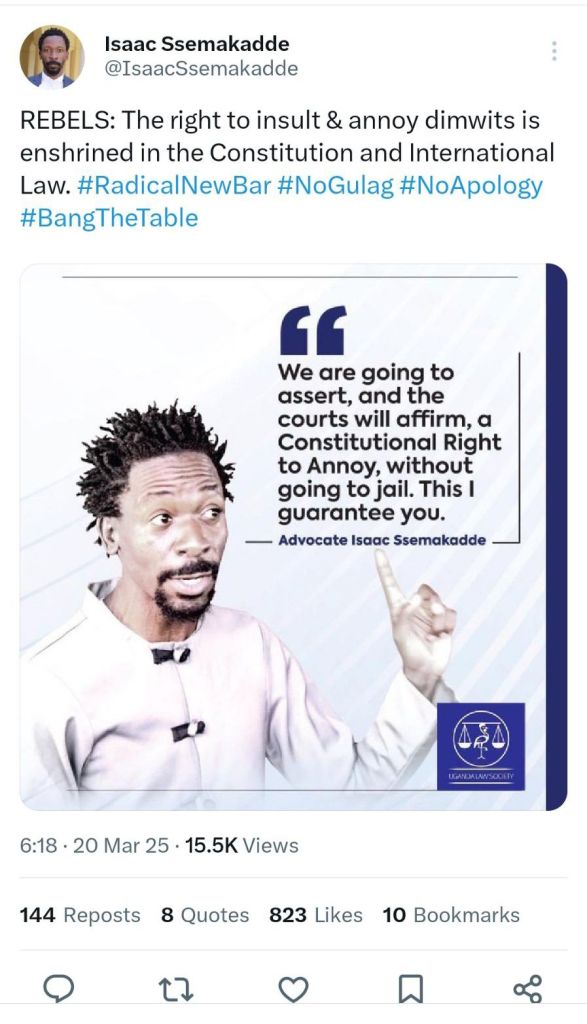
Uganda’s judiciary just went full-on nuclear—and there’s no holding back. On New Law Year day, the very system that’s supposed to be the bastion of justice turned into a circus. The ULS President got stonewalled, the Chief Justice practically demanded an apology, and then came the blow—Justice Ssekana slammed down a two-year sentence on Ssemakadde for contempt of court. It wasn’t just a ruling; it was a middle finger to anyone who dared question the establishment.
And if that wasn’t enough, the entire scandal is being dragged into the international arena. The Judiciary, in a move that can only be described as a self-inflicted public relations massacre, has tried to weaponize an Interpol Red Notice for an offense as laughably flimsy and culturally controversial as “insulting the modesty of a woman.” Yes, you read that right. While Interpol is busy chasing down genuine threats, war Lords, Drug cartels, Uganda’s courts are out here acting like they’re in a personal vendetta—pursuing a man for throwing sharp words at the system.
The madness deepens: the whole legal shambles that produced the warrant is under revision in the High Court, completely unattended, like a sinking ship left to rot. And guess what? Ssemakadde isn’t going down without a fight. He’s vowed, through his legal team, to challenge any Red Notice that dares to be issued against him—an audacious promise that practically screams “bring it on!”
Meanwhile, the Executive and Parliament, both seasoned in navigating international diplomacy, stand in stark contrast to the Judiciary’s response. Having faced sanctions, blacklisting, and travel bans in the past, they are well-versed in managing the complex web of international scrutiny, asset freezes, and the like. Who doesn’t recall the free Bobi Wine protests that rocked global capitals. Who doesn’t recall a foreign affairs minister who was on global travel sanctions. Have we very quickly forgotten the backlash from Western states when the Uganda’s Anti-Homosexuality Act was passed into Law and upheld by the Constitutional Court. Experts and negotiators from the Ministry of Foreign Affairs burnt the midnight oil and the Ugandan state is still here to stay. The Judiciary, however, is primarily trained in upholding decorum, judicial conduct, and domestic legal frameworks. It is ill-equipped to handle the nuances of foreign policy, international relations, and diplomacy. So, the real question is: if the international community begins to ask hard-hitting questions about accountability and the rule of law—questions that go beyond the courtroom—will the Attorney General and the Ministry of Foreign Affairs step in to shield the Judiciary from the fallout? Or will they be left to fend for themselves, with their lack of expertise in international relations becoming glaringly apparent?
Yes, development partners like the European Union, funders of the SUPREME project, Pepperdine University behind the plea bargain project, IDLO, Amnesty International, the Democratic Governance Facility (who knows they may come back) will have key questions about transparency, accountability and Rule of Law, directly addressed to our third estate about where their Millions of Aid is going. They will not be amused if they think their resources are being deployed to fight what appears to be petty fights.
And what more, individual partner states with a long tradition of democracy may refuse to hand over President Ssemakade on grounds that the Red Notice is politically motivated and targeting free speech and dissent. Dramatically enough, interpol itself may refuse to put out the Red Notice, why? It goes against the Interpol Constitution. The offense leading up to the warrant isn’t listed as one of those for which a Red Notice can be put out and enforced.
This isn’t your everyday legal drama; it’s a blood-soaked, high-stakes showdown where the very soul of Uganda’s justice system is on trial. Ssemakadde, with the cunning of a renegade professor from Money Heist, baited the Judiciary into a carefully crafted trap. Just like the Professor orchestrated the heists with meticulous precision, Ssemakadde pulled off a legal masterstroke, using the Judiciary’s own flaws against it. His provocation wasn’t a reckless act of defiance; it was a radical surgery planned to expose the raw, festering wounds of Uganda’s ailing legal system. The Judiciary walked straight into his trap, and now the courts stand naked and vulnerable on the global stage.
So here we are, witnessing a system that once prided itself on upholding justice now doing a complete 180 into chaos. The Judiciary has thrown down the gauntlet, and if the international community decides to respond, it won’t be a pretty sight. The madness is palpable, the stakes are astronomical, and the fallout could reshape Uganda’s legal landscape forever.
At this point, there’s only one entity that can pull Uganda’s judiciary back from the brink of absolute disaster: the relevant High Court Judge. The request for a Red Notice is a ticking time bomb, and if it’s not halted right here, within the Judiciary itself, the fallout will be catastrophic. The international community is already watching, and Uganda’s fragile legal system is on the verge of being exposed in the harshest possible light. This isn’t just about one man; this is about the future of Uganda’s justice system and its credibility on the world stage.
But amid the chaos, there’s still hope. There are still clean judges, magistrates, and lawyers who believe in the integrity of the law and the values of justice. This system is not beyond redemption, but it’s going to take those who truly care about upholding the rule of law to stand up, speak out, and fight for a better, fairer future. This moment—this unprecedented crisis—can be the turning point for Uganda’s legal system if the right people step forward.
The Judiciary stands at a crossroads. If swift, decisive action isn’t taken now, Uganda’s courts will find themselves at the heart of a global scandal—a bloodbath of embarrassment from which there may be no recovery. This is the moment of truth. The question is: will the Judiciary rise to the occasion, or will it collapse under the weight of its own mistakes?
The clock is ticking, and the time for action is now. The relevant High Court Judge holds the key—let them make the right call before it’s too late.
DISCLAIMER: This Blog is not made to attack the institution of the Judiciary but to spark conversations and discourse on vital reforms.
More about the author on the about page for feedback and comments.
 enenlegalworld
Leave a reply to OF CHAINS AND ROBES: When the Judiciary Surrendered Its Soul at the Altar of Power – enenlegalworld Cancel reply