Tag: Accountability

  • When the Constitution Loses Its Teeth: A Lament After Faruku

    When the Constitution Loses Its Teeth: A Lament After Faruku

    Imagine your son leaves home to go to the farm.

    He never returns.

    Days become weeks.

    Weeks become months.

    You move from police station to police station looking for him.

    Nobody tells you where he is.

    Nobody tells you what he has done.

    Nobody tells you when he will come home.

    Then one morning, somebody calls.

    “He is being produced in court.”

    You rush there.

    He arrives limping.

    His mother begins to cry.

    Even before he speaks, everybody in court can see that something happened.

    The State says he is a criminal.

    He says he was tortured.

    The Court agrees that his rights were violated.

    But the trial continues anyway.

    That is why the Constitutional Court’s decision in Faruku Muhamed and 2 others v Attorney General matters. A copy of the judgment can be accessed here

    Many Ugandans will never read the judgment.

    Many will never understand the legal arguments.

    But every Ugandan should understand what is at stake.

    Because this case is not really about criminals.

    It is about power.

    For nearly twenty years , in cases like those of Uganda Law Society and the famous Kayunga riots Uganda’s courts had been slowly teaching the State a simple lesson:

    There are some lines you do not cross.

    Some rights are so important that violating them comes at a heavy price.

    That principle was not created to protect criminals.

    It was created to protect citizens.

    It was created because Uganda knows what happens when people in power stop fearing the Constitution.

    Our Constitution was not written in paradise.

    It was written after years of arbitrary arrests.

    Years of torture.

    Years of disappearances.

    Years of constitutional crises.

    Years in which the ordinary citizen stood almost naked before the power of the State.

    The framers understood something simple.

    A government should never be allowed to break the law in order to enforce the law.

    That is why some rights were declared non-derogable.

    Untouchable.

    Non-negotiable.

    Beyond convenience.

    Beyond politics.

    Beyond excuses.

    The Faruku decision changes that conversation.

    The Court has not legalized torture.

    The Court has not abolished constitutional rights.

    The Court has done something more subtle.

    It has reduced the cost of violating them.

    And history teaches us that constitutional decline rarely begins when rights are abolished.

    It begins when violating them becomes cheaper.

    Supporters of the decision ask a fair question.

    Should a murderer walk free because he was tortured?

    Should a terrorist escape punishment because his rights were violated?

    Those questions sound persuasive.

    Until we ask another.

    If the State already had enough evidence to convict, why was torture necessary in the first place?

    Why break the ribs?

    Why remove the fingernails?

    Why apply electric wires?

    Why violate the Constitution at all?

    That is the question Uganda should be asking.

    Instead, we are being encouraged to focus on what happens after the violation.

    Sue for damages.

    File another case.

    Seek compensation.

    But every Ugandan knows the reality.

    The person who emerges from years of detention, trial, imprisonment, poverty and trauma rarely possesses the energy, resources or influence required to start another legal battle.

    The remedy exists on paper.

    Life exists in reality.

    And those two things are not always the same.

    Perhaps the most frightening symbol of this reality is a single word.

    “Drones.”

    There was a time when a drone was something that flew in the sky.

    Today, many Ugandans hear that word and think of something else entirely.

    Think about how abnormal that is.

    Think about how much had to happen before an entire country accepted that vocabulary.

    Think about how many stories are hidden inside that single word.

    The abnormal has become normal.

    The shocking has become routine.

    The unacceptable has become familiar.

    And when that happens, constitutional erosion is already underway.

    Some people will say these concerns are exaggerated.

    They will say rights still exist.

    They will say courts remain independent.

    Perhaps.

    But constitutional history is filled with societies that discovered too late that rights on paper are not the same thing as rights in practice.

    A Constitution is not tested when it protects the popular.

    It is tested when it protects the unpopular.

    It is not tested when it restrains the weak.

    It is tested when it restrains the powerful.

    The true measure of constitutionalism is not how the State treats those it likes.

    It is how the State treats those it fears, suspects, opposes or despises.

    That is why this moment matters.

    Not because a criminal might benefit.

    But because power always expands into spaces where consequences disappear.

    Today it may be a suspected criminal.

    Tomorrow it may be a journalist.

    The next day it may be a businessman.

    The day after that it may be an opposition supporter.

    One day it may be your son.

    Or your daughter.

    Or you.

    The Supreme Court may yet reverse this decision.

    History may yet correct it.

    But the real answer will not be found in law reports.

    It will be found in what follows.

    If State agencies become more respectful of constitutional rights, perhaps the Court’s faith in alternative remedies will be vindicated.

    If they do not, future generations may look back upon Faruku as the moment Uganda’s Constitution was not destroyed—

    but the moment it was asked to stand aside while power carried on with business as usual.

    Our Constitution was meant to be a fence around the citizen.

    A fence is only as strong as the dog that guards it.

    If the dog can no longer bite, only the thief has reason to celebrate.

    That is why some of us are mourning today.

    Not because the Constitution is dead.

    But because it has been asked to whisper where once it could roar.

    DISCLAIMER:

    The contents of this Blog are not intended to be used as a substitute for legal advice. The author shall not accept liability for use of the contents of this Blog as legal advice. Readers are encuraged to consult qualified advocates for real life situations for legal advice.

    JOIN THE UNDERGROUND AND FUEL THE MOVEMENT

    We have created a dedicated fans WhatsApp Channel. Don’t miss the latest updates, get early bird access to our latest blog posts and more, so much more. Click the following link to follow the Channel: https://whatsapp.com/channel/0029Vb9BQqw5a246bWVsLl3j

    Independent institutional critique and advocacy for a radical overhaul of legal culture require time, deep research, and uncompromised independence. If these narratives bring value to your legal journey or challenge your perspective, please visit our HOME PAGE to see how you can support this platform directly and keep the critique fierce and relentless.

    Enen Ambrose. Advocate

    Member, Judiciary Affairs Committee,

    Uganda Law Society

    & Founder–Enen Legal World

  • Chronicles of His Worship Mulyanyama — Episode 3

    Chronicles of His Worship Mulyanyama — Episode 3

    When “Just Cause” Entered the Registry


    Author’s Note: The Chronicles of His Worship Mulyanyama is a serialized literary commentary designed to constructively critique the institutional and structural implications of the Magistrates Courts (Amendment) Act, No. 6 of 2026. This work is a creative exploration of the human infrastructure behind public service and is not intended to ridicule, embarrass, or undermine the integrity of the Judiciary.

    The brown envelope had not lied.

    TRANSFER OF FILES – FOR JUST CAUSE.
    No explanation. No appeal. Just a signature from the Chief Magistrate and a list of file numbers.

    Among them: File No. 43. The twins fighting over cassava. Imat Nekolina’s envelope. Ocen Okello’s breach of contract case for the supply of beans to Kec Primary School.

    All of them, transferred. To whom? For what reason? The envelope did not say.

    Mulyanyama set the letter down. He did not call the Chief Magistrate. He simply stared at his phone.


    Counsel Ogwang Adede woke before sunrise.

    He had spent 200,000 shillings on fuel the previous evening – a calculated investment. Today, he would drive from Lira to Omwonyo‑le for Ocen Okello’s case. Four years of beans. Four years of adjournments. Today, he would close the defence under Order 17 Rule 4.

    He checked his phone.

    A message from the headmaster: “Fees balance remains. Your son cannot sit exams.”

    He silenced it. First, court. Then fees.


    Then he opened the Lira High Court WhatsApp group.

    NOTICE: The Honourable Judge will not sit this week. He has been deployed to Omwonyo‑le for a donor‑funded SGBV session. All matters stand adjourned.

    He refreshed. The Omwonyo‑le Magistrates Court group had a new notice:

    NOTICE: His Worship Mulyanyama has been designated Registrar for the forthcoming SGBV session. Additionally, a donor‑funded plea bargaining session will run for two weeks. No judicial officer will be at Omwonyo‑le during this period.

    He scrolled further.

    UPDATE: All other magistrates and the Registrar have travelled for a Judiciary conference. Only those excused for donor conditionalities remain in session.

    Counsel Ogwang Adede stared at the screen.

    In Lira – no Judge.
    In Omwonyo‑le – no Mulyanyama.
    No Magistrate. No Registrar. No court.
    Two weeks.

    He had spent 200,000 shillings on fuel. But that was not the worst of it.

    That morning, he had been expecting a deposit of 30,000,000 shillings in taxed costs from a judgment debtor – Okullo Aram. The matter was coming up for Notice to Show Cause before the Registrar of the High Court in Lira. Okullo had called last evening, panicking, begging not to be thrown into civil prison. He was prepared to deposit the money in front of the Registrar.

    Then Okullo sent a message: a photo of a notice from the Registrar’s chambers. The Registrar had travelled to Kampala overnight – for a donor‑funded workshop on case management.

    After sending the notice, Okullo’s phone went silent.

    Counsel Ogwang Adede called back. Twice. Three times. Nothing.

    Later, he learned that Okullo Aram had five children in university and three in secondary school. The money that was meant for taxed costs had been redirected – to tuition fees, to accommodation, to books.

    The debtor had not fled. He had simply reprioritised. And the law could not touch him – because the Registrar was not there to hear the Notice to Show Cause.

    His clerk’s salary would wait.
    His legal assistant’s salary would wait.
    The headmaster’s message about his son’s exams would not wait.


    Then his firm WhatsApp group buzzed.

    A calling letter. From His Worship Munyakuzi, Chief Magistrate of Oneka Iden – the Chief Magisterial area under which Omwonyo‑le fell.

    TRANSFER OF FILE – FOR JUST CAUSE.
    On the court’s own motion, Ocen Okello’s case is transferred to my court for hearing.

    No application from any party. No consent. No explanation.
    Just just cause.

    Counsel read it twice. His hands did not shake. They had done this before.


    Mulyanyama had also seen the letter.

    He picked up his phone and called Munyakuzi.

    “Sir, with respect… those are live matters. Judicial independence –”

    A pause. Then Munyakuzi laughed.

    “Worship, did you not read Section 217A of the amendment? I have powers to transfer those files to my Court.”

    The line went dead.

    Mulyanyama stared at his phone. The ground at Omwonyo‑le had swallowed an axe. Now the law was swallowing itself.


    Ocen Okello did not learn about the transfer from a noticeboard.

    He learned it from Alyek Molly.

    He had not even reached the bank. His Boxer motorcycle was still coughing dust somewhere between Abako and Oneka Iden when his phone vibrated.

    He smiled when he saw the name. Alyek Molly – Registry. He answered immediately.

    “My daughter… how is today?”

    For a second, Alyek said nothing. Then her voice came – soft, tired, almost apologetic.

    “Mzee… don’t come to court.”

    Silence.

    “I have already told your lawyer.”

    Ocen slowed the motorcycle. “What now?”

    Alyek looked through the registry window before answering. “His Worship has two critical assignments.” She lowered her voice. “He has been designated Registrar for the SGBV session… and after that… another plea bargain project. Two hundred files. Fifteen days.”

    Ocen said nothing.

    Alyek swallowed. “Mzee… save your fuel.”

    The line went dead.


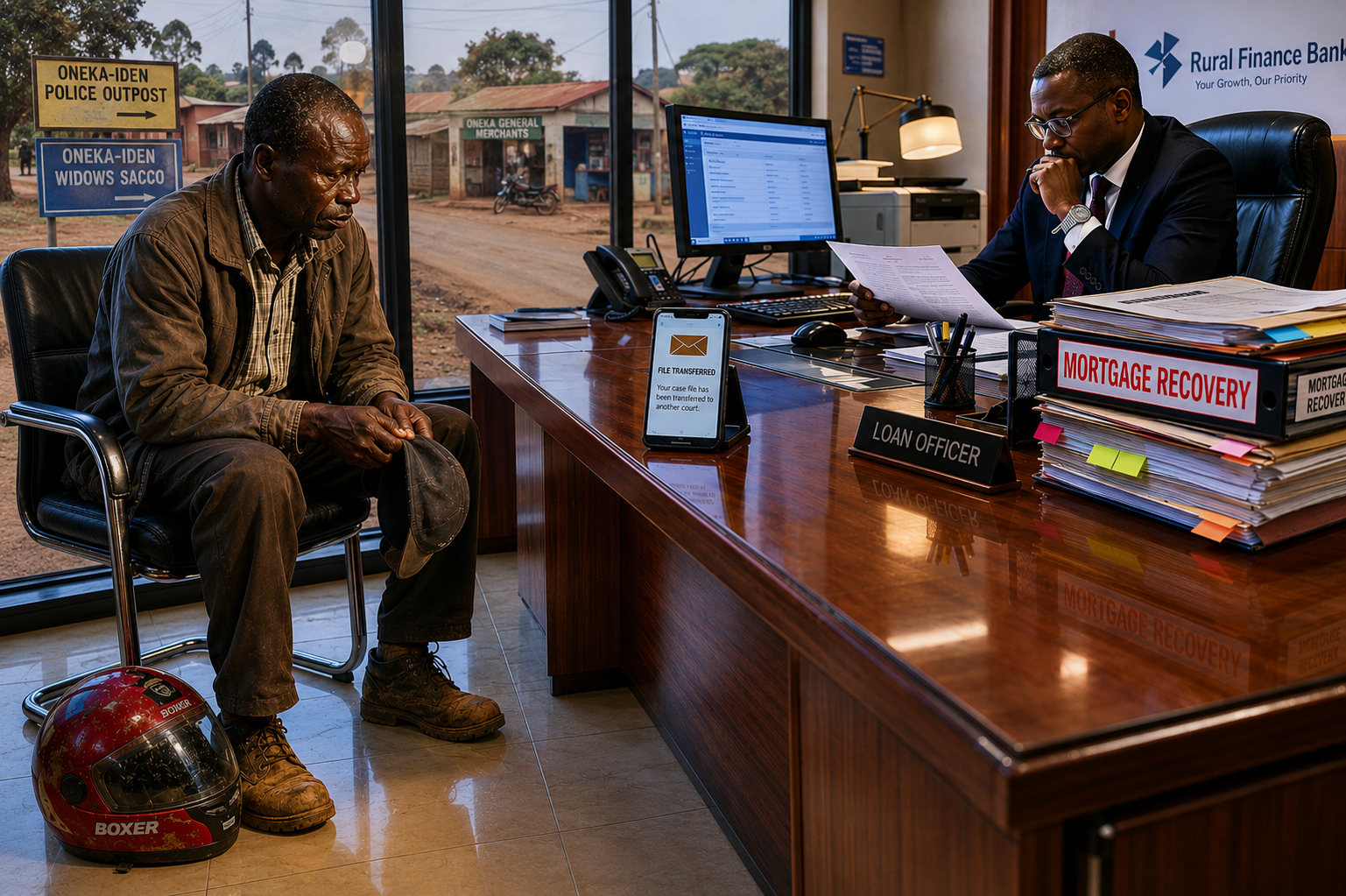
    Forty minutes later, Ocen Okello sat inside the office of the loan officer.

    Tie. Ledger. Calculator. No smile.

    The file marked MORTGAGE RECOVERY – FINAL NOTICE lay open on the desk.

    Ocen removed his cap. Held it in both hands. And began pleading.

    “Sir… please do not sell my house.”

    He swallowed. “The case is very near judgment, I promise.”

    The loan officer said nothing. So Ocen continued.

    “My lawyer says… no more than one month.”

    He pointed weakly toward Omwonyo‑le. “The court has some delays… delays I do not fully understand… delays I cannot even explain properly…”

    Just then – his phone vibrated again.

    This time, Counsel Ogwang Adede.

    He opened the message.

    Brown envelope. Three words.

    TRANSFERRED FOR JUST CAUSE.

    Ocen read it once. Read it twice. Then slowly looked back at the loan officer… and for the first time in four years… did not know which debt was more dangerous – the one inside the bank, or the one inside the court.


    By lunchtime, Omwonyo‑le was already whispering.

    The new Chairperson of the School Management Committee of Kec Primary School – the same school that had eaten Ocen Okello’s beans – was an old boy of Chief Magistrate Munyakuzi.

    In Omwonyo‑le, rumours travelled faster than judgments.
    And this rumour had teeth.

    “He is willing to vouch for his old buddy,” Alyek Molly heard from a clerk in Oneka Iden. “To save the school from an old crippling debt.”

    Alyek said nothing. She was still calculating her mother’s medication. Friday’s tuition. The per diem that would now not come.


    That evening, Mulyanyama sat in his rented room above the pharmacy in Oneka Iden.

    The brown envelope still lay on the table.
    Open. Unfolded. Unanswered.

    The names stared back at him.
    Imat Nekolina. Ocen Okello.
    Four years. Red ribbons. Borrowed fuel. Dead witnesses.
    Transferred. For just cause.

    His phone vibrated.
    Counsel Ogwang Adede.

    Mulyanyama stared at the screen for two rings. Then answered.

    No greetings. Just breathing.

    Then Counsel spoke.

    “Worship… what is going on?”

    Silence.

    “What happened?”

    Another silence. Then the question that hit harder than any objection ever raised in court:

    “Who complained?”

    Mulyanyama looked again at the brown envelope. Then at the ceiling. Then finally spoke. Quietly. Almost apologetically.

    “Counsel… I honestly have no idea.”

    A pause. Then –

    “Just orders from above.”

    Neither man spoke again. For a few seconds, all that remained between lawyer and magistrate was breathing.

    Then the line went dead.

    And for the first time since the amendment, His Worship Mulyanyama realised something far more dangerous than corruption:

    Sometimes a file is not stolen. Sometimes… it is simply called upward.


    Before you blame a magistrate for “delayed justice”… ask two questions:

    Who funded the last special session in your court? And how many times has a file been transferred – without your consent – “for just cause”?

    The system is not broken.
    The system is fully booked.

    Enen Ambrose

    Advocate

    Member: Judiciary Affairs Committee

    Uganda Law Society,

    For feedback or comments: enen@enenlegalworld.com

    If you missed the start of this journey, you can catch up on the systemic breakdown of the Magistrates Courts in Chronicles of His Worship Mulyanyama — Episode 2

    Legal Disclaimer Fiction & Non-Defamation Notice:

    This post is a pure work of fiction and creative literature. The characters, dialogue, specific incidents, and settings—including the character of His Worship Mulyanyama and the location of Omwonyo-le Magistrates Court—are products of the author’s imagination or are used fictitiously. Any resemblance or exact matches to actual persons, living or dead, real-life judicial officers, or specific ongoing cases is entirely coincidental. This text is created solely for the purpose of systemic legislative critique and systemic advocacy; it is not maliciously constructed, nor should it be interpreted as an attempt to defame, misrepresent, or malign any living individual or public office holder.

    The legal references in this Series is for information purposes only and is not intended to be used as a substitute for legal advice. The author does not assume responsibility or admit liability arising from the use of the contents of this blog as legal advice.

    The author strongly encourages readers to consult a licensed attorney for specific context related legal advice.

    FUEL THE MOVEMENT

    Independent institutional critique and advocacy for a radical overhaul of legal culture require time, deep research, and uncompromised independence. If these narratives bring value to your legal journey or challenge your perspective, please visit our HOME PAGE to see how you can support this platform directly and keep the critique fierce and relentless.

    Enen Ambrose. Advocate & Founder–Enen Legal World


  • THE QUIET VIOLENCE OF PROCEDURE III: When the System Sleeps, Justice Goes to Luzira. Reflections on ECCMIS, Offline Caching, and the Agony of an Unprepared Court

    THE QUIET VIOLENCE OF PROCEDURE III: When the System Sleeps, Justice Goes to Luzira. Reflections on ECCMIS, Offline Caching, and the Agony of an Unprepared Court

    Enen Legal World Logo.


    I. Gethsemane, 33 AD

    There is a moment in the Gospel of Mark that haunts every leader, every judge, every system builder.

    Jesus goes to the Garden of Gethsemane to pray. He takes Peter, James, and John. He is sorrowful, troubled, facing the cross. He asks them to stay awake, to watch with him.

    Then he walks away, prays, returns – and finds them sleeping.

    “Simon, are you asleep? Could you not keep watch for one hour?” (Mark 14:37)

    He warns them: “Watch and pray, so that you will not fall into temptation. The spirit is willing, but the flesh is weak.” (Matthew 26:41)

    They sleep again. Then the mob arrives. Jesus is arrested. And the disciples flee. Peter denies him three times out of fear.

    The consequence of sleeping? Failure at the moment of testing.

    II. Gethsemane, Buganda Road Court, 2026

    On 21 May 2026, an advocate appeared before a Magistrate at Buganda Road Chief Magistrate’s Court. His client had been charged with obtaining 600 million shillings by false pretence. The Advocate had uploaded bail application documents onto ECCMIS – the Judiciary’s flagship electronic case management system.

    The Advocate asked to be heard on bail.

    The Magistrate tried to access the uploaded documents.

    The network failed.

    ECCMIS would not display the files. The magistrate could not see the bail application. And instead of invoking the fallback provisions of the law – instead of assisting the advocate under Rule 9(4) and Rule 24(5) of the Judicature (Electronic Filing) Rules, 2025 – the Magistrate declined to hear the application.

    The Advocate was remanded to Luzira Prison until 4 June 2026.

    The system slept. And justice went to Luzira.

    Image: Buganda Road Court. Photo Credit, Nile Post, a member of the Next Media Company.


    III. The Spirit Is Willing – But the Flesh Is Weak

    The Judicature (Electronic Filing, Service and Virtual Proceedings) Rules, 2025 (S.I. No. 21 of 2025) are, on paper, remarkably progressive.

    Rule 24(5) of the Rules provide thus:

    The court may, in its discretion, adjust the schedule for responding to any affected filings, postpone the next court event, or provide other relief. It is my view that “others relief” includes a fall back position to actually hear the bail application manually, the network failure notwithstanding.

    The spirit of these Rules is willing. No judiciary transitions from paper to digital systems without friction, uncertainty, or implementation failures – and Uganda is no exception.

    But the flesh – the actual ECCMIS software and the training (or lack thereof) of judicial officers – is weak.

    The magistrate did not invoke Rule 24(5) Did not provide other relief i.e. a fall back position to actually hear the bail application, Why?

    Two possibilities – and both point away from individual malice and toward systemic failure.

    IV. Why Did the Court Sleep? Two Systemic Failures

    First: No offline caching in ECCMIS.

    If ECCMIS had an automatic local cache, the Magistrate’s computer would have downloaded all documents for that day’s matters the night before – or upon morning boot, or periodically. Even if the live network failed, the cached documents would remain accessible. The bail application would have been visible. The hearing could have proceeded.

    But ECCMIS, as currently deployed, appears to depend heavily on live connectivity. When the network fails, the court becomes blind. That is not a user error. That is an architecture flaw – though I write as an external observer, not as someone with access to internal design documents.

    What is needed: A software update that configures ECCMIS to:

    · Pre‑cache all case files for matters listed on a given day.
    · Update the cache every morning or whenever internet is available.
    · Allow offline access with a clear timestamp (“cached as of [time]”).
    · Sync back to the central system once connectivity is restored.

    This is not rocket science. Email clients do it. Mobile banking apps do it. Google Drive, One Drive and other online file back-up systems do it. Even WhatsApp caches messages offline. The Judiciary’s ECCMIS can do it – if the builders prioritise resilience over assumption of constant connectivity.

    Second: Inadequate training of judicial officers.

    Rule 60 of the 2025 Rules commands:

    The court shall, in collaboration with stakeholders, periodically undertake training for court users, judicial officers, unrepresented litigants and the public on use of ECCMIS.

    Where is that training? If Magistrates do not know they can assist under Rule 9(4), if they do not know they can order a paper fallback – then the Rules are dead letters. The fault is not primarily the Magistrate’s. The fault is the system that failed to prepare her.

    The Magistrate in Buganda Road was not malicious. She was unprepared. She was left alone with a broken network and no institutional backup. And like Peter in Gethsemane, she found herself in a situation where the institution had not equipped her to watch – the failure was systemic, not merely personal.

    V. The Blame Must Shift

    Public anger after the Buganda Road incident has, predictably, focused on the Magistrate. Some have called her incompetent. Others have suggested bias.

    I disagree.

    The Magistrate is the front‑line foot soldier of a digital transformation that was rolled out without full readiness. She was given a system that struggles offline, and no training on what to do when it fails. She was handed a beautiful set of Rules (S.I. 2025 No. 21) but not the practical tools to implement them.

    The real responsibility lies with:

    · The architects of ECCMIS – who designed a system that assumes perpetual internet connectivity in a country where power and data are unreliable.
    · The Judiciary’s leadership – who rolled out the paperless mandate without ensuring that every Magistrate understands Rules 9 and 24, and without installing basic offline caching.
    · The training units – who have not conducted the mandatory training required by Rule 60.

    Yes, the Magistrate could have done more. She could have read the Rules. She could have asked for an adjournment. She could have called the registry. But when a system fails, we do not blame the soldier alone. We also examine the armour and the General who deployed him and gave the orders.

    VI. A Concrete Way Forward

    The solution is not to abandon ECCMIS. It is to fix it.

    1. Technical fix: offline caching.
    The Judiciary’s ICT team must implement automatic local caching on all court computers. This is a one‑time software upgrade that pays for itself within weeks by eliminating network‑related adjournments.

    2. Training fix: mandatory, periodic, verifiable.
    Every judicial officer and court clerk must undergo hands‑on training on:

    · How to use offline mode.
    · How to invoke Rule 9(4) to assist litigants.
    · How to grant relief under Rule 24(5).
    · How to handle network failures without remanding people, especially when the question of Bail, which touches on the liberty and presumption of innocence of an accused person comes up for consideration.

    3. Accountability fix: a practice direction.
    The Chief Justice should issue a practice direction reminding all courts of their obligations under Rules 9 and 24, and requiring that any refusal to hear a matter due to ECCMIS failure be accompanied by a written explanation of why Rules 9(4) and 24(5) for fall back positions could not be followed.

    VII. Gethsemane, 2026 and Beyond

    Jesus did not condemn the disciples for sleeping. He warned them. He told them to watch and pray – because the flesh is weak.

    The flesh of ECCMIS is weak. The network fails. The cache is absent. The training is insufficient. But the spirit of the Rules is willing.

    The question is whether the Judiciary will watch – or continue to sleep.

    Because every time a Magistrate refuses to assist a litigant when ECCMIS fails, every time an Advocate or his client is remanded because the network is down, every time justice is delayed or denied not by malice but by unpreparedness – that is not a technical glitch.

    That is the agony of an unprepared court.

    And the consequence is always the same: those who came seeking justice flee. Their rights are denied. Their liberty is lost. And the system that was meant to protect them becomes the very instrument of their suffering.

    “Could you not keep watch for one hour?”

    The hour is now. The network will fail again. The question is not if – but when, and how the court responds.

    Will we equip our Magistrates (and in fact all judicial officers) to stay awake? Or will we keep sending accused persons to Luzira because the cache was empty and the training never came?

    The spirit is willing. Let us finally strengthen the flesh.

    DISCLAIMERS:
    This blog is not an attack on the Magistrate who handled the Buganda Road matter. Magistrates work under enormous pressure with limited resources. The critique here is directed at systemic failures: the architecture of ECCMIS, the inadequacy of training, and the absence of offline preparedness. Fair commentary is not personal attack.

    This blog is not legal advice. Readers should consult qualified attorneys for case‑specific guidance.

    Enen Ambrose
    Member, Judiciary Affairs Committee, Uganda Law Society
    For comments or feedback: enen@enenlegalworld.com

  • Of Gold, Dairy, and Slow Poison: Elison Karuhanga and the Perils of Development Without Accountability

    Of Gold, Dairy, and Slow Poison: Elison Karuhanga and the Perils of Development Without Accountability

    Enen Legal World Logo

    There is a seductive danger in confusing development with institutional health.

    Yes, Uganda has grown sectors.
    Yes, milk production rose.
    Yes, roads were built.
    Yes, factories emerged.

    Let us even grant these achievements at their most generous interpretation, though many of the surrounding statistics and political narratives remain fiercely contested. The deeper question lies elsewhere.

    Ancient empires also built roads.

    The question is whether those roads outlasted the emperor, and in more recent history, whether the institutions managing them answered to citizens or merely to the political survival of one man.”

    That is where Elison Karuhanga’s argument becomes deeply troubling.

    Not because it defends industrialisation. Industrialisation is necessary.

    But because it quietly asks Ugandans to romanticise concentrated power itself.

    The article repeatedly frames scepticism toward entrenched political authority as elite cynicism, as though accountability were merely an inconvenience imposed by intellectual spectators standing outside history.

    Yet history teaches something far less flattering.

    Apartheid South Africa built one of the continent’s most sophisticated industrial economies. Gaddafi’s Libya produced impressive welfare indicators and modern infrastructure. Mobutu’s Zaire cultivated the imagery of national grandeur and developmental ambition.

    Yet history eventually exposed the same weakness in each case: institutions had become subordinate to personalities, patronage, or exclusionary systems of power.

    Infrastructure is not self-validating.

    The real question is never whether factories, highways, dams, or industrial parks exist. The deeper question is whether the institutions beneath those projects remain independent enough to survive the men who built them.

    Development without accountability does not eliminate instability.

    It postpones it.

    And when accountability weakens long enough, entitlement emerges. From entitlement comes impunity. And from impunity comes institutional decay.

    That is precisely the warning at the heart of Mahmood Mamdani’s 2025 book, Slow Poison: Idi Amin, Yoweri Museveni, and the Making of the Ugandan State. Mamdani’s argument is not that Uganda failed because it lacked projects or economic ambition. It is that the post-independence dream was gradually dismantled through tribalised politics, institutional corrosion, political violence, and the fragmentation of citizenship itself.

    A country may increase exports while weakening citizenship.

    That is not transformation.

    That is deferred fragility.

    And perhaps nowhere is this contradiction more revealing than within the intellectual class now defending presidential mythology in the name of developmental realism.

    Many of us were repeatedly lectured about the supposed “neutrality” of the Uganda Law Society whenever lawyers confronted excesses of state power. We were told institutions must remain above politics.

    Yet neutrality now appears remarkably flexible when the task is constructing emotional narratives around presidential permanence and historical indispensability.

    One begins to suspect that neutrality was never truly about insulating institutions from politics, but about regulating the direction in which criticism could travel.

    That selective application is itself part of the institutional decay being ignored.

    When institutions of accountability suspend their scepticism in order to celebrate power, they accelerate the very “slow poison” they should be resisting.

    And this is why the romantic language of “stubborn men who shape history” should concern us more than inspire us.

    History is full of stubborn men.

    Some built nations.

    Others merely built systems too personalised to survive them.

    Uganda’s tragedy has never been a shortage of ambitious rulers.

    It has been the absence of institutions strong enough to survive them, and disciplined enough to tell them no.

    And if we are to have the rule of law rather than the rule of men with a gun, a Bible, and a pen, then a few stubborn men and women must demand that development be built on accountability, not just the romanticisation of power.

    The roots of accountability are bitter, but the fruits are sweet.

    This, fellow countrymen and women, is my contribution to that cause.

    Enen Ambrose.

    Advocate. 

    For feedback or comments: enen@enenlegalworld.com