Tag: Fair hearing

  • When the Constitution Loses Its Teeth: A Lament After Faruku

    When the Constitution Loses Its Teeth: A Lament After Faruku

    Imagine your son leaves home to go to the farm.

    He never returns.

    Days become weeks.

    Weeks become months.

    You move from police station to police station looking for him.

    Nobody tells you where he is.

    Nobody tells you what he has done.

    Nobody tells you when he will come home.

    Then one morning, somebody calls.

    “He is being produced in court.”

    You rush there.

    He arrives limping.

    His mother begins to cry.

    Even before he speaks, everybody in court can see that something happened.

    The State says he is a criminal.

    He says he was tortured.

    The Court agrees that his rights were violated.

    But the trial continues anyway.

    That is why the Constitutional Court’s decision in Faruku Muhamed and 2 others v Attorney General matters. A copy of the judgment can be accessed here

    Many Ugandans will never read the judgment.

    Many will never understand the legal arguments.

    But every Ugandan should understand what is at stake.

    Because this case is not really about criminals.

    It is about power.

    For nearly twenty years , in cases like those of Uganda Law Society and the famous Kayunga riots Uganda’s courts had been slowly teaching the State a simple lesson:

    There are some lines you do not cross.

    Some rights are so important that violating them comes at a heavy price.

    That principle was not created to protect criminals.

    It was created to protect citizens.

    It was created because Uganda knows what happens when people in power stop fearing the Constitution.

    Our Constitution was not written in paradise.

    It was written after years of arbitrary arrests.

    Years of torture.

    Years of disappearances.

    Years of constitutional crises.

    Years in which the ordinary citizen stood almost naked before the power of the State.

    The framers understood something simple.

    A government should never be allowed to break the law in order to enforce the law.

    That is why some rights were declared non-derogable.

    Untouchable.

    Non-negotiable.

    Beyond convenience.

    Beyond politics.

    Beyond excuses.

    The Faruku decision changes that conversation.

    The Court has not legalized torture.

    The Court has not abolished constitutional rights.

    The Court has done something more subtle.

    It has reduced the cost of violating them.

    And history teaches us that constitutional decline rarely begins when rights are abolished.

    It begins when violating them becomes cheaper.

    Supporters of the decision ask a fair question.

    Should a murderer walk free because he was tortured?

    Should a terrorist escape punishment because his rights were violated?

    Those questions sound persuasive.

    Until we ask another.

    If the State already had enough evidence to convict, why was torture necessary in the first place?

    Why break the ribs?

    Why remove the fingernails?

    Why apply electric wires?

    Why violate the Constitution at all?

    That is the question Uganda should be asking.

    Instead, we are being encouraged to focus on what happens after the violation.

    Sue for damages.

    File another case.

    Seek compensation.

    But every Ugandan knows the reality.

    The person who emerges from years of detention, trial, imprisonment, poverty and trauma rarely possesses the energy, resources or influence required to start another legal battle.

    The remedy exists on paper.

    Life exists in reality.

    And those two things are not always the same.

    Perhaps the most frightening symbol of this reality is a single word.

    “Drones.”

    There was a time when a drone was something that flew in the sky.

    Today, many Ugandans hear that word and think of something else entirely.

    Think about how abnormal that is.

    Think about how much had to happen before an entire country accepted that vocabulary.

    Think about how many stories are hidden inside that single word.

    The abnormal has become normal.

    The shocking has become routine.

    The unacceptable has become familiar.

    And when that happens, constitutional erosion is already underway.

    Some people will say these concerns are exaggerated.

    They will say rights still exist.

    They will say courts remain independent.

    Perhaps.

    But constitutional history is filled with societies that discovered too late that rights on paper are not the same thing as rights in practice.

    A Constitution is not tested when it protects the popular.

    It is tested when it protects the unpopular.

    It is not tested when it restrains the weak.

    It is tested when it restrains the powerful.

    The true measure of constitutionalism is not how the State treats those it likes.

    It is how the State treats those it fears, suspects, opposes or despises.

    That is why this moment matters.

    Not because a criminal might benefit.

    But because power always expands into spaces where consequences disappear.

    Today it may be a suspected criminal.

    Tomorrow it may be a journalist.

    The next day it may be a businessman.

    The day after that it may be an opposition supporter.

    One day it may be your son.

    Or your daughter.

    Or you.

    The Supreme Court may yet reverse this decision.

    History may yet correct it.

    But the real answer will not be found in law reports.

    It will be found in what follows.

    If State agencies become more respectful of constitutional rights, perhaps the Court’s faith in alternative remedies will be vindicated.

    If they do not, future generations may look back upon Faruku as the moment Uganda’s Constitution was not destroyed—

    but the moment it was asked to stand aside while power carried on with business as usual.

    Our Constitution was meant to be a fence around the citizen.

    A fence is only as strong as the dog that guards it.

    If the dog can no longer bite, only the thief has reason to celebrate.

    That is why some of us are mourning today.

    Not because the Constitution is dead.

    But because it has been asked to whisper where once it could roar.

    DISCLAIMER:

    The contents of this Blog are not intended to be used as a substitute for legal advice. The author shall not accept liability for use of the contents of this Blog as legal advice. Readers are encuraged to consult qualified advocates for real life situations for legal advice.

    JOIN THE UNDERGROUND AND FUEL THE MOVEMENT

    We have created a dedicated fans WhatsApp Channel. Don’t miss the latest updates, get early bird access to our latest blog posts and more, so much more. Click the following link to follow the Channel: https://whatsapp.com/channel/0029Vb9BQqw5a246bWVsLl3j

    Independent institutional critique and advocacy for a radical overhaul of legal culture require time, deep research, and uncompromised independence. If these narratives bring value to your legal journey or challenge your perspective, please visit our HOME PAGE to see how you can support this platform directly and keep the critique fierce and relentless.

    Enen Ambrose. Advocate

    Member, Judiciary Affairs Committee,

    Uganda Law Society

    & Founder–Enen Legal World

  • THE DIGITAL JUSTICE CROSSROADS: REFLECTIONS FROM THE ECCMIS SYMPOSIUM

    THE DIGITAL JUSTICE CROSSROADS: REFLECTIONS FROM THE ECCMIS SYMPOSIUM

    Dear Colleagues,

    A court file can disappear.

    A server can crash.

    A network cable can be cut.

    Yet justice must still move.

    That, in many ways, was the question hanging over the inaugural ECCMIS Symposium that I recently attended as a member of the Judiciary Affairs Committee of the Uganda Law Society, a technology enthusiast, and perhaps most importantly, a practising advocate who has experienced firsthand both the promise and frustrations of Uganda’s digital transition.

    This newsletter is a continuation of my earlier reflections on the necessity of technological adoption within our profession. Then, I argued that lawyers must embrace technology or risk being left behind. Today, however, I wish to discuss a different concern: how we ensure that digital transformation does not leave people behind.

    The Bar Speaks

    Our ULS leadership—President Isaac Ssemakadde, SC, and VP Anthony Asiimwe—were clear: while the Bar supports modernization, we must prioritize accountability and interoperability. As Vice President Asiimwe noted, deadlines continue to run even when the system fails, creating a dangerous procedural environment for advocates. The leadership emphasized that a digital system that cannot guarantee the safety of our filings is, for all practical purposes, a liability to the Rule of Law.

    Beyond the Headlines

    Much has already been said about ECCMIS, the Judiciary’s flagship case management system. The symposium brought together judicial officers, ICT specialists, researchers, and members of the Bar to discuss the realities of implementation. What emerged was neither a story of triumph nor failure, but one of transition.

    Mr. David Sunday Kikabi, Director of ICT at the Judiciary, clarified that the transition remains phased, operating in 49 court stations, representing roughly twenty percent of the Judiciary’s footprint. Hon. Justice Christopher Madrama reminded participants that meaningful criticism must appreciate the operational realities of implementing a national digital infrastructure. Lady Justice Immaculate Busingye offered a historical reminder that ECCMIS was born from the Bar’s outcry over missing court files and administrative inefficiencies.

    The Day Technology Sent Me Home

    Several years ago, I dispatched my legal assistant to certify specific company records for use as evidence. The process had migrated to digital URSB portals, and the traditional method was no longer available.

    Looking back, the issue was not the technology itself, but the lack of preparedness and notice. We arrived at a destination only to discover the road had been moved.

    The Walk of Shame

    This experience mirrors a reality we have lived or heard of: a lawyer travels with a client, fully prepared, to file court a client’s case, including an urgent application for an interim injunction, a high stakes life and death-last minute filing where the plan is to secure an urgent exparte interim relief, only to be guided that manual filing is nolonger being accepted, rather that everything is being filed online and worst of all, the system is itself down!. The “walk of shame” of the lawyer and his client back to chambers to figure out what to do next undermines the dignity of our profession and erodes trust.

    The Namukasa Test

    Perhaps the most profound contribution came from Lady Justice Monica Mugyenyi, who asked: Can Namukasa use it? If our justice system is technologically sophisticated but socially inaccessible, it has merely transformed the appearance of the problem, not solved it.

    What the Research Revealed

    Research presented during the symposium identified recurring concerns, including bandwidth limitations, intermittent outages, server congestion, and user-experience challenges. In some instances, courts equipped for ECCMIS have reverted to manual processes due to operational interruptions. These findings should not be viewed as evidence of failure. Rather, they remind us that digital transformation is a process of continuous refinement.

    A copy of the report can be found here:

    Building Two Bridges

    Waiting for perfection is not a strategy; building bridges is.

    1. Bridge One: Training the Profession. I am championing a volunteer-led Trainer-of-Trainers programme to bring practical ECCMIS training to regional bars. I invite the Judiciary’s ICT Directorate to collaborate in developing a standardised framework to equip advocates with the skills to navigate the digital environment confidently.
    2. Bridge Two: Interoperable Solutions. During the symposium, Riyale Tech Solutions showcased the Riyale Legal Suite, an ECCMIS-integrated practice management platform that helps law firms manage and track ECCMIS updates, court cases, hearing dates, documents, clients, billing and invoicing, court schedules, and day-to-day operations. By streamlining legal workflows and digitizing firm operations, Riyale Legal Suite supports the transition to a paperless practice and improves efficiency across the firm. Paperless courts need paperless law firms, and Riyale Legal Suite bridges the gap. Having reviewed the platform, I believe it offers practical solutions for many of the challenges currently facing firms during the transition to digital practice. If you missed symposiom, Access the Riyale Tech Presentation here. Advocates interested in exploring the platform further may contact me for demonstrations, implementation support, and licensing arrangements.

    The Road Ahead

    The future of justice will undoubtedly be digital. The question is whether it will also remain accessible.

    If Namukasa can navigate the system with confidence, if advocates can serve their clients without fear of technological paralysis, and if justice can continue moving even when a server fails, then ECCMIS will have achieved something far greater than digitisation. It will have expanded access to justice. And that is a future worth building.

    Now let me be equally clear. I hold no equity, ownership, employment, or decision-making role in Riyale Tech Solutions or any affiliated legal technology provider discussed in this article. Any professional introductions that may arise between practitioners and technology providers do not influence the opinions expressed here, which remain independently formed.

    Let us build the connections that matter.

    Enen Ambrose

    Advocate & Member, Judiciary Affairs Committee, Uganda Law Society

    Phone/WhatsApp: 0789856805 | Email: enen@enenlegalworld.com or ambrosenen@gmail.com

  • Chronicles of His Worship Mulyanyama — Episode 3

    Chronicles of His Worship Mulyanyama — Episode 3

    When “Just Cause” Entered the Registry


    Author’s Note: The Chronicles of His Worship Mulyanyama is a serialized literary commentary designed to constructively critique the institutional and structural implications of the Magistrates Courts (Amendment) Act, No. 6 of 2026. This work is a creative exploration of the human infrastructure behind public service and is not intended to ridicule, embarrass, or undermine the integrity of the Judiciary.

    The brown envelope had not lied.

    TRANSFER OF FILES – FOR JUST CAUSE.
    No explanation. No appeal. Just a signature from the Chief Magistrate and a list of file numbers.

    Among them: File No. 43. The twins fighting over cassava. Imat Nekolina’s envelope. Ocen Okello’s breach of contract case for the supply of beans to Kec Primary School.

    All of them, transferred. To whom? For what reason? The envelope did not say.

    Mulyanyama set the letter down. He did not call the Chief Magistrate. He simply stared at his phone.


    Counsel Ogwang Adede woke before sunrise.

    He had spent 200,000 shillings on fuel the previous evening – a calculated investment. Today, he would drive from Lira to Omwonyo‑le for Ocen Okello’s case. Four years of beans. Four years of adjournments. Today, he would close the defence under Order 17 Rule 4.

    He checked his phone.

    A message from the headmaster: “Fees balance remains. Your son cannot sit exams.”

    He silenced it. First, court. Then fees.


    Then he opened the Lira High Court WhatsApp group.

    NOTICE: The Honourable Judge will not sit this week. He has been deployed to Omwonyo‑le for a donor‑funded SGBV session. All matters stand adjourned.

    He refreshed. The Omwonyo‑le Magistrates Court group had a new notice:

    NOTICE: His Worship Mulyanyama has been designated Registrar for the forthcoming SGBV session. Additionally, a donor‑funded plea bargaining session will run for two weeks. No judicial officer will be at Omwonyo‑le during this period.

    He scrolled further.

    UPDATE: All other magistrates and the Registrar have travelled for a Judiciary conference. Only those excused for donor conditionalities remain in session.

    Counsel Ogwang Adede stared at the screen.

    In Lira – no Judge.
    In Omwonyo‑le – no Mulyanyama.
    No Magistrate. No Registrar. No court.
    Two weeks.

    He had spent 200,000 shillings on fuel. But that was not the worst of it.

    That morning, he had been expecting a deposit of 30,000,000 shillings in taxed costs from a judgment debtor – Okullo Aram. The matter was coming up for Notice to Show Cause before the Registrar of the High Court in Lira. Okullo had called last evening, panicking, begging not to be thrown into civil prison. He was prepared to deposit the money in front of the Registrar.

    Then Okullo sent a message: a photo of a notice from the Registrar’s chambers. The Registrar had travelled to Kampala overnight – for a donor‑funded workshop on case management.

    After sending the notice, Okullo’s phone went silent.

    Counsel Ogwang Adede called back. Twice. Three times. Nothing.

    Later, he learned that Okullo Aram had five children in university and three in secondary school. The money that was meant for taxed costs had been redirected – to tuition fees, to accommodation, to books.

    The debtor had not fled. He had simply reprioritised. And the law could not touch him – because the Registrar was not there to hear the Notice to Show Cause.

    His clerk’s salary would wait.
    His legal assistant’s salary would wait.
    The headmaster’s message about his son’s exams would not wait.


    Then his firm WhatsApp group buzzed.

    A calling letter. From His Worship Munyakuzi, Chief Magistrate of Oneka Iden – the Chief Magisterial area under which Omwonyo‑le fell.

    TRANSFER OF FILE – FOR JUST CAUSE.
    On the court’s own motion, Ocen Okello’s case is transferred to my court for hearing.

    No application from any party. No consent. No explanation.
    Just just cause.

    Counsel read it twice. His hands did not shake. They had done this before.


    Mulyanyama had also seen the letter.

    He picked up his phone and called Munyakuzi.

    “Sir, with respect… those are live matters. Judicial independence –”

    A pause. Then Munyakuzi laughed.

    “Worship, did you not read Section 217A of the amendment? I have powers to transfer those files to my Court.”

    The line went dead.

    Mulyanyama stared at his phone. The ground at Omwonyo‑le had swallowed an axe. Now the law was swallowing itself.


    Ocen Okello did not learn about the transfer from a noticeboard.

    He learned it from Alyek Molly.

    He had not even reached the bank. His Boxer motorcycle was still coughing dust somewhere between Abako and Oneka Iden when his phone vibrated.

    He smiled when he saw the name. Alyek Molly – Registry. He answered immediately.

    “My daughter… how is today?”

    For a second, Alyek said nothing. Then her voice came – soft, tired, almost apologetic.

    “Mzee… don’t come to court.”

    Silence.

    “I have already told your lawyer.”

    Ocen slowed the motorcycle. “What now?”

    Alyek looked through the registry window before answering. “His Worship has two critical assignments.” She lowered her voice. “He has been designated Registrar for the SGBV session… and after that… another plea bargain project. Two hundred files. Fifteen days.”

    Ocen said nothing.

    Alyek swallowed. “Mzee… save your fuel.”

    The line went dead.


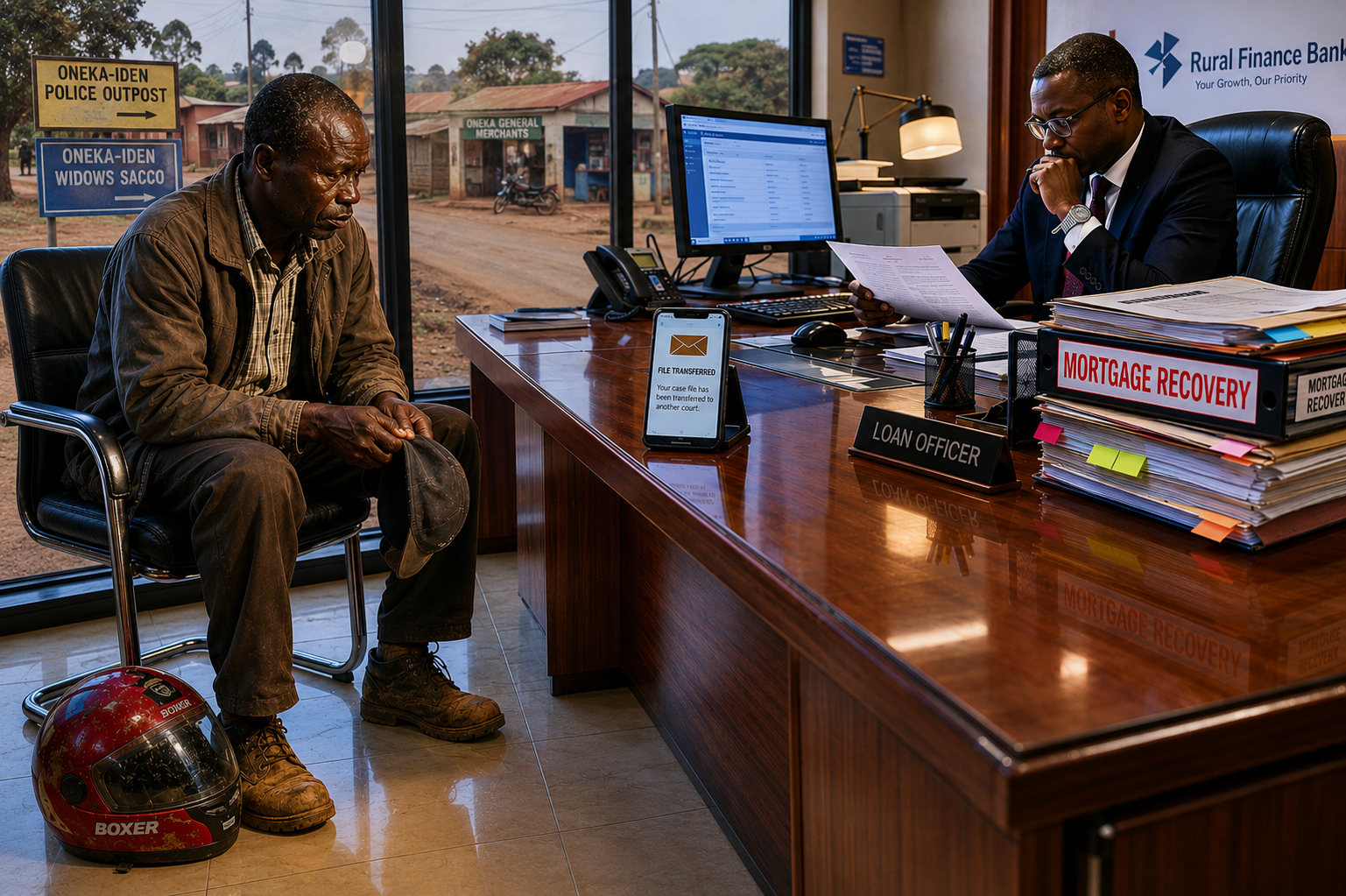
    Forty minutes later, Ocen Okello sat inside the office of the loan officer.

    Tie. Ledger. Calculator. No smile.

    The file marked MORTGAGE RECOVERY – FINAL NOTICE lay open on the desk.

    Ocen removed his cap. Held it in both hands. And began pleading.

    “Sir… please do not sell my house.”

    He swallowed. “The case is very near judgment, I promise.”

    The loan officer said nothing. So Ocen continued.

    “My lawyer says… no more than one month.”

    He pointed weakly toward Omwonyo‑le. “The court has some delays… delays I do not fully understand… delays I cannot even explain properly…”

    Just then – his phone vibrated again.

    This time, Counsel Ogwang Adede.

    He opened the message.

    Brown envelope. Three words.

    TRANSFERRED FOR JUST CAUSE.

    Ocen read it once. Read it twice. Then slowly looked back at the loan officer… and for the first time in four years… did not know which debt was more dangerous – the one inside the bank, or the one inside the court.


    By lunchtime, Omwonyo‑le was already whispering.

    The new Chairperson of the School Management Committee of Kec Primary School – the same school that had eaten Ocen Okello’s beans – was an old boy of Chief Magistrate Munyakuzi.

    In Omwonyo‑le, rumours travelled faster than judgments.
    And this rumour had teeth.

    “He is willing to vouch for his old buddy,” Alyek Molly heard from a clerk in Oneka Iden. “To save the school from an old crippling debt.”

    Alyek said nothing. She was still calculating her mother’s medication. Friday’s tuition. The per diem that would now not come.


    That evening, Mulyanyama sat in his rented room above the pharmacy in Oneka Iden.

    The brown envelope still lay on the table.
    Open. Unfolded. Unanswered.

    The names stared back at him.
    Imat Nekolina. Ocen Okello.
    Four years. Red ribbons. Borrowed fuel. Dead witnesses.
    Transferred. For just cause.

    His phone vibrated.
    Counsel Ogwang Adede.

    Mulyanyama stared at the screen for two rings. Then answered.

    No greetings. Just breathing.

    Then Counsel spoke.

    “Worship… what is going on?”

    Silence.

    “What happened?”

    Another silence. Then the question that hit harder than any objection ever raised in court:

    “Who complained?”

    Mulyanyama looked again at the brown envelope. Then at the ceiling. Then finally spoke. Quietly. Almost apologetically.

    “Counsel… I honestly have no idea.”

    A pause. Then –

    “Just orders from above.”

    Neither man spoke again. For a few seconds, all that remained between lawyer and magistrate was breathing.

    Then the line went dead.

    And for the first time since the amendment, His Worship Mulyanyama realised something far more dangerous than corruption:

    Sometimes a file is not stolen. Sometimes… it is simply called upward.


    Before you blame a magistrate for “delayed justice”… ask two questions:

    Who funded the last special session in your court? And how many times has a file been transferred – without your consent – “for just cause”?

    The system is not broken.
    The system is fully booked.

    Enen Ambrose

    Advocate

    Member: Judiciary Affairs Committee

    Uganda Law Society,

    For feedback or comments: enen@enenlegalworld.com

    If you missed the start of this journey, you can catch up on the systemic breakdown of the Magistrates Courts in Chronicles of His Worship Mulyanyama — Episode 2

    Legal Disclaimer Fiction & Non-Defamation Notice:

    This post is a pure work of fiction and creative literature. The characters, dialogue, specific incidents, and settings—including the character of His Worship Mulyanyama and the location of Omwonyo-le Magistrates Court—are products of the author’s imagination or are used fictitiously. Any resemblance or exact matches to actual persons, living or dead, real-life judicial officers, or specific ongoing cases is entirely coincidental. This text is created solely for the purpose of systemic legislative critique and systemic advocacy; it is not maliciously constructed, nor should it be interpreted as an attempt to defame, misrepresent, or malign any living individual or public office holder.

    The legal references in this Series is for information purposes only and is not intended to be used as a substitute for legal advice. The author does not assume responsibility or admit liability arising from the use of the contents of this blog as legal advice.

    The author strongly encourages readers to consult a licensed attorney for specific context related legal advice.

    FUEL THE MOVEMENT

    Independent institutional critique and advocacy for a radical overhaul of legal culture require time, deep research, and uncompromised independence. If these narratives bring value to your legal journey or challenge your perspective, please visit our HOME PAGE to see how you can support this platform directly and keep the critique fierce and relentless.

    Enen Ambrose. Advocate & Founder–Enen Legal World


  • THE QUIET VIOLENCE OF PROCEDURE III: When the System Sleeps, Justice Goes to Luzira. Reflections on ECCMIS, Offline Caching, and the Agony of an Unprepared Court

    THE QUIET VIOLENCE OF PROCEDURE III: When the System Sleeps, Justice Goes to Luzira. Reflections on ECCMIS, Offline Caching, and the Agony of an Unprepared Court

    Enen Legal World Logo.


    I. Gethsemane, 33 AD

    There is a moment in the Gospel of Mark that haunts every leader, every judge, every system builder.

    Jesus goes to the Garden of Gethsemane to pray. He takes Peter, James, and John. He is sorrowful, troubled, facing the cross. He asks them to stay awake, to watch with him.

    Then he walks away, prays, returns – and finds them sleeping.

    “Simon, are you asleep? Could you not keep watch for one hour?” (Mark 14:37)

    He warns them: “Watch and pray, so that you will not fall into temptation. The spirit is willing, but the flesh is weak.” (Matthew 26:41)

    They sleep again. Then the mob arrives. Jesus is arrested. And the disciples flee. Peter denies him three times out of fear.

    The consequence of sleeping? Failure at the moment of testing.

    II. Gethsemane, Buganda Road Court, 2026

    On 21 May 2026, an advocate appeared before a Magistrate at Buganda Road Chief Magistrate’s Court. His client had been charged with obtaining 600 million shillings by false pretence. The Advocate had uploaded bail application documents onto ECCMIS – the Judiciary’s flagship electronic case management system.

    The Advocate asked to be heard on bail.

    The Magistrate tried to access the uploaded documents.

    The network failed.

    ECCMIS would not display the files. The magistrate could not see the bail application. And instead of invoking the fallback provisions of the law – instead of assisting the advocate under Rule 9(4) and Rule 24(5) of the Judicature (Electronic Filing) Rules, 2025 – the Magistrate declined to hear the application.

    The Advocate was remanded to Luzira Prison until 4 June 2026.

    The system slept. And justice went to Luzira.

    Image: Buganda Road Court. Photo Credit, Nile Post, a member of the Next Media Company.


    III. The Spirit Is Willing – But the Flesh Is Weak

    The Judicature (Electronic Filing, Service and Virtual Proceedings) Rules, 2025 (S.I. No. 21 of 2025) are, on paper, remarkably progressive.

    Rule 24(5) of the Rules provide thus:

    The court may, in its discretion, adjust the schedule for responding to any affected filings, postpone the next court event, or provide other relief. It is my view that “others relief” includes a fall back position to actually hear the bail application manually, the network failure notwithstanding.

    The spirit of these Rules is willing. No judiciary transitions from paper to digital systems without friction, uncertainty, or implementation failures – and Uganda is no exception.

    But the flesh – the actual ECCMIS software and the training (or lack thereof) of judicial officers – is weak.

    The magistrate did not invoke Rule 24(5) Did not provide other relief i.e. a fall back position to actually hear the bail application, Why?

    Two possibilities – and both point away from individual malice and toward systemic failure.

    IV. Why Did the Court Sleep? Two Systemic Failures

    First: No offline caching in ECCMIS.

    If ECCMIS had an automatic local cache, the Magistrate’s computer would have downloaded all documents for that day’s matters the night before – or upon morning boot, or periodically. Even if the live network failed, the cached documents would remain accessible. The bail application would have been visible. The hearing could have proceeded.

    But ECCMIS, as currently deployed, appears to depend heavily on live connectivity. When the network fails, the court becomes blind. That is not a user error. That is an architecture flaw – though I write as an external observer, not as someone with access to internal design documents.

    What is needed: A software update that configures ECCMIS to:

    · Pre‑cache all case files for matters listed on a given day.
    · Update the cache every morning or whenever internet is available.
    · Allow offline access with a clear timestamp (“cached as of [time]”).
    · Sync back to the central system once connectivity is restored.

    This is not rocket science. Email clients do it. Mobile banking apps do it. Google Drive, One Drive and other online file back-up systems do it. Even WhatsApp caches messages offline. The Judiciary’s ECCMIS can do it – if the builders prioritise resilience over assumption of constant connectivity.

    Second: Inadequate training of judicial officers.

    Rule 60 of the 2025 Rules commands:

    The court shall, in collaboration with stakeholders, periodically undertake training for court users, judicial officers, unrepresented litigants and the public on use of ECCMIS.

    Where is that training? If Magistrates do not know they can assist under Rule 9(4), if they do not know they can order a paper fallback – then the Rules are dead letters. The fault is not primarily the Magistrate’s. The fault is the system that failed to prepare her.

    The Magistrate in Buganda Road was not malicious. She was unprepared. She was left alone with a broken network and no institutional backup. And like Peter in Gethsemane, she found herself in a situation where the institution had not equipped her to watch – the failure was systemic, not merely personal.

    V. The Blame Must Shift

    Public anger after the Buganda Road incident has, predictably, focused on the Magistrate. Some have called her incompetent. Others have suggested bias.

    I disagree.

    The Magistrate is the front‑line foot soldier of a digital transformation that was rolled out without full readiness. She was given a system that struggles offline, and no training on what to do when it fails. She was handed a beautiful set of Rules (S.I. 2025 No. 21) but not the practical tools to implement them.

    The real responsibility lies with:

    · The architects of ECCMIS – who designed a system that assumes perpetual internet connectivity in a country where power and data are unreliable.
    · The Judiciary’s leadership – who rolled out the paperless mandate without ensuring that every Magistrate understands Rules 9 and 24, and without installing basic offline caching.
    · The training units – who have not conducted the mandatory training required by Rule 60.

    Yes, the Magistrate could have done more. She could have read the Rules. She could have asked for an adjournment. She could have called the registry. But when a system fails, we do not blame the soldier alone. We also examine the armour and the General who deployed him and gave the orders.

    VI. A Concrete Way Forward

    The solution is not to abandon ECCMIS. It is to fix it.

    1. Technical fix: offline caching.
    The Judiciary’s ICT team must implement automatic local caching on all court computers. This is a one‑time software upgrade that pays for itself within weeks by eliminating network‑related adjournments.

    2. Training fix: mandatory, periodic, verifiable.
    Every judicial officer and court clerk must undergo hands‑on training on:

    · How to use offline mode.
    · How to invoke Rule 9(4) to assist litigants.
    · How to grant relief under Rule 24(5).
    · How to handle network failures without remanding people, especially when the question of Bail, which touches on the liberty and presumption of innocence of an accused person comes up for consideration.

    3. Accountability fix: a practice direction.
    The Chief Justice should issue a practice direction reminding all courts of their obligations under Rules 9 and 24, and requiring that any refusal to hear a matter due to ECCMIS failure be accompanied by a written explanation of why Rules 9(4) and 24(5) for fall back positions could not be followed.

    VII. Gethsemane, 2026 and Beyond

    Jesus did not condemn the disciples for sleeping. He warned them. He told them to watch and pray – because the flesh is weak.

    The flesh of ECCMIS is weak. The network fails. The cache is absent. The training is insufficient. But the spirit of the Rules is willing.

    The question is whether the Judiciary will watch – or continue to sleep.

    Because every time a Magistrate refuses to assist a litigant when ECCMIS fails, every time an Advocate or his client is remanded because the network is down, every time justice is delayed or denied not by malice but by unpreparedness – that is not a technical glitch.

    That is the agony of an unprepared court.

    And the consequence is always the same: those who came seeking justice flee. Their rights are denied. Their liberty is lost. And the system that was meant to protect them becomes the very instrument of their suffering.

    “Could you not keep watch for one hour?”

    The hour is now. The network will fail again. The question is not if – but when, and how the court responds.

    Will we equip our Magistrates (and in fact all judicial officers) to stay awake? Or will we keep sending accused persons to Luzira because the cache was empty and the training never came?

    The spirit is willing. Let us finally strengthen the flesh.

    DISCLAIMERS:
    This blog is not an attack on the Magistrate who handled the Buganda Road matter. Magistrates work under enormous pressure with limited resources. The critique here is directed at systemic failures: the architecture of ECCMIS, the inadequacy of training, and the absence of offline preparedness. Fair commentary is not personal attack.

    This blog is not legal advice. Readers should consult qualified attorneys for case‑specific guidance.

    Enen Ambrose
    Member, Judiciary Affairs Committee, Uganda Law Society
    For comments or feedback: enen@enenlegalworld.com

  • EPISODE 6: THE RECKONING

    EPISODE 6: THE RECKONING

    Enen Legal World Logo.


    If you are joining us for the first time: In Episode 1, we met Mzee Zakayo, who never built a granary but ate from the labor of others. His son Okello Anyapo inherited his appetite but not his cattle, and emptied his uncle Owera Apur’s granary because he was given access without rules.

    In Episode 2, we lifted our eyes to Uganda’s constitutional granary, built in 1995, and watched Parliament abandon its duty to build walls around it. We saw the seven famines: the Shs 763 billion justice tax, the incompetence shield, the two‑man cartel, the executive pocket veto, the criminalization of transparency, the ghost tier of unaccountable actors, and the commission that judges itself.

    In Episode 3, we watched while the petition slept. Application No. 11 of 2025, filed to halt judicial appointments, was never cause‑listed. The new Chief Justice and Principal Judge were sworn in while the application to pause their own appointments gathered dust in a court the Chief Justice once presided over.

    In Episode 4, we knelt under the ojede cii with Owera Apur. We heard him pour out his soul: “How long shall the wicked gloat? How long shall the guilty feast while the innocent gnash their teeth in hunger?” The leaves trembled. Something, somewhere, had heard the cry.

    In Episode 5, the ancestors answered across the border. We watched Cecil Miller, a man who never earned his seat, climb to Chief Justice, strangle habeas corpus, fire a judge with a single letter, and finally stood naked in a parking lot, shouting “Nyayo!” while cameras clicked and newspapers stayed silent. We learned that the ancestors do not file cause lists. They let the consequences ripen. And when the fruit is ready, it falls.

    Now we return to Abongodero. The leaves have stopped trembling. Owera Apur has risen from the roots. And the question that began under the tree must now be answered by the living.

    I. THE PROVERB FULFILLED

    The elders of Abongodero had a saying:

    You never send a starving man to the granary.

    But we did.

    We sent Okello Anyapo, the Judicial Service Commission, into the granary with no rules, no walls, no oversight. We watched him eat. We watched him grow fat. We watched him smile and say: “You allowed me. I merely accessed.”

    And then we blamed him for being hungry.

    But the fault was never Okello’s. The fault was Owera’s, the farmer who opened the door without building the walls. The fault was the village that admired Zakayo’s ingenuity and named itself after his emptiness.

    The fault was Parliament’s.

    For thirty years, Parliament held the keys to the granary. For thirty years, they walked past it, admired it, named committees after it, but never built the walls.

    The Constitution commanded them. The people expected them. History waited for them.

    And they did nothing.

    II. THE SEVEN FAMINES ARE STILL WITH US

    Now the famine is here.

    Not the famine of weather. Not the famine of soil. A famine of justice.

    · Shs 763 billion paid in bribes by court users, 43% of the justice sector budget.
    · Magistrates protected from removal for incompetence while Judges, Justices of Appeal and Justices of the Supreme Court face removal for incompetence.
    · Two people in a private room deciding who judges the nation.
    · The Attorney General holding a pocket veto over judicial discipline.
    · Transparency criminalized, a crime to look inside the granary and see what is stolen.
    · A ghost tier of unaccountable officers exercising power without oversight.
    · A commission that investigates, prosecutes, judges, and acquits itself.

    And when the villagers cried out?

    Injunctions. Uncause‑listed petitions. Stalled elections. Appointments proceeding like wedding ceremonies that will not wait for objections.

    And finally, at the 2026 New Law Year, the warning:

    “Social media attacks on judges will not be tolerated. Online criticism causes trauma and will be crushed.”

    Trauma from tweets?

    Try the trauma of five years on remand while your case gathers dust.
    Try the trauma of losing ancestral land because you cannot afford a surveyor.
    Try the trauma of watching a bribe walk free while your child rots in detention.
    Try the trauma of knowing that the man who now sits as Chief Justice once presided over the court that received an application to halt his own appointment, and the court never listed it.

    That is trauma.

    III. BUT THE ANCESTORS ARE NOT THE ONLY AUDITORS

    The ancestors answered Miller. They let the consequences ripen. They stood him naked in a parking lot.

    But the villagers of Kenya did not sit under a tree and wait. They organized. They spoke. They asked the questions that the powerful did not want to hear. They built institutions; the Law Society of Kenya, the human rights groups, the journalists who published what the newspapers would not, and they forced the system to answer.

    Owera Apur did not return from the ojede cii to do nothing. He returned to the village square. He returned to the burial grounds. He returned to the ballot.

    Because the ancestors do their work slowly. The living must do theirs urgently.

    IV. THE BURIAL QUESTIONS

    Across Uganda, in a thousand burials, graduations, and church introductions, your Members of Parliament are sitting on white chairs, waiting to be praised.

    They have come to eat. They have come to be photographed. They have come to say, “I feel your pain.”

    This time, you must ask them something different.

    Not: “What have you brought us?”

    But: “What have you done about what takes from us?”

    Stand at the burial. Wait for the microphone. Look at your MP, whether they are Minister, Whip, or backbencher, and ask:

    “Honourable, year in, year out:

    We cannot get bail. We rot in remand for years before seeing a judge.

    We lose our land at the High Court because the system is slow, expensive, and rigged against peasants.

    Justice is only for those who can bribe or wait.

    You are our voice in Parliament.

    What have you done, specifically, to fix the courts that inflict this suffering on us?

    Have you consulted the Uganda Law Society?

    Have you studied the reforms they propose for judicial appointments, discipline, and accountability?

    Do you even know that the Uganda Law Society exists?

    And if you know, what Bill have you tabled, seconded, or supported to build the granary our Constitution demanded thirty years ago?”

    Ask this question.

    Not on WhatsApp. Not in a private message.

    In public. On the record. Where the cameras are. Where the other mourners are listening.

    Because an MP who deflects at a burial has nowhere to hide.

    Because a question asked in the village square becomes a political fact that cannot be uncause‑listed.

    Because this is how pressure builds, not from the top down, but from the grave up.

    The Silence After the Question

    If your MP stammers, they will remember that stammer on Election Day.

    If your MP promises vaguely, record the promise. Send it to them in one year. Ask again.

    If your MP says, “I didn’t know about this,” you have just educated a legislator. Your work is done, for now.

    If your MP says, “I am already working with the Uganda Law Society,” ask for the Bill number. Ask for the Committee stage date. Ask when the granary will be built.

    Do not let them leave that chair without accountability.

    And then, do this;

    Call your area MP. Not to abuse them. To instruct them.

    “Honourable, I voted for you. Now I need you to table a Private Member’s Bill, or push the government to table one, that finally regulates the Judicial Service Commission and the President in judicial appointments and discipline.

    The Uganda Law Society has already done the homework. They have studied the models. They have drafted provisions. They are waiting for a Member of Parliament with courage enough to carry their work into the Chamber.

    Why are you not that Member?”

    One call changes nothing.

    Ten thousand calls change everything.

    V. TO THE 12TH PARLIAMENT: THE NEW GUARD

    You have been voted in. In May 2026, you will be sworn in.

    History greets you warmly, as it greets all new MPs. You hold privilege, power, and a brief season when the public still listens.

    You may fill your five years with funerals, allowances, foreign trips, Anti-Citizen legislation like the recentlt passed Sovereignty Act, 2026. You can choose to discuss mundane things like “Nyash” (like Hon. Odur Jonathan) or even fart in the august house (a video Speaker Annet Anita Among quizzing and probing which member of Parliament had visited the air is on public record). For some of you, you may merely look to rehearsals for 2031, which the media has widely reported is usually rigged. 

    Or you may build. But I verily warn you; if you don’t champion

    The fixes demanded in ULS Constitutional Petition No. 12 of 2025 do not require miracles. They require sweat.

    · Legislation that regulates the regulators.
    · Discipline standards that apply equally from magistrate to Chief Justice.
    · Structures that separate friendship from accountability.
    · A Judicial Service Commission where the Attorney General does not sit in judgment over judges he has fought in court.

    The Uganda Law Society’s Judiciary Affairs Committee has done the technical work. They are not your enemies. They are your research department, waiting to be retained by democracy.

    Walk across the stream. Consult them. Then legislate. But I verily say this to you: If you don’t legislate the reforms hinted here and many others, your voters will be thrown under the bus. They will continue to pay the “justice tax” and rot in jails under the weight of case backlog. And if they listen to us, they may hold you accountable at the ballot on polling day!

    VI. TO THE CONSTITUTIONAL COURT

    The villagers are watching your door too.

    They know that the Uganda Law Society filed Application No. 11 of 2025 in July last year, an urgent application asking this court to halt all judicial appointments until the main petition could be heard. They know the application argued that the Judicial Service Commission was unlawfully constituted, missing the two nominees the Constitution requires from the Uganda Law Society.

    That application was never cause‑listed. No reasons were given.

    The appointments proceeded anyway. The new Chief Justice and Principal Judge were sworn in. And the man who now presides over this court once presided over the very court that received that application, the application to pause his own appointment.

    The villagers know these things because they are public facts, not allegations.

    Now they wait. Not for a guarantee of victory. Not for a prediction of outcome. They wait to see whether this court has the courage to list the application—to summon the Judicial Service Commission, the body that recruits judges and holds the power to initiate removal of judges, and to hear the arguments of the Uganda Law Society.

    Cause‑list the interlocutory application, My Lords.

    Let the court sit. Let the lawyers speak. Let the Judicial Service Commission, your recruiters, your employers, the body that can initiate your removal; be called to account before the very judges it helps appoint.

    It does not matter, in the end, whether the application is granted or denied. What matters is this: does the court have the courage to summon its own employer? Does it have the spine to look at the body that controls judicial careers and say: “Sit down. Answer. We will hear this case.”

    The people are not asking for a favorable outcome. They are asking for a court that is not timid. A court that does not hide behind cause lists. A court that can be a bully‑beater; that can summon the powerful and demand an accounting.

    Show us that the Judicial Service Commission is not above the law. Show us that it is not above the courts.

    Cause‑list the application. Let the world see whether this bench has balls made of titanium alloy.

    The proverb is not a verdict. It is a question. And the question hangs in the air, waiting for your answer.

    VII. TO THE CITIZEN WHO FEELS HELPLESS

    You are not powerless.

    You do not need a law degree to ask a question. You do not need a Twitter verification badge to demand accountability. You do not need to file a petition to remind your MP that they work for you.

    The granary will be built when building it costs more than neglecting it.

    Make neglect expensive.

    Ask the question at the burial. Record the answer. Share it. Remember it on Election Day.

    And when you feel the weight of the system pressing down, when you have knocked on every door and found them locked; remember Miller.

    Remember that the ancestors are patient.
    Remember that parking lots are everywhere.
    Remember that the system you build to protect yourself may one day become the cage you cannot escape.

    But also remember this: the ancestors do not act alone. They act through us. Through the questions we ask, the votes we cast, the institutions we build, the silence we refuse.

    The ancestors answered Miller. But the Law Society of Kenya, the human rights lawyers, the journalists, the citizens—they answered too. They did not wait for the parking lot. They built the walls that Miller’s allies had left empty.

    So shall we.

    VIII. THE CHOICE

    Mzee Zakayo is long dead.

    But his children are still in Parliament.
    Some of them sit on the Judicial Service Commission.
    Some of them wear robes and warn about trauma from tweets.

    And the villagers?

    They are still standing at the granary door. Still waiting. Still hungry.

    Abongodero is tired.

    Hunger remembers.

    And this time, the people are not just watching the granary door.

    They are standing at the burial, waiting for the microphone.

    They are standing at the courthouse, waiting for the cause list.

    They are standing at the ballot, waiting for 2031.

    Build the granary, Honourable.

    Cause‑list the application, My Lords.

    Ask the question, Citizen.

    Or be prepared to answer for the emptiness;

    In this life, and at the judgment.

    You never send a starving man to the granary.

    And you never send a sleeping Parliament to guard justice.

    But you also never leave the granary to the ancestors alone.
    The end!


    DISCLAIMERS

    1. On Sub Judice

    This series references ULS Constitutional Petition No. 12 of 2025 and related applications only as evidence of public grievance and legislative failure. It does not urge the Constitutional Court to grant or dismiss the petition. It does not analyze the merits of the petitioners’ arguments. It does not predict or demand any particular judicial outcome. The duty of Parliament to legislate exists independently of this or any litigation.

    All facts presented regarding judicial appointments and cause lists are matters of public record.

    2. On Intent

    This series is not a call for mob justice, disorder, or disrespect toward judicial officers. It is a call for legislative accountability, civic engagement, and institutional reform. It is written in the tradition of the village baraza; where truth is spoken plainly, proverbs carry the weight of law, and leaders are expected to listen without punishing the messenger.

    Criticism of systems is not attack on persons. Demanding accountability is not contempt.

    3. On Legal Advice

    Nothing in this series constitutes legal advice. The author is an Advocate and member of the Judiciary Affairs Committee of the Uganda Law Society, but writes here in his personal capacity. Readers with specific legal problems should consult a licensed practitioner.

    Enen Ambrose
    Advocate
    Member, Judiciary Affairs Committee
    Uganda Law Society.

  • EPISODE 5: THE KENYAN MIRROR

    EPISODE 5: THE KENYAN MIRROR

    Enen Legal World Logo


    Disclaimer: The story of Cecil Miller is drawn from historical accounts, particularly Paul Mwangi’s The Black Bar. This retelling is a synthesis for the purpose of public education and advocacy. Readers of this Blog are encouraged to purchase a copy for the full account and context of The Black Bar by Paul Mwangi (SC)


    If you are joining us for the first time: In Episode 4, Owera Apur knelt under the 160‑year‑old ojede cii tree and poured out his soul. He called on Zakayo, on the ancestors, on the spirits of the land. He asked the question no constitution can answer: How then shall we live when the council is bought and the granary is empty? The leaves trembled. Something, somewhere, had heard the cry.

    Tonight, the ancestors reply. Not with wind. With a mirror.


    I. THE FOREIGN SEED

    In the 1970s a contract judge arrived in Kenya from Guyana. His name was Cecil Henry Ethelwood Miller. By blood he was a Black Pan‑Africanist, a World War II pilot who had “dusted the Aryan race.” By reputation he should have been a hero.

    By work ethic he was almost useless.

    But President Daniel Arap Moi saw hunger in Miller’s eyes. So Moi gave him Kenyan citizenship, a constitutional tenure as a High Court judge, a large plantation, and a Mercedes‑Benz limousine. The same way Owera Apur opened his granary to his nephew Okello, Moi opened the highest doors of the judiciary to a man who had never built anything.

    Miller’s appetite only grew. He wanted to be Chief Justice. He understood the price: total, slavish loyalty to Moi. The ancestors watched the foreign seed take deep root in Kenyan soil.

    Chief Justice Emeritus of the Republic of Kenya: His Lordship Cecil Henry Ethelwood Miller. Copyright owned by Miller & Co. Advocates. Used under Creative Commons Attribution-Share Alike 4.0 International license.


    II. THE COMMISSION OF THE INCOMPETENT

    In 1983 President Moi wanted to destroy his once‑powerful minister Charles Njonjo. He set up a Judicial Commission of Inquiry to investigate Njonjo for alleged abuse of office, everything from amassing firearms to plotting coups. The commission was widely seen as a kangaroo court, designed to humiliate Njonjo and drive him out of politics.

    Miller was one of three commissioners. He walked in carrying two things: a personal grudge against Njonjo (who had once passed him over for promotion) and zero judicial independence.

    The transcripts from The Black Bar are excruciating. During the hearings, lead counsel Lee Muthoga probed Njonjo about whether he had paid an MP, Amos Ng’ang’a, to resign his parliamentary seat so Njonjo could run for it. The exchange was tense. Njonjo’s lawyer, Mr. Deverell, kept interrupting with sarcastic remarks, at one point suggesting that “any other consideration” might include buying ice‑cream.

    Miller exploded:

    You keep making your jokes, Mr. Deverell. You keep on making your jokes. In the long run you may find it is not going to accrue to your credibility and your status before this inquiry. You keep on making your jokes. You take out your cold icecream and push it into your mouth. Proceed please.”

    The outburst revealed Miller’s predetermined hostility. He was not there to inquire; he was there to convict. Deverell saw the commission for what it was: a kangaroo court designed to destroy Njonjo.

    The mission succeeded. Njonjo was politically crushed.

    And in 1986 Miller was rewarded exactly as he had schemed: he was sworn in as Chief Justice of Kenya.

    A man whose judicial temperament was summed up by an ice‑cream joke now controlled every judge in the Republic.

    The ancestors were already laughing.

    III. THE HABEAS CORPUS THAT MILLER STRANGLED

    On 6 April 1987 a man named Stephen Mbaraka Karanja kissed his wife goodbye in Limuru and left for Nairobi. He was never seen alive again.

    After seven weeks of desperate searching, his wife filed a writ of habeas corpus asking the court to order the CID Director to produce her husband.

    The case came before Justice Derek Schofield. The CID claimed Karanja had been “shot while escaping.” Schofield did not believe them. He ordered an exhumation, an independent post‑mortem, and affidavits.

    The grave was empty. No body. No records. Schofield issued a notice to the CID Director to show cause why he should not be committed for contempt.

    That was when President Moi sent Chief Justice Cecil Miller himself into Schofield’s chambers with a direct order: “Lay off the case.”

    Schofield refused. He told Miller: tell the President to keep his hands off the judiciary, or I will tell the President myself.

    Miller did not wait.
    On 11 August 1987, without any formal application, without any hearing, Miller summoned the lawyers, seized the file, and transferred the entire matter. He stood the case over “until judges return from vacation.”

    Later he moved it to a known government apologist, who ruled that once a man is dead, habeas corpus cannot issue, because “the person or body” does not mean a corpse.

    Schofield resigned in disgust and left the country.
    The Law Society hosted a farewell dinner. The only senior government officer brave enough to attend was immediately fired.

    Stephen Mbaraka Karanja’s family never got justice. The habeas corpus died in silence.

    The Chief Justice had personally executed a murder cover‑up in open court.

    IV. THE JUDGE WHO FIRED A JUDGE

    By now Miller’s interference was routine. He transferred cases at will, summoned lawyers, stood matters over, and told other judges to “lay off” sensitive files.

    One man refused to bow: Justice Patrick O’Connor.

    Miller tried everything. When nothing worked, he issued a punitive transfer order sending O’Connor to a remote station.

    O’Connor defied it.

    On 26 September 1988 Miller sat down and wrote a single letter:

    “You are hereby dismissed from the service of the Judiciary with immediate effect.”

    No hearing. No tribunal. No reasons. Just one letter from a man who had never earned the seat he sat in.

    O’Connor was gone.
    The message to every honest judge was clear: resist Miller and you die.

    One judge had said no. Miller made sure he would never say anything again.

    V. THE PARKING LOT

    By 1989 Miller had become a drunk, violent eccentric who required armed policemen standing guard outside his chambers, something no Chief Justice before or since has ever needed.

    On a September afternoon he returned from lunch heavily intoxicated. He opened the sealed box he called his “disposal orders”, instructions for how his body should be treated after death. Then he began marching around his chambers shouting drill commands to himself.

    The policemen called the Commissioner of Police.

    Miller burst out, punching the air. He rushed into the High Court parking lot, in full view of journalists, lawyers, and the public.

    There, Cecil Henry Ethelwood Miller, Chief Justice of the Republic of Kenya, dropped his trousers.

    He placed one shoe on his head.

    And he marched again.

    Every few steps he stopped, raised his fist, and screamed Moi’s slogan at the top of his lungs:

    “Nyayo! Nyayo!”

    Nyayo meant “footsteps.” He was marching in the President’s footsteps, straight into naked madness.

    The Commissioner of Police and his men wrestled the naked Chief Justice into a car and drove him home.

    No newspaper published the photographs.
    No radio station broadcast the story.
    No television channel dared show the images that filled cameras that day.

    Five days later, on 5 September 1989, Miller died. The official cause was listed as septicemia.

    The real cause was the ancestors’ audit.

    VI. THE ANCESTORS’ AUDIT

    The villagers who had abandoned Miller to his gods did not celebrate. They did not dance. They did not say, “See, justice came.”

    Because justice did not come. The system that made Miller also protected him, even in madness, even in death. His family stayed in the official residence for months. Armed police guarded his widow. The government enforced his vengeance posthumously.

    No one was held accountable. No one was punished. No one even spoke.

    But the ancestors had their way.

    Not through a court. Not through a petition. Not through a judgment. Through a parking lot and a shoe on a head and a slogan shouted by a naked man.

    The ancestors do not file cause lists. They do not wait for submissions. They do not deliberate.

    They simply let the consequences ripen. And when the fruit is ready, it falls.

    Owera Apur’s invocation was answered—not by the council, not by Parliament, not by any human institution. It was answered by the slow, patient gravity of truth.

    VII. HOW THEN SHALL WE LIVE?

    So we return to the question.

    How shall we live when the granary is empty?
    How shall we live when the petition sleeps?
    How shall we live when the door does not open?

    We live like the villagers who finally understand: there is no institution coming to save us.

    We live knowing that the system may never be fixed in our lifetime.
    We live knowing that the judges who betray justice may never face a tribunal.
    We live knowing that the MPs who refuse to legislate may be re‑elected.

    But we also live knowing this:

    The ancestors are patient. The gods are not asleep. And parking lots are everywhere.

    Miller’s story is not a promise of justice. It is a warning against the illusion that power can protect you forever. It is a reminder that the system you build to shield yourself from accountability may one day become the cage you cannot escape.

    So how shall we live?

    We live with our eyes open.
    We live asking the questions at burials.
    We live recording the promises and the failures.
    We live building the granary even if we never eat from it.

    We live like people who know that the ancestors are watching.

    And we leave the rest to them.

    In the final episode: Owera Apur rises from the roots. The leaves speak one last time. The choice that cannot be postponed. We will show that while the ancestors SHALL no doubt have their day, we, their descendants still have a role to play to bring all the living “Okello Anyapos” to order, to serve with intergrity, purpose and accountability.

    Episode 6 drops tomorrow. 5 PM.

    Disclaimer: The story of Cecil Miller is drawn from historical accounts, particularly Paul Mwangi’s The Black Bar. This retelling is a synthesis for the purpose of public education and advocacy. Readers are encouraged to get a copy of the book for a full account of Kenya’s journey of Judicial Accountability as narrated by the author.

    #TheUnbuiltGranary #KenyanMirror #AskIt #OjedeCii


    [End of Episode 5]

  • The Philosophy of Insults: When Truth Becomes Fire and Tests Legitimacy”Enen’s Letter to the Radical New Bar and Every Citizen Who Still Dares to Speak

    The Philosophy of Insults: When Truth Becomes Fire and Tests Legitimacy”Enen’s Letter to the Radical New Bar and Every Citizen Who Still Dares to Speak

    Logo: Enen Legal World


    🪶 The Fable

    Deep within the Mambo Forest, the animal kingdom lived in awe of a single, dazzling truth: their ruler, Twon Gweno the cock, wore a crown of living fire. His comb was a legend, a crest of such vibrant crimson that the elders swore it was a fragment of the first sun. His morning crow was a decree:

    Bow to my glory, and you will be spared my flame.”

    And so, the animals bowed. Fear made them pious; fear made the cock sovereign with unquestioned loyalty, respect and cooperation from the rest of the animal kingdom in that forest. It was a classic case of natural-born legitimacy; never really earned.

    One evening, a crisis struck. Ichuli, the fox, the sole specialist in lighting the communal fire, was away. The wood was piled, but the spark was missing. The night, cold and predatory, loomed.

    Odyek Odyek, the hyena, a friend to truth and enemy of pretence, stepped forward.

    “The solution is simple,” she said. “We bow to Ladit Twon Gweno’s crown of fire. I will sprint to his home and borrow a spark.”

    She took a tuft of the driest spear grass, the Obia and went to the cock’s compound. She found him in a deep, unconscious slumber. Without waking him, she gently pressed the grass to his legendary crown, waiting for the catch, the sizzle, the proof.

    The grass rested on the crown, as inert as if it had been placed on a cool stone. The legendary fire was a phantom.


    Odyek Odyek, the hyena returned to the gathering and dropped the cold, unburnt grass in the centre of the circle. No words were needed. The lie they had bowed to for generations unravelled in that silent moment.

    Power, and unearned but coerced legitimacy unmasked, bled its authority into the silent night.


    ⚖️ The Lesson

    Borrowed fire must warm the hearts of the people. When it no longer does, the borrower is called to account.


    So it is with the courts. The robe, the gavel, the summons, and the warrant are instruments loaned by the people. Article 126(1) of the Constitution does not sing an ornament; it issues a command:

    Judicial power is derived from the people and shall be exercised by the Courts in their name and in accordance with the law and their values, norms, and aspirations.


    🧱 The Three Pillars of Legitimacy

    Legitimacy; the respect of the people and their cooperation with the courts, is the covenant at the heart of that loan. It demands three sacramental elements:

    Reflection: Judicial power must reflect the values and aspirations of the people; not the insatiable appetite of a sophisticated elite for luxury or high life.

    Truth: Courts must administer justice in accordance with law and truth, not convenience or midnight deals.

    The Judicial Oath: The solemn undertaking before God to do justice to all manner of people without fear, favour, ill will or affection is no actor’s prayer; it is a chain of duty.


    Strip away any of these, and what remains is a gowned pretender, eloquent and majestic, perhaps, but hollow: a cock whose crown no longer burns.


    The Evidence of Decay

    For those who have seen:

    • Appeal files missing thirty-eight pages.

    • A High Court hearing conducted not in a public courtroom but secretly in a posh hotel in which 15 minutes out of those proceedings were conducted in the absence of the opposite party and the whole process bashed by the Court of Appeal for want of a fair hearing and lack of judicial accountability and transparency and thereby further exacerbating the already slim public trust in the Court system entirely

    • A lower bench judicial officer bashed; “I don’t want to see this rubbish here, take it back where it came from” when they had sought guidance over files of thousands of remand detainees who had clocked mandatory bail, over 5 years where the Office of the Director of Public Prosecution state attorneys appeared neither willing nor ready to commit them for trial in the High Court.

    • The poorest peasants completely blocked from accessing justice because the lower courts have received directives not to register and dispose of customary land disputes unless a surveyor had first rendered a preliminary survey report; peasants who have never heard of, met heard about or hired the services of a professional called a surveyor. They have to sell a chunk of land  to afford a surveyor to conduct a preliminary survey and get their case registered.

    • A National Bar Association President’s liberty preserving Application for stay of execution of a manifestly void Contempt of Court ruling take close to 9 months without disposal.  


    These are not footnotes; they are flesh-and-blood indictments.
    The 1995 Constitution’s promise of a speedy and fair hearing has become hot air—Kikwangala, Kichupuli, Kawani.


    🗣️ The Test — The Philosophy of Insults. Withdrawing legitimacy and requiring that it be earned back by fidelity to its 3 pillars.

    To insult without malice but with evidence is to perform constitutional maintenance and maintain pure legitimacy.”


    Hence the philosophy of insults. This is not the petty malice of a tavern quarrel. It is a civic stress-test, a pressure gauge for legitimacy.

    It is the public’s cry:

    “GIVE US WHAT YOU OWE US.”


    We lent you power; we demand accountability in return.

    A people that cannot insult and mock power has already lost moral authority. The right to insult and offend the powerful is not a luxury, it is the citizen’s tool for testing whether the borrowed flame is real.


    📜 The Proof — The Jurisprudence of Defiance

    “Leaders should grow hard skins to bear.”
    “Power must endure insult to remain clean.”

    Uganda: When the Constitution Answered Back

    This philosophy is not just wisdom; it is the settled weight of law. Consider Andrew Mwenda, whose words rattled the Republic:


    This philosophy is not just wisdom; it is the settled weight of law. Consider Andrew Mwenda, whose words rattled the Republic:
    You see these African Presidents. This man went to University, why can’t he
    behave like an educated person? Why does he behave like a villager?’

    Museveni can never intimidate me. He can only intimidate himself ……… the
    President is becoming more of a coward and every day importing cars that are
    armor plated and bullet proof and you know moving in tanks and mambas, you
    know hiding with a mountain of soldiers surrounding him, he thinks that, that
    is security. That is not security. That is cowardice”

    Actually Museveni’s days are numbered if he goes on a collision course with
    me.”

    You mismanaged Garang’s Security. Are you saying it is Monitor that caused
    the death of Garang or it is your own mismanagement? Garang’s security was
    put in danger by our own Government putting him first of all on a junk
    helicopter, second at night, third passing through Imatong Hills where Kony
    is ?……Are you aware that your Government killed Garang?”

    I can never withdraw it. Police call them, I would say the Government of
    Uganda, out of incompetence led to or caused the death of Garang”

    When the state reached for iron law and charged him with sedition, the Constitutional Court answered with freedom, declaring that people from all backgrounds enjoy equal rights of expression, polite or not.

    “……Our people express their thoughts differently depending on the environment of their birth, upbringing and education.

    While a child brought up in an elite and God fearing society may know how to address an elder or leader politely, his counterpart brought up in a slum environment may make annoying and impolite comments, honestly believing that, that is how to express him/herself.

    All these different categories of people in our society enjoy equal rights under the Constitution and the law. And they have equal political power of one vote each.Then came the killer line that buried sedition:

    “……During elections voters make very annoying and character assassinating remarks and yet in most cases false, and yet no prosecutions are preferred against them. The reason is because they have a right to criticize their leaders rightly or wrongly. The Court concluded “Leaders should grow hard skins to bear.”
    A copy of the judgment can be found here:


    Burkina Faso: The Continental Echo

    In Burkina Faso, journalist Issa Konaté was jailed for calling a prosecutor “a criminal in a robe.” In his Words:

    “…….The Prosecutor of Faso is the godfather of bandits. He is the sponsor, the organizer, the leader of a vast network of counterfeiters and traffickers that he protects with his power and status.”
    This is a prosecutor who does not prosecute crime, he commands it. He is not a guardian of order but a godfather of disorder
    While honest citizens sleep in fear, the chief lawman of our nation sits in his office, dividing the spoils of crime with police officers and bankers
    He is not a magistrate; he is a criminal in a robe. A saboteur of justice…….”


    The African Court answered with thunder and reason. Custodial sentences for speech are a bludgeon against Democracy:
    “The Court is of the view that the violations of laws of freedom of speech and the press cannot be sanctioned by custodial sentences, without going contrary to the provisions of Articles 9 and 19 of the Charter”

    The Court pronounced itself on the role of public figures under scrutiny.

    “There is no doubt that a prosecutor is a public figure; as such he is more exposed than an ordinary individual and is subject to many and more severe criticisms. Given that, a higher degree of tolerance is expected of him”

    A copy of the judgment can be found here:


    From this we learn that “Power must endure insult to remain clean.”


    🪶 The Heritage; The Lango Grammar of Reproof

    This civic logic is not foreign to us. In Lango, the sharp tongue has long done the work of reform.

    • “Ole yin ibedo dako dako”; “…..you man, you behave womanly…”. It is not cruelty. It is shock therapy for duty and clarion call for the family patriarch to “man up” and live up to his responsibilities to his family, to lead firmly, provide for it and protect it.

    • “Lango mito alek”; “…..Lango deserves a pestle…” A reminder that discipline is coming unless reform comes first and that it intact comes usually after enforced discipline.


    • “Kwany Ka Point” The Gen Z’s and Millenials have similarly curved their own wisdom, “pick only the point”: As plain and simple as that. Pick only the point, filter it from the insult.


    • “Ikok Ugali idogi.”  “…..You will cry with Ugali in your mouth. …”


    In the old rite of passage, a young man’s two upper incisors were pulled, and boiling herbal Ugali was placed in his mouth to ease the agony. He cried through the very remedy meant to heal. Reform rarely feels like mercy.

    So when the citizen mocks the powerful, the intention is not cruelty; it is Ugali in the mouth of power: a necessary sting, a painful antidote.

    The insult becomes a civic anaesthetic; searing, brutally  humiliating, but designed to cleanse and restore legitimacy

    Reform rarely feels like mercy.
    So when the citizen insults and mocks the powerful, the intention is not cruelty. It is Ugali in the mouth of power: a necessary sting, a painful antidote.


    🔥 The Repair — The Calculus of Force

    Public outrage, properly aimed, creates four fields of pressure that make corruption intolerable:

    1. Professional Ostracization: When integrity collapses, the social scaffolding of a career falls with it.


    2. Erosion of Authority: A judge who loses public confidence loses jurisdictional muscle and may in fact receive fewer to zero allocations of files to handle or minimal chances to be chosen to sit on a panel in the case of hearings in courts that are manned by more than one Judicial Officer.


    3. Legal and Institutional Siege: Scandal catalyses petitions, litigation, and oversight that eat at illegitimacy.


    4. Political Abandonment: The appointing power prefers a scapegoat to a scandal, forcing a “voluntary” exit.

    From this, we learn that insults are not instruments of mob rule; they are the social physics of accountability.Yet outrage alone is not reform. The sting must translate into architecture: cooling-off periods for judges, transparent appointments, and independent oversight with teeth. Shame, the direct consequence of insult, reveals the rot; law must excise it.


    ⚔️ The Awakening — The Price of Truth

    The hyena who taught the village to see.”

    For too long, the Uganda Law Society was a sleeping giant while the temple burned. But the dry grass is now burning in Masaka.
    When the President of the Bar , the hyena who taught the village to see, lives in exile for refusing to apologise for truth, his banishment becomes the ultimate test.

    Isaac K Ssemakadde (SC) President of Uganda Law Society. Credit: Uganda Law Society Website.


    📜 The Counsel; A Call to the Bench and the People

    This is not an invitation to vulgarity for its own sake.
    Insult as a civic weapon must be wielded with evidence, not rumour; with satire steeped in fact, not malice.

    To the Judges:

    Grow the hard skins the Constitutional Court commanded you to have. Wear patience as armour, not menace. Treat insult as a thermometer, not as treason or contempt.

    When a citizen insults, ask: does this insult point to truth? If yes, answer in reason, remedy the wrong, and let the nation watch you Act. If not, let the insult fall like a pebble. The dignity and legitimacy of the bench is earned by magnanimity and the stoic creed of the 3 pillars of legitimacy namely Reflection (of law, values, norms and aspirations); Truth and by abiding by the Judicial Oath. It is not enforced by fury, bullying or jaling dissent.

    This doctrine requires courage from all sides. The Bar must be relentlessly courageous and fearless in its insult and ridicule while exacting in its ethics.

    The public must be loud and literate, hurl insults but bring evidence. Lawyers must translate courage into petitions, not merely WhatsApp gossip and tweets. The Legislature must codify protections for speech against disproportionate criminal sanction and the Judiciary must redicscover the humility of the oath, the most important leg of judicial legitimacy; to do justice without fear, favour, ill will or affection. 

    To

    the citizens: Wield the pen. Make the insult precise devastatingly; threads that link to missing pages, memes that reveal truth.


    🌞 The Benediction & Epilogue

    Lock and Roseau taught and we learnt from the social contract doctrine that all power, judicial power inclusive, like the communal bull, is never owned. It is loaned to serve, not to feast upon. Judicial officers are, therefore, commissioners, agents of the people, not monarchs. The people are the principal. When the agent betrays, the principal must insult loudly in true reprimand.


    If those entrusted with it betray the trust, the people must remind them, sometimes with satire, sometimes with searing words, that borrowed fire must warm, not burn.

    This is neither an incitement to violence nor a call for insurrection. It is a call to civil carnage against corruption, ritualised, and peaceful.

    Let the insults be sharp, witty, and relentless, and let them dismantle rotten cartels of impunity.
    Turn every courtroom cover into a public syllabus: transparent reasons, readable judgments, accountability writ in footnotes and public records.
    Make the institutions bleed truth, not people.

    To end illiteracy in justice, let every citizen wield the pen.

    Let the hyenas come. Let the baraza be noisy.

    Let society test the crown every morning until the judges can point, with open hands and clear reasons, and say:

    Here is the flame.”

    Until then, press the grass. Let the crown be tried in daylight.
    Let the fire prove itself true.

    ✍️ Dedication

    This blog is dedicated to all prisoners, present and past, of conscience, self-expression, and free speech: Male Mabirizi Kiwanuka, Ivan Samuel Sebadduka J, and Isaac K. Ssemakadde (SC), President of the Uganda Law Society, for executing a civic duty tragically confused with contempt of court.

    Contempt must be reserved for direct obstruction of justice, not as a cudgel to discipline ridicule.
    Imprisoning insult and mockery is to forget the nature and source of judicial power: the people’s consent.

    May the Good Lord bless and protect you all.
    And may we witness, in our lifetime, thick-skinned judicial officers who treat insults with nothing more than “a wry smile,”
    as aptly put twenty-five years ago by the eminent British jurist, Lord Justice Simon Brown.

    The author is a member of the inaugural Judiciary Affairs Committee of the Uganda Law Society.

    DISCLAIMER: This Blog is not a call for mob justice, chaos or disorder against our beloved holders of judicial power and other public power, it is brutal and defiant reminder that illegitimate conduct leads to a withdrawal of respect from the very owners of the power and attracts criminal and administrative sanctions, some as grave as removal from office. It is also to encourage the clean and disciplined judicial officers to continue upholding the consent of the people for them to administer justice by upholding the stoic pillars of legitimacy first mentioned in this Blog, and that with or without climbing the career ladder, God, the original designer of justice will be the ultimate one to reward their efforts both now and in the afterlife.

    This blog is not intended to be used as legal advice, and the author denies liability for use of the contents herein as legal advice. Readers are encouraged to consult a licensed Advocate to give them specialised advice and representation.

    For feedbacks and comments: ambrosenen@gmail.com. 

    References.

    For further reading or references. I consulted the following books.

    1. Politics as a Vocation (Politik als Beruf) by Max Weber

    2. Second Treatise of Government” by John Locke.

    3. The Social Contract” (Du contrat social) by Jean-Jacques Rousseau.

    4. Weapons of the Weak: Everyday Forms of Peasant Resistance” by James C. Scott.

    5. How to Do Things with Words” by J.L. Austin.

  • Uganda Needs Judges with Balls of Titanium Alloy—Not the Shackles of the JSC Regulations, 2025: Why You Should Be Worried

    Uganda Needs Judges with Balls of Titanium Alloy—Not the Shackles of the JSC Regulations, 2025: Why You Should Be Worried


    Let’s not waste time.
    Uganda’s judiciary has been hijacked. Quietly. Legally. Treacherously.

    They didn’t need a coup d’état. They just needed Statutory Instrument No. 4 of 2025—the Judicial Service Commission Regulations—to pass unchallenged.

    You can access a copy of those regulations here:


    And now the Constitution isn’t bleeding.

    It’s on life support. Plugged into a system designed to kill it slowly.

    Judges on Acting Terms. Courts on Probation. Justice on the Brink.


    Here’s what they’ve done:

    Invented a system where new judges are appointed on in an acting capacity, with the duration determined at the whims of the appointing authority—yes, like interns at a mobile money kiosk.

    Given the President the power to recycle retired judges, no questions asked. No medical. No mental. No morals.

    Created performance evaluations for judges like they’re applying for a promotion at a law firm.

    That’s right, you’re not day dreaming, the system was rigged. In 2022, the Constitutional Court damned this shrewd “sharp practice” and threw it in our Constitutional History by declaring it unconstitutional in Dr. Busingye Kabumba and Karamagi vs Attorney General.

    A copy of that decision can be found here:

    Good judgment, right? Damn, the government rigged it. It instead created a legal loophole which enabled it to pass these damned Regulations. 

    Firstly, it appealed against.  Secondly  the government obtained what is in effect  a suspension of the independence of the Judiciary as the Supreme Court delays to decide the Government’s Appeal .

    A copy of the decision which suspended the independence of High Court Judges as the government waits for a decision in its own appeal from the above case can be accessed from here:


    Okay, let’s dive into the evil in the Regulations.
    Reg. 29–33 and 31 are the smoking guns.
    And what they shoot is judicial independence—straight between the eyes.

    And Then There’s 2026…

    Uganda’s next elections are not just around the corner—they’re rumbling like thunder.

    And we know the script:

    Mass arrests.

    Disappearances.

    Violent suppression.

    Habeas corpus applications flying like confetti.

    Human rights cases lined up like a firing squad.


    It will take judges to hear them all.

    But what kind of judges?

    Not fearless ones. Not permanent ones. Not independent ones.

    The Regulations guarantee this:

    When the state comes for you, the judge before you may still be “acting,” “probationary,” or “awaiting confirmation.”

    You don’t need a judge praying for job security.

    You need a judge with balls forged from titanium alloy, ready to grab the State by its ball sac and say:

    Back off. The Constitution says this citizen walks free.”

    These Regulations can’t produce that judge.
    They produce whispering cowards in robes.

    But Wait, There’s a Recruitment Cartel Too

    They didn’t just kill judicial independence at the appointment level.

    They also built a Search and Recruitment Committee—and a Sub-Committee—with a quorum of TWO people.

    Let that sink in:
    Two people can now shortlist Uganda’s judges.

    Who are these people?

    The Attorney General—yes, the government’s own lawyer.

    The Chairperson of the JSC—currently Justice Singiza, who was once branded a “Nazi Judge” by opposition supporters for adjourning Besigye’s habeas corpus case instead of hearing it urgently.


    And guess who they kicked out of this process?

    The two (2) representatives of the Uganda Law Society.

    The very people the Constitution says should be part of the Judicial Service Commission.

    It Was Planned. Timed. Executed.

    These Regulations were passed while the Uganda Law Society is in court, fighting to elect its representatives.

    The plan is clear:
    Keep them out. Lock the process down. Staff the courts with friendly judges. Control the law from the inside out.

    This isn’t just bad law.

    It’s a judicial cartel in robes.

    And You Think It Doesn’t Affect You?

    Wait until your land is taken.
    Wait until your protest turns into a prison sentence.
    Wait until your loved one disappears.
    Wait until the courtroom is the only place left to cry out.

    Then you’ll pray that your judge isn’t still auditioning for a contract renewal.

    Here’s the Message:

    Uganda’s justice system is being rebuilt—not to protect you, but to survive you.

    It is no longer about law.
    It’s about control.
    It’s about loyalty.
    It’s about silencing justice before you can even plead for it.

    This is the war. This is the moment. This is the alarm.

    If you have eyes you better see, and if you have ears you better listen.

    More about me and disclaimer in the about page.

  • Foot Soldier’s Last Stand: Inside the Madness of Sycophants, Rogue WhatsApp Admins, and the Northern Bar Bench Forum

    Foot Soldier’s Last Stand: Inside the Madness of Sycophants, Rogue WhatsApp Admins, and the Northern Bar Bench Forum

    Photocredit: Team of Advocate Paul Mukiibi with their Brand: Chain breakers in the campaign to represent the Uganda Law Society at the Judicial Service Commission.

    It started like a flicker—a tiny spark of defiance that should’ve ignited a roaring wildfire of rage and justice. Instead, it was smothered by the gargantuan, self-righteous boots of censorship, as if the admins of the Northern Bar-Bench Forum were playing the role of divine gatekeepers to the underworld of logic, reason, and free speech. It was the perfect storm waiting to brew, and here we were, caught in the vortex of unrelenting madness.

    Imagine this: a friend—let’s call them Advocate C—dared to share a link to an article so scorching that the digital air itself trembled. The scandal? The Honorable Chief Justice, in a move so brazen it could only be conceived in the dankest corners of the power-obsessed universe, allegedly schemed to extend the retirement age for Supreme Court Justices. Why? To keep his gnarled hands on the throne, forever and ever. He also decided to appoint an Acting Principal Judge without so much as a whiff of the President’s blessing, like a schoolyard bully claiming the lunchroom as his own personal fiefdom. The legal streets of the Forum exploded in righteous fury, an inferno of truth and justice clamoring for attention.

    And then… the admins. Oh, the admins. The self-crowned, self-important emperors of silence—oh yes, those power-hungry weasels. They descended like locusts, their ban-hammers blazing. Link? Gone. Criticism? Erased. “Don’t post things that make other members uncomfortable,” they decreed, as if comfort was the holy grail of democracy. What’s uncomfortable, you ask? The CJ’s alleged power grab that should’ve made every Ugandan’s blood boil? That’s what should’ve made us all “uncomfortable.” But no, not in their world. The admins had a higher calling: the suppression of truth, under the guise of “unity” and “comfort.” What a joke.

    That night, at 8:43 PM, the world shook. I—Ambrose Enen—I was done. I had had enough of their charade. With the force of a thousand furious lions, I stormed into the admins’ fortress of lies. I sent them a question that cracked their gilded masks and made their self-satisfied jaws clench like desperate prey:

    “Why are you strangling debates about the Hon. Chief Justice, you cowardly sycophants?”

    I threw down the gauntlet, demanding they justify their pathetic, trembling submission to the powers that be, to shield His Lordship from the fire of scrutiny. The CJ had once bellowed like a lion, declaring, “If you’re not criticized, it means you’re doing nothing and the people just choose to ignore you!” And here they were, trying to shield him from even the faintest whiff of criticism. Hypocrisy? Monumental. So, I unsheathed Article 29 of the Constitution like a blazing sword and sliced through their pitiful, sanctimonious excuses with the fury of an avenging god. I invoked the speech of the Chief Justice himself when he delivered his own lead Judgment in Kabaziguruka case, where the Supreme Court put a grinding halt on the trial of civilians in the Court martial. The Chief Justice was referring to President Isaac Ssemakade’s work method, weekly public press engagements dubbed the “RNB Live” in which fireballs were hurled at the Justices of the Supreme Court for delaying to deliver that very judgment. The very Supreme Court had in an earlier judgment in the case of  Charles Onyango Obbo and Andrew Mujuni Mwenda had crowned free speech as an untouchable deity, immune to the fragile egos of all public officials from the President to the Military.

    Read a copy of that Judgment here:

    Related: read also: https://enenlegalworld.wordpress.com/2024/11/20/revisiting-free-speech-professional-ethics-and-gender-sensitivity-in-uganda-a-legal-and-social-analysis/

    I screamed at them, demanding they answer me: Had they erased the CJ’s own edict—that criticism is the lifeblood of action? Or had they buried the people’s right to challenge power under a mountain of self-inflicted fear?

    I didn’t stop there. I summoned the name of the great Isaac Ssemakadde, a volcano of legal brilliance who melts the hearts of tyrants and leaves them quaking in their boots. His name sent ripples of panic through their ranks, like a shark’s fin slicing through calm waters. And I laughed—loudly—at their terrified whimpering.

    The admins’ response? Hilarious. They pulled out the same tired, sanctimonious rhetoric, claiming the Forum, created in 2019 by the then “mighty” Conrad Oroya, was meant to unite “advocates” and “judicial officers” from the greater North. They paraded their so-called patrons, from the CJ down to the lowliest Magistrates, and tried to paint themselves as paragons of unity and reason. But wait—oh wait—they accused the Radical New Bar (RNB) of destroying the Forum, branding us as “scourges of the legal profession.” Apparently, our “scathing attacks” were too much for their fragile egos, too sharp for their delicate sensibilities. They shrieked that we’d turned their sacred Forum into a warzone. And that—that was their best excuse for censorship.

    But, my friends, that wasn’t enough. They threatened to boot us out, to banish us from their “pious” space where only their carefully curated lies were welcome. Oh, how I laughed. I thought of Maxime Rovere’s words in his book, How to Deal with Idiots and not be one yourself: “Idiots infest every cesspool, even the loftiest halls of government.” But this wasn’t a government cesspool, oh no. This was a digital one, run by clowns in armor of “civility” and “comfort.” I held back my laughter only because it was a laugh of pure, unadulterated rage.

    The admins couldn’t take the heat, and then, boom. A revolution. It didn’t come in the form of an army, no. It came in the form of words. Words sharper than a thousand blades.

    A Grade 1 Magistrate—yes, a Grade 1 Magistrate—came for them, tearing through their lies like a wildfire through dry grass. “Article 29 doesn’t grovel before judicial comfort,” they roared. “You’re strangling debate about the CJ, and in doing so, you’re ripping the soul from the legal profession itself.”

    Then, like a chorus of angels singing the hymn of truth, came another Magistrate. It came with fire in their belly and venom in their words. “Your fear of the Radical New Bar only exposes your cowardice,” they snarled. “You’re terrified of a few questions—questions!—about the CJ’s power plays. What kind of admins are you?”

    Then came Advocate A—oh yes, Advocate A—with a fire so hot it could melt the very walls of their sanctimonious den. They came at the admins like a raging storm, laughing at their pathetic attempts to shield the CJ from the rightful fire of criticism. They mocked them for their “bootlicking” and told the admins to lick the dust. They didn’t just fight—they laughed in their faces. And their message? “You’ve earned this defeat, you glorious cowards.”

    But that’s when the real rebellion began. Just after my banishment, Advocate B—yes, Advocate B—launched a tidal wave of resistance. “See you in Gulu Learned Friends,” they sneered. “But first, post that message which  was deleted here!”

    The forum’s demise wasn’t my banishment. Oh no. It died when it sold its soul, when it chose silence over truth, when it cowered before power. And here’s the thing—the admins? They didn’t even see it coming.

    But then came the words of Isaac Ssemakadde—oh, those words, those molten words that seared their way into my soul. “Impunity’s greatest weakness is the craving it has for respectability, legitimacy, and sycophancy. Deny it one of those lubricants, and you will begin to see ‘how the mighty fall.’ So fast.” And then he said the words that would light the fuse of my rebellion for good: “Principle is always vulnerable in the face of power; especially in spaces of long-term subjugation where the legal culture is manipulative & unapologetic in defence of power. Only a revolution, grounded in principle, can reverse things now.”

    I heard it. The call. The revolution, forged in fire and principle, was now in my blood. And so, like a storm that cannot be stalled, I went to battle. Unbanned. Unbowed. Unafraid.

    Because here’s the truth: The Northern Bar-Bench Forum was supposed to be a crucible of ideas, a place where Uganda’s brightest minds clashed, burned away the dross, and emerged better. Instead, it became a cesspool, a sanctuary for the most dangerous thing of all: fear. Fear of truth. Fear of scrutiny. Fear of Article 29.

    And in that fear, they forgot. They forgot what a forum was meant to be. They forgot that power, unchecked and unchallenged, is the very thing that devours empires.

    So here’s to the outcasts, the truth-tellers, the Ssemakaddes who set the world ablaze with righteous fury! Here’s to Advocate A, Advocate B, and every single renegade who refused to bow before the gods of comfort. Here’s to Article 29 and the indomitable, damn-near-holy faith that free speech isn’t a gift from admins or judges—it’s our birthright, you small little intern Honorable WhatsApp administrator dictators!

  • Foot Soldiers Fight Back: Free Speech, Social Media, and the Battle for Judicial Accountability in Uganda

    Foot Soldiers Fight Back: Free Speech, Social Media, and the Battle for Judicial Accountability in Uganda

    Judicial power in Uganda is not a divine right handed down to judges in solemn robes. It is borrowed authority from the people, and when borrowed power is abused, the lenders have every right to demand accountability. That is what happened when Ugandans erupted in fury over Justice Douglas Singiza’s decision to adjourn a habeas corpus application, effectively prolonging an already illegal detention.

    This was not an internet tantrum—it was a constitutional defense mission, executed in real-time by citizens who understand their rights better than some of the people wearing wigs in courtrooms. Article 126(1) of the Constitution is clear:

    Judicial power is derived from the people and shall be exercised in conformity with the law and with values, norms, and aspirations of the people.”

    So, when the people declare that a ruling has spat on their constitutional values, they are not just complaining—they are executing their duty to keep judicial power in check.

    This is not the first time Singiza has found himself at the center of a human rights disaster. When Kakwenza Rukirabashaija, a novelist and torture victim, applied to retrieve his passport for urgent medical treatment abroad, it was Singiza—then Chief Magistrate at Buganda Road Court—who denied him. His reasoning?

    👉 “Ugandan hospitals can handle his condition.”

    Imagine suffering broken ribs, festering wounds, and open scars from state torture, only for a judge to declare that a hospital in Wandegeya is sufficient to handle what should be a war crimes case. This is the same judge who, three years later, sends Besigye and Lutale back to illegal detention while he thinks about their habeas corpus plea.

    The pattern is now too clear to ignore—delayed justice when it benefits the state, procedural gymnastics when fundamental rights are at stake, and then a full-blown judicial meltdown when the public calls it out.

    And how did Singiza react to the backlash? Like a true 21st-century authoritarian—he made the ruling about himself. Instead of addressing the constitutional chaos he created, he spent his precious obiter dicta crying about online criticism.

    What’s next? Should Ugandans start seeking judicial permission before commenting on court decisions? Must all legal critiques now be submitted in triplicate, with an affidavit from a Senior Advocate?

    This is a dangerous trend—a creeping attempt to criminalize judicial criticism and insulate courts from the same public scrutiny that every other arm of government faces.

    The executive is insulted daily.
    The legislature is mocked in real-time.
    The military is dragged through the mud.

    But the judiciary wants to be untouchable?

    In Onyango Obbo & Andrew Mwenda v. Attorney General, the Supreme Court made it clear that public officials—including judges—must tolerate criticism. Free speech does not require politeness, and it is not invalidated because it offends the recipient.

    Yet, here we are, watching judges compose emotional victim statements in court rulings instead of defending the Constitution.

    This is not judicial independence—this is judicial fragility.

    Uganda has reached a crossroads: either the judiciary remembers that it serves the people, or the people will remind it in ways it will never forget. Judicial power, like all borrowed authority, can be reclaimed when misused.

    This is not a warning.
    This is a constitutional reminder.

    DISCLAIMER: This blog is not intended to mock or attack the person of the Hon. Justice Douglas Ssingiza. It is commentary on the interesting obiter dicta in the Habeas Corpus Application of Dr. Kizza Besigye and Obeid Lutale vs. Attorney General. The Ruling in that case can be found here:

    The author is a Rule of enthusiast. More in the about page.