
The Magistrate Who Never Carried Lunch

Author’s Note: The Chronicles of His Worship Mulyanyama is a serialized literary commentary designed to constructively critique the institutional and structural implications of the Magistrates Courts (Amendment) Act, No. 6 of 2026. This work is a creative exploration of the human infrastructure behind public service and is not intended to ridicule, embarrass, or undermine the integrity of the Judiciary.
At 7:45am, His Worship Mulyanyama was nowhere near court.
He sat inside a parked Judiciary double‑cabin pickup, forty kilometres from Omwonyo‑le Magistrates Court. Engine off. Air dead. Phone in hand.
Battery: 19%.
Bank balance: not enough.
Fuel gauge: hovering just above E – the dangerous place where public service stops being transport… and becomes theology.
On his screen: Mo‑kash. Wewole. ManguCash. Ka‑Sente.
Four lenders. Four rejections. One salary.
He had not yet started the engine. Because before justice could move, fuel had to move first.
So he made another call. Not to a litigant. Not to a lawyer. To a friend.
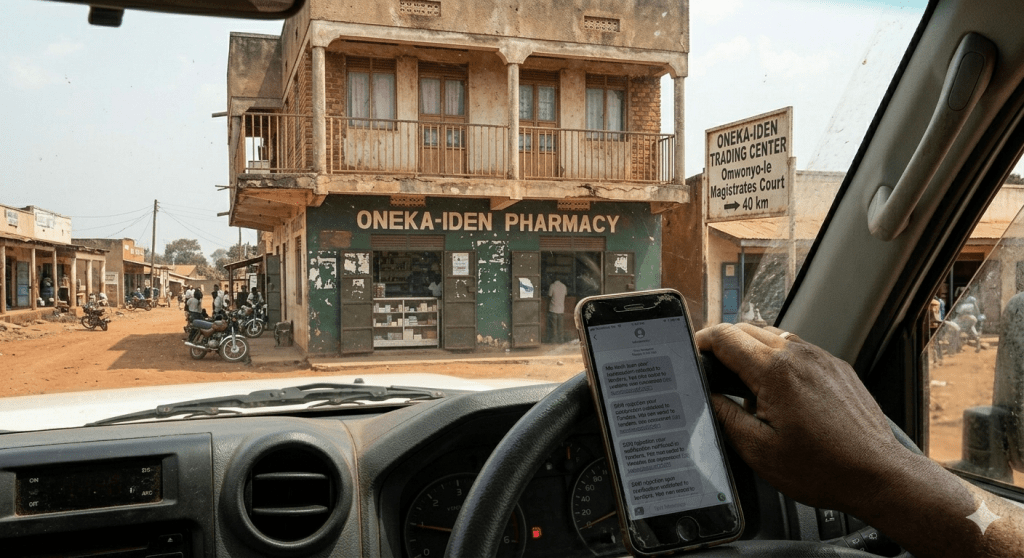
By 10:06am, the double‑cabin rolled into Omwonyo‑le.
The benches were already full.
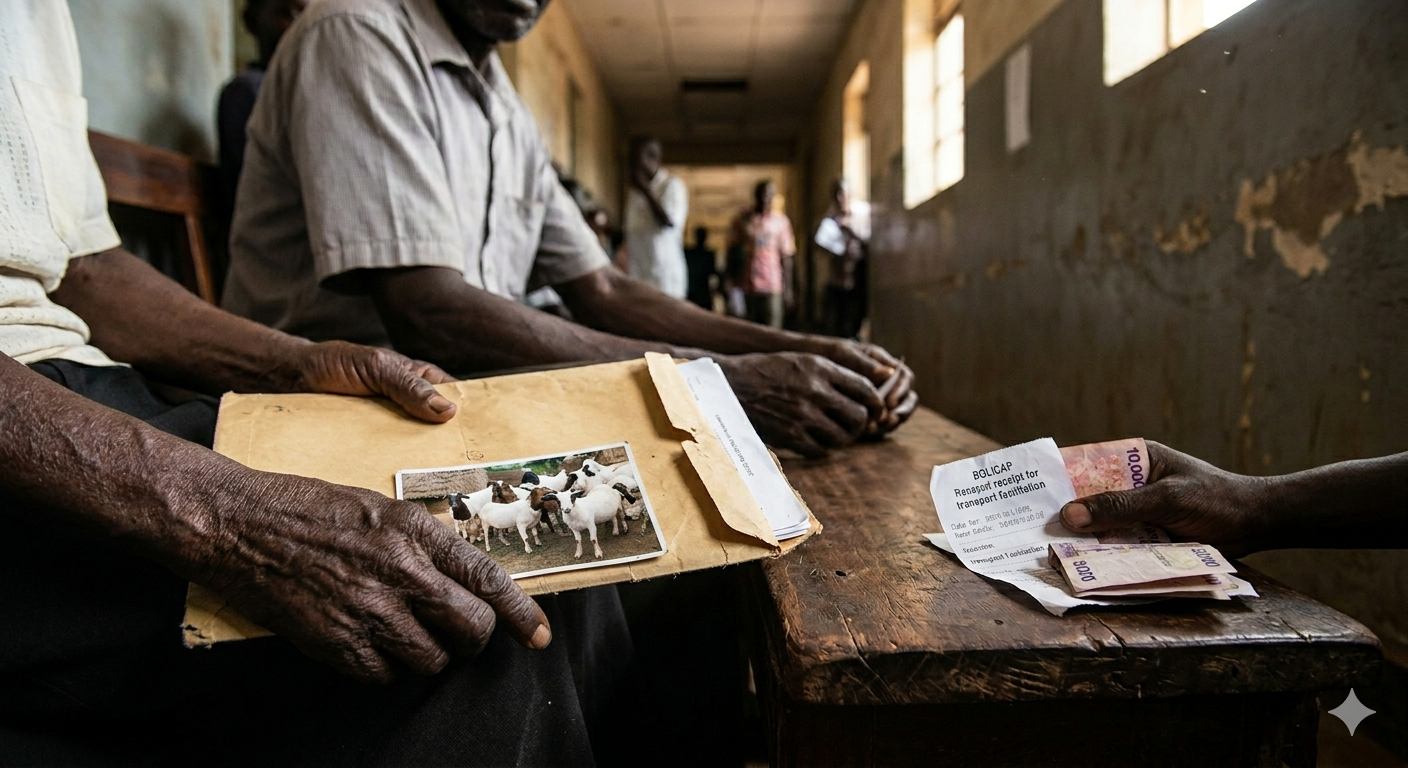
Imat Nekolina had walked three kilometres from her village, a faded manila envelope pressed against her chest. Inside: a death certificate, two handwritten land agreements, and a photograph of six goats – the only things her late husband had left behind. She had been coming to court since 2022. This morning, she left cassava unharvested. Again.
Ocen Okello had kicked his Boxer motorcycle until it coughed to life. Four years earlier, he supplied beans to a government primary school. Class One children had become Class Five. Two headteachers transferred. One bursar retired. The beans had long been eaten – but Ocen had never been paid.
Yesterday, after every friend with a smartphone suddenly became “busy”, and every relative promised to “call back”, Ocen borrowed his advocate’s transport facilitation from Bolicap – because his lawyer was driving from Lira on the day of the case. This morning, he still had no money of his own. So before sunrise, he crossed the trading centre, placed his extra tablet on the wooden counter of Okello Ajing. Okello Ajing looked at it twice, then pushed a few folded notes across. Just enough for fuel – to follow a file that had forgotten his name.
Mulyanyama stepped out of the pickup. He did not apologise for the delay. He simply walked to his chambers, put on his robe, and inked his stamp.
The robe covered the sweat. The stamp covered the hunger. The silence covered the missed calls.
Court No. 2 had eighty‑three matters cause‑listed before lunch.
He signed bail forms. Stamped adjournments. Called absent lawyers. Listened to excuses. Listened to tears. Listened to lies. Listened to truth.
Stamped. Signed. Stamped. Signed. Stamped. Signed.
By 10:56am, he could no longer remember whether File No. 43 was cattle theft, trespass, or twins fighting over their father’s cassava garden. Only that all of them wanted justice – and all of them wanted it today.
At 11:02am, his phone vibrated again.
“Daddy, school says no exam without fees.”
He read the message. Locked the screen. Then proceeded to deny bail in a case involving twenty thousand shillings. The accused had no transport to return for trial. Mulyanyama explained the law – the risk of absconding, the need for sureties, the presumption of innocence.
His voice was steady. His reasoning was sound. But between his words, the message sat: No exam without fees.
By noon, he had not eaten.
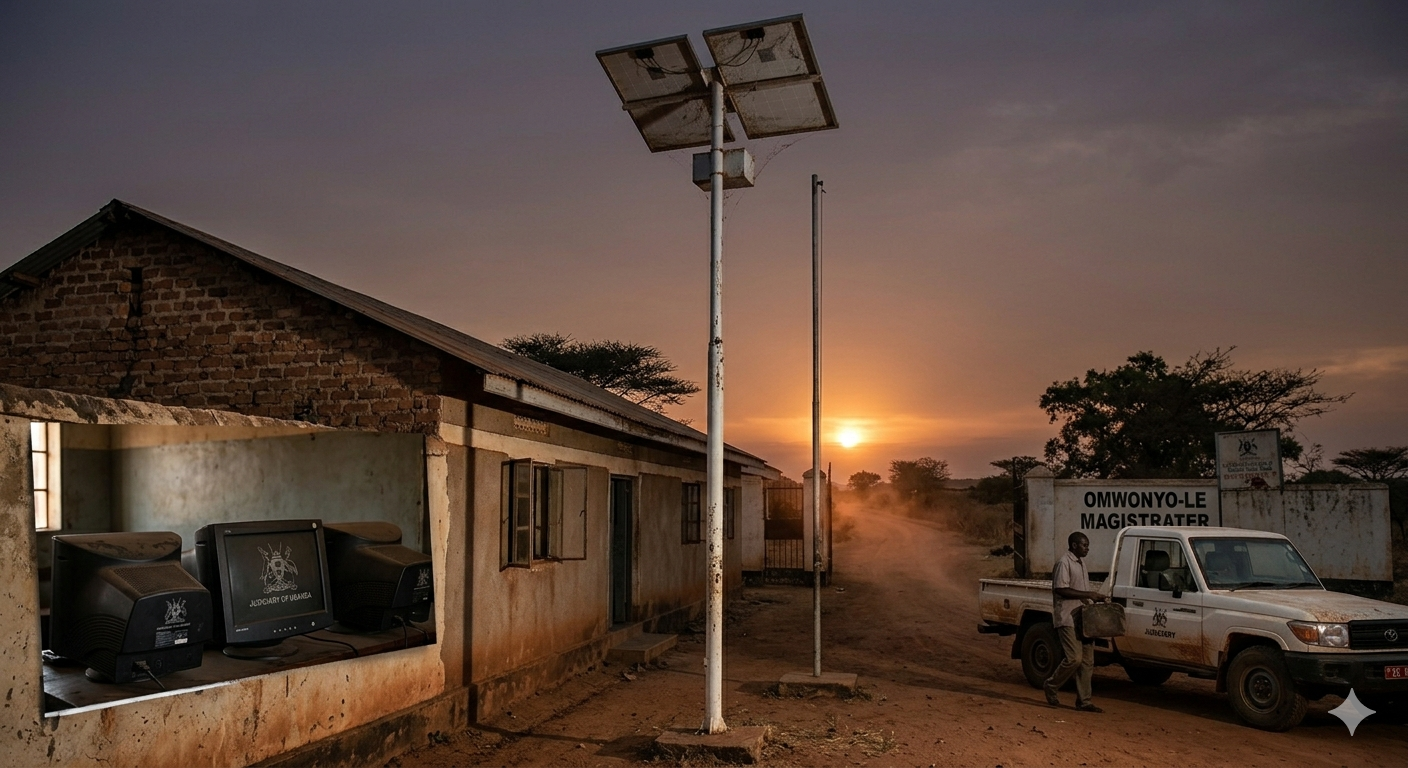
Court No. 1 had computers. Three of them. All bearing the Judiciary crest. All covered in dust. Outside, a solar mast stood proudly beside the flagpole – as if justice here ran on sunlight.
And on good weeks… it did. When the batteries cooperated. When the switch‑over panel remembered its job. When Umeme remembered Omwonyo‑le existed. Which was usually one morning in five – sometimes between six and ten.
After that, the screens went black. And when judgments had to be written, when reports had to be filed, when legal research had to be done – Mulyanyama would remove his robe, start the government pickup, and drive twenty kilometres to the nearest trading centre… to borrow electricity.
That was the unwritten rule of Omwonyo‑le: You do not complain. You endure.
A litigant approached his desk. Not with a bribe. With a roasted goat leg wrapped in old newspaper. Steam rose. The man said nothing. He simply bowed and left.
Mulyanyama looked at the meat. He looked at the phone. He looked at Imat Nekolina. He hesitated. Then he ate.
This was his first meal of the day.
And somewhere in Kampala, Parliament had quietly decided that His Worship Mulyanyama was ready for more – more files, more value, more pressure – under the newly enacted Magistrates Courts (Amendment) Act, No. 6 of 2026.
No one asked about his clerk.
No one asked about his fuel.
No one asked what he had eaten.
No one asked about the missed calls.
No one asked about the solar mast, or the twenty‑kilometre drive to borrow electricity.
They simply raised his jurisdiction – and left his stomach empty.
Before His Worship Mulyanyama could deliver justice… he first had to finance it.
The ground at Omwonyo‑le had swallowed an axe.
Now it was swallowing him.
Before you judge His Worship Mulyanyama… visit your nearest court. Stand there for one morning. Count the files. Count the faces. Then ask one question:
What is missing here?
You may not like the answer.
And in Omwonyo‑le… hunger was only the beginning.
Because one week later… a white Land Cruiser entered the court compound.
Some systems do not collapse.
They simply teach good people how to survive inside broken ones.
Enen Ambrose,
Advocate.
Member: Judiciary Affairs Committee
Uganda Law Society
Legal World. enen@enenlegalworld.com
Legal Disclaimer
Fiction & Non-Defamation Notice:
This post is a pure work of fiction and creative literature. The characters, dialogue, specific incidents, and settings—including the character of His Worship Mulyanyama and the location of Omwonyo-le Magistrates Court—are products of the author’s imagination or are used fictitiously. Any resemblance or exact matches to actual persons, living or dead, real-life judicial officers, or specific ongoing cases is entirely coincidental. This text is created solely for the purpose of systemic legislative critique and systemic advocacy; it is not maliciously constructed, nor should it be interpreted as an attempt to defame, misrepresent, or malign any living individual or public office holder.
If you loved this Episode 1 and would love to continue enjoying it, Please acccess Episode 2 from here:
Chronicles of His Worship Mulyanyama The Mobile Court That Ate the Diary— Episode II
FUEL THE MOVEMENT Independent institutional critique and advocacy for a radical overhaul of legal culture require time, deep research, and uncompromised independence. If these narratives bring value to your legal journey or challenge your perspective, please visit our HOME PAGE to see how you can support this platform directly and keep the critique fierce and relentless.
— Enen Ambrose. Advocate & Founder–Enen Legal World


Leave a comment